Jackie Stewart's Role in F1 Safety Reforms
Jackie Stewart's campaign reshaped F1 safety—reviving the GPDA, improving tracks, gear, and medical response, and reducing driver deaths.

Jackie Stewart, a three-time Formula 1 World Champion, transformed the sport by prioritizing driver safety in an era when fatalities were shockingly common. In the 1960s, F1 drivers faced a 66% chance of fatality over five years, racing on dangerous tracks with minimal safety measures. Stewart’s 1966 crash at Spa-Francorchamps, where he was trapped in a fuel-soaked car for 25 minutes, exposed the sport’s lack of emergency preparedness and became his motivation to push for change.
Key highlights of Stewart’s safety campaign:
- Revived the Grand Prix Drivers' Association (GPDA): United drivers to demand safety improvements, including boycotts of unsafe tracks like Spa and Nürburgring.
- Advocated for Track Safety: Called for barriers, run-off zones, and better-trained marshals.
- Pioneered Safety Equipment: Championed full-face helmets, fireproof suits, and mandatory seatbelts.
- Introduced Medical Reforms: Pushed for mobile medical units and on-site doctors at every race.
Despite backlash from fans and media who romanticized F1’s danger, Stewart’s efforts reduced driver fatalities by 38% in the 1970s. His legacy lives on in today’s advanced safety protocols, proving that performance and protection can coexist.
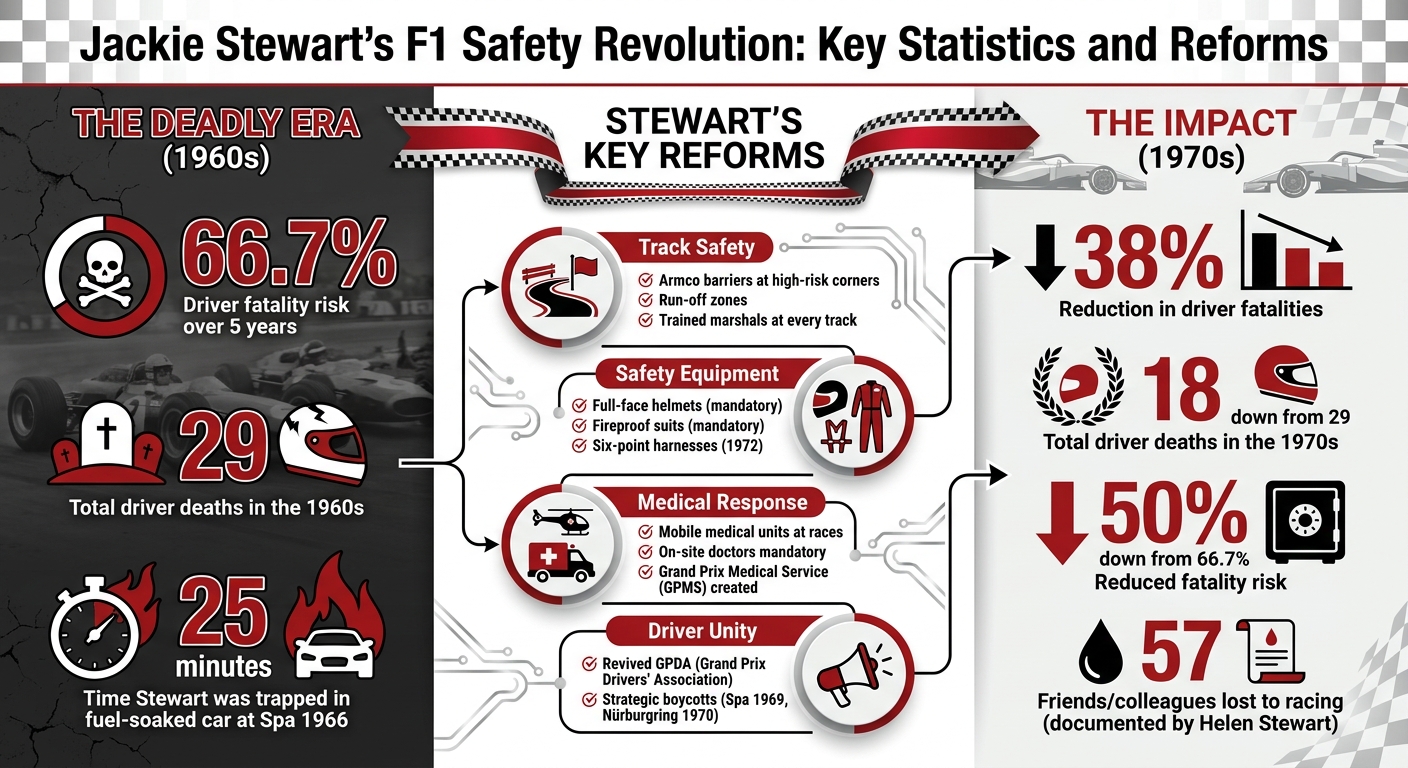
Jackie Stewart's Impact on F1 Safety: Key Statistics and Reforms
Formula One in the 1960s: A Deadly Era
Driver Deaths and Inadequate Safety Standards
The 1960s were a perilous time for Formula One drivers, with a staggering statistic revealing they faced a roughly 66.7% chance of fatality over a five-year period. The risks were amplified by a combination of dangerous circuits and a lack of proper safety measures. Tracks like the original Nürburgring and Spa-Francorchamps were notorious for their high-speed corners, often with no barriers or run-off areas. A single mistake could easily turn fatal.
Crashes frequently led to devastating outcomes, with fires being a common and deadly consequence. Drivers were often trapped in their vehicles as fuel leaks ignited, and the lack of track marshals made rescue efforts painfully slow. Medical response was equally inadequate - there was no dedicated Grand Prix medical team, and organizers relied on local services using outdated ambulances that sometimes struggled to even find the hospital. Basic safety gear was also woefully lacking. Drivers competed without full-face helmets or proper seatbelts, leaving them incredibly vulnerable during accidents. The tragic deaths of Piers Courage and Jochen Rindt in 1970 highlighted the ongoing dangers, both men being close friends of Jackie Stewart. These losses fueled a growing determination among some drivers, including Stewart, to push for better safety standards.
The 'Brave Daredevil' Culture in Motorsport
In this era, Formula One's danger wasn't just accepted - it was celebrated. The sport's high-risk nature was romanticized, with drivers viewed as fearless daredevils. Racing was seen as a test of bravery, and taking extreme risks was worn as a badge of honor. Jackie Stewart, a vocal advocate for safety, faced criticism for challenging this mindset:
"It was said I removed the romance from the sport, that the safety measures took away the swashbuckling spectacular that had been. They said I had no guts."
One of the most striking examples of this mentality came during the 1968 German Grand Prix at the Nürburgring. Stewart won the race by over four minutes in treacherous conditions - thick fog and pouring rain reduced visibility to nearly zero. Despite his victory, Stewart later argued that the race should have never taken place under such dangerous circumstances. However, efforts to improve safety were met with resistance. Organizers, media, and even fellow drivers were hesitant to embrace changes that might tarnish the sport's heroic image. This deeply ingrained culture would soon face a turning point, as events unfolded that forever altered Formula One's approach to safety.
sbb-itb-7c68254
The 1966 Spa-Francorchamps Crash: Stewart's Turning Point
The Crash and Its Aftermath
During the opening lap of the 1966 Belgian Grand Prix at Spa-Francorchamps, a sudden rainstorm turned the track into chaos. Jackie Stewart, driving his BRM, lost control and crashed violently into a hut and a pole before sliding into a ditch. Trapped in the wreckage, with fuel dangerously leaking around him, Stewart endured a terrifying 25-minute wait for help.
The crash laid bare Formula One's glaring lack of emergency preparedness. With no official responders on hand, fellow drivers Graham Hill and Bob Bondurant stopped to assist. They even borrowed a wrench from a spectator to unbolt the steering wheel and free Stewart. The ordeal didn’t end there - Stewart was loaded into an outdated ambulance, which then got lost on the way to the hospital.
Miraculously, Stewart escaped with only a broken collarbone. But the incident exposed the sport’s dangerous inadequacies and became a catalyst for change, sparking Stewart’s resolve to address Formula One’s safety issues head-on.
Stewart's Personal Mission for Change
The chaos of Spa-Francorchamps marked a turning point for Jackie Stewart. Determined to never face such a situation again, he began taping a wrench to his steering wheel as a precaution. But his ambitions went far beyond personal safety.
Stewart saw the glaring contradiction in Formula One: drivers were expected to push their limits, yet the sport offered almost no safety infrastructure. He became a vocal advocate for systemic changes, calling for on-site medical teams, improved track designs with barriers and run-off areas, and better rescue protocols. His persistent efforts led to significant advancements, including the introduction of full-face helmets, mandatory seatbelts by 1972, and mobile medical units at races.
Though many resisted his push for reform, claiming it stripped the sport of its daring, Stewart’s work redefined what safety meant in Formula One. His relentless advocacy laid the groundwork for the modern safety standards that protect drivers today.
Stewart's Safety Advocacy: Key Actions and Challenges
Reviving the Grand Prix Drivers' Association (GPDA)
Jackie Stewart understood that individual complaints about safety fell on deaf ears. To tackle this, he revitalized the Grand Prix Drivers' Association (GPDA), turning it into a united and powerful voice for safety reforms. The GPDA, under Stewart's leadership, used strategic boycotts to demand change. For instance, in June 1969, drivers boycotted the Belgian Grand Prix at Spa-Francorchamps when track owners refused to install the requested Armco crash barriers. This bold move pushed the owners to rethink their safety standards. Similarly, when the Nürburgring failed to meet safety demands the following year, the GPDA's collective pressure led to the German Grand Prix being moved to the Hockenheimring.
These actions not only brought drivers together but also laid the groundwork for critical improvements in track safety and equipment standards.
Pushing for Track Improvements
Stewart's focus wasn't limited to uniting drivers - he also zeroed in on the infrastructure of Formula One circuits. He advocated for installing Armco safety barriers at high-risk corners, expanding run-off areas to minimize collisions with solid objects, and ensuring every track had trained marshals equipped to handle emergencies. Even after achieving changes at the Nürburgring, Stewart remained vocal about its dangers, refusing to let the issue fade.
His persistence led to significant upgrades in circuit design and maintenance, addressing some of the most dangerous aspects of the sport. However, improving the tracks was only part of his mission - driver protection also needed a major overhaul.
Advancing Safety Equipment and Standards
Stewart's push for better safety extended to the gear drivers relied on. He championed the use of full-face helmets and fireproof suits, both of which became standard in Formula One. He was also instrumental in making seatbelts mandatory, culminating in the introduction of six-point harnesses in 1972. Beyond equipment, Stewart supported the creation of the Grand Prix Medical Service (GPMS), a mobile emergency unit designed to provide immediate care. He insisted on having a qualified doctor at every race, a stark contrast to his 1966 crash, where no medical help was immediately available.
These efforts weren’t without backlash. Critics argued that Stewart's measures dulled the sport’s thrill, with some even labeling him "gutless." But Stewart remained steadfast, famously stating:
"I would have been a much more popular World Champion if I had always said what people wanted to hear. I might have been dead, but definitely more popular."
How Jackie Stewart Changed Formula 1 Safety Forever
The Impact and Legacy of Stewart's Safety Reforms
Stewart's unwavering dedication to safety brought tangible improvements both on and off the track.
Decline in Driver Fatalities: The Numbers
The numbers tell a compelling story. In the 1960s, Formula One saw 29 driver fatalities. After Stewart’s safety reforms, that number dropped to 18 in the 1970s - a decrease of about 38%. Early in Stewart's career, drivers faced a staggering 66.7% risk of fatal accidents, which fell to approximately 50% at its peak. These percentages aren’t just statistics; they represent lives saved. Stewart’s mission was deeply personal - his wife, Helen, documented the loss of 57 friends and colleagues to racing-related accidents during his career.
Modern Safety Innovations Rooted in Stewart's Work
Stewart’s advocacy laid the groundwork for many safety measures now standard in Formula One. His efforts led to better track designs, including run-off areas and catch-fencing, replacing the dangerously inadequate natural barriers of the past. One pivotal moment came after his terrifying 1966 crash at Spa-Francorchamps, where he was trapped for 25 minutes in a fuel-soaked cockpit without immediate medical help. This ordeal spurred Stewart to push for dedicated emergency response systems, which eventually evolved into today’s Medical Car and advanced trauma centers at every race circuit.
But Stewart’s influence wasn’t limited to technology. He also played a key role in reshaping how drivers approached the sport, advocating for a culture of professionalism over recklessness.
How Stewart Changed F1's Driver Culture
Through his leadership in the Grand Prix Drivers' Association (GPDA), Stewart helped transform the image of Formula One drivers. Before his efforts, many racers - especially those with military backgrounds - saw danger as an unavoidable part of the job. Stewart challenged this mindset, proving that safety and success could coexist. His commanding win at the 1968 German Grand Prix at the Nürburgring, where he triumphed by over four minutes in treacherous fog and rain, gave him the credibility to demand changes at tracks he called “hideously dangerous”.
The rise of global television coverage and the influx of major sponsors in the 1970s also played a role. Sponsors, wary of associating their brands with fatal accidents, supported Stewart’s push for higher safety standards. His leadership in uniting drivers through the GPDA shifted the balance of power, forcing race organizers to prioritize safety. Thanks to Stewart’s efforts, Formula One transitioned from a sport where death was an accepted risk to one that now sets the standard for managing industrial risks.
Conclusion
Jackie Stewart's efforts to improve Formula One safety reshaped the sport in ways few could have imagined. In a time when drivers faced a startling two-in-three chance of dying within a five-year career span, Stewart played a pivotal role in turning a dangerous pastime into a disciplined profession with established safety measures. Thanks to his advocacy, seatbelts, full-face helmets, fireproof suits, and a dedicated medical unit became standard in Grand Prix racing.
He stood firm against the prevailing "daredevil" culture of the era, even as fans and media labeled him "gutless" and accused him of stripping the sport of its romanticism. Despite the backlash, Stewart remained steadfast, driven by his belief that protecting lives outweighed the pursuit of popularity. As he once said, "I wouldn't have done what I did if I had wanted to win a popularity contest". His determination sparked a shift in how drivers and teams approached safety, laying the groundwork for the advancements that followed.
Stewart's legacy carries valuable lessons for motorsport today. He showed that professional success can lend weight to calls for change, using his championship wins to push for systemic safety reforms. His philosophy that safety is an ongoing process, not a one-time achievement, continues to resonate as Formula One evolves alongside new technologies and faster cars.
Now, Formula One stands as a global example of how safety and performance can go hand in hand. Stewart’s vision transformed the sport into one where risk is carefully managed without compromising the thrill of competition. As he wisely put it, "Nobody's perfect, but all of us can be better than we are".
FAQs
How did the GPDA boycotts actually force track owners to make changes?
The GPDA boycotts showcased the drivers' united strength, compelling track owners to prioritize safety improvements. These protests effectively urged authorities to tackle safety issues, ensuring racing events could continue.
Which of Stewart’s safety demands became mandatory first - and why?
Jackie Stewart's advocacy led to the introduction of full-face helmets and seatbelts as mandatory safety measures in Formula One. These changes were aimed at improving driver protection and minimizing injuries during accidents, showcasing the impact of his efforts to raise safety standards in the sport.
What F1 safety systems today trace back to the 1966 Spa crash?
Modern Formula 1 safety measures trace back to the 1966 Spa crash, which highlighted the need for better driver protection. Changes included the introduction of safety barriers and larger run-off areas at dangerous corners. These improvements were heavily championed by Jackie Stewart, whose advocacy played a major role in transforming safety standards within the sport.