Real-Time Monitoring: Role of Sensors in F1 Cars
How F1 teams use 300+ sensors and live telemetry to optimize performance, strategy, and safety — and how 2026 rules will change sensing.
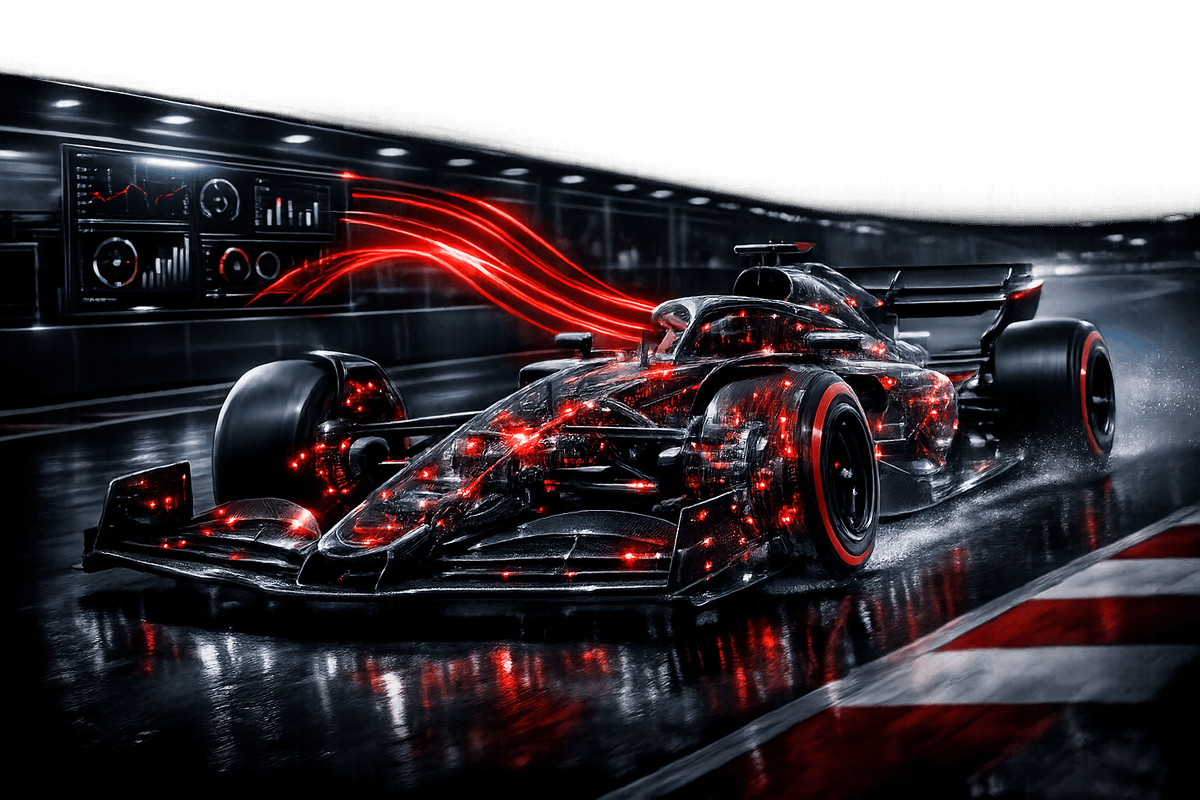
Formula 1 cars produce over 1.1 million data points per second using 300+ sensors. Teams rely on this real-time telemetry to make split-second decisions, optimize performance, and improve safety. Modern F1 sensors fall into three categories: control (e.g., engine RPM, throttle), monitoring (e.g., tire pressure, brake temps), and instrumentation (e.g., aerodynamics, suspension). These sensors not only shape race strategies but also enhance driver feedback and vehicle reliability. With the 2026 regulations introducing advanced power units and active aerodynamics, sensor technology will play an even bigger role in managing energy systems and dynamic car adjustments.
Telemetry insight with Komatsu and Williams Racing
sbb-itb-7c68254
Main Categories of Sensors in F1 Cars
F1 Car Sensor Categories and Key Data Points
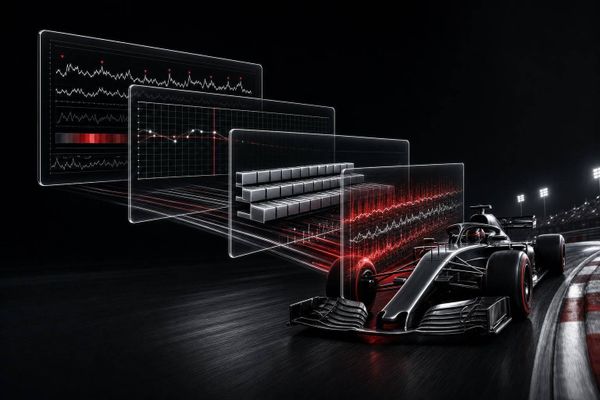
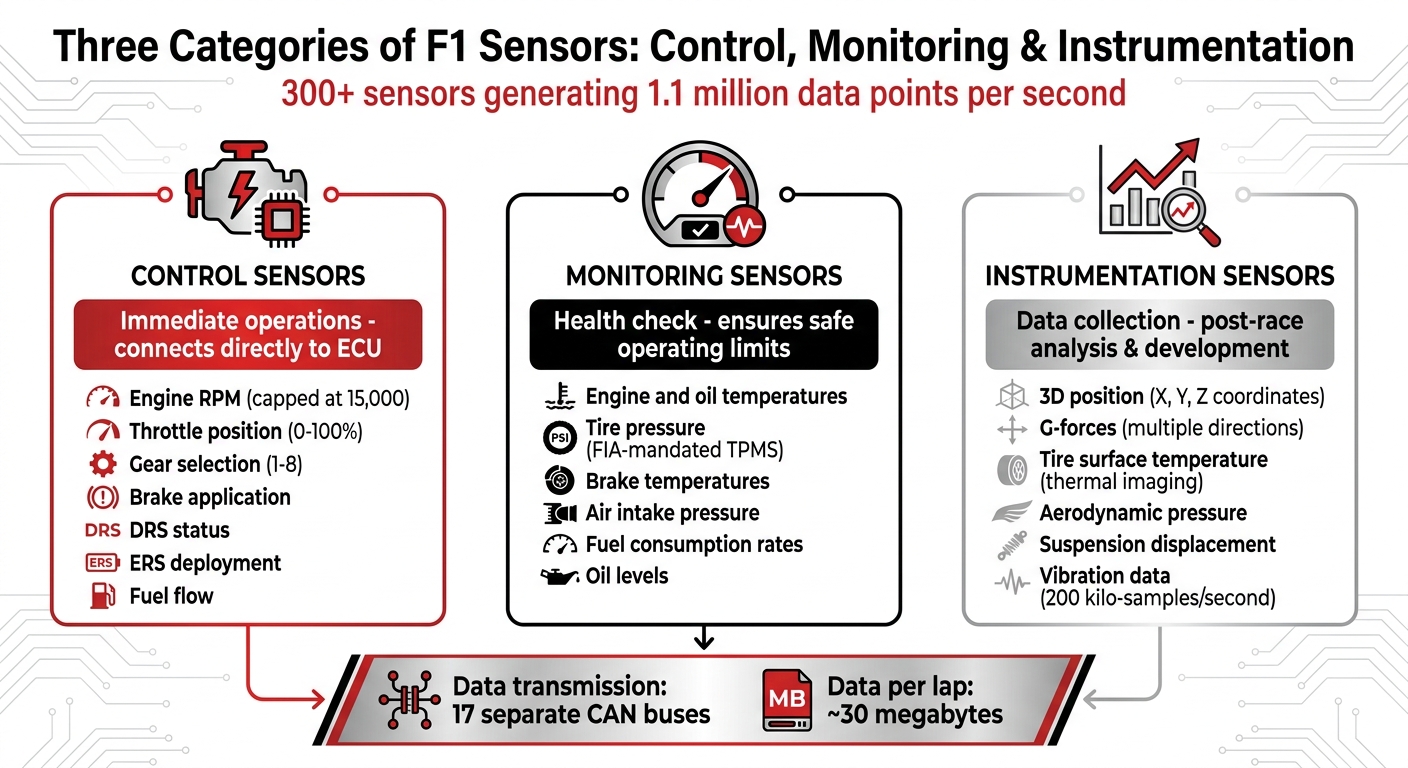
F1 sensors are grouped into three main categories: Control, Monitoring, and Instrumentation. This classification helps engineers manage the massive flow of telemetry data - around 30 megabytes per lap - and distinguish between data that requires immediate attention during a race and data that can be analyzed later.
As the Mercedes-AMG PETRONAS F1 Team explains:
"We divide these into three categories: control, instrumentation and monitoring. All of them deliver pressure, temperature, inertial and displacement data and are embedded into all systems on the car".
These sensors communicate via 17 separate CAN (Controller Area Network) buses, which enable multiple devices and Electronic Control Units (ECUs) to exchange information simultaneously. Each category plays a specific role in optimizing performance and ensuring safety on the track. Let’s break down what each category does.
Control Sensors
Control sensors are vital for the car's immediate operations. They connect directly to the ECU and manage critical systems like the gearbox, Energy Recovery System (ERS), and engine performance. These sensors monitor parameters such as:
- Engine RPM (capped at 15,000)
- Throttle position (0–100%)
- Gear selection (typically 1–8)
- Brake application
- DRS (Drag Reduction System) status
- ERS deployment
- Fuel flow
Without these sensors functioning properly, driver inputs - whether steering or pressing buttons - wouldn’t translate into effective performance on the track.
Monitoring Sensors
Monitoring sensors act like a health check for the car, keeping tabs on temperatures, pressures, and wear to ensure everything operates within safe limits. These sensors measure:
- Engine and oil temperatures
- Tire pressure (via FIA-mandated Tire Pressure Management Systems)
- Brake temperatures
- Air intake pressure
- Fuel consumption rates
- Oil levels
With this real-time data, engineers can respond quickly during races. For instance, if brake temperatures rise dangerously or tire pressures drop unexpectedly, the pit wall can adjust the strategy to prevent failures.
Instrumentation Sensors
Instrumentation sensors are primarily used for detailed data collection to aid post-race analysis and future car development. These sensors capture precise measurements such as:
- The car’s 3D position (X, Y, and Z coordinates)
- G-forces in multiple directions
- Tire surface temperature using thermal imaging
- Aerodynamic pressure
- Suspension displacement
While some of this data is transmitted live during races, much of it is stored and accessed after the race via physical connections. For example, vibration data is sampled at rates as high as 200 kilo-samples per second. This level of detail is invaluable for fine-tuning the car and improving performance in future races.
Critical Data Points Collected by F1 Sensors
The sheer volume of telemetry data from F1 sensors highlights the need to pinpoint the measurements that truly shape race-winning strategies. Let’s break down the key data points that turn raw numbers into decisive actions on the track.
Engine and Speed Data
Engine sensors are at the heart of both performance and tactical decision-making. They monitor metrics like RPM, torque, air intake temperature and pressure, fuel consumption, oil levels, and Energy Recovery System (ERS) usage. This data serves two main purposes: fine-tuning performance and avoiding mechanical issues. Engineers keep a close watch on the power unit's condition in real time, spotting potential problems before they escalate. For instance, tracking air intake and engine temperatures allows adjustments to engine mapping to prevent overheating as track conditions change.
This data also helps drivers refine their skills. By analyzing throttle position and gear selection, engineers can identify areas where a driver’s shifting patterns differ from the ideal, offering feedback to improve acceleration timing.
"The driver has to become one with the data that is generated on the car in order to extract every last drop of performance from every component of the car".
But engine data isn’t the whole story. Tire and brake metrics are equally critical for making split-second decisions during a race.
Tire and Brake Data
Tire and brake sensors are essential for crafting race strategies. These sensors measure tire pressure, surface and carcass temperatures, wear rates, brake pressure, disc temperature, and whether the brake is applied (on/off). Using machine learning, teams analyze both historical and live data to predict tire wear based on factors like weather, track conditions, and driving styles.
A great example of this came during the 2019 British Grand Prix. Mercedes AMG Petronas used real-time tire wear data and competitor positioning to guide Lewis Hamilton into a perfectly timed pit stop during a safety car period, which played a key role in his victory. Similarly, Red Bull Racing’s meticulous analysis of sensor and video data helped them achieve the fastest pit stop in F1 history - just 1.82 seconds - during the 2019 Brazilian Grand Prix.
Telemetry also helps drivers manage tire performance. Engineers can advise drivers when to conserve their tires or when to push harder for faster laps. Brake data is just as critical; monitoring thermal conditions lets teams address potential issues before they lead to race-ending failures.
Aerodynamic and Suspension Data
Aerodynamic and suspension sensors focus on stability and handling. They measure downforce ratios, suspension travel, ride height, steering angle, slip angles, and vehicle tilt. Tools like load cells and potentiometers track dynamic forces and suspension movement, showing how the car responds under acceleration and maintains stability at high speeds.
In September 2025, the UNI Maribor Grand Prix Engineering team demonstrated the impact of such data. They used load cells and inertial sensors to test their electric race car, proving that their aerodynamic upgrades boosted total thrust force by 29.32% at higher speeds.
"Experimental analysis of the aerodynamic package's effectiveness is crucial, particularly in motorsport, where aerodynamics performance plays a significant role in achieving better lap times".
During races, engineers monitor live telemetry graphs for ride height and suspension data. When you hear commands like "Box Box" or "Push now" over the team radio, those decisions are often based on these real-time graphs. These measurements directly influence on-the-spot adjustments that can make or break a podium finish.
How F1 Teams Transmit and Analyze Sensor Data
Telemetry Systems in F1
The journey from sensors embedded in an F1 car to actionable strategies begins with Controller Area Network (CAN) buses. These systems, a standard in automotive technology, connect various devices throughout the vehicle. In an F1 car, 17 CAN buses work together to feed data into the Electronic Control Unit (ECU). The ECU collects input from over 250 sensors, synchronizes their timing, and encrypts the data for secure transmission.
This data is relayed from the car to the pit garage via wireless antennae mounted on the car's nose. During each lap, the live telemetry stream generates about 30 megabytes of data, which is then sent to the team's factory for real-time analysis. For example, during the Mexico race weekend, the Mercedes-AMG PETRONAS F1 Team transferred an incredible 11 terabytes of data between their trackside team and their factories in Brackley and Brixworth. Latency for European races is typically around 10 milliseconds, but for flyaway races like those in Australia or Japan, it increases to approximately 300 milliseconds.
When the car returns to the pits, teams use a direct connection to offload data. This method transfers two to three times more information compared to live telemetry, making it essential for detailed analysis after each session. By the end of a race, teams usually gather at least 30 GB of data. Over the course of a race weekend, including video data, this total can exceed 1 terabyte per car.
This intricate system of data collection and transmission has come a long way from the stopwatch era of the 1950s. It provides teams with the capability to conduct rapid analysis, which is key to shaping their strategy. Once the data reaches the factory, advanced analytics turn these raw figures into valuable insights.
Using Predictive Analytics for Strategy
Once transmitted, the data is processed using tools like the Advanced Telemetry Linked Analysis System (ATLAS), an industry-standard software developed by McLaren Applied. ATLAS allows engineers and drivers to examine performance metrics in real time as well as post-session. Metrics such as braking points and cornering speeds are reviewed to identify the tiny differences that can separate a podium finish from a mid-pack result.
"If you can understand, from a hard scientific perspective, how your car is performing, you can optimize it in a way that just isn't possible for a human." - Elizabeth Blackstock, Journalist
Machine learning and predictive modeling are now central to race strategy. Data scientists simulate millions of race scenarios, analyzing factors like tire degradation, fuel usage, and ideal pit stop timing based on both historical and real-time data. These algorithms can even incorporate variables like weather changes or track conditions to refine their predictions. For example, they might recommend the best moment to pit during a safety car period or when to push for an overtake. This reliance on AI-driven analytics allows teams to anticipate problems and adjust strategies faster than ever before.
How Real-Time Monitoring Shapes Race Strategy
Modern racing teams rely on a network of over 300 sensors to transform raw data into actionable strategies. These sensors track everything from tire pressure to fuel usage, enabling split-second decisions that can make or break a race. This isn't just about knowing what's happening on the track - it's also about forecasting what could happen next. By predicting outcomes, teams gain a strategic edge, staying one step ahead of their rivals.
"In the quest for racing excellence, data is not just an asset; it's the lifeblood of modern Formula 1." - Catapult
The ability to interpret this real-time data effectively often separates winners from the rest of the pack. Let’s explore how this data shapes critical race strategies, like pit stops and driver guidance.
Planning Pit Stops and Tire Changes
Pit stops are no longer just about speed - they’re about timing and precision. Real-time data on tire pressure, temperature, and wear helps teams pinpoint the "pit window", the ideal moment to change tires for maximum advantage. This window is a moving target, influenced by factors like track conditions, weather changes, and competitor strategies.
By combining live telemetry with historical data, teams can predict tire degradation with incredible accuracy. Advanced AI models trained on over a million past race records simulate various scenarios, factoring in tire types and their unique characteristics. For instance:
- Soft tires offer the fastest laps but wear out quickly, requiring frequent changes.
- Medium tires balance speed and durability, making them suitable for mid-race stints.
- Hard tires last longer but compromise lap speed, ideal for strategies that involve fewer pit stops or "overcut" maneuvers.
Historical moments like Mercedes’ perfectly timed safety car pit stop or Red Bull’s record-breaking 1.82-second stop showcase how sensor data and precise planning can lead directly to race wins.
Real-time monitoring also helps teams decide whether a driver should push their tires to the limit or conserve them for later. By tracking tire wear energy - essentially the stress on the tire’s contact patch - engineers can predict when grip will drop off sharply, ensuring pit stops happen before performance suffers.
Providing Driver Feedback During Races
While pit strategies rely heavily on predictive data, real-time monitoring also plays a crucial role in guiding drivers during the race. Engineers use live telemetry to provide feedback on areas like braking, acceleration, and cornering. For example, sensors analyze how closely a driver approaches the apex before braking, offering insights to refine cornering techniques.
This feedback extends to tactical decisions, too. "Battle Forecasts" use real-time data to predict when a chasing competitor might attempt an overtake, helping drivers adjust their defensive or offensive strategies accordingly. Tire wear energy metrics further inform drivers about how much performance remains in their tires, guiding decisions on whether to push harder or conserve.
With over 300 sensors generating more than 1.1 million telemetry data points per second, teams can also make on-the-fly adjustments to car settings. This might include tweaking aerodynamic configurations to balance speed with tire preservation or adjusting engine modes to optimize fuel efficiency.
"F1 Telemetry Data is indispensable during races... These split-second decisions, informed by F1 Telemetry, can dramatically impact the race outcome." - Catapult
When technical problems arise, AI-powered diagnostic tools can identify and resolve issues up to 86% faster than manual methods. By analyzing system logs and recommending real-time fixes, these tools help teams address potential failures before they lead to race-ending retirements. This capability keeps cars competitive and drivers in the fight until the very last lap.
Conclusion: What's Next for Sensor Technology in F1
The 2026 regulation changes are set to completely transform sensor systems in Formula 1. With the introduction of new power units that evenly split energy between electric and combustion systems, teams will face the challenge of adapting to a staggering 300% increase in electrical power compared to current hybrid setups. This shift demands entirely redesigned sensor arrays to monitor energy deployment and ensure seamless interaction between these power sources.
These updated regulations open the door to cutting-edge, sensor-driven advancements. For instance, active aerodynamics will rely on sensors to control movable front and rear wings, dynamically adjusting downforce in real-time. This system not only reduces drag on straights but also enhances grip in corners, with sensors managing the transitions for optimal performance. Additionally, the new "Overtake Mode" will replace the current DRS system, providing extra power when proximity sensors detect a car within one second of the vehicle ahead.
"The biggest challenge is probably that we are starting from scratch on everything - new tyres, new fuel, new engine, new chassis, new sporting regulations - new everything." - Frederic Vasseur, Ferrari Team Principal
The move to 100% sustainable fuels adds another layer of complexity. Sensors will be crucial for monitoring combustion characteristics to maintain thermal efficiency above 50%, adapting to the unique properties of these new fuels. This aligns with the push for more dynamic, real-time race strategies. Meanwhile, AI-powered predictive systems will take a giant leap forward, moving beyond historical data to forecast race scenarios as they unfold, optimizing energy recovery and fuel management.
Driver biometrics are also set to expand their role. With manual energy deployment becoming increasingly intricate, sensors will monitor drivers' physical stress levels and cognitive load, helping teams assess their ability to manage these heightened demands. As Williams driver Alex Albon pointed out: "There will be an element of the drivers who have the brain capacity to understand and facilitate all these demands will go well". The lighter cars (reduced by about 66 lbs) and shorter wheelbases (approximately 8 inches less) will also necessitate compact sensor designs that maintain high-quality data collection.
These advancements promise to integrate seamlessly with live data systems, reshaping race strategies and pushing the boundaries of what’s possible in Formula 1.
FAQs
Which F1 sensor data matters most during a race?
Formula 1 cars generate a wealth of sensor data during a race, covering everything from vehicle speed and tire pressure to engine performance and temperatures. Teams also monitor pressures, suspension positions, G-forces, and driver control inputs.
This data isn't just numbers - it's the heartbeat of the car. It allows teams to perform real-time analysis, enabling them to make split-second decisions that can fine-tune performance and adjust strategies on the fly.
How do teams keep telemetry reliable and secure?
F1 teams go to great lengths to ensure telemetry systems are both reliable and secure. These systems rely on high-speed, resilient networks capable of managing a staggering 1.5 terabytes of data during a single race weekend. This immense data flow supports real-time decisions that can make or break a race.
To keep this sensitive information safe, teams use encrypted communication channels, secure wireless protocols, and advanced authentication techniques. On top of that, partnerships with cybersecurity experts help shield telemetry data from potential interception or tampering, ensuring nothing compromises their performance during crucial moments on the track.
What new sensor demands will 2026 rules create?
The 2026 Formula 1 regulations are set to bring a wave of changes, including lighter cars, hybrid power units, and advanced aerodynamic systems. To keep up with these advancements, new sensor requirements will be introduced.
These sensors will play a crucial role in collecting and analyzing precise, real-time data. This data won't just help teams fine-tune performance on the track; it will also ensure compliance with the updated regulations. The focus on accuracy and efficiency highlights the increasing reliance on technology to push the limits of what's possible in F1 racing.