Williams vs McLaren: '90s Dominance
Williams' engineering-led dominance vs McLaren's driver-focused resurgence: how tech, engines and design shaped 1990s F1.
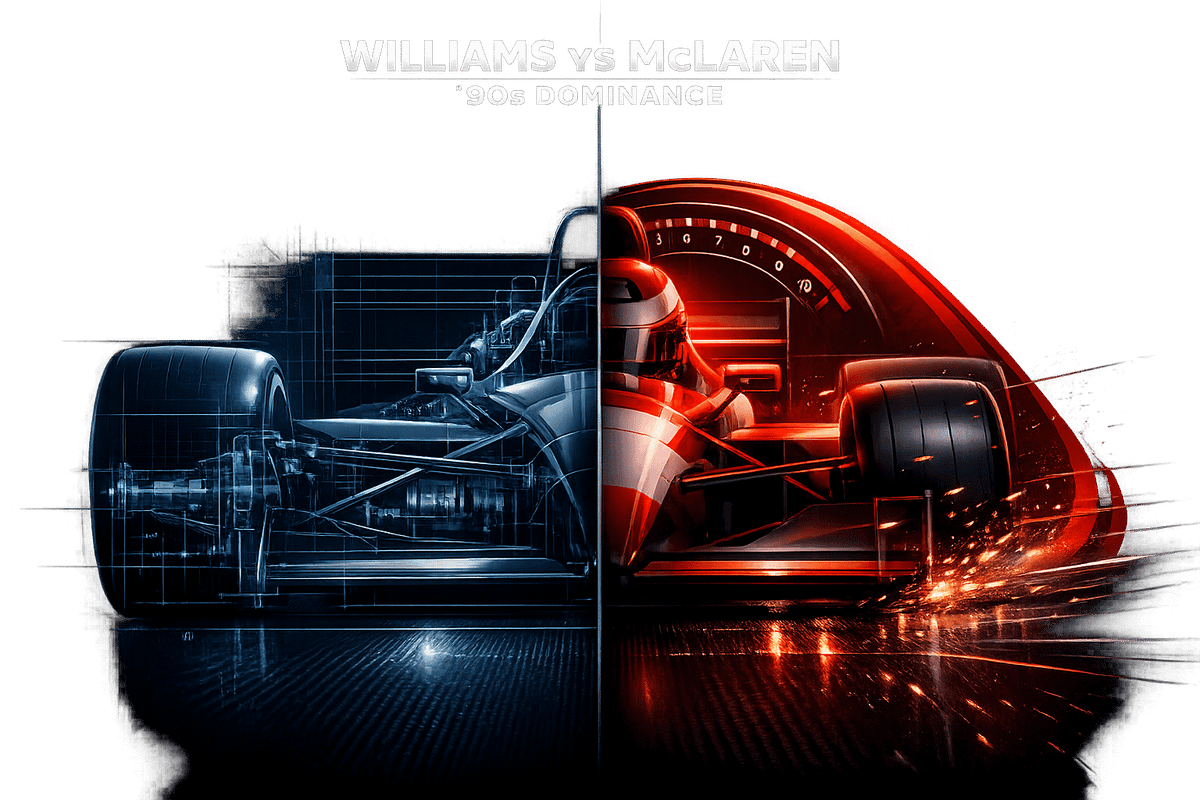
Williams and McLaren defined Formula One in the 1990s. Between them, they secured eight Drivers' and Constructors' Championships, showcasing contrasting approaches to racing success. Williams focused on engineering excellence, leveraging active suspension and Renault engines to dominate the mid-'90s. McLaren, prioritizing driver performance, relied on partnerships with Honda and Mercedes, ending the decade on top with Mika Häkkinen's back-to-back titles.
Key Takeaways:
- Williams (1992–1997): Five Constructors' titles, active suspension innovation, and Renault-powered dominance.
- McLaren (1990–1991, 1998–1999): Driver-centric strategy, Honda and Mercedes engines, and Adrian Newey's designs for late-decade resurgence.
- Philosophy Clash: Williams built the fastest cars; McLaren tailored cars for drivers.
Quick Comparison:
| Team | Drivers' Titles | Constructors' Titles | Key Strength | Star Drivers |
|---|---|---|---|---|
| Williams | 4 | 5 | Active suspension | Mansell, Prost, Hill, Villeneuve |
| McLaren | 4 | 3 | Driver focus | Senna, Prost, Häkkinen |
This rivalry shaped F1's most competitive decade, driven by engineering and strategy.
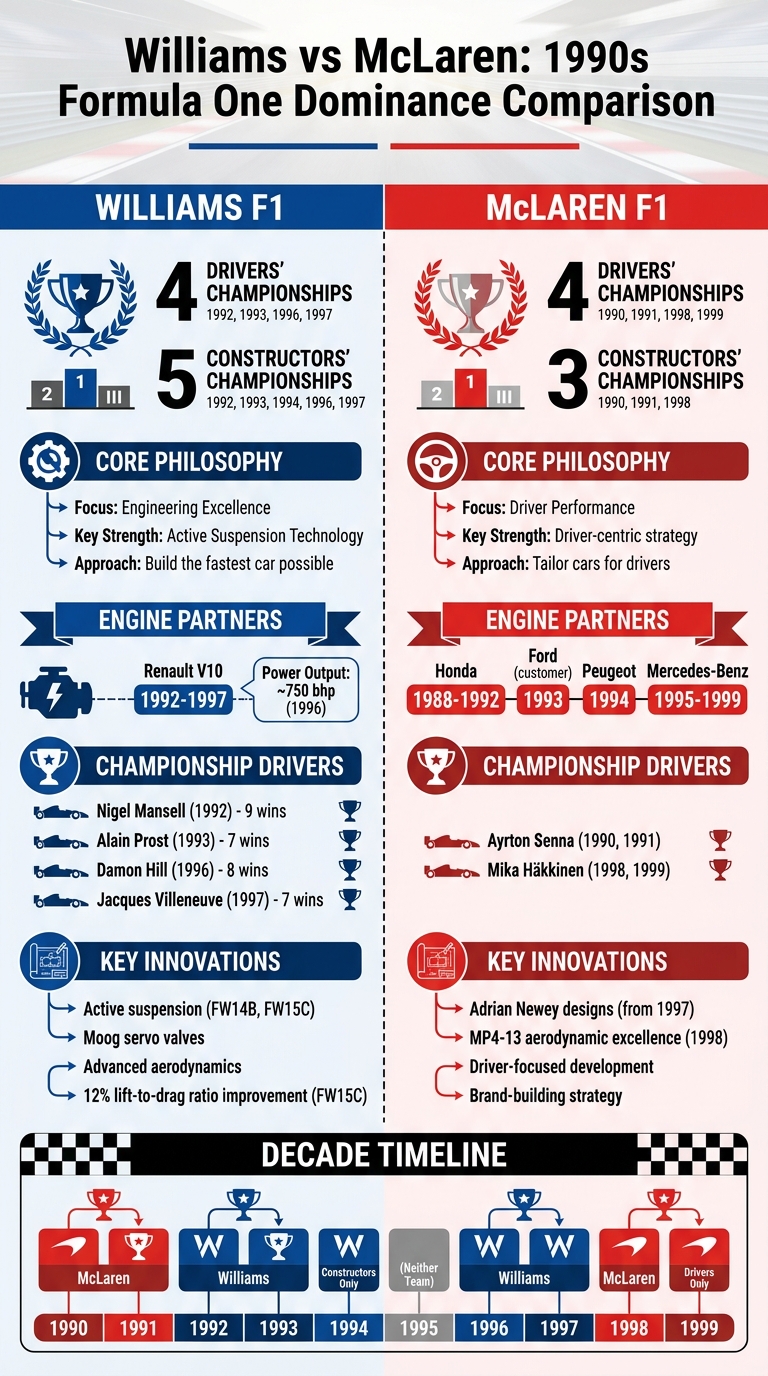
Williams vs McLaren 1990s F1 Championship Comparison
F1 cars of the 90s SCREAMING on the Goodwood Hillclimb |Minardi M191B, McLaren MP4/6, Williams FW14B
sbb-itb-7c68254
Williams' 1990s Dominance
In the early 1990s, Williams reshaped Formula One by focusing on technical superiority. Between 1992 and 1997, they achieved five Constructors' Championships and four Drivers' titles, establishing themselves as the team to beat. Their strategy revolved around creating the fastest car possible, driven by groundbreaking technology and a roster of championship-caliber drivers.
Active Suspension Technology
Williams' edge during this era came largely from their cutting-edge active suspension systems, featured in the FW14B and FW15C chassis. These systems utilized hydraulic actuators and Moog servo valves to maintain an ideal ride height, which significantly boosted aerodynamic efficiency. By keeping the car stable, Williams engineers could optimize underfloor aerodynamics, giving their cars a performance advantage that was hard to replicate.
The Renault V10 engine played a crucial role, powering the high-pressure hydraulic pumps needed for the active suspension. Combined with advanced electronic control systems designed by engineers like Paddy Lowe, Williams perfected this technology. Technical illustrator Craig Scarborough summed up the FW14B's dominance:
"Its speed came from its aerodynamics, but only because they were underpinned by the active suspension and powerful Renault engine".
While rivals like Benetton only introduced active suspension in 1992, Williams had already mastered it. McLaren, whose dominance faded by the early 1990s, couldn't keep pace with Williams' superior technical package. In 1992, Williams racked up 164 points in the Constructors' Championship - 65 points ahead of McLaren. This technological edge laid the foundation for their drivers' success.
Championship Drivers: Mansell, Prost, Hill, and Villeneuve
Four drivers claimed World Championships with Williams in the 1990s, each contributing their unique style to the team's success. Nigel Mansell dominated in 1992, winning nine races with the FW14B before moving to CART. The car's superior chassis and active suspension were instrumental in his record-breaking season. In 1993, Alain Prost's methodical approach paired perfectly with the FW15C's advanced electronics, earning him seven wins and his fourth title, finishing 26 points ahead of Ayrton Senna.
Damon Hill, who stepped up as team leader following Senna's tragic death in 1994, showcased remarkable resilience. His efforts culminated in the 1996 championship, where he secured eight wins. Despite his achievements, Williams controversially replaced him for the 1997 season, underscoring their philosophy that drivers were secondary to the car's performance. Jacques Villeneuve, the last Williams champion of the decade, clinched the 1997 title and delivered the team's 100th race victory at the British Grand Prix.
Five Constructors' Championships: 1992-1997
Williams' dominance during this period was a testament to their technical expertise and strategic foresight. The FW14B and FW15C set the tone for 1992 and 1993, leveraging active suspension to deliver unmatched performance. When the FIA banned electronic aids, Williams adapted quickly. Although the FW16 initially struggled post-ban, the team refocused on aerodynamic efficiency, securing championships in 1994, 1996, and 1997.
| Season | Drivers' Champion | Wins | Key Technology |
|---|---|---|---|
| 1992 | Nigel Mansell | 9 | Active Suspension (FW14B) |
| 1993 | Alain Prost | 7 | Active Suspension (FW15C) |
| 1994 | N/A | 7 | FW16 (Adapted) |
| 1996 | Damon Hill | 8 | FW18 (High-Aero Focus) |
| 1997 | Jacques Villeneuve | 7 | FW19 (Final Renault Era) |
Powering all five championship-winning campaigns was the Renault V10 engine. By 1996, it delivered around 750 bhp, with innovations like pneumatic valve return springs enabling higher revs compared to conventional coil springs. This close partnership with Renault gave Williams a development advantage that customer teams, like McLaren with their Ford engines, simply couldn't match.
McLaren's Technical and Strategic Approach
Under Ron Dennis, McLaren embraced a strategy that put drivers at the center of its operations rather than focusing solely on engineering. Drivers were treated as key stakeholders, with cars designed to meet their specific needs. This philosophy influenced decisions ranging from engine partnerships to technical innovations, creating a balance between building the brand and achieving on-track success. This approach laid the groundwork for pivotal technical collaborations and memorable driver achievements.
Engine Partnerships: Honda and Mercedes
McLaren's dominance in the late 1980s was fueled by its partnership with Honda, which delivered four consecutive Constructors' Championships from 1988 to 1991. The 1988 season was particularly outstanding, with the team securing 15 wins out of 16 races. However, Honda's exit at the end of 1992 left McLaren in a tough spot. In 1993, they had to rely on customer Ford V8 engines, which lacked the power of the works engines used by rivals. The situation worsened in 1994 when unreliable Peugeot engines resulted in a winless season.
The partnership with Mercedes-Benz, which began in 1995, marked a turning point but required patience. It took three years of development before the collaboration bore fruit. The arrival of Adrian Newey from Williams in 1997 further strengthened the team's ability to integrate the Mercedes engine effectively. By 1998, McLaren-Mercedes had returned to dominance, winning five of the first six races. While the engine partnerships laid the technical foundation, McLaren's drivers were crucial in turning these developments into championship victories.
Star Drivers: Senna, Prost, and Häkkinen
McLaren's roster of star drivers played a critical role in converting engineering advancements into championship success. During the late 1980s, the fierce rivalry between Ayrton Senna and Alain Prost led to consecutive titles and highlighted Ron Dennis's ability to manage internal competition. Senna's influence extended beyond the track; his presence was instrumental in securing the Honda engine deal.
Even during challenging times, Senna's talent shone through. In 1993, despite driving a car equipped with an underpowered customer Ford engine, he managed to win three of the first six races, matching Alain Prost, who was in a far superior Williams. Keith Collantine, editor of RaceFans, remarked that Senna's:
"struggles against the odds in 1992 and 1993"
became a defining part of his legacy. Later, Mika Häkkinen led McLaren's resurgence in the late 1990s, clinching back-to-back Drivers' Championships in 1998 and 1999.
Back-to-Back Championships: 1998-1999
McLaren's return to championship glory in the late 1990s was a result of calculated adjustments rather than drastic changes. Adrian Newey's MP4-13 design for 1998 was described as "vastly quicker" than its competitors, successfully adapting to new regulations such as grooved tires and narrower car dimensions. After years of development, the Mercedes V10 engine delivered the reliability and performance needed to compete at the highest level. Mika Häkkinen's consecutive titles in 1998 and 1999 solidified McLaren's status as a dominant force once again, proving that their patient, driver-focused strategy had paid off in championship success.
Direct Comparison: Williams vs McLaren
Looking deeper into their strategies, a side-by-side comparison highlights the key technical and performance differences between Williams and McLaren.
Technical Philosophy: Active Suspension vs Aerodynamics
Williams dominated the mid-'90s with active suspension technology. This system allowed their cars to maintain a stable ride height, enabling bold aerodynamic designs. The result? Lap time improvements measured in "whole seconds" and a 12% boost in the FW15C’s lift-to-drag ratio compared to earlier models. Motorsport technology journalist Craig Scarborough explains:
"The active ride system could maximize aerodynamics, allowing the use of more extreme geometries as the car would remain stable relative to the ground."
However, this cutting-edge system wasn’t without flaws. Issues like sensor errors and hydraulic air pockets occasionally hampered reliability.
McLaren, on the other hand, took a driver-focused approach. Under Ron Dennis, the team steered away from relying on advanced electronics, especially after the 1994 ban on electronic aids diminished Williams’ advantage. Instead, McLaren concentrated on aerodynamic refinement. When Adrian Newey joined in 1997, his design for the MP4-13 maximized performance under the new narrow-track and grooved-tire regulations of 1998, creating a car that outpaced its competitors.
Engine Suppliers: Renault vs Honda/Mercedes
Engines were a defining factor in both teams’ successes. Williams’ collaboration with Renault was a game-changer. The Renault V10 engine powered them to five Constructors' Championships between 1992 and 1997. Known for its superior power and reliability, it consistently outclassed customer engines and became a benchmark for performance.
McLaren’s engine journey was more inconsistent. Early reliance on Ford and Peugeot engines couldn’t match the dominance of Williams’ Renault partnership. McLaren’s golden period with Honda (1988–1991) ended when Honda exited Formula 1 in 1992. Their partnership with Mercedes, starting in 1995, took a few years to mature. By 1998, the Mercedes V10 had developed into a competitive powerhouse, helping McLaren reclaim their position at the top.
Performance Data: Wins, Poles, and Titles
The differences in technical and strategic choices were evident on the track. Williams thrived in the mid-'90s, winning five Constructors' Championships in six years (1992, 1993, 1994, 1996, 1997) and four Drivers' Championships with Nigel Mansell (1992), Alain Prost (1993), Damon Hill (1996), and Jacques Villeneuve (1997). Mansell’s 1992 season was particularly dominant, with nine wins, and the FW15C often outpaced rivals by 1.5–2 seconds in qualifying.
McLaren’s success bookended the decade. They secured titles early with Honda power (1990, 1991) and later with Mercedes (1998, 1999). Ayrton Senna’s back-to-back Drivers' Championships in 1990 and 1991, followed by Mika Häkkinen’s in 1998 and 1999, highlighted McLaren’s resurgence. However, they managed only three Constructors' Championships compared to Williams’ five during this period.
| Team | Drivers' Championships | Constructors' Championships | Primary Engine Partner |
|---|---|---|---|
| Williams | 4 (1992, 1993, 1996, 1997) | 5 (1992, 1993, 1994, 1996, 1997) | Renault |
| McLaren | 4 (1990, 1991, 1998, 1999) | 3 (1990, 1991, 1998) | Honda / Mercedes |
This table sums up how each team’s strategy and technology shaped their accomplishments and cemented their legacies in the 1990s.
Key Seasons and Turning Points
The '90s rivalry between McLaren and Williams was shaped by pivotal moments, driven by evolving technologies and strategic decisions. Here’s a closer look at three defining periods.
1991: McLaren's Last Triumph Over Williams
In 1991, McLaren enjoyed its final season of dominance before Williams' technical innovations took center stage. Ayrton Senna claimed his third Drivers' Championship, powered by McLaren's Honda V12 engine, which delivered both strength and reliability. Meanwhile, Williams began to narrow the gap with the promising FW14, showcasing early experiments with active suspension. Though Williams wasn’t yet the dominant force, the groundwork for their future success was clearly being laid.
1992–1993: The Era of Williams' Supremacy
Williams reached an extraordinary level of technical achievement during these seasons, with the FW14B and FW15C redefining what Formula 1 cars could do. The FW14B, equipped with advanced active suspension, allowed Nigel Mansell to clinch the championship well before the season concluded, setting a record of nine wins in a single year. By mid-season, Williams-Renault had amassed 100 points, leaving McLaren-Honda trailing with just 36.
The 1993 FW15C took things even further, with improved engine performance and a 12% increase in the lift-to-drag ratio. Mark Hughes described it as "the most advanced F1 car of all time". McLaren, now using customer Ford V8 engines after Honda's departure, managed occasional flashes of brilliance, thanks to Senna’s skill. His victory at the European Grand Prix at Donington Park was a standout moment, but it also highlighted the growing performance gap between the two teams.
1998–1999: McLaren's Comeback
McLaren’s resurgence began in August 1997 when they secured Adrian Newey from Williams. His first full design for McLaren, the Mercedes-powered MP4-13, capitalized on new FIA regulations requiring narrower cars and grooved tires. The results were immediate: McLaren dominated the early part of the 1998 season, winning five of the first six races. Mika Häkkinen went on to win eight races that year, securing his first Drivers' Championship and delivering McLaren its first Constructors' title since 1991 .
In 1999, Häkkinen narrowly defended his title, edging out Ferrari’s Eddie Irvine by just two points. Meanwhile, Williams, having lost its works Renault engine supply after 1997, struggled to maintain its mid-decade dominance. Summing up the impact of Newey’s move, Keith Collantine of RaceFans remarked:
"Michael Schumacher's biggest rival was not a driver but a designer: Adrian Newey".
This quote encapsulates how one individual’s influence reshaped the competitive dynamics of Formula 1 during that era.
Conclusion
The 1990s transformed Formula One from a sport focused on mechanical ingenuity into a high-stakes, data-driven contest. Williams led the charge with groundbreaking advancements during the "active era", setting new technological standards in F1 . At the same time, McLaren, under Ron Dennis, redefined how teams operated by creating the modern "super-team" model, blending racing success with strong partnerships and premium sponsorships.
This decade introduced innovations that pushed teams far beyond basic car construction. Wind tunnel testing, simulation technology, and in-house electronics became integral to success. Adrian Newey's designs for Williams and McLaren embodied this new era, combining engineering expertise with strategic foresight.
Such rapid technological advancements led the FIA to introduce stricter regulations. The 1994 ban on electronic driver aids and the 1998 introduction of narrow-track cars with grooved tires were direct responses to these breakthroughs . Williams' FW15C, packed with advanced systems, symbolized the heights of this technological revolution.
The contrasting approaches of Williams and McLaren left a lasting impact on Formula One. Williams prioritized engineering the fastest car on the grid, while McLaren took a broader view, building a brand that extended beyond racing. Over time, McLaren's diversified strategy proved more sustainable than Williams' purely engineering-focused approach. This era highlighted that innovation, while crucial, must align with a forward-thinking strategy to maintain long-term success.
FAQs
Why was Williams’ active suspension so hard to beat?
The Williams FW14B’s active suspension system stood out as a game-changer by blending advanced aerodynamics with a cutting-edge mechanism that dynamically adjusted the car’s ride height in real time. This adjustment maximized grip and stability, giving the car a considerable advantage throughout the 1992 season. Its flawless combination of innovative technology and precise engineering made it a dominant force on the track.
How did the 1994 electronics ban change Williams vs. McLaren?
The 1994 ban on electronics changed the dynamic of Formula 1, significantly impacting Williams' dominance. Advanced driver aids like traction control and active suspension, which had been critical to their success, were no longer allowed. This rule leveled the competition, shifting the focus to driver skill and car setup. McLaren, which had relied less on these technologies, adjusted effectively, leading to a tighter competition and reducing Williams' technological advantage during the mid-1990s.
What made McLaren’s 1998–1999 comeback happen so fast?
McLaren’s rapid comeback during 1998–1999 was driven by a mix of technical brilliance, sharp strategy, and exceptional driving. At the heart of this revival was the MP4/13, a cutting-edge car powered by a strong Mercedes-Benz engine and designed with highly refined aerodynamics. The team also introduced innovations like active suspension and focused heavily on precise race setups and tire management, giving them a competitive edge. Mika Hakkinen’s steady performance and remarkable skill played a pivotal role, culminating in the 1998 Constructors' Championship and marking McLaren’s powerful return to form.