Mid-Season Rule Changes: Driver Performance Analysis
Analysis of 2026 mid-season F1 rule changes and how energy-system tweaks reshaped driver consistency, strategy, and safety.
The 2026 Formula 1 season introduced major technical changes, focusing on energy systems and safety, which significantly influenced driver performance. These updates included the removal of the MGU-H, a 300% increase in electrical power, and a new 50-50 power split between electric and combustion engines. However, the adjustments led to challenges with car handling, setup sensitivity, and energy management.
To address these issues, the FIA rolled out mid-season rule changes at the Miami Grand Prix on May 3, 2026. Key updates included:
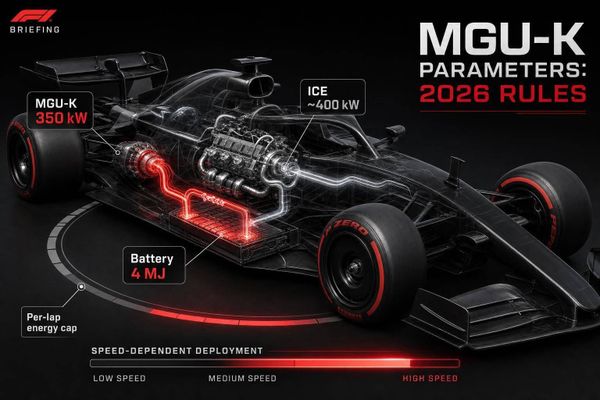
- Energy Management Adjustments: Reduced energy recharge from 8MJ to 7MJ and increased hybrid output from 250kW to 350kW.
- Boost Button Limit: Capped at 150kW to improve predictability and safety.
- MGU-K Deployment: Standardized at 350kW in straight-line zones and 250kW elsewhere.
Driver Performance Highlights:
- Max Verstappen: Struggled with consistency and energy recovery, suffering from setup sensitivity and a crash in Melbourne.
- Lewis Hamilton: Delivered steady performances for Ferrari, avoiding incidents and securing a podium in Shanghai.
- Lando Norris: Maintained consistent pace and adapted well to McLaren's energy strategies.
- Charles Leclerc: Showed strong lap-to-lap stability but faced strategic challenges during races.
The mid-season updates aimed to simplify energy management, promote consistent racing, and improve safety. While some drivers adapted quickly, others faced ongoing challenges, reshaping the competitive dynamics of the 2026 season.
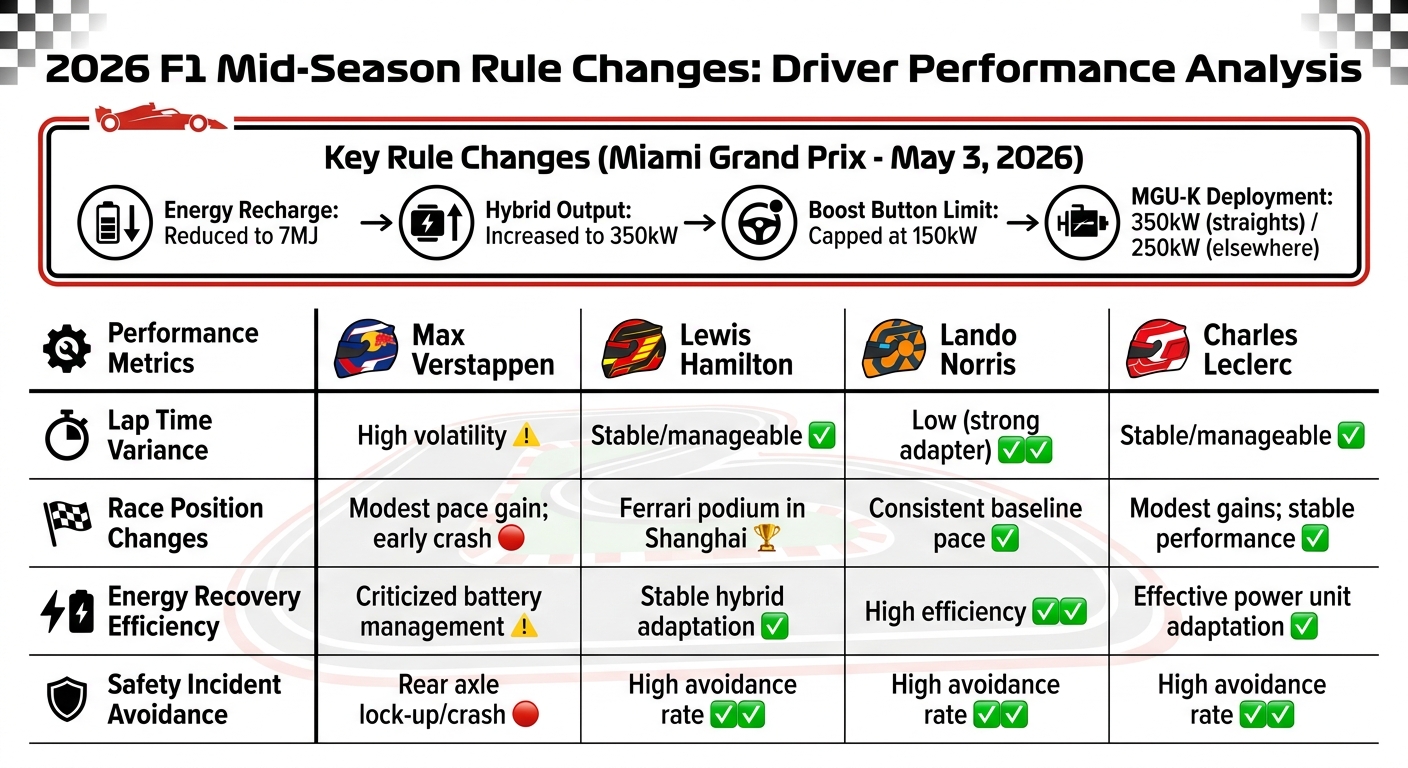
2026 F1 Mid-Season Rule Changes: Driver Performance Comparison
The FIA Just Changed the 2026 F1 Rules : Everything Is Different for Miami!
sbb-itb-7c68254
1. Max Verstappen
Max Verstappen kicked off the 2026 season with some strong opinions about the new technical regulations. His frustrations weren’t just words - they showed up in the numbers, revealing his struggle to consistently adapt to the sweeping changes.
Lap Time Variance
At the Melbourne circuit, Verstappen’s median lap times saw a slight improvement compared to his 2025 performance, proving that his raw speed was still competitive. But the real challenge lay in consistency. The updated 2026 regulations didn’t just test how fast a driver could go - they tested how reliably they could maintain that speed lap after lap.
For Verstappen, the new rules brought volatility. The removal of the MGU-H, the increased electrical output from the MGU-K, and the introduction of active aerodynamics made the cars far more sensitive to setup tweaks. While drivers like Fernando Alonso and Esteban Ocon quickly found a rhythm, Verstappen struggled to navigate the tight setup window. His biggest hurdle was balancing performance across different fuel loads and tire degradation stages, a task made trickier by the heightened sensitivity of the new aero and power unit configurations.
These consistency issues didn’t just affect lap times - they carried over into race day challenges.
Race Position Changes
In response to these widespread struggles, the FIA rolled out mid-season adjustments at the Miami Grand Prix on May 3, 2026. These changes were designed to address the concerns Verstappen and others had raised. Key updates included reducing energy harvesting from 8 megajoules to 7 megajoules and increasing hybrid power output from 250 kW to 350 kW. This allowed drivers to push harder over longer stretches without constantly managing battery levels. To minimize dramatic performance shifts, the boost button was limited to 150 kW, while the MGU-K was set to deliver 350 kW in straight-line zones and 250 kW elsewhere.
These adjustments aimed to make the cars more predictable and manageable, addressing some of the consistency and safety concerns Verstappen had been vocal about.
Energy Recovery Efficiency
Even with these changes, Verstappen faced ongoing challenges with energy recovery under the revised rules. While his median pace improved slightly in the early races, he struggled to consistently tap into peak performance. The increased electrical output from the MGU-K, intended to compensate for the removal of the MGU-H, proved tricky to handle. Engineers noted that the cars were more sensitive to setup changes, leading to greater lap-to-lap variability across the grid. Drivers like Alonso and Ocon adapted more quickly, maintaining steadier performances, while Verstappen found himself grappling with energy management in nearly every race.
Safety Incident Avoidance
Safety also became a significant concern for Verstappen. One key moment in Melbourne underscored the risks of the new regulations. During qualifying, he crashed due to what engineers identified as a rear axle lock-up. This incident skewed his P10 metric - a measure of clean-lap performance - and highlighted the unpredictable nature of the new cars. Data analyst Jordan Goodman reflected on the incident:
"The biggest outlier is Verstappen, a vocal critic of the new regulations. His P10 result is inflated after his early crash, apparently due to a rear axle lock-up."
This crash brought safety concerns to the forefront. The mid-season rule changes, including stabilizing power delivery and capping the boost button, were designed to reduce these risks and make the cars more predictable in high-speed situations.
2. Lewis Hamilton
Lewis Hamilton's move to Ferrari in 2026 marked a significant shift in his career, requiring a fresh approach to adapt to the team's dynamics and the new regulations. Unlike the aggressive style of Max Verstappen or the noticeable pace gains of drivers like Fernando Alonso, Hamilton has settled into a consistent, mid-pack role - neither dominating the field nor struggling to keep up.
Lap Time Variance
At the Australian Grand Prix in Melbourne, Hamilton's median lap times were comparable to his 2025 performance. The 2026 regulation changes, such as the removal of the MGU-H and the increased electrical output from the MGU-K, reshaped energy deployment strategies. Despite these changes, Hamilton managed to avoid the unpredictable pace swings that impacted some of his competitors. The early effect of the new rules wasn't about outright speed loss but rather maintaining consistency.
While Hamilton's top speed didn’t see a dramatic boost, his lap-to-lap performance remained steady. The introduction of active aerodynamics and lower-drag packages altered the car's handling, but Hamilton adapted well, avoiding the inconsistencies seen in younger drivers like Gabriel Bortoleto. During private testing in Barcelona, Hamilton clocked a fastest lap of 1:16.348, showcasing Ferrari's improved power unit reliability.
Race Position Changes
Hamilton's methodical adjustments placed him in a steadier midfield role, contrasting with Verstappen's more volatile performances. Ferrari supported Hamilton's transition by making key structural changes, including replacing his long-time race engineer Riccardo Adami. This move aimed to improve communication around car setups and address the confidence issues Hamilton faced in 2025, when he struggled with a car prone to causing unforced errors. The 2026 SF-26 proved to be more reliable, though it still required precise setups to perform optimally.
Hamilton's racecraft has emphasized consistency over outright speed. While Alonso and Esteban Ocon showed greater pace improvements, Hamilton delivered steady performances across multiple laps. His lap-to-lap stability, measured by the Coefficient of Variation (CV), remained solid, grouping him with teammates Charles Leclerc and Lando Norris - drivers known for prioritizing consistency over chasing peak performance.
Energy Recovery Efficiency
The transition from the MGU-H to a more powerful MGU-K, paired with the introduction of 100% sustainable fuels, demanded a complete overhaul of energy management strategies. Hamilton's Clean Pace (P10) metric, which reflects peak speed, remained nearly unchanged from 2025, signaling stable performance. According to Goodman, the increased electrical output and active aerodynamics made the cars "different to operate, especially over multiple laps." Hamilton's extensive experience allowed him to handle these challenges effectively. His ability to optimize energy recovery contributed to his clean and incident-free races.
Safety Incident Avoidance
Hamilton's reliability stood out under the new regulations. While Verstappen suffered a crash in Melbourne due to a rear axle lock-up, Hamilton avoided similar incidents, demonstrating his consistent handling of the 2026 cars. The updated regulations made the cars "nervous and unpredictable", but Hamilton's steady execution helped him adapt better than many of his peers. Mid-season adjustments introduced at the Miami Grand Prix on May 3, 2026, aimed to make the cars more predictable. Despite missing the podium entirely in 2025 for the first time in his career, Hamilton's ability to maintain stability in 2026 highlighted the importance of experience in navigating sweeping technical changes.
3. Lando Norris
During the mid-season shift in regulations, Lando Norris faced a series of unique challenges. He described the updated cars as "odd" and "unpredictable" due to the removal of the MGU-H and the introduction of fully sustainable fuels. These changes forced him to adapt his driving style, including experimenting with unconventional gear strategies like "lifting everywhere to go quicker".
Lap Time Variance
Norris's lap times showed a consistent pattern following the 2026 regulations, with his median lap times remaining "closer to flat." This consistency set him apart from younger drivers such as Gabriel Bortoleto and Liam Lawson, who experienced more fluctuations in their lap-to-lap performance, as reflected in their higher Coefficient of Variation (CV). A mid-season technical adjustment, implemented before the Japanese Grand Prix, further impacted performance by reducing the maximum allowable energy recharge.
Race Position Changes
The early 2026 regulations disrupted race dynamics significantly. Norris described energy deployment as "yo-yoing", with drivers often at the mercy of software-controlled systems. To address these issues, the FIA introduced mid-season changes - announced on April 20, 2026, and implemented at the Miami Grand Prix on May 3. These adjustments reduced the maximum energy regeneration from 8 MJ to 7 MJ per lap, curbing the "superclipping" maneuvers that had been destabilizing race positions and altering energy management strategies.
Energy Recovery Efficiency
To enhance energy recovery, the FIA increased harvesting power from 250 kW to 350 kW. Norris, in particular, benefited from McLaren's testing results, which showed positive outcomes from this change. Previously, he had relied on manual lift-and-coast techniques to manage energy. The updated power split for 2026 cars balanced at approximately 50-50, with 400 kW from the internal combustion engine and 350 kW from the MGU-K. After these adjustments, MGU-K deployment was limited to 250 kW in non-critical areas, such as outside corner exits and overtaking zones. This change helped drivers manage energy more predictably and contributed to safer racing conditions.
Safety Incident Avoidance
To address safety concerns, the mid-season regulations introduced a maximum boost cap of +150 kW. This measure aimed to reduce the risk of crashes caused by sudden speed differentials when some cars deployed full electrical power while others were in harvesting mode. Additionally, an automatic detection system for slow starts was implemented. This system triggered the MGU-K to auto-deploy, helping to prevent incidents like the grid collision that occurred earlier in the season involving Liam Lawson. These changes played a critical role in improving safety on the track.
4. Charles Leclerc
Charles Leclerc approached the 2026 regulations with a steady and strategic mindset. His lap pace showed remarkable consistency, with a median performance that remained "closer to flat" compared to his 2025 results. This stability highlighted his ability to adapt to the new cars, as reflected in a smaller shift in his Coefficient of Variation (CV) compared to many of his competitors.
Lap Time Variance
Under the updated rules, Leclerc's hallmark became his lap-to-lap consistency. The elimination of the MGU-H and the increased reliance on the MGU-K introduced new challenges, particularly in managing "Overtake Mode." This was especially tricky at high-throttle tracks like Melbourne, where energy recovery was limited by the circuit layout. At Melbourne, drivers spend about 78% of the lap at full throttle, with just three braking zones lasting more than 0.4 seconds. These conditions made maintaining consistent lap times while defending positions a tough balancing act, but Leclerc handled it with precision.
Race Position Changes
The 2026 Australian Grand Prix showcased a dramatic shift in racing dynamics, with 120 overtakes compared to just 45 in 2025. Leclerc was in the thick of this action, battling George Russell in seven lead changes within the first nine laps. While some drivers struggled - like Verstappen with consistency or Norris relying heavily on lift-and-coast tactics - Leclerc embraced the new strategic demands. He summed up the experience with a playful analogy:
"This is like the mushroom in Mario Kart. Before, it was more about who is the bravest at braking the latest, maybe now there's a bit more of a strategic mind behind every move you make."
Leclerc further explained the new challenges:
"Every boost button activation, you know you're going to pay the price big time after that, and so you always try and think multiple steps ahead to try and end up eventually first."
Despite leading the race until lap 26, Leclerc's position slipped after Ferrari opted not to pit during a Virtual Safety Car period. This decision underscored the strategic complexity of the new regulations and hinted at areas for refinement in Ferrari's approach to energy management.
Energy Recovery Efficiency
Ferrari's power unit design gave Leclerc a noticeable edge in energy management. The team opted for a smaller turbocharger to counter the turbo lag introduced by the removal of the MGU-H. This adjustment improved race starts and overall performance early in the season. Leclerc was one of the few drivers to express satisfaction with the 2026-spec cars, even sharing his enjoyment over team radio. As the season progressed, mid-season updates helped stabilize energy deployment, aligning well with Leclerc's positive outlook on the new regulations.
Pros and Cons
On April 20, 2026, mid-season changes shook up driver performances in Formula 1. The FIA introduced two key adjustments: reducing energy recharge from 8MJ to 7MJ and increasing peak power from 250kW to 350kW. These tweaks aimed to address concerns over excessive battery management and dangerous speed gaps between cars. However, the impact varied significantly depending on how well each driver adjusted.
Max Verstappen faced the most challenges adapting. His struggles were evident, culminating in an early crash that highlighted difficulties with the new battery management system. Verstappen didn’t hold back his frustration, calling the changes "a joke" and pointing to deeper technical issues.
Lewis Hamilton and Lando Norris, on the other hand, handled the changes with ease. Hamilton delivered Ferrari’s first podium under the new rules during the Shanghai race, showcasing his ability to manage energy recovery efficiently. Similarly, Norris impressed with his consistent performances and smooth adaptation, making him one of the standout drivers of the season.
Charles Leclerc found himself in a middle ground. While not as dominant as Norris or Hamilton, he managed to adapt effectively to Ferrari’s revamped power unit, maintaining steady performances throughout.
These mid-season modifications didn’t just alter driver performances - they also reshaped strategies and highlighted the varying adaptability of top competitors.
Driver Comparison Summary:
| Driver | Lap Time Variance | Race Position Changes | Energy Recovery Efficiency | Safety Incident Avoidance |
|---|---|---|---|---|
| Max Verstappen | High volatility | Modest pace gain; early crash | Criticized battery management | Rear axle lock-up/crash |
| Lewis Hamilton | Stable/manageable | Ferrari podium in Shanghai | Stable hybrid adaptation | High avoidance rate |
| Lando Norris | Low (strong adapter) | Consistent baseline pace | High efficiency | High avoidance rate |
| Charles Leclerc | Stable/manageable | Modest gains; stable performance | Effective power unit adaptation | High avoidance rate |
Conclusion
The mid-season rule changes planned for the Miami Grand Prix on May 3, 2026, signal a pivotal moment for F1 regulations. By shifting the focus away from excessive battery management and toward more aggressive racing, the FIA aims to recalibrate the sport's competitive dynamics. This measured approach reflects a preference for incremental adjustments over sweeping transformations.
Driver adaptation has been mixed so far. While some have adjusted quickly, others have struggled with inconsistencies despite showing improved speed. The upcoming changes in Miami could further impact this balance, especially for Kimi Antonelli and George Russell. Antonelli currently leads the championship standings by 9 points over his Mercedes teammate, adding an extra layer of intrigue to the race.
Safety concerns also played a significant role in shaping these updates. The 150 kW cap on the boost button helps to minimize performance gaps during overtaking, reducing the risks associated with sudden power surges.
The adjustments are designed to promote competitive balance by prioritizing consistency and safety. As the season unfolds, the ability to fine-tune setups for steady performance will likely outweigh the pursuit of isolated peak speeds. Teams that focus on reliable execution rather than chasing the fastest lap times are expected to gain a strategic edge.
These mid-season changes also highlight a new approach to regulatory updates in Formula One. Instead of waiting for the off-season, the FIA has shown a readiness to adapt rules mid-year, guided by driver input and safety data. This method strikes a balance between innovation and maintaining a level playing field, reshaping the competitive landscape in the process.
FAQs
Why did the FIA change the energy rules mid-season?
The FIA made mid-season adjustments to the energy rules in response to feedback from drivers, teams, and fans. These changes now allow teams to harvest energy at a rate of 350 kW. The update aims to cut down on superclipping time and encourage more consistent flat-out driving, addressing concerns about excessive energy harvesting during races.
How do the MGU-K limits affect overtaking and lap time consistency?
The MGU-K limits play a big role in shaping overtaking opportunities and maintaining consistent lap times by capping energy deployment. With less electrical power available for overtaking, drivers may find it harder to execute passes. Plus, the new energy management strategies introduced in the 2026 regulations could lead to more fluctuating lap times as drivers adapt. These adjustments push teams and drivers to fine-tune their performance while working within stricter energy limits.
Which teams are best positioned to gain from the Miami updates?
Teams that can adjust effectively to the 2026 regulations, such as Red Bull Racing, are expected to gain the most from the Miami updates. Red Bull’s history of resourcefulness and cutting-edge strategies in both aerodynamics and power units places them in a strong position for the upcoming technical changes. Similarly, other teams that excel in these critical areas might also find themselves well-prepared to capitalize on the shift.