F1 Pit Wall Communication: Key Roles Explained
How F1 pit wall teams use radios, telemetry, strategists, and remote ops to make split-second race decisions.
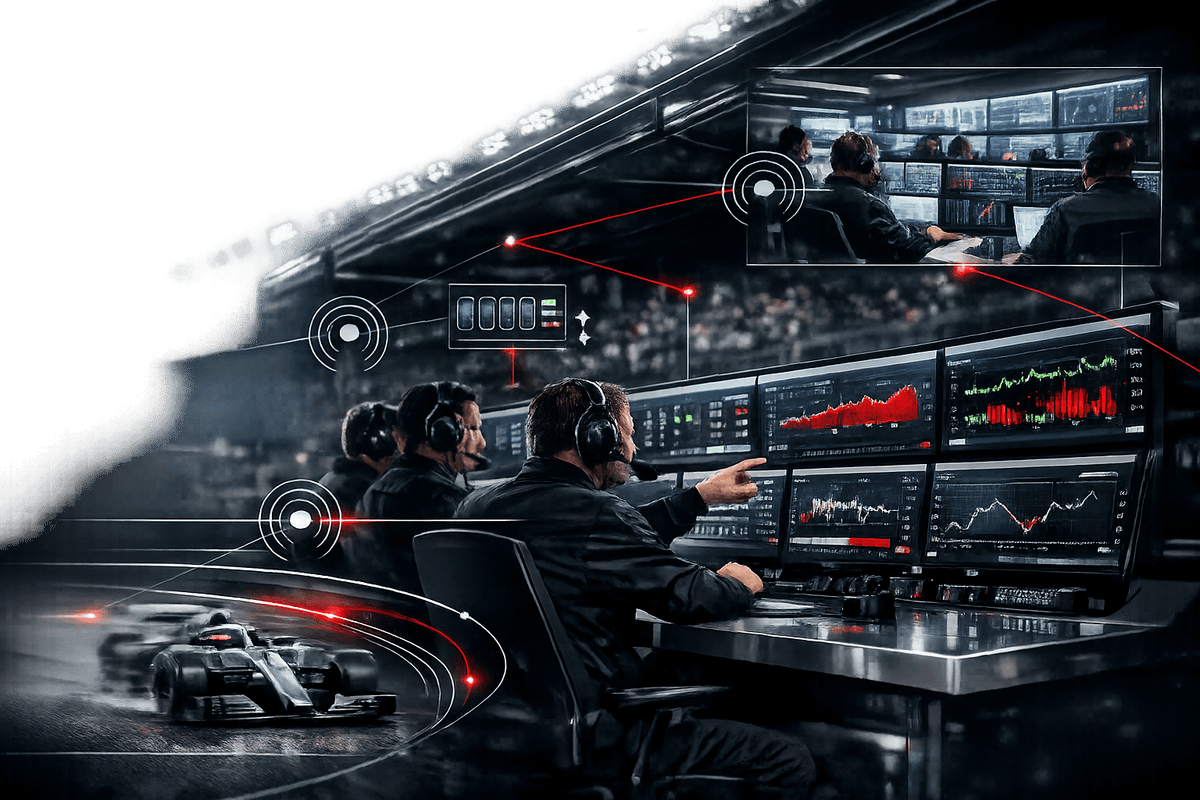
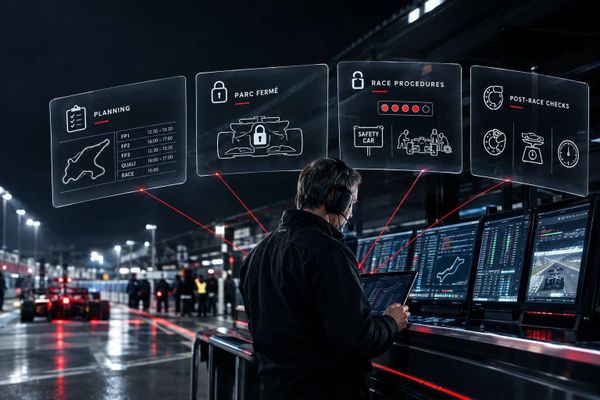
F1 pit wall communication is the backbone of race-day strategy. It’s where real-time decisions are made, blending live data with on-the-spot judgment to guide drivers. Here's what you need to know:
- What is the pit wall? A trackside command center where 4-7 team members oversee strategy, car performance, and driver support.
- Why is communication critical? Drivers face intense physical and mental demands. Only the Race Engineer speaks directly to them, ensuring clear, concise instructions like “Box, box” for pit stops.
- Core roles: Team Principal, Chief Strategist, Race Engineer, and Performance Engineers work together to analyze data, monitor rivals, and adjust tactics in real time.
- Tools and systems: Teams rely on digital radios, live telemetry, and GPS tracking to monitor car performance and conditions. Remote operations rooms back at the factory provide additional support.
F1 teams combine cutting-edge technology with human expertise, ensuring every decision is precise and timely. This coordination can make or break a race.
Key Components of F1 Pit Wall Communication
Communication Channels and Tools
At the heart of pit wall operations is the digital radio system connecting drivers and engineers. Drivers activate this system using a push-to-talk button on their steering wheels. These radios are equipped with noise-canceling technology to cut through the deafening engine sounds and wind noise, even at speeds exceeding 185 mph.
In addition to voice communication, real-time telemetry plays a critical role. This constant data stream provides insights into tire temperatures, fuel flow, ERS (Energy Recovery System) status, brake energy, and suspension metrics, giving engineers an immediate snapshot of the car's performance. Pit wall monitors consolidate these telemetry feeds with GPS tracking, detailed micro-sector timings, interval data, and live weather updates sourced from Meteo France. When electronic systems fail, teams fall back on physical pit boards to relay essential information like positions, time gaps, and "BOX" calls.
Interestingly, the international broadcast feed displayed on pit wall screens has a slight delay. This means engineers sometimes hear crowd reactions to incidents before they see them unfold on their monitors.
All these systems on the pit wall are tightly integrated with remote operations for seamless coordination.
Factory-Based Operations and Their Role
The pit wall team may be the most visible part of race-day operations, but they’re supported by a massive network of remote analysts and strategists working behind the scenes. Oracle Red Bull Racing describes this dynamic as:
"The people on the pit wall are very much the visible tip of the iceberg, supported by a large group of people behind them... in the Ops Room back at the factory."
Teams like Red Bull (based in Milton Keynes) and Ferrari (in Maranello) operate remote operations centers that mirror every data feed, camera angle, and telemetry stream coming from the track. Ferrari’s strategy department, led by Iñaki Rueda, focuses on real-time analysis of their drivers' performance while also monitoring rival teams’ strategies.
However, these factory-based teams don’t communicate directly with drivers. Instead, they relay their insights to the Chief Race Engineer, who filters the information and ensures the driver isn’t overwhelmed with unnecessary details.
FIA Rules on Radio Communication
FIA regulations give teams considerable freedom in their radio communications, allowing them to discuss strategies, reliability issues, and car settings. However, drivers must execute all adjustments themselves, as remote control of car functions via telemetry is strictly forbidden. Additionally, corner-by-corner coaching was largely outlawed in 2016, pushing teams to adopt concise and coded language for key instructions.
To keep strategies hidden from competitors, teams rely on these codes. For example, during the 2013 Malaysian Grand Prix, Red Bull used "Multi 21" to signal their drivers about the preferred finishing order. Similarly, Mercedes uses the phrase "Hammer time" to instruct Lewis Hamilton to push at maximum pace. Other shorthand, such as "Strat 5" or "Plan A/B/C", helps engineers quickly communicate tire strategies or engine settings without revealing their plans to rival teams.
sbb-itb-7c68254
How Do F1 Teams Communicate Over A Race Weekend? Albert Fabrega’s F1 TV Tech Demo | Crypto.com
Core Roles on the F1 Pit Wall
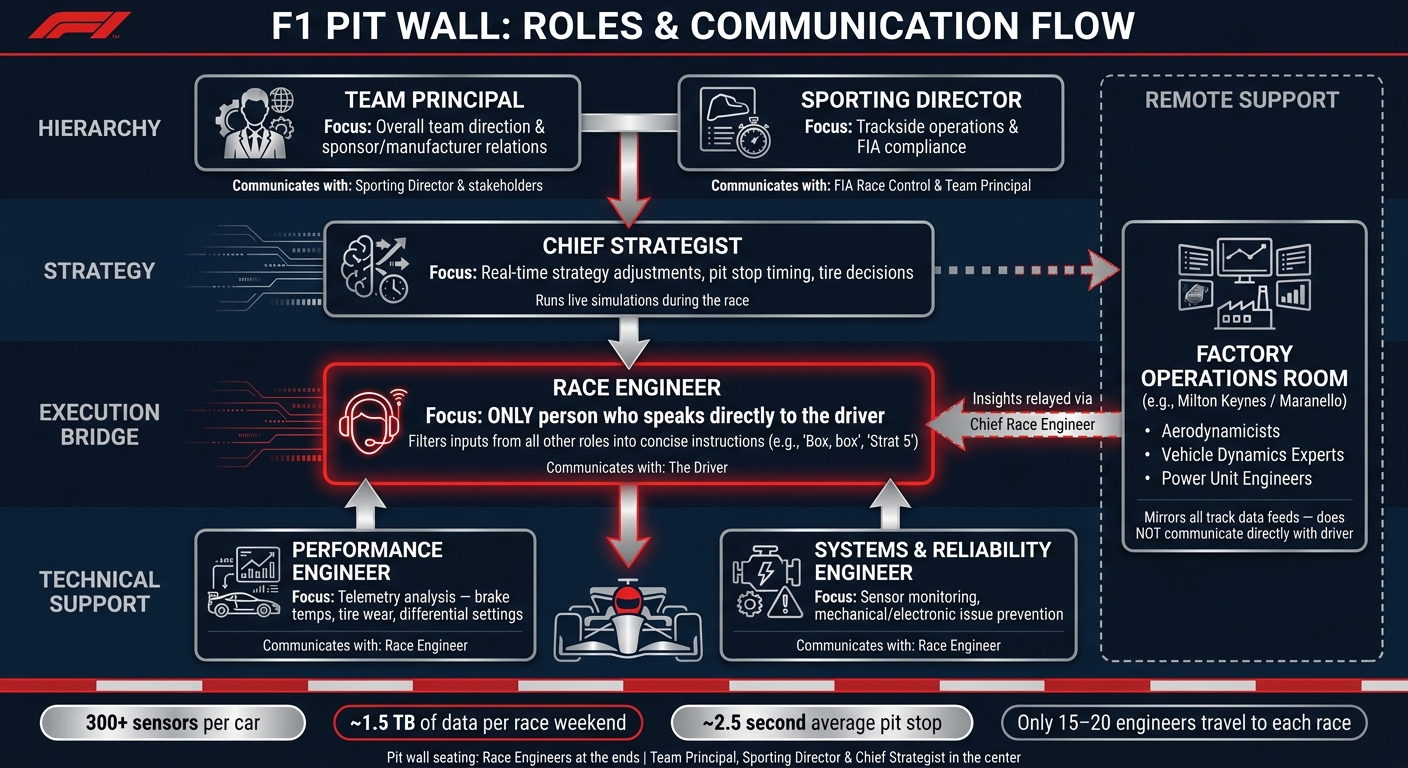
F1 Pit Wall Roles & Communication Flow Explained
The pit wall operates as a finely tuned command center, where each role has a specific purpose. This structure allows teams to make quick, precise decisions during high-pressure moments. Every individual on the pit wall contributes to seamless coordination, ensuring that race strategies are executed without a hitch.
Team Principal or Sporting Director
While these roles are sometimes confused, they serve very different functions. The Team Principal oversees the team's overall direction, making big-picture decisions and managing relationships with sponsors, manufacturers, and the organization as a whole. Meanwhile, the Sporting Director focuses on operations at the track. They handle the pit crew, ensure compliance with regulations, and act as the main point of contact with FIA Race Control. Both roles are stationed at the pit wall, where they can respond to conditions that go beyond what data alone can reveal.
Chief Strategist
The Chief Strategist takes broad directives and refines them into actionable race tactics. They create pre-race strategies and adjust them in real time based on live data, competitor movements, and weather updates. Working closely with the strategy team back at the factory, they run simulations during the race to identify the best moments for pit stops and tire changes. While they don't communicate directly with the driver, their insights are relayed through the Race Engineer.
Race Engineer
The Race Engineer is the only person who speaks to the driver during the race. They take inputs from various specialists - such as strategists, performance engineers, and tire experts - and condense it into clear, concise instructions that the driver can act on immediately.
"The race engineer is the primary voice they hear, filtering inputs from strategists, performance engineers, tyre specialists, and the sporting director." - Dominika Jordan, Sports Writer, Race Sundays
This is why race radio commands like "box, box" or "Strat 5" are kept short and to the point.
Performance and Systems Engineers
Performance Engineers focus on telemetry, analyzing data like brake temperatures, tire wear, and differential settings. They provide the Race Engineer with recommendations to help the driver either preserve the car or push for faster laps. Systems and Reliability Engineers, on the other hand, monitor sensors for potential mechanical or electronic issues, aiming to catch problems before they escalate. Together, these engineers ensure that the car performs at its best while staying reliable throughout the race.
The seating arrangement on the pit wall reflects the team's communication flow. Race Engineers are positioned at the ends to limit distractions, while the Team Principal, Sporting Director, and Chief Strategist sit in the center, enabling quick face-to-face discussions. This setup ensures that strategic decisions move inward and execution flows outward efficiently.
| Role | Primary Focus | Main Communication Link |
|---|---|---|
| Team Principal | Team leadership and overall direction | Sporting Director and stakeholders |
| Sporting Director | Trackside operations and compliance | FIA Race Control and Team Principal |
| Chief Strategist | Real-time strategy adjustments | Race Engineer and strategy team |
| Race Engineer | Driver communication and car setup | The driver |
| Performance Engineer | Telemetry and car performance | Race Engineer |
How Communication Shapes Race Strategy
Real-Time Decision-Making
In Formula 1, every lap churns out a flood of data. With more than 300 sensors on a modern F1 car streaming live telemetry to both the pit wall and the factory, the real challenge isn't collecting data - it's knowing how to act on the right piece of information at the perfect moment.
Take the 2021 Spanish Grand Prix as a standout example. Lewis Hamilton had lost the lead, but Mercedes' strategists, James Vowles and Rosie Wait, analyzed the live data and made a bold call: pivot from a one-stop to a two-stop strategy. Meanwhile, Red Bull stuck to their one-stop plan. This decision meant Hamilton had to close a 22-second gap in just 23 laps. He pulled it off, taking the lead with six laps to spare. This outcome was only possible because of seamless communication between the pit wall and Mercedes' remote operations team, who worked together to evaluate competitor gaps, tire wear rates, and track position in real time. Such quick decisions also ripple into the precision needed for pit stops.
Pit Stop Coordination
A pit stop might only last about 2.5 seconds at the highest level, but the preparation begins long before the car hits the pit lane. The Head of Track Operations oversees the mechanics and technicians, while the Head of Race Strategy pinpoints the best timing for the stop. The Race Engineer then relays the pit stop signal to the driver - using short, pre-agreed cues like "box, box" - to ensure the driver stays focused.
But it’s not just about data; physical coordination plays a huge role too. Ferrari's Sporting Director Laurent Mekies explains:
"Race engineers have to be able to see that the set-up changes they've requested are being made, and they have to have eye-contact with the number one mechanic and the driver."
This visual connection between the Race Engineer, the lead mechanic, and the driver ensures that the strategy on paper translates into flawless execution on the track. And all of this must happen while respecting the driver’s ability to process information under immense pressure.
Managing Driver Information Load
On the pit wall, controlling the flow of information is as important as crafting the strategy itself.
Ferrari's Laurent Mekies puts it clearly:
"Like any difficult working environment, we try to minimise the amount of talking and, as far as the pit wall is concerned, we especially try to apply that to the race engineers, disturbing them as little as possible."
Every message sent to the driver is kept concise and actionable. But sometimes, a senior voice needs to cut through the noise. A memorable example occurred during the 2018 Austrian Grand Prix. A Virtual Safety Car error cost Hamilton the lead, dropping him from 1st to 4th. Chief Strategist James Vowles personally stepped in with a calm, 10-second message over the radio:
"Lewis, it's James. I have thrown away the win today but you have the potential opportunity to get back up. Just keep your tyres cool. We trust in you and believe in you. I'm sorry."
In those few seconds, Vowles not only acknowledged the error but also gave Hamilton a clear technical focus and a morale boost. This disciplined approach to communication is what keeps the entire pit wall strategy sharp and effective.
How F1 Pit Wall Communication is Changing
With advancements in data analytics and remote support, Formula 1 teams are rethinking how they handle radio protocols and the structure of pit wall operations.
The Role of Data Analytics and Machine Learning
Modern Formula 1 cars are technological marvels, packed with over 300 sensors that generate approximately 1.5 terabytes of data during a race weekend. This massive influx of information has reshaped how pit wall teams operate, requiring quick filtering and translation into actionable insights.
Specialists now play a pivotal role in transforming raw telemetry data into concise, digestible signals for strategists on the pit wall. Beyond just processing existing data, machine learning models are stepping in to identify patterns and trends - like predicting tire wear or spotting unusual energy recovery system (ERS) behavior - often before human engineers can detect them. Pit wall displays have also become incredibly customizable, allowing engineers to tailor their screens to include GPS tracking, weather radar with storm predictions, mini-sector times, and live telemetry.
Laurent Mekies, Ferrari's Sporting Director, highlights the importance of prioritizing data:
"Selecting the information you need is part of trying to work efficiently – particularly in the tough moments."
The challenge isn’t the availability of data but deciding what’s worth acting on. This shift toward digital tools is driving a more integrated and remote-focused approach to operations.
Growing Reliance on Remote Operations
The pit wall you see during a race is just the tip of the iceberg. Behind the scenes, Remote Operations Rooms (RORs) - like Red Bull Racing’s facility in Milton Keynes or Ferrari’s strategy hub in Maranello - mirror every data feed and camera angle from the track. These rooms enable remote specialists, including aerodynamicists, vehicle dynamics experts, and power unit engineers, to provide immediate analysis to trackside teams.
With only 15–20 engineers traveling to races, the bulk of technical support now operates from these remote locations. This shift has reshaped roles, with the Chief Race Engineer acting as a vital link between the track and factory operations. In some cases, roles have even merged; for example, Red Bull’s Acting Head of Sporting also serves as a Senior Race Strategy Engineer.
Where Communication Protocols Are Headed
As remote operations take on a larger role, communication protocols are evolving to ensure no critical on-track details are lost. While digital systems dominate, the physical pit wall remains essential for capturing real-world cues that sensors might overlook - like an unusual engine noise or sudden weather changes.
Red Bull Racing has pointed out that the traditional row of pit wall seats is becoming less critical:
"In an era of clear, multi-channel communication, and with the ability to monitor multiple track feeds – of visuals and data – from anywhere, there is no absolute need for a row of seats at the edge of the track."
However, Formula 1 seems to be leaning toward a hybrid model, combining the depth of remote analysis with the irreplaceable insights gained trackside. Communication is also becoming more coded to prevent rivals from deciphering strategies, with shorthand like "Strat 5" or "Scenario 7" used to relay plans discreetly over the radio. To prepare for potential system failures, teams continue to rely on backup methods like pit boards and hand signals.
Conclusion
The pit wall's communication system is the heart of race strategy, blending real-time data with human intuition to guide split-second decisions.
In Formula 1, pit wall communication relies on a structured network of roles, precise information flow, and a mix of cutting-edge data analysis with on-the-spot judgment. The Race Engineer serves as the driver's direct link, while the Chief Strategist keeps a watchful eye on tire strategies and competitor moves. Each team member on the pit wall works toward a singular goal: making the best possible decision, even when the data isn't perfect. As Ferrari's Laurent Mekies aptly put it, communication is simply irreplaceable.
What makes this system so fascinating is its ability to merge advanced technology with practical, hands-on experience. Teams analyze massive amounts of data but still depend on subtle signals like a mechanic's gesture or the sound of an engine revving - details that no algorithm can replicate. Over the years, pit wall communication has evolved from basic hand signals to incorporating machine learning, all while holding onto the proven methods that continue to deliver results. Understanding these roles and their interplay offers a richer appreciation of the strategic depth behind every race.
As Formula 1 continues to push the boundaries of technology and strategy, the pit wall remains the cornerstone of the sport's tactical mastery.
For more insights into F1 strategy, team operations, and the technical side of racing, check out F1 Briefing for in-depth analysis that goes beyond the race-day coverage.
FAQs
Why can only the Race Engineer talk to the driver?
The Race Engineer serves as the driver's only point of contact during the race, ensuring communication stays clear and direct. Their role involves passing along crucial updates about safety, strategy, and performance. Meanwhile, the rest of the team works behind the scenes, analyzing data and telemetry to provide the insights needed for real-time decisions.
What data matters most when choosing a pit-stop strategy?
When it comes to planning a winning pit-stop strategy, certain types of data are absolutely essential. Teams rely heavily on telemetry insights, which provide details on tire wear, fuel levels, and engine performance. Timing screens are another critical tool, offering sector times and gap analysis to gauge on-track positioning.
But that's not all - weather forecasts and track temperatures are also major factors. These help teams anticipate how conditions might change and adapt their approach accordingly. And let’s not overlook the importance of real-time driver feedback. Combining this input with the data allows teams to fine-tune decisions about when to pit, which tires to use, and what adjustments are needed to keep performance at its peak.
How do teams stay competitive if radio coaching is restricted?
F1 teams maintain their edge on the track even with restrictions on radio coaching by leveraging a mix of advanced telemetry, strategic pre-race planning, and coded communication. The pit wall team plays a crucial role, analyzing real-time data such as car performance metrics, GPS positioning, and weather updates. This allows them to make informed strategic calls without violating the rules.
Drivers stick to pre-planned strategies and rely on coded exchanges with their engineers. These methods ensure they can adapt quickly to changing race conditions while staying compliant with the regulations.