F1 Safety Tech Timeline: Halo to HANS
Timeline of F1 safety advances from basic protections to the HANS device and Halo, showing how engineering cut fatalities and reshaped motorsport safety.
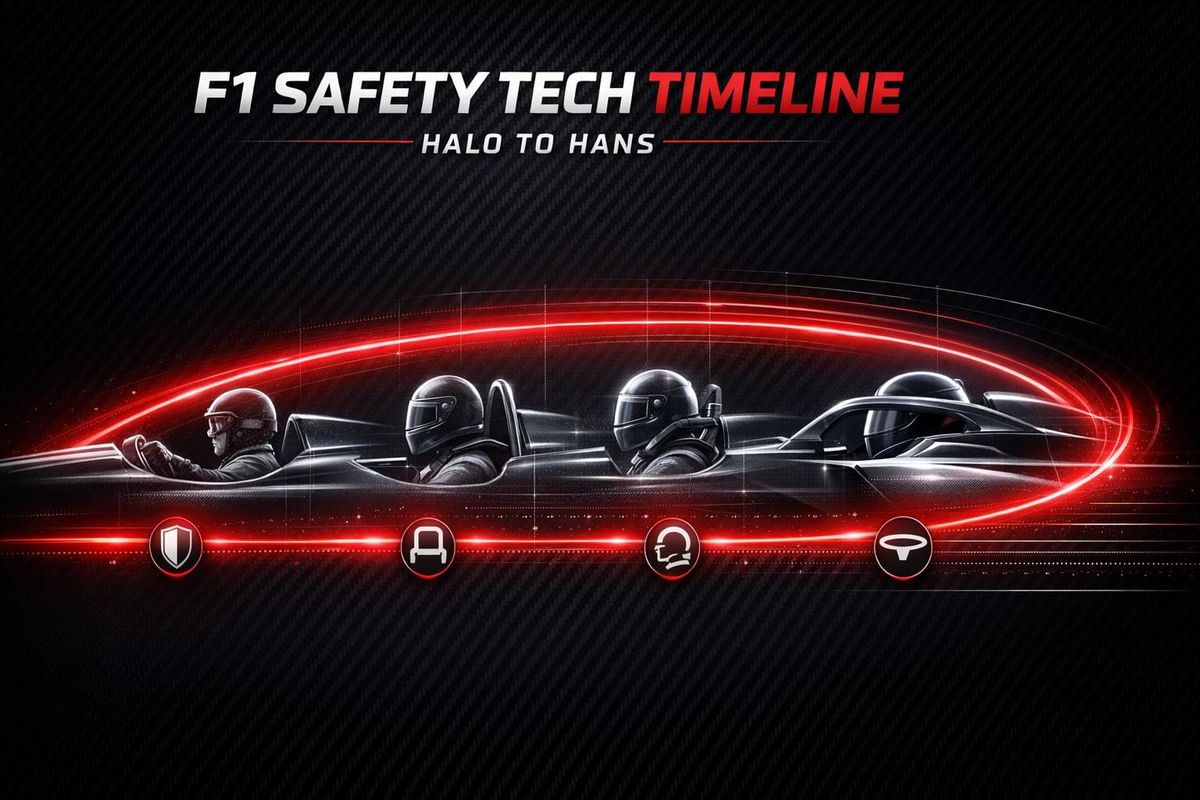
Formula 1 has always been risky, but safety advancements like the HANS device and the Halo have saved lives. Both were introduced after tragic accidents and faced initial skepticism before becoming essential. The HANS device, mandatory since 2003, prevents fatal neck injuries in crashes. The Halo, introduced in 2018, protects drivers from debris and cockpit intrusions. Together, they’ve transformed driver safety, reducing fatalities and influencing motorsports globally.
- HANS Device (2003): Prevents head and neck injuries by redirecting crash forces.
- Halo (2018): Titanium structure shields drivers from debris and collisions.
These innovations reflect F1's shift from reactive to proactive safety measures, protecting drivers in high-speed crashes and setting new standards across motorsports.
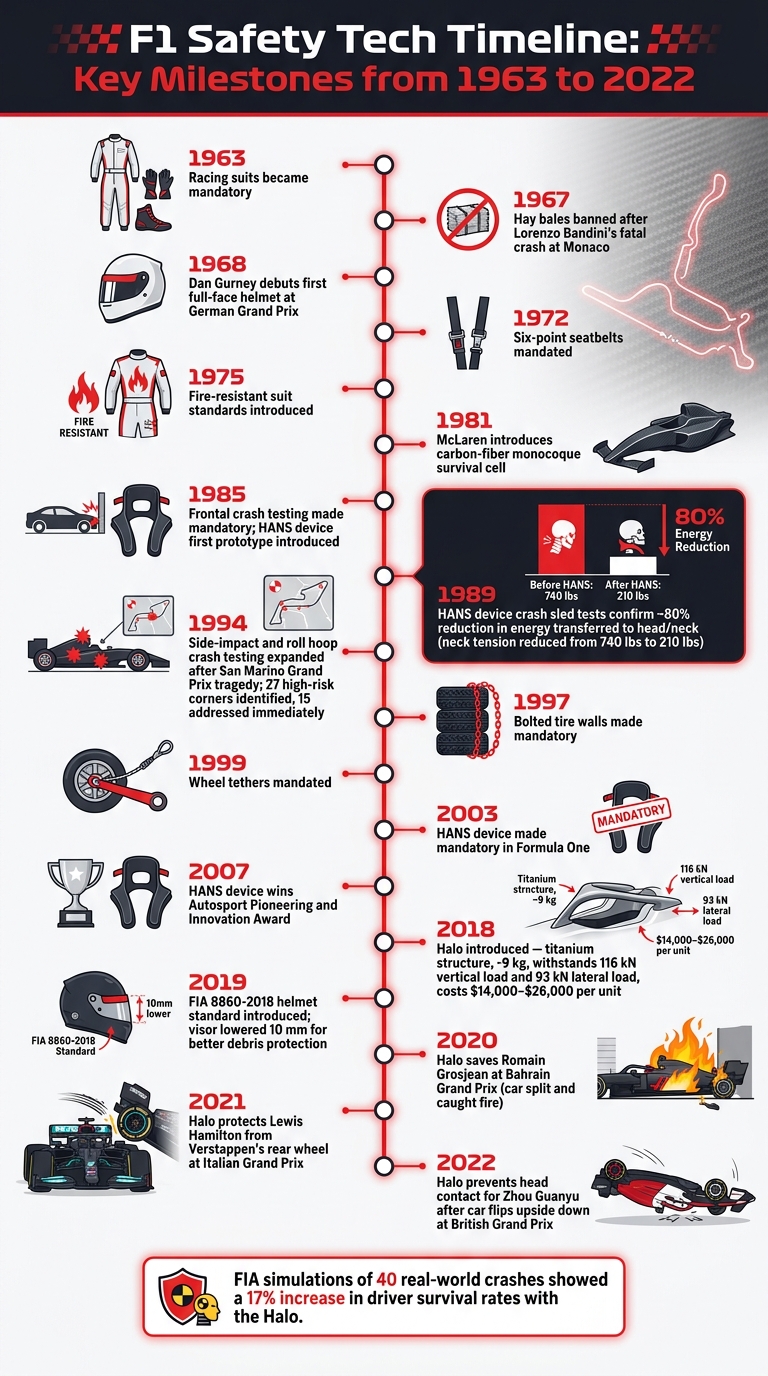
F1 Safety Tech Timeline: Key Milestones from 1963 to 2022
Early Safety Measures in Formula One (1960s–2002)
Basic Safety Standards in Early F1
In the early days of Formula One, driver safety was far from the priority it is today. Racing suits became mandatory in 1963, but it wasn't until 1975 that fire-resistant standards were introduced. Similarly, six-point seatbelts, now an essential safety feature, weren't required until 1972. Cars at the time also lacked specialized fuel cells, which left drivers at a higher risk of fires during crashes. A major step forward came in 1968 when Dan Gurney debuted the first full-face helmet at the German Grand Prix. This innovation replaced the open-face helmets that left drivers' faces exposed to extreme speeds, marking a pivotal moment in helmet design. While these measures were important, they were just the beginning of a long process spurred by tragic accidents.
How High-Profile Tragedies Shaped Safety Rules
The risks of Formula One during this period were staggering. Between 1963 and 1973, drivers faced a two-in-three chance of fatality. Sir Jackie Stewart, who witnessed the loss of 57 fellow drivers, described the era's grim reality:
"To be a racing driver between 1963 and 1973 was to accept not the possibility, but the probability of death."
Stewart became a vocal advocate for safety, leading efforts like the 1969 boycott of Spa-Francorchamps due to its hazardous conditions. His push for reforms led to the adoption of seatbelts and improved fire protection. The death of Jim Clark in 1968 at Hockenheim, where his car collided with trees after leaving the track, underscored the dangers drivers faced. Another critical moment came with the 1994 San Marino Grand Prix. After that tragic weekend, computer analysis identified 27 "very high risk" corners on the F1 calendar. Immediate action was taken to address 15 of these through circuit redesigns and performance regulations. These events catalyzed advancements in both car design and track safety.
Survival Cells and Trackside Barriers
A major milestone in car safety came with McLaren's introduction of the carbon-fiber monocoque in 1981. This survival cell was designed to absorb impact energy, protecting the driver by keeping the cockpit intact during crashes. By 1985, frontal crash testing became mandatory, and after 1994, testing expanded to include side-impact and roll hoop evaluations. Over time, the speed for frontal crash tests increased from 23 mph (11 m/s) to 29 mph (13 m/s), while the maximum allowable average deceleration rose from 25g to 40g.
Trackside safety also saw significant improvements. Hay bales, which had been a common sight, were banned in 1967 after Lorenzo Bandini's fatal crash at Monaco, where the bales caught fire. Guardrails replaced hay bales, but they brought their own dangers, as shown by Helmut Koinigg's fatal crash at Watkins Glen in 1974. This led to the development of energy-absorbing tire walls and, eventually, Tecpro barriers. By 1997, bolted tire walls became mandatory, and wheel tethers were introduced in 1999 to prevent loose wheels from causing fatalities, following incidents at the 2000 Italian and 2001 Australian Grands Prix. These changes set the stage for even greater safety innovations in the years to come.
| Year | Advancement | Impact |
|---|---|---|
| 1967 | Hay bales banned | Reduced fire hazards at tracks |
| 1972 | 6-point seatbelts mandated | Lowered the risk of driver ejection during crashes |
| 1981 | Carbon-fiber monocoque introduced | Provided a protective survival cell for drivers |
| 1985 | Frontal crash testing made mandatory | Improved car structural standards |
| 1994 | Expanded crash testing to include side-impact and roll hoop tests | Increased protection from lateral impacts |
| 1999 | Wheel tethers mandated | Minimized risks from loose wheels hitting drivers or marshals |
sbb-itb-7c68254
The HANS Device: How It Changed Driver Safety
How the HANS Device Was Developed and Tested
The HANS (Head and Neck Support) device was created in the early 1980s by Dr. Robert Hubbard, a biomechanical engineering professor at Michigan State University. The idea came after the tragic death of racer Patrick Jacquemart. Dr. Hubbard identified a critical safety issue: in high-speed frontal crashes, while seatbelts secure the torso, the head continues to move forward. This violent motion often results in a basilar skull fracture, a typically fatal injury.
The first prototype was introduced in 1985, and by 1989, crash sled tests showed its effectiveness. The device reduced the energy transferred to the head and neck by about 80%. For example, vertical neck tension dropped from 740 lbs to 210 lbs, with similar reductions in forward shear. Made of carbon fiber, the HANS device resembles a U-shaped collar placed under the harness and connected to the helmet with tethers. Instead of absorbing energy at the neck, it redirects forces to stronger parts of the body, like the forehead, chest, and torso. This groundbreaking design set the stage for its eventual adoption as a mandatory safety measure.
Making the HANS Device Mandatory in 2003
Despite clear evidence of its safety benefits, the path to making the HANS device mandatory wasn’t easy. The 1994 San Marino Grand Prix, which brought renewed attention to driver safety, prompted the FIA to sponsor research. This research confirmed the HANS device was more effective at managing crash forces than other systems. However, many drivers resisted using it, citing discomfort. Complaints ranged from the device rubbing against collarbones to feeling overly restrictive.
One key improvement was the addition of quick-release shackles, inspired by sailboat rigging, which allowed drivers to exit their vehicles quickly during emergencies. These changes helped address the concerns, and in 2003, Formula One made the HANS device mandatory for all drivers.
Driver Safety After the HANS Device
Once it became mandatory in 2003, the HANS device began changing how driver safety was viewed. However, acceptance wasn’t immediate. Many drivers were skeptical, with some openly opposing its use. NASCAR driver Mark Martin famously said in 2001:
"I would not wear one for anything. I'll just keep my fingers crossed and take my chances."
Others referred to the tethers as "that damn noose", a sentiment tied to Dale Earnhardt's fatal basilar skull fracture during the 2001 Daytona 500. His death became a turning point, underscoring the urgent need for better safety measures and accelerating the HANS device's adoption across motorsports.
The HANS device represented a shift in safety priorities. Before its introduction, efforts mainly focused on reinforcing cockpits and improving barriers. The HANS device brought a new focus: managing the forces acting on a driver during a crash. This philosophy later influenced other advancements, such as the halo system and improved helmet designs. The device’s impact was widely recognized, earning the Autosport Pioneering and Innovation Award in 2007. In 2016, Dr. Robert Hubbard and Jim Downing received the SAE International Award for Motorsport Safety in honor of their contributions.
Decoding the Halo: How It Revolutionized Safety in F1 Cars !
The Halo Device: A New Standard in Driver Protection
Building on earlier advancements like the HANS device, the Halo has set a new benchmark in Formula One safety.
Development and Testing of the Halo (2016–2017)
The push for the Halo device gained momentum after a series of tragic and alarming incidents. In 2009, Henry Surtees lost his life in a Formula 2 race when a loose wheel struck him, and Felipe Massa suffered a severe head injury at the Hungarian Grand Prix after being hit by a suspension spring. Jules Bianchi's fatal accident in 2014 further highlighted the need for improved cockpit protection.
The FIA focused on three key crash scenarios for the Halo: shielding drivers in car-to-car collisions, preventing helmets from hitting barriers, and protecting against large debris. Alternative solutions were explored, including Red Bull's transparent Aeroscreen and a polyvinyl chloride Shield tested by Sebastian Vettel at the 2017 British Grand Prix. However, both were dismissed due to visibility issues.
Engineering Features of the Halo
The Halo is a titanium structure that attaches to the car's chassis at three points. Weighing about 9 kilograms, it’s crafted from aerospace-grade titanium and can endure massive forces - 116 kN of vertical load (equivalent to the weight of a London double-decker bus) and 93 kN of lateral load.
"We had to strengthen the design of the chassis so it would be able to take roughly the weight of a London double decker bus sitting on top of the halo." - James Allison, Technical Director, Mercedes-AMG Petronas
To integrate the Halo, teams had to reinforce their car chassis to meet strict load tests while managing the added weight. Each Halo unit costs between $14,000 and $26,000. Teams were also allowed to make aerodynamic adjustments, such as adding small fairings up to 20 mm. These adaptations led to unique solutions like McLaren’s top-mounted fins, Haas’ vortex generators, and Sauber’s aerodynamic lips.
The result? A device engineered to withstand extreme conditions and save lives.
The Halo in Action: Key Incidents
The Halo has repeatedly proven its value in high-stakes situations. FIA simulations of 40 real-world crashes showed a 17% increase in driver survival rates with the Halo in place. Here are some key examples:
| Incident | Driver | What Happened | Outcome |
|---|---|---|---|
| 2018 Belgian Grand Prix | Charles Leclerc | Alonso’s airborne McLaren hit Leclerc’s Halo | The Halo sustained damage, but Leclerc was uninjured |
| 2020 Bahrain Grand Prix | Romain Grosjean | Car split and caught fire after hitting a barrier | The Halo deflected the barrier, allowing Grosjean to escape |
| 2021 Italian Grand Prix | Lewis Hamilton | Verstappen’s rear wheel landed on Hamilton’s cockpit | The Halo absorbed the impact, protecting Hamilton |
| 2022 British Grand Prix | Zhou Guanyu | Car flipped upside down; roll hoop failed | The Halo prevented head contact with the ground |
One of the most dramatic incidents occurred during the 2020 Bahrain Grand Prix. Romain Grosjean’s car split in half and burst into flames after colliding with a barrier. The Halo deflected the barrier’s upper section, creating the space Grosjean needed to escape. Reflecting on the accident, he said:
"I wasn't for the halo some years ago, but I think it's the greatest thing that we've brought to Formula 1, and without it I wouldn't be able to speak with you today." - Romain Grosjean, Haas F1 Team
Lewis Hamilton shared similar sentiments after the 2021 Italian Grand Prix, where the Halo shielded him from Verstappen’s rear wheel:
"Thank god for the halo. That ultimately saved me. And saved my neck." - Lewis Hamilton, Mercedes-AMG Petronas
Safety Developments After the Halo
After the Halo system proved its life-saving potential, Formula 1 didn't stop there. The sport has continued to push the boundaries of safety for drivers and circuits alike. Since the Halo's introduction, advancements in safety technology have further demonstrated F1's dedication to protecting its participants.
Helmet and Barrier Advancements Since 2018
Once cockpit protection was addressed, attention turned to improving helmets and barriers. In 2019, the FIA introduced the FIA 8860-2018 helmet standard, a result of over a decade of collaboration with leading manufacturers. These helmets underwent rigorous testing for impact resistance, weight, and flame protection. A key improvement? The visor was lowered by 10 mm to better shield drivers from debris.
"The current top‑end helmets are already the safest in the world but the new standard will take them to the next level." - Laurent Mekies, FIA Safety Director
Tracks have also seen upgrades. Modern circuits now feature advanced barriers designed to absorb crash energy more effectively. Additional wheel tethers have been implemented to minimize the risk of flying debris, enhancing the existing safety measures.
Future Technologies in Driver Safety
Formula 1 is leveraging data and technology to continue improving safety. Tools like the FIA Accident Data Recorder capture critical crash data, helping engineers and medical teams better understand incidents. Simulation tools and on-site medical response systems have also been enhanced to reduce risks during crashes.
F1's Impact on Other Motorsports
F1's safety innovations have influenced the broader world of motorsports. Technologies such as the Halo and the HANS device have been adopted by Formula 2, Formula 3, Formula E, and even IndyCar. Additionally, the FIA's Grade One circuit certification process has spurred safety upgrades across racing venues worldwide, setting a higher standard for motorsport safety infrastructure.
Conclusion: The Legacy of F1 Safety Innovations
Formula One safety has transformed dramatically, evolving from basic precautions to advanced engineering solutions like the titanium Halo. This progress, driven by tragic incidents and rigorous data analysis, has consistently pushed the boundaries of tradition. The HANS device tackled internal injuries - specifically basilar skull fractures - while the Halo was created to guard against external cockpit intrusions. Together, these innovations marked a shift from reactive measures to proactive, engineering-driven protection.
Both the HANS device and the Halo faced initial skepticism for challenging the sport's traditions. However, their life-saving impact has silenced critics. As former champion Jackie Stewart observed, resistance to the Halo echoed the 1960s opposition to seatbelts - both of which ultimately became indispensable. FIA simulations of 40 historical accidents revealed that the Halo improved survival rates by 17%, highlighting its role in setting new safety benchmarks. In a sport that had recorded 33 fatalities by 2026, these advancements underscore the high stakes and the critical importance of safety innovation.
The impact of these breakthroughs extends far beyond Formula One. The Halo is now a mandatory feature in Formula 2, Formula 3, Formula 4, and Formula E, and it has influenced the development of IndyCar's Aeroscreen. These enhanced safety measures now protect drivers across the motorsport spectrum, creating a ripple effect that reaches well beyond the F1 grid.
"I wasn't for the halo some years ago, but I think it's the greatest thing that we've brought to Formula 1, and without it I wouldn't be able to speak with you today." - Romain Grosjean, F1 Driver
For a deeper dive into the technical aspects of these innovations, visit F1 Briefing for more detailed analyses and discussions.
FAQs
How does HANS prevent neck injuries in a crash?
The HANS device is designed to protect against neck injuries by restricting excessive head movement in relation to the torso during high-impact crashes. By spreading crash forces more evenly across the body, it helps lower the chances of neck strain or fractures.
Why did F1 choose the Halo over a full cockpit screen?
The Halo was introduced in Formula One as a way to offer robust head protection for drivers without compromising their ability to see clearly. While a full cockpit screen was considered, it came with significant drawbacks - such as obstructed visibility and complex design issues - that could have disrupted both the racing experience and driver performance. The Halo, on the other hand, manages to enhance safety while staying true to the core spirit of Formula One.
What other safety upgrades came after the Halo?
Formula 1 has introduced a range of safety measures alongside the halo to protect drivers even further. These include full-face helmets designed to shield drivers from debris and impacts, fire-resistant racing suits that offer critical protection in case of fire, and enhanced crash barriers like tire walls to absorb energy during collisions. Additionally, improved incident response protocols ensure faster and more effective aid in emergencies, all working together to minimize the risks drivers face on the track.