F1 Audience Trends: South Africa Vs Nigeria
Compares F1 viewing access, cost, and revenue potential in South Africa vs Nigeria; SA favors near-term revenue, Nigeria shows long-term growth upside.
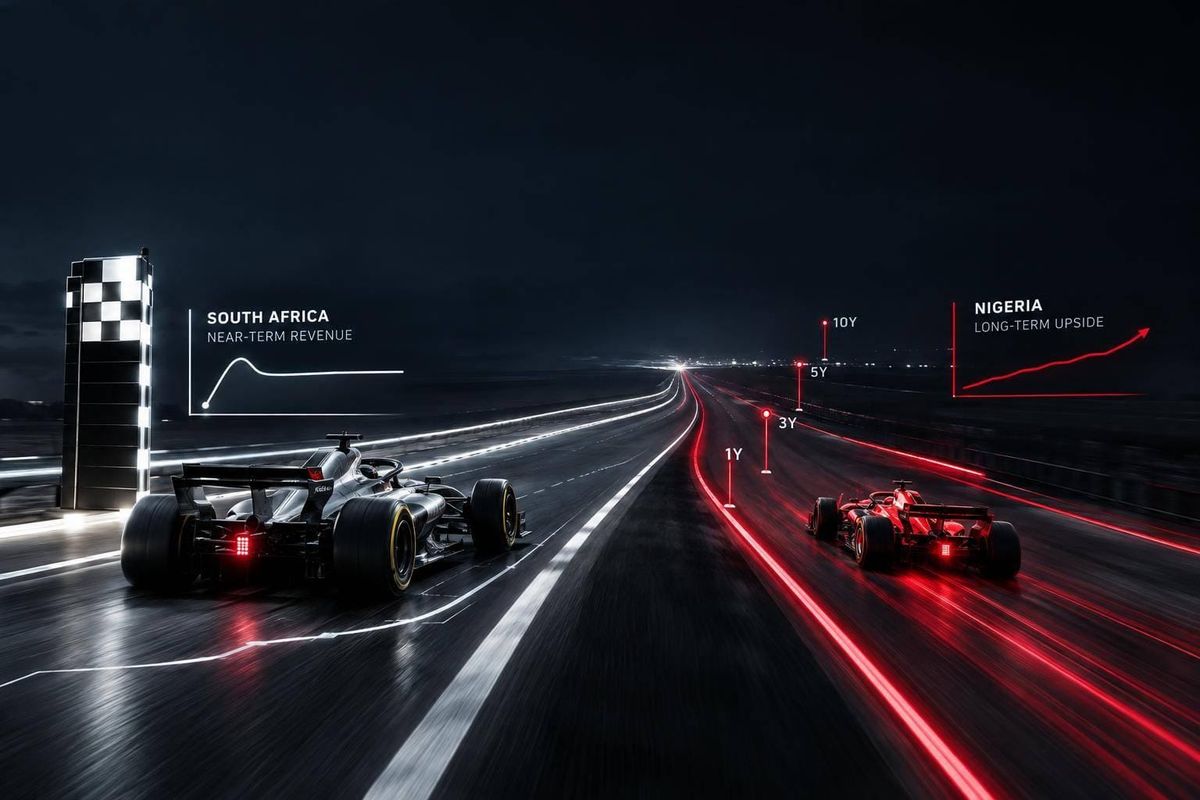
I see South Africa as the stronger near-term F1 revenue market, while Nigeria has more room for long-term audience growth - not a proven larger audience. My starting point is affordability: the article’s 2024–2025 figures put DStv Premium at about 19% of South Africa’s monthly minimum wage versus more than 50% of Nigeria’s.
I compare access, cost, fan habits, mobile viewing, and revenue - not population alone. For either market, I’d track repeat race viewing and paid subscriptions before treating online interest as audience growth.
Quick Comparison
| Factor | South Africa | Nigeria |
|---|---|---|
| Live access cited | DStv/SuperSport and F1 TV Pro | DStv/SuperSport; F1 TV Access has no live race video |
| Viewing habits | Established pay-TV and motorsport base | Digital discovery and shared screenings |
| Streaming barriers | Subscription costs and power interruptions | Data costs, payment hurdles, and connection issues |
| Revenue paths | Sponsorship, hospitality, and a possible race return | Sponsor-backed screenings and paid subscriptions |
| What to measure | Retention and spending per subscriber | Repeat attendance and paid conversion |
<u>Neither market can be ranked by audience size without comparable viewing data.</u> I also treat the quoted prices as historical figures, not confirmed October 2026 rates, and a Kyalami race return as a possibility - not a scheduled event.
F1 Viewing Access and Costs
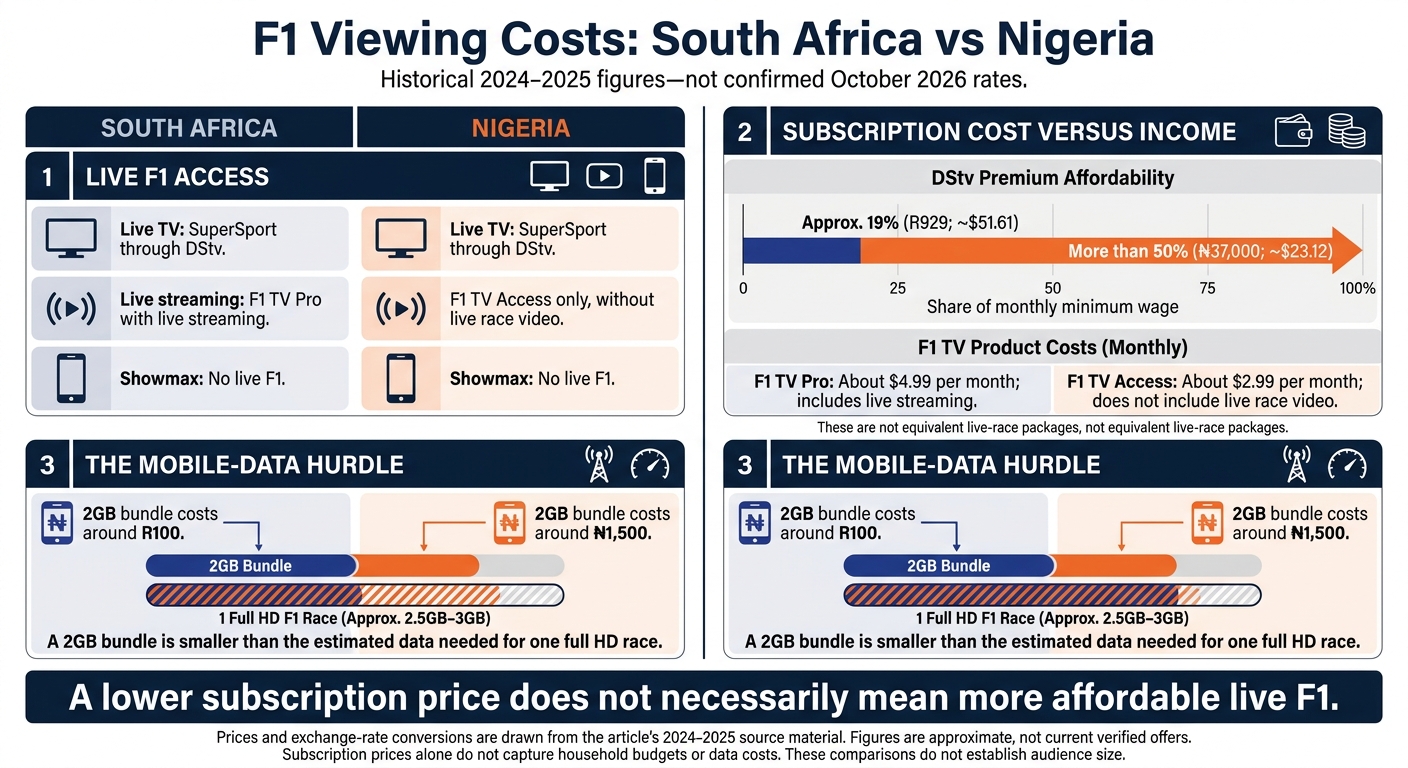
F1 Viewing Costs: South Africa vs Nigeria
SuperSport through DStv carries live F1 in both markets. Streaming options, however, differ sharply.
Live TV and Streaming Access
| Access point | South Africa | Nigeria |
|---|---|---|
| Live TV | SuperSport through DStv | SuperSport through DStv |
| Live streaming | F1 TV Pro with live streaming | F1 TV Access only, without live race video |
| Showmax | No live F1 | No live F1 |
South Africa’s higher fiber broadband penetration makes home streaming more practical. Nigeria’s market relies more on mobile data, with payment hurdles and international-card restrictions adding to the difficulty.
Viewing Costs Compared With Income
Getting access is one hurdle. Paying for it is another.
Using the source material’s 2024–2025 exchange rates, DStv Premium costs about R929 ($51.61) in South Africa and ₦37,000 ($23.12) in Nigeria. According to the same material, that works out to roughly 19% of South Africa’s monthly minimum wage and more than 50% of Nigeria’s.
F1 TV Pro costs about $4.99 per month in South Africa. Nigeria’s F1 TV Access costs about $2.99 per month, but it does not include live race video.
Mobile data adds another bill. A 2GB bundle costs around R100 in South Africa and ₦1,500 in Nigeria, while streaming one full F1 race in HD uses about 2.5GB to 3GB.
GDP per capita tells only part of the affordability story: it misses household spending power and per-GB data costs. South Africa’s challenge is keeping viewers watching regularly. Nigeria’s is turning low-cost entry into repeat full-race viewing. These price gaps help determine whether fans watch every race or follow the sport in fragments.
sbb-itb-7c68254
Fan Loyalty and Mobile Viewing
Access tells us who can tune in. Loyalty tells us who comes back. Audience depth means repeat viewers - not racing history or population size. The table separates verified behavior from growth potential, but comparable retention figures are not provided.
| Viewing signal | South Africa | Nigeria |
|---|---|---|
| Motorsport history | Kyalami hosted 21 Formula 1 World Championship races between 1967 and 1993. That history supports awareness, but it is not a current audience count. | Interest is more media-led. Population size does not establish F1 reach. |
| Repeat viewing | Established pay-TV habits. | Greater reliance on shared, event-based viewing. |
| Community activity | Car clubs and track-day groups offer an existing motorsport network. | WhatsApp groups and viewing parties offer ways into fan communities, not proof of national reach. |
These differences shape how each market turns interest into regular viewing.
South Africa: Racing History and Repeat Viewing
The test is retention, not just access. Kyalami gives South Africa a racing heritage, but returning households and minutes watched must show whether fans keep tuning in.
Nigeria: New Fans and Shared Viewing
Nigeria’s path starts with discovery, followed by a viewing routine. Drive to Survive, creators, and behind-the-scenes stories can introduce fans to F1 and lead them toward shared viewing. That can help more people watch, but one subscription still counts as one account.
Mobile Viewing: Clips Versus Full Races
Connections, users, and coverage measure different things. The estimates below use different denominators, so they cannot support a like-for-like ranking of penetration.
| Measure | South Africa | Nigeria | What it means for viewing |
|---|---|---|---|
| Smartphone access | Estimates often refer to connections or adults. | Estimates often refer to distinct users or the population. | Neither measure establishes a direct audience ceiling. |
| Broadband availability | Stronger urban fixed-broadband access is described. | Access depends more on mobile connections. | Coverage alone does not show who streams. |
| Data affordability | Data spending can limit mobile viewing. | Lower household budgets can limit sustained streaming. | Compare data costs with income, not price alone. |
| Reliability | Power interruptions can disrupt viewing, especially during load shedding. | Congestion and downtime can interrupt sessions. | Disconnections can shorten viewing without showing a loss of interest. |
Short clips help fans discover F1. Live text and timing let them follow races with less data, while full-race streams need a sustained connection and a larger data budget. Track clip views and full-race streams separately: watching a clip is not watching a race, and an interrupted stream does not mean a fan has lost interest.
Audience Growth and Revenue Limits
Access matters only if it leads to revenue. South Africa offers a stronger near-term market for premium revenue, while Nigeria offers longer-term audience growth. Paid-viewer and sponsorship data are not public, so this comparison looks at growth signals rather than totals.
| Factor | South Africa | Nigeria |
|---|---|---|
| Growth opportunity | A possible Kyalami race return and premium hospitality | Community screenings and paid conversion from mobile audiences |
| Access barrier | Premium subscription costs relative to household income | Data costs and a lack of localized, free-to-air F1 coverage |
| Revenue channels | Automotive and banking sponsorships; tourism and hospitality packages | Telecom, fintech, and beverage partnerships |
| Tracking signals | Average revenue per subscriber and event revenue | Repeat viewing, screening attendance, and paid conversion |
South Africa’s revenue potential centers on premium events. Nigeria has more room for audience growth, but turning that audience into paying customers will take longer.
South Africa: A Possible Race Return and Sponsorship
A Kyalami return remains hypothetical. If it returns as a Grade 1 venue, revenue would come from hospitality, tourism, media, and grassroots motorsport - but only after official confirmation.
Nigeria: Lower-Cost Access and Fan Communities
Before increasing spending, test local race explainers, creator partnerships, and flexible payments to see what turns mobile viewers into paying customers.
Public viewing centers can test demand across multiple races by tracking attendance, repeat visits, and paid conversions. Tie sponsor funding to repeat participation and event costs that can be covered over time - not social engagement alone. Audience growth needs to show up in viewer behavior, not just headlines.
How to Track Audience Growth
Viewing framework: Use the same definitions in both countries.
- Verified reach = distinct viewers across broadcast and authorized streaming
- Live-session completion = live race minutes watched ÷ race duration
- Repeat viewing = distinct races watched per viewer
- Mobile watch time = minutes watched on mobile
- Full-season retention = share of an opening-period viewer cohort still watching in a specified closing period
Commercial framework:
- Paid conversion = attributable new paying accounts ÷ eligible tracked audience over a fixed period
- Event attendance = checked-in guests, with repeat visitors reported separately
- Sponsorship revenue = money received, with in-kind support reported separately
Unless publicly disclosed, these metrics require records from broadcasters, platforms, or commercial partners.
Conclusion: What Each F1 Market Needs to Grow
South Africa has the stronger near-term revenue case; Nigeria has more room for long-term growth. The difference isn't interest alone. It's how easily that interest becomes repeat viewing. Neither market can be ranked definitively without comparable subscriber, retention, and conversion data.
South Africa needs affordable, reliable viewing options beyond its established subscription base to keep viewers coming back. Nigeria needs lower-cost mobile access to turn digital discovery into a habit of watching full races.
History doesn't remove price barriers. And population size alone doesn't prove audience leadership without retention data.
FAQs
How can shared screenings reveal actual F1 audience size?
Shared screenings help account for fans who watch one feed together at home or in public venues. Individual streaming logins and TV tuning data may miss these viewers.
Activity on social platforms, fantasy leagues, and second-screen apps can point to group viewing. By combining these signals with local event participation, analysts can get a more accurate estimate of total audience reach.
Could cheaper mobile access make Nigeria a stronger F1 market?
Lower mobile access costs could help F1 grow in Nigeria by making streaming, live timing, and real-time telemetry easier to access. These features help draw younger fans into the sport, but they depend on reliable, high-speed connections.
Affordable, consistent access could let more Nigerians follow the technical details and race-day drama, building a closer connection to F1 - as mobile engagement has done in other growing markets.
Would a South African Grand Prix attract lasting viewers?
A South African Grand Prix would likely build a lasting audience with data-driven broadcasts that make the sport’s technical details easy to follow. Research suggests that real-time telemetry and live timing help viewers understand race strategy, tire management, and team dynamics - turning casual interest into long-term fandom.
Pairing that depth with dramatic storytelling helps keep a varied audience watching, including Gen Z and female fans.