Why F1 Active Suspension Took 10 Years
Active suspension only became a championship tool after hydraulics, sensors, software, setup, funding and team experience all aligned.
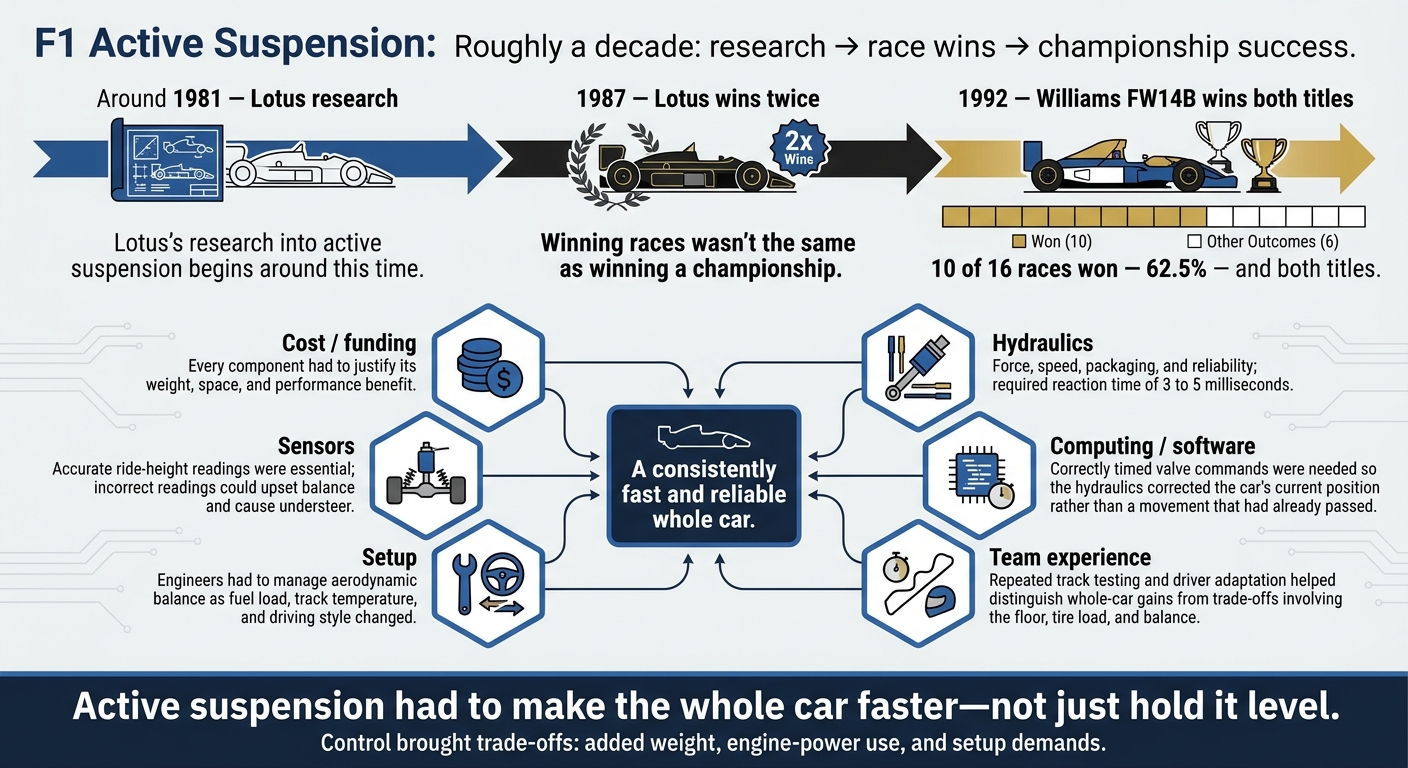
I’d sum up F1’s decade-long wait this way: active suspension had to make the whole car faster - not just hold it level. From Lotus’s research around 1981 to Williams’s titles in 1992, teams had to solve six linked problems: cost, hydraulics, sensors, computing, setup, and team experience.
Ground effect made ride height matter more, but controlling it added weight, used engine power, and required accurate readings and well-timed software commands. Drivers and engineers also needed track time to get the balance right.
The key distinction? <u>Winning races wasn’t the same as winning a championship.</u> Lotus won twice with active suspension in 1987. Williams’s FW14B won 10 of 16 races in 1992 - 62.5% - and both titles. That’s why I see this as a story of making the parts work together, not waiting ten years for the first win.
F1 Active Suspension: From Research to 1992 Titles
1987 F1 Brazilian GP - Peter Wright explain Lotus 99T active suspension
sbb-itb-7c68254
Why Hydraulics Were Costly and Hard to Keep Reliable
Once teams proved the concept worked, they faced the next challenge: fitting hydraulics into a race car that could use them.
Hydraulic Components and Failure Risks
Active suspension needed both force and speed. To control ride height effectively, it had to react in just 3 to 5 milliseconds. The hardware also had to fit around the driver, fuel, and powertrain. Solving both the control and packaging problems delayed the move to a race-ready system.
The Cost of Integrating Active Suspension
Integration was expensive because every part had to earn its place in terms of weight, space, and performance gains.
Getting the hardware into the car was only the first hurdle. The system still needed accurate sensors and control logic to work on track.
Why Sensors, Computers, and Software Needed Years of Work
How Measurement Errors and Delays Affected Handling
Once the hydraulics fit the car, engineers had to tell them exactly what the car was doing. The control system needed to measure ride height accurately and react fast. In a high-downforce car, even a small delay or an incorrect reading could upset the balance and cause understeer.
How Electronic Control Improved Hydraulic Response
Hardware alone wasn’t enough. The control loop had to act at the right time. If valve commands arrived late, the hydraulics could respond to a movement that had already passed instead of correcting the car’s current position.
Getting that timing right took years of software work. Engineers could review telemetry between sessions, but the software still had to turn accurate readings into correctly timed commands, keeping the car predictable lap after lap. That bottleneck led teams into repeated setup work and track testing.
How Teams Learned to Make Active Suspension Work
Why Active Suspension Added Setup Work
Active suspension changed setup work - it didn’t remove it. Engineers still had to keep aerodynamic balance stable as fuel load, track temperature, and driving style changed. More downforce made that balance more sensitive: even a small shift could cause understeer.
Drivers also had to adjust to a different feel under braking and at turn-in. The hydraulics needed to work with their instinctive inputs, not against them. Along with cost, control, and reliability, setup remained as important as the hardware.
Why Williams Needed More Testing Before 1992
Williams had to establish which ride-height changes made the car faster overall. A change that helped the floor could also affect tire load and balance. Repeated testing helped the team separate gains from trade-offs.
Better hardware was only part of the job. Track testing showed whether the whole package was faster. Williams built its advantage by working through those trade-offs and producing a race package that delivered consistent results.
What the FW14B Achieved in 1992
The FW14B brought its hydraulics, electronics, setup, and aerodynamics into alignment. That made it effective across a full race weekend, not just during isolated tests.
Conclusion: Solving 6 Barriers Together
By 1992, the challenge was no longer invention. It was getting everything to work together. Active suspension needed six fixes at once: funding, computing, sensors, hydraulics, setup, and team experience. All six had to come together to make the car consistently fast and reliable. That’s why active suspension took a decade to become a championship tool.
FAQs
How did teams balance active suspension’s gains against its weight and power demands?
Teams had to weigh active suspension’s aerodynamic gains against its added weight, power demands, and complex hydraulic controls. Precise ride-height control helped maintain ground-effect performance, but engineers still had to account for the car’s center of gravity and aerodynamic balance.
As sensor data and computing models became more accurate, teams could simulate these trade-offs before committing to hardware.
Why couldn’t faster computers alone solve active suspension’s problems?
Faster computers couldn’t replace accurate sensors or reliable hydraulic systems. Active suspension needed both to adjust quickly and maintain precise ride height, which was key to ground-effect performance.
Simulations also couldn’t fully reproduce how aerodynamics behaved on the track. Teams still had to check their models against wind tunnel tests and on-track telemetry. Computing power alone couldn’t close that gap.
How did drivers adapt to active suspension’s unfamiliar feel?
Drivers learned to trust active suspension to keep the car stable, even when it felt unfamiliar and robotic. The system automatically controlled ride height, pitch, and roll to optimize downforce, but that also removed the familiar feedback drivers relied on to judge the car’s limits. As they grew more confident in its precision, they changed their driving styles to take advantage of the added stability and grip.