Hamilton vs. Verstappen: Public Reactions to 2021 Clashes
Fan, team and media reactions to the 2021 Hamilton–Verstappen clashes, covering Silverstone, Monza, Jeddah and the Abu Dhabi finale.
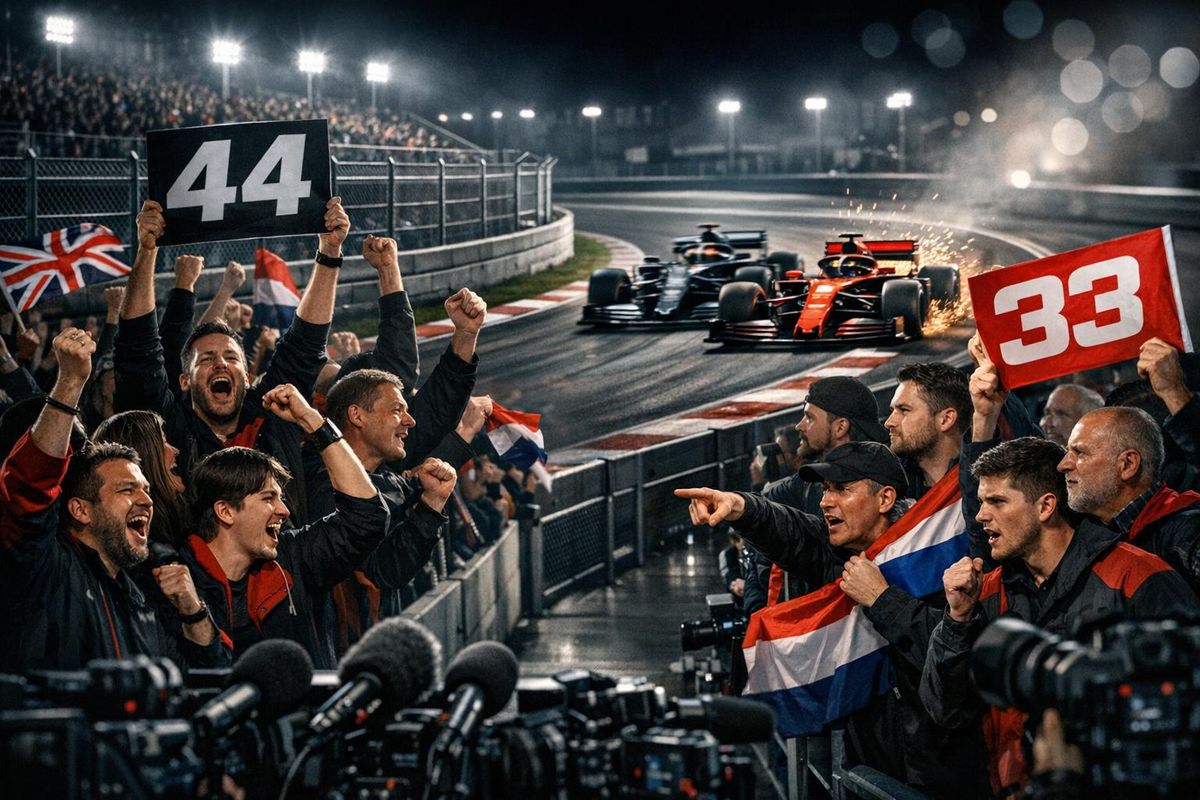
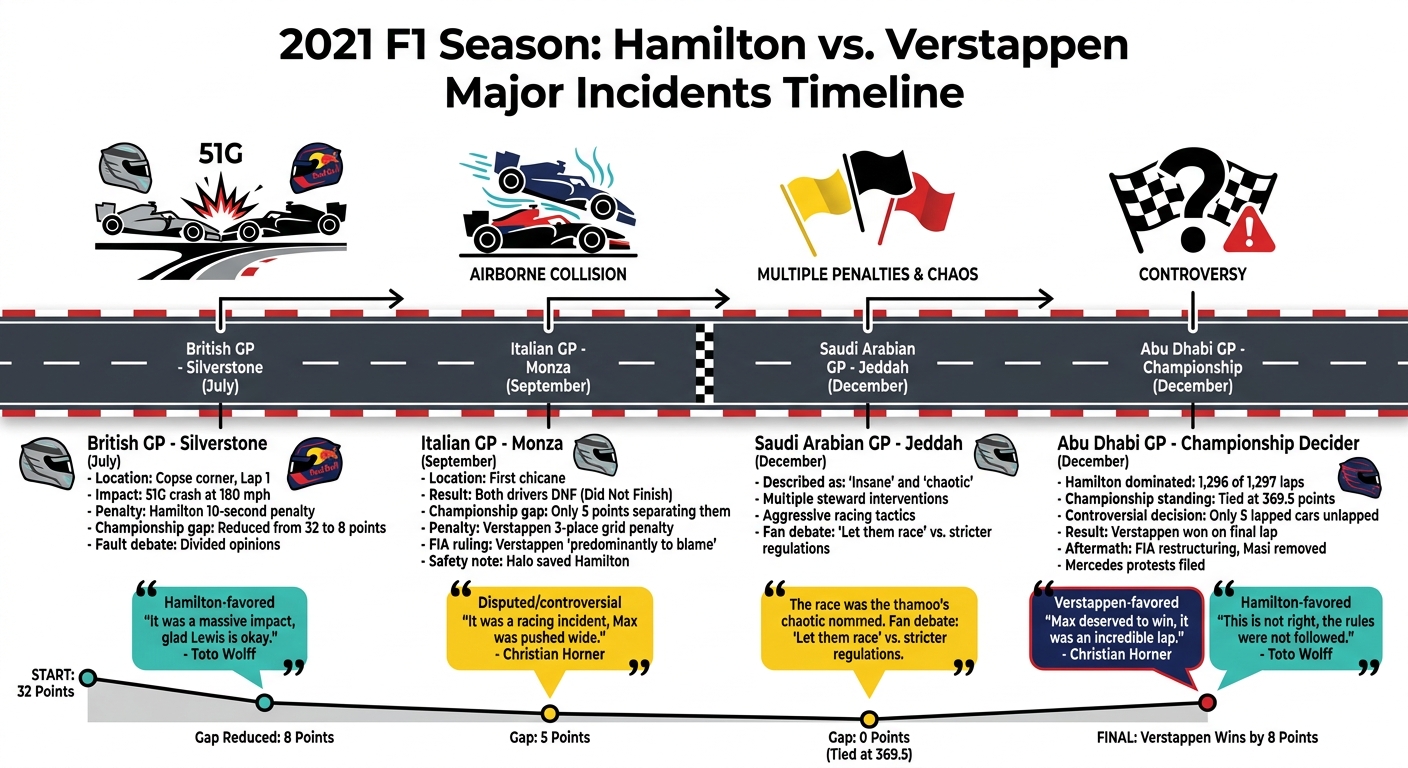
The 2021 Formula 1 season was one of the most dramatic in the sport's history, defined by the fierce rivalry between Lewis Hamilton and Max Verstappen. Key moments like the Silverstone crash, Monza collision, and the controversial Abu Dhabi finale sparked intense debates among fans, teams, and media. Here's a quick summary of the season's flashpoints:
- Silverstone Crash (British GP): Hamilton and Verstappen collided at high speed, leading to Verstappen's 51G impact. Fans were divided on fault, with Red Bull calling Hamilton's move risky and Mercedes defending it as within the rules.
- Monza Collision (Italian GP): Verstappen's car landed on Hamilton's after contact, with the FIA blaming Verstappen and issuing a penalty. The incident highlighted the growing tension between the two.
- Jeddah Drama (Saudi GP): Aggressive racing and multiple penalties dominated this chaotic race, polarizing fans over racing tactics and steward decisions.
- Abu Dhabi Finale: A controversial call by Race Director Michael Masi allowed Verstappen to pass Hamilton on the final lap, securing his first title. The decision led to protests, fan outrage, and changes in F1 governance.
The season's twists and turns didn't just decide a championship - they sparked ongoing debates about racing rules, driver conduct, and the role of entertainment in F1.
2021 F1 Season Hamilton vs Verstappen Key Incidents Timeline
The Final Lap that BROKE F1 | 2021 Abu Dhabi
sbb-itb-7c68254
British Grand Prix: The Silverstone Crash
The British Grand Prix at Silverstone saw its first dramatic moment on Lap 1 at Copse, one of the circuit’s most challenging corners. Hamilton made a move to overtake on the inside after feinting to the right, while Verstappen held his line on the outside. The result was a collision: Hamilton's front-left wheel struck Verstappen's right-rear wheel, sending Verstappen into the tire barriers at a staggering 180 mph. The impact registered at 51G, an alarming force that required Verstappen to be taken to a local hospital for precautionary checks. Despite receiving a 10-second penalty for the incident, Hamilton went on to secure his eighth British Grand Prix win. The crash not only tightened the championship points gap but also escalated tensions in what had already become a fiercely competitive rivalry.
Social Media Reactions
The crash sparked heated debates online, with fans and analysts split over who was at fault. Central to the discussion was whether Hamilton had gotten far enough alongside Verstappen and if he had misjudged the corner apex. For some, it was a racing move that went wrong, while others criticized Hamilton's approach as overly aggressive. The incident fueled what many described as a season-long atmosphere of animosity and heightened drama between the two camps.
Team and Driver Statements
The fallout extended to the teams, with Red Bull and Mercedes offering sharply differing viewpoints. Red Bull’s Christian Horner did not hold back, saying:
"Putting a wheel up the inside at Copse, one of the fastest corners in this World Championship, was ill-judged and a huge risk by Lewis to both drivers."
Horner further argued that Hamilton was "not significantly alongside Max", pointing to track positioning as evidence.
On the other hand, Mercedes’ Toto Wolff defended Hamilton with a more technical perspective:
"These things are nasty to look at, but there is a clear regulation and that is something that is black and white on paper… that if the front axle is over the middle of the car on the outside, it's your corner."
Hamilton remained unapologetic, emphasizing his commitment to aggressive racing and refusing to back down from wheel-to-wheel battles.
Media Coverage Comparison
Media analysts provided a more balanced perspective on the incident. Karun Chandhok from Sky Sports F1 remarked:
"I think Lewis expected Max to back out of it, and Max expected Lewis to back out of it... I would put it down as a racing incident."
Jolyon Palmer, a former F1 driver, added that while Hamilton missed the apex slightly, Verstappen also took a considerable risk by continuing to turn in at such a high-speed corner. Current driver Charles Leclerc weighed in, agreeing:
"I think it's a racing incident, it's very difficult to put the blame on one or the other."
The crash had immediate championship implications, reducing Verstappen’s lead from 32 points to just 8 points. Its effects lingered beyond Silverstone, influencing subsequent races. Verstappen later revealed that the crash left him with persistent blurred vision, likening the experience to "driving a speedboat at 300 kph" on bumpy circuits.
Italian Grand Prix: The Monza Collision
The rivalry between Hamilton and Verstappen hit a dramatic turning point at Monza's first chicane. As Hamilton exited the pits, Verstappen closed in, attempting an outside pass to gain the inside line at Turn 1. However, Hamilton edged Verstappen toward the track's boundary, leading Verstappen's Red Bull to hit a raised "sausage kerb." The impact launched Verstappen's car onto Hamilton's Mercedes, taking both drivers out of the race. At the time, only 5 points separated them in the championship standings.
Hamilton later credited the halo cockpit protection system for preventing a severe injury, remarking that it "saved my neck". Following the incident, the FIA stewards deemed Verstappen "predominantly to blame" and issued him a three-place grid penalty for the next race in Sochi. With the championship at stake, every point counted, and this collision added another layer of tension to their already fiery rivalry. The crash not only fueled the season’s intensity but also drew strong reactions from fans and media alike.
Fan Perspectives on Blame
The Monza collision divided fans. Supporters of Hamilton argued that Verstappen's aggressive move left him poorly positioned, leading to an unavoidable crash. Former F1 driver and analyst Jolyon Palmer weighed in, suggesting that Verstappen’s decision reflected the high-stakes nature of battling his direct title rival:
"I believe that against anybody else in that Grand Prix, Max would have been more cautious... It was the do or die nature of the moment, with everything at stake that meant he kept his foot in and attempted an audacious move."
On the other hand, Verstappen’s fans pointed fingers at Hamilton, accusing him of narrowing the space in the braking zone and leaving Verstappen with no realistic options. Palmer also highlighted the shared misjudgment by both drivers: "Lewis expected Max to back out rather than risk the collision, and Max expected Lewis to give him more space. In reality, given everything at stake, both of those expectations in the heat of the moment turned out to be naïve."
Media Headlines and Reporting
The incident quickly became a lightning rod for media coverage. Headlines described the Monza crash as the point where the season-long rivalry "boiled over". Many outlets framed the clash as a "battle of styles", contrasting Hamilton's calculated approach with Verstappen's aggressive pursuit of every opportunity. Formula 1 writer Edd Straw captured the moment’s gravity:
"The collisions at the first chicane during the Italian Grand Prix were when the rivalry boiled over."
The media also likened the collision to the legendary Prost-Senna battles, underscoring the growing tension between Mercedes and Red Bull. Team principals Toto Wolff and Christian Horner offered starkly different takes - Wolff labeled it a "tactical foul", while Horner dismissed it as a "racing incident". This clash only deepened the narrative of a "generational battle" between Hamilton, the seasoned champion, and Verstappen, the ambitious challenger, further captivating fans and raising the stakes for the championship.
Saudi Arabian Grand Prix: The Jeddah Battles
The 2021 Saudi Arabian Grand Prix in Jeddah was a pivotal moment in the championship, marked by intense on-track drama and controversy. With tensions between Hamilton and Verstappen reaching a boiling point, race stewards were frequently called upon to mediate incidents, adding to the already heated atmosphere. This race not only fueled the rivalry but also sparked polarized reactions from fans and the media.
Public Response to Racing Tactics
Reactions to the dramatic events in Jeddah were sharply divided. Supporters of Red Bull embraced a "let them race" mindset, arguing against what they viewed as excessive interference from the stewards. On the other hand, Hamilton’s fans advocated for stricter and clearer regulations, emphasizing the importance of safety on the track. Hamilton himself echoed this sentiment, warning that unchecked aggression could lead to dangerous collisions.
Social Media Sentiment Data
The fierce rivalry between Hamilton and Verstappen spilled over onto social media, where fans and commentators described the race with words like "insane" and "chaotic." These descriptors captured the extraordinary intensity of their competition throughout the season. Fans passionately debated the balance between aggressive racing and the need for tighter regulatory control, each side staunchly defending their favorite driver. The season-long drama made the rivalry one of the most talked-about in recent Formula 1 history.
Abu Dhabi Grand Prix: The Championship Decider
The 2021 Abu Dhabi Grand Prix will forever be remembered for its dramatic and contentious ending. After dominating 1,296 of the season's 1,297 laps, Lewis Hamilton appeared poised to secure his record-breaking eighth championship. However, a decision by Race Director Michael Masi changed everything. Instead of following the usual protocol of allowing all lapped cars to unlap themselves, only the five cars between Hamilton and Max Verstappen were permitted to do so. This gave Verstappen a clear shot at Hamilton on the final lap, enabling him to overtake and clinch his first championship title. This deviation from standard procedure immediately divided the Formula 1 community.
Divided Fan Reactions
The fan base erupted in debate. Supporters of Hamilton criticized the decision, citing a clear breach of Article 48.12, which states the safety car should remain on track until the lap after all lapped cars have unlapped themselves. George Russell summed up the frustration of many Hamilton fans when he said:
"Max is a worthy champion... but this is unacceptable. I cannot believe what we've just seen".
On the other hand, Verstappen's fans stood by the Race Director’s actions, arguing that the "let them race" philosophy was in the spirit of the sport and preferable to ending the championship under a safety car. The stakes couldn’t have been higher, with both drivers entering the final round tied at 369.5 points - a scenario not seen since 1974.
Team Protests and FIA Response
In the immediate aftermath, Mercedes filed two formal protests, alleging breaches of the sporting regulations. Team Principal Toto Wolff voiced his frustration during the race in a now-iconic radio exchange:
"No Michael! No Michael, no! That was so not right!".
Hamilton himself expressed his disbelief, stating:
"This is getting manipulated, man!".
Red Bull's Christian Horner defended the decision, saying:
"The Race Director in difficult circumstances made absolutely the right call and strategically we got it right".
The stewards dismissed Mercedes' protests but gave the team 96 hours to decide whether to pursue an official appeal. These protests highlighted growing concerns about F1’s governance and the consistency of race control decisions.
Long-Term Impact on Perceptions
The controversy surrounding the Abu Dhabi finale left a lasting mark on Formula 1. The FIA later admitted that the incident had damaged the sport's reputation, acknowledging widespread confusion over safety car rules among fans, teams, and drivers. Public trust in race control took a significant hit, prompting a major restructuring within the FIA. This included the removal of Michael Masi as Race Director.
The race also reignited debates about whether F1 prioritizes entertainment over fairness. Critics argued the finish felt "engineered" to heighten drama, particularly for television audiences and Netflix’s Drive to Survive series. These events reshaped discussions around regulatory consistency and transparency, with the fallout continuing to influence the sport in the years that followed.
Public Opinion Trends Across the 2021 Season
Changes in Fan Support
The 2021 F1 season was a rollercoaster that divided fans like never before. With the championship lead flipping five times over a packed 22-race calendar, emotions ran high. To make things even more dramatic, Hamilton and Verstappen finished in the top two spots 14 times. Fan loyalties shifted after pivotal moments: Hamilton's penalty at Silverstone, Verstappen's crash at Monza, and another penalty in Saudi Arabia all showcased their contrasting styles. Hamilton's calculated approach stood in stark contrast to Verstappen's aggressive, high-stakes tactics.
Then came Abu Dhabi - the race that left the F1 world buzzing. Verstappen's victory sparked heated debates. Some fans praised his bold strategy, while others, including Hamilton himself, questioned the fairness of the officiating. The FIA later acknowledged that the controversy stemmed from a "significant misunderstanding" of the rules, which they admitted hurt the sport’s reputation. These events didn't just shape the season; they redefined how fans viewed the drivers and the sport itself.
Effects on the Rivalry and F1's Audience
The rivalry between Hamilton and Verstappen reached a boiling point, fueling intense emotions among fans and reshaping the sport's narrative. This high-stakes drama brought Formula 1 into the spotlight, drawing comparisons to iconic rivalries like Prost vs. Senna. It wasn’t just long-time fans who were hooked - Netflix’s Drive to Survive capitalized on the drama, attracting millions of new viewers and expanding F1’s global reach.
But the fallout wasn’t all positive. Discontent over controversial decisions led to whispers about Hamilton’s potential retirement and forced the FIA to take action. The governing body overhauled race control, removing Michael Masi as Race Director and revamping communication protocols. These changes underscored how fan pressure and a loss of trust pushed F1 to focus on consistency and fairness, even if it meant rethinking how races were managed.
Conclusion
From dramatic collisions to heated FIA decisions, the 2021 Formula 1 season reshaped rivalries in unforgettable ways. Decided in the most dramatic fashion - on the final lap - the Hamilton–Verstappen duel sparked debates that still echo today. Team principals added fuel to the fire, with Red Bull’s Christian Horner criticizing Hamilton’s actions as “ill-judged,” while Mercedes’ Toto Wolff defended them as “racing each other hard”. This wasn’t just a battle between two drivers; it became a clash of ideologies that divided the F1 community.
Throughout the season, shifting power dynamics in the sport were on full display. Heated exchanges and regulatory controversies - like Hamilton’s frustrated radio messages and team protests - highlighted how communication played a pivotal role. Fans, too, became deeply involved, dissecting Safety Car rules and debating racing room regulations as they analyzed every overtaking move and incident on track.
The season also brought to light enduring questions about racing etiquette. Former F1 driver Jolyon Palmer summed it up perfectly:
"Lewis expected Max to back out rather than risk the collision, and Max expected Lewis to give him more space. In reality... both of those expectations in the heat of the moment turned out to be naïve".
This mutual unwillingness to back down has become a hallmark of modern Formula 1 rivalries.
The 2021 season stands as a benchmark for controversy and debate over racing standards. It was a vivid reminder that Formula 1’s most gripping narratives often emerge not from dominance, but from intense conflict - and that the opinions of fans can be just as divided as the stewards’ rulings that sparked these debates.
FAQs
What rules determine who “owns” a corner in F1?
In Formula 1, determining who "owns" a corner comes down to a mix of driver positioning, skillful racecraft, and respect for racing etiquette. According to the FIA's sporting code, the driver on the racing line typically has priority. However, overtaking and positioning must always be executed safely and within the rules. Drivers need to strike the right balance between being assertive and cautious to steer clear of penalties or collisions.
Why was Abu Dhabi 2021 considered a Safety Car rules controversy?
The Abu Dhabi 2021 controversy centered on decisions involving the Safety Car during the final laps of the race. The handling of lapped cars became a major point of contention, as only certain cars were permitted to un-lap themselves. Critics claimed this, combined with the timing of the restart, created an advantage for Max Verstappen, potentially altering the championship's outcome. This incident triggered heated debates about whether the rules were followed correctly or deliberately adjusted, marking it as one of Formula 1's most debated moments.
What FIA changes came after the 2021 finale?
After the 2021 season, the FIA rolled out some important rule changes. One key update focused on safety car restarts: drivers must now stay in a single file and avoid overlapping until the race officially resumes.
Looking ahead, car design regulations underwent a major overhaul starting in 2022. These changes included adjustments like improved underbody aerodynamics and simplified front wing designs. And this isn't the end - more updates are already scheduled for 2026.