How F1 Teams Prioritize Real-Time Data
Explains how F1 teams use AI, edge computing, and telemetry to filter 1.1M data points/sec for pit strategy, safety, and performance.
Formula 1 teams rely on real-time data to make split-second decisions that can impact race outcomes. With over 300 sensors per car, generating 1.1 million data points per second, this data helps monitor engine performance, tire wear, aerodynamics, and even driver biometrics. Teams use advanced systems like AI tools, machine learning, and cloud computing to process and analyze this massive data stream during races, enabling strategies like optimal pit stop timing, energy deployment, and safety monitoring.
Key Takeaways:
- Telemetry Systems: Cars transmit data at speeds over 10 MB/s to pit crews and headquarters.
- AI in Action: Machine learning filters critical data for immediate decisions, while simulations predict race scenarios.
- Safety & Strategy: Real-time insights prevent mechanical failures and optimize race strategies.
- Massive Data: Teams process up to 1.5 TB of data per race.
Real-time analytics is the backbone of modern F1, giving teams the tools to stay ahead in a sport where every millisecond counts.
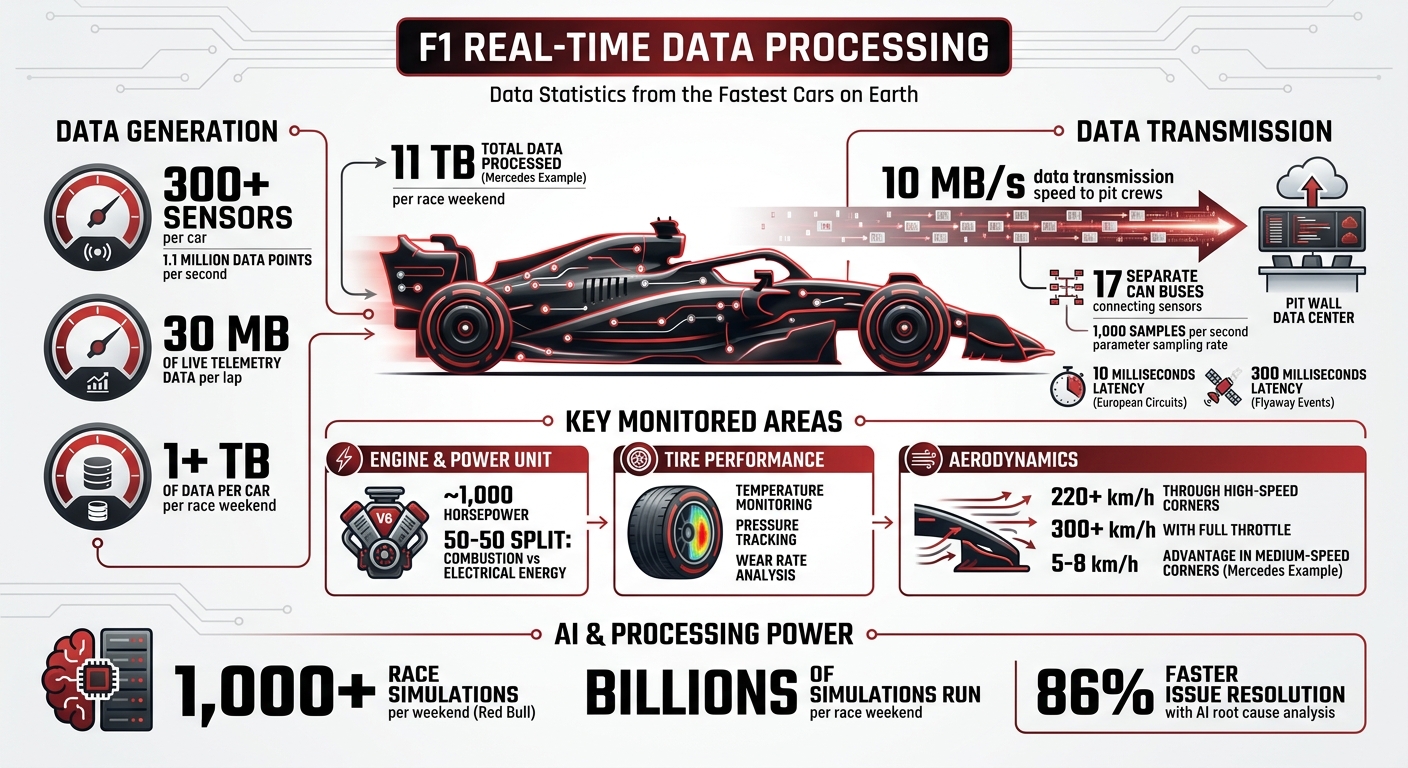
F1 Real-Time Data Processing: Key Statistics and Metrics
Building a Real-Time F1 Telemetry Dashboard with Pinot and Flink on AWS | Let's Talk About Data
sbb-itb-7c68254
Key Telemetry Data Points Teams Monitor
Modern F1 cars generate a staggering amount of telemetry data, but teams focus on a few crucial metrics to make real-time decisions during races. These key areas include engine and power unit health, tire performance, and aerodynamic efficiency. Each provides critical insights that shape strategies both on the track and at the pit wall.
Engine and Power Unit Metrics
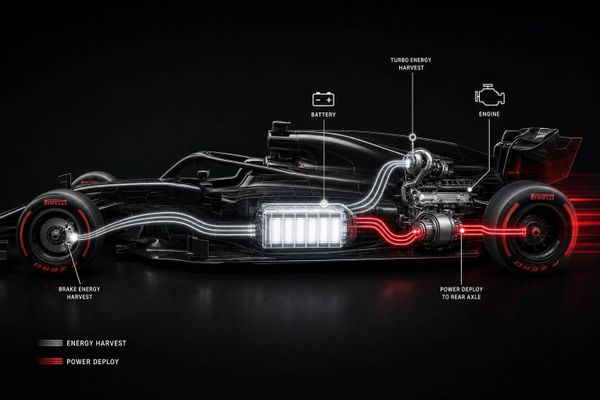
Engine telemetry monitors factors like RPM, fuel usage, and the performance of the Energy Recovery System (ERS). By 2026, power units deliver around 1,000 horsepower through a hybrid system with a 50–50 split between combustion and electrical energy. This setup requires teams to carefully manage energy deployment to avoid battery cut-offs during critical moments of the race.
"You don't know when your battery will cut on the straights."
Charles Leclerc of Scuderia Ferrari has highlighted how this data helps teams decide the best moments to deploy electrical power, whether for overtaking or defending track position.
Tire Performance and Degradation
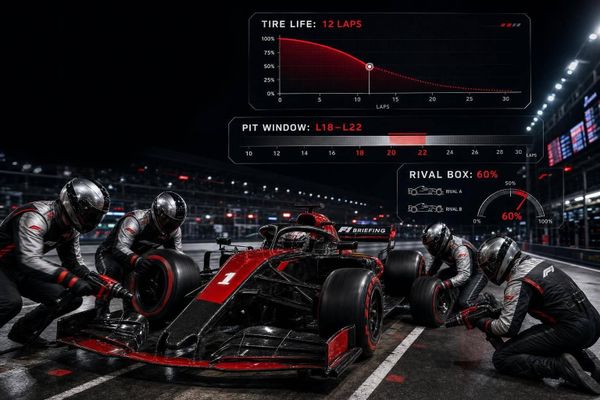
Tire telemetry focuses on surface and carcass temperatures (often monitored via thermal imaging), pressures, and wear rates. Engineers use this data to calculate "tire wear energy", which helps predict grip loss and determine the ideal timing for pit stops. For example, during the 2026 Japanese Grand Prix, Kimi Antonelli set a fastest lap of 1:32.432 on Hard compound tires that had already seen 27 laps of wear.
Telemetry also reveals how driving style impacts tire life. At the 2026 Australian Grand Prix, George Russell's win was partly attributed to his precise throttle control, with accelerator inputs ranging between 0% and 100%. This approach maximized tire longevity while maintaining competitive lap times.
Aerodynamics and Drag Adjustments
Aerodynamic telemetry measures variables like ride height, suspension settings, and the performance of movable elements such as DRS and the newly introduced 2026 "MovWing." These metrics are essential for balancing straight-line speed with cornering ability. At the 2026 Japanese Grand Prix, Antonelli's data showed he maintained speeds above 220 km/h (137 mph) through the high-speed Esses and took the 130R corner at over 300 km/h (186 mph) with full throttle application.
Comparative telemetry also highlights car-specific strengths. For instance, the Mercedes W17 maintains higher minimum speeds - about 5–8 km/h (3–5 mph) - in medium-speed corners, while Ferrari excels in acceleration out of slower corners.
How Teams Prioritize Data During Races
Every F1 car generates a staggering 1.1 million data points per second from over 300 sensors. For teams, the challenge lies in extracting the most critical insights during the intense moments of a race, where every decision counts. To tackle this, teams rely on a mix of advanced AI systems and human expertise, creating a dynamic partnership that drives their strategies.
Using AI and Machine Learning
Machine learning algorithms play a key role in filtering endless streams of telemetry data, ensuring engineers focus only on actionable insights. Tools like Track Pulse - developed through a partnership between F1 and AWS - analyze millions of data points to identify patterns, such as unexpected tire wear or opportunities for overtaking. This automated process helps teams avoid data overload during high-pressure scenarios.
For immediate decisions, edge computing is used to process critical data, such as brake temperatures or energy recovery system (ERS) adjustments, in real time. Less urgent information is sent to cloud systems for detailed analysis. Red Bull Racing, for instance, runs over 1,000 race simulations each weekend using cloud infrastructure, comparing live telemetry against predictive models to flag anomalies that require quick action.
A notable example occurred during the Hungarian Grand Prix in August 2023, when Aston Martin used AI simulations to predict tire degradation and identify gaps in traffic. This allowed them to execute an undercut strategy that gained six positions.
While AI handles the heavy lifting of data processing, it’s the human element that applies the strategic judgment needed to make race-winning decisions.
Collaborative Decision-Making at the Pit Wall
Once AI has filtered the raw data, human experts step in to refine and execute decisions. The pit wall becomes a hub of collaboration, where race engineers, strategists, and remote operations centers combine their expertise. This teamwork ensures that data insights are translated into effective actions. Engineers stationed remotely - sometimes thousands of miles away - focus on specific areas like power unit performance or aerodynamics, relaying only the most critical findings to the trackside team.
Both Red Bull Racing and Mercedes-AMG rely on Apache Kafka, an open-source event streaming platform, to manage this enormous data flow. Acting as a "central nervous system", this technology processes millions of data points almost instantly, enabling the pit wall to make rapid, informed decisions.
"The best F1 teams understand that the success of every race-day decision is predicated on the time it takes for data to journey from input to action." - Diginomica
Real-Time Data Processing and Storage Systems
F1 teams rely on advanced infrastructure to handle massive amounts of data in near-real time. Each car generates about 30 MB of live telemetry data per lap, transmitted via RF and microwave links. Over a single race weekend, the data output - covering telemetry, video, and simulation files - can exceed 1 TB per car. To put this into perspective, Mercedes reportedly processes 11 TB of data per race weekend, highlighting the need for systems capable of managing such high-throughput demands.
High-Performance Data Transmission Systems
Each F1 car is equipped with over 300 sensors, all connected through 17 separate Controller Area Network (CAN) buses. These feed into the Electronic Control Unit (ECU), which serves as the car’s central hub for data. The system samples parameters up to 1,000 times per second, producing an immense stream of telemetry data that is encrypted and transmitted to the pit wall using standardized telemetry protocols over radio frequency and microwave links.
Latency depends on the race location. At European circuits, it’s as low as 10 milliseconds, but for long-distance, flyaway events, it can reach 300 milliseconds due to the extended transmission distances. Once a car returns to the pits, teams offload additional high-resolution data - amounting to two to three times the volume of live telemetry - via a physical link, capturing details that couldn’t be transmitted in real time.
Cloud-Based Data Storage and Analysis
Cloud platforms play a critical role in managing and analyzing F1 data. Teams store decades of historical race data - some spanning over 70 years - in systems like Amazon S3 to provide essential context for real-time decision-making during races. In November 2024, Formula 1 collaborated with AWS to implement a root cause analysis solution using Amazon Bedrock, which cut the time needed to resolve race-day technical issues by 86%.
"The system not only monitors and resolves issues up to 86 percent faster, but it also predicts and prevents problems before they arise." – Amazon Web Services
This system uses large language models to automatically analyze logs, correlate incidents, and streamline problem-solving, allowing engineers to focus on improving performance. Data flows to remote Mission Control centers through high-speed fiber-optic or satellite links, ensuring that critical insights reach decision-makers without delay. This distributed network maintains consistency across cloud platforms, enabling seamless collaboration and rapid responses.
How Real-Time Data Affects Race Outcomes
Real-time telemetry plays a key role in shaping race results. Teams that can interpret signals from an incredible 1.1 million data points per second often secure podium finishes by making faster, smarter decisions than their competitors.
Case Studies: Mercedes and Red Bull Strategies
The impact of real-time data is clear in strategies used by top teams like Mercedes and Red Bull. For example, during the British Grand Prix in July 2019, Lewis Hamilton of Mercedes-AMG Petronas claimed victory by making a perfectly timed pit stop during a safety car period. This decision, based on live telemetry and analysis of tire wear and competitor positions, allowed the team to seize an opportunity that others missed. The success came from combining live data with predictive simulations, giving Mercedes a tactical edge.
Red Bull Racing has taken data-driven strategy to another level. Using cloud infrastructure, the team runs billions of simulations per race weekend, evaluating dozens of scenarios simultaneously. These simulations, powered by reinforcement learning, have improved their average race placement from 5.63 to 5.33 in realistic models. It's a clear example of how machine learning can directly enhance performance on the track.
Interestingly, Mercedes and Red Bull approach technology differently. Red Bull relies on Oracle Cloud for large-scale simulations, while Mercedes uses deep learning and XGBoost models to precisely predict tire energy and degradation. These contrasting methods highlight how different philosophies can still deliver competitive results.
Balancing Risk and Reward
Beyond specific examples, teams constantly juggle risks and rewards using real-time analysis. Split-second decisions must weigh limited data against the intense pressure of competition. To reduce errors, teams use a dual-analysis system: trackside engineers focus on the car’s immediate condition, while remote operations rooms run live strategy models to validate the data against broader simulations. This setup helps avoid costly mistakes when conditions change suddenly, like unexpected rain or rapid tire wear.
"Pit-stop calls are calculations made in the blink of an eye." – Delta - The Analytics Cell
Driver strategies add another layer of complexity. For instance, Hamilton often pits earlier to secure fresh tires for a "shorter first stint", while Verstappen prefers a "longer first stint", prioritizing track position despite the risk of tire degradation. Predictive analytics help teams pinpoint the "cliff" - the moment when tire performance drops sharply. Teams that time this correctly gain critical seconds, while those that misjudge it risk losing positions or overworking their tires.
Advancements like AI-driven root cause analysis have also transformed race-day operations. These systems can resolve technical issues up to 86% faster than manual troubleshooting, allowing engineers to focus on critical strategy decisions. In a sport where 63% of enterprise use cases require data processing within minutes to stay relevant, this speed advantage can make all the difference in a race.
Conclusion: The Future of Real-Time Data in F1
Formula One's use of real-time data is set to grow even more as technology advances. The sport is shifting from reactive monitoring to predictive modeling, where AI and machine learning will help forecast critical race factors, such as tire wear and fuel usage, with impressive accuracy. This means teams will be better equipped to predict and prepare for race events rather than just responding to them.
A major area of progress is in automated prioritization of data. For instance, F1's "Track Pulse", created with Amazon Web Services, already processes an astonishing 1.1 million data points per second to highlight key race moments automatically. By 2025, these tools are expected to integrate generative AI, simplifying complex data analysis. As one F1 representative explained, "Track Pulse allows us to harness all of our available data, as well as analytics that AWS enables, to create more exciting stories for fans".
The growing role of IoT devices will also take data collection to the next level. While current F1 cars already rely on hundreds of sensors to capture performance metrics, future systems will offer even more detailed insights into areas like engine performance and aerodynamic efficiency - all in real time. This will empower teams to fine-tune car setups during races by comparing live telemetry with historical data stored in the cloud.
AI and machine learning will also revolutionize predictive maintenance, helping teams avoid mechanical failures on race day. By prioritizing data that signals potential issues, AI will allow teams to address problems before they escalate. Additionally, serverless architectures will enable systems to scale instantly during high-pressure situations, allowing engineers to focus on strategy rather than managing hardware.
As discussed earlier, real-time analytics is now a cornerstone of Formula One. To put it simply, data isn't just a tool - it's the driving force behind modern F1. Or, as Catapult aptly states:
"In the quest for racing excellence, data is not just an asset; it's the lifeblood of modern Formula 1".
The teams that excel in predictive analytics and automated decision-making are poised to dominate the sport in the years to come.
FAQs
How do teams decide which telemetry data matters most during a race?
Formula 1 teams rely heavily on telemetry data to make real-time decisions and refine race strategies. The most crucial metrics include tire conditions, engine status, vehicle performance, and driver biometrics. These factors directly influence critical choices, such as when to schedule pit stops or adjust strategies mid-race.
With advanced data streaming technology, teams process millions of data points every second. However, they zero in on the insights that matter most, tailoring their focus based on the race context, track conditions, and the actions of competitors. This precision ensures they stay ahead in the high-stakes world of Formula 1.
How fast is F1 telemetry, and does latency change by track location?
F1 telemetry operates at lightning-fast speeds, transmitting data at up to 1,000 times per second (1,000 Hz). This means each car produces an astounding 1 to 1.1 million data points every second. However, the efficiency of this data transfer can be influenced by factors like the track's location and the quality of the surrounding network infrastructure.
How do AI simulations actually influence pit-stop and tire strategy calls?
AI simulations are crucial in shaping pit-stop and tire strategies during races. They use real-time predictive models to analyze telemetry data, including tire wear, fuel levels, and track conditions. These simulations help teams predict the outcomes of various strategies, guiding decisions on the best times for pit stops, tire changes, or adjustments to driving techniques. By processing constantly changing race data, AI empowers teams to make precise, informed choices that respond to evolving conditions and boost overall race performance.