Pole Positions vs. Title Wins: Historical Trends
Early-season poles often predict F1 champions—66% for drivers and 70%+ for teams—but accuracy drops as the season progresses.
In Formula 1, pole positions often hint at championship outcomes, but the connection isn't absolute. Here’s what the data shows:
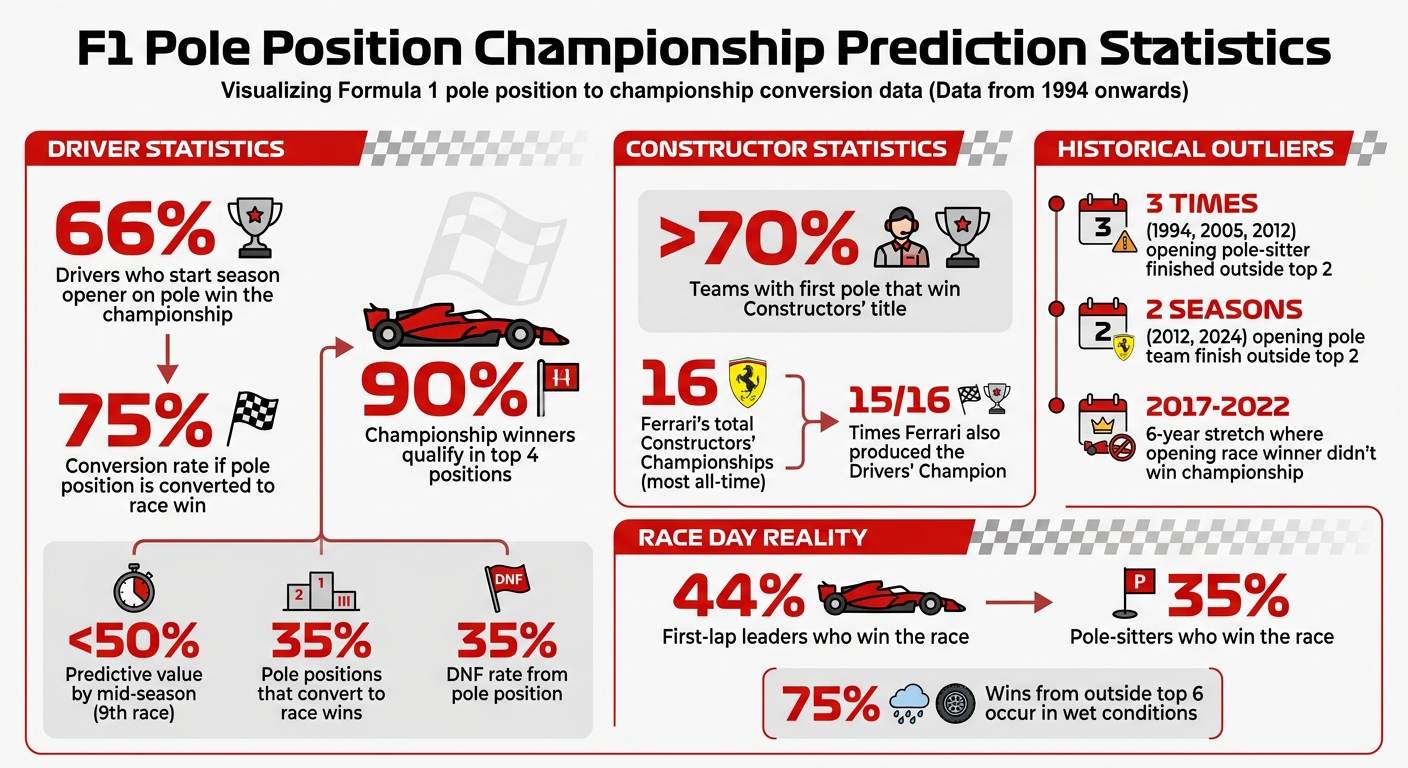
- Drivers: 66% of those starting the season opener on pole win the championship. If they convert that pole into a race win, their chances rise to 75%.
- Constructors: Over 70% of teams earning the first pole secure the Constructors' title. However, exceptions like McLaren’s 2024 title win from poor qualifying show how races can defy trends.
- Mid-Season Shift: By the ninth race, pole position becomes less predictive, with fewer than 50% of champions starting from pole.
- Challenges: Factors like mechanical issues, strategic compromises, and unpredictable weather reduce pole-to-title reliability.
While pole positions highlight raw speed, race-day dynamics, longer calendars, and mid-season upgrades often determine the ultimate champions.
F1 Pole Position to Championship Conversion Rates: Drivers vs Constructors
1. Driver Pole-to-Championship Conversion
Historical Correlation
Since 1994, starting the season opener from pole position has often been a strong indicator of championship success. Roughly 66% of drivers who claim pole at the first race go on to win the Championship. That figure jumps to 75% if the pole sitter also wins the opening race. Interestingly, only three times - 1994, 2005, and 2012 - has the pole sitter from the opening race finished outside the top two spots in the final standings. However, this predictive trend becomes less reliable as the season progresses.
Era-Specific Trends
While early-season poles are telling, the connection weakens in the later stages of the championship. By the ninth race of the season, fewer than half of eventual champions start from pole position. This decline can be linked to challenges like mechanical issues and unpredictable summer weather during European races. Between 2017 and 2022, there was a six-year stretch where the winner of the opening race did not win the championship. Yet, pole position at the season opener remained a more dependable measure of long-term success compared to race wins.
Influencing Factors
Championship-winning drivers tend to qualify in the top four in an impressive 90% of races. One notable outlier was in 2005, when Fernando Alonso was forced to qualify under unusual conditions. A wet track during his session, compared to dry conditions for his rivals, led to a disrupted grid order. Despite such exceptions, consistently strong qualifying performances early in the season often set the tone for championship contenders.
sbb-itb-7c68254
2. Constructor Pole-to-Championship Conversion
Historical Correlation
Qualifying speed has long been a strong indicator of success in the Constructors' Championship. Historically, over 70% of teams that claim pole position at the first race of the season go on to win the championship. This is largely because constructor success relies on the collective performance of both cars, reducing the impact of individual mistakes.
Since 1994, only two seasons - 2012 and 2024 - have seen the team on pole in the opening round fail to finish in the top two of the final standings. Ferrari leads the pack with an impressive 16 Constructors' Championships, and in 15 of those, they also produced the Drivers' Champion. This consistency highlights how a strong qualifying performance often translates to dominance throughout the season.
These historical trends provide a foundation for understanding how shifts in regulations have influenced the correlation between pole positions and championship outcomes.
Era-Specific Trends
The link between pole positions and championship success has evolved significantly across different eras. For example, during the Hybrid Era (2014–2021), Mercedes showcased an almost flawless connection between qualifying dominance and championship victories. However, the current ground-effect era has introduced greater unpredictability. In 2024, McLaren won the Constructors' Championship despite sharing the season’s pole tally with Red Bull at eight each. Similarly, in 2025, McLaren clinched the title with six races to spare, equaling Red Bull's record for the earliest championship win, even though Red Bull led with seven poles that season.
The extended 24-race calendars and increasingly intricate technical regulations have weakened the predictive power of early-season poles. Teams now have more chances to recover from early setbacks through mid-season upgrades. Regulation changes, like the 2014 introduction of 1.6-liter V6 turbo-hybrids and the 2022 ground-effect rules, initially create performance disparities, but teams often close these gaps as the season progresses.
Influencing Factors
Beyond historical and regulatory shifts, several technical and strategic elements influence how pole positions translate into championship success. Technical reliability is a critical factor. With strict limits on power unit components and enhanced gearbox durability, reliability has become paramount. Any failures can lead to grid penalties, effectively negating the advantage of qualifying performance.
Strategy also plays a key role. Since the 2010 ban on refueling, cars must begin races with up to 110 kg of fuel, forcing teams to balance between qualifying speed and race-day performance. These compromises often shape the trajectory of championship battles.
Drive to Analyze 1 - Who starts best from Pole Position in F1 (And how does Lando Norris compare)?
Pros and Cons
Pole positions often serve as a strong early indicator of performance, but their reliability as a championship predictor has its limits. Pole positions primarily showcase raw car speed, largely unaffected by race-day variables like pit stop errors, accidents, or mechanical issues. This explains the solid correlation - 66% for drivers and over 70% for constructors - between pole positions and championship outcomes, as qualifying focuses on pure pace rather than the unpredictable nature of races.
That said, relying on pole positions for predictions comes with risks. Historically, drivers starting from pole have won only 35% of races, while experiencing an equally high 35% rate of DNFs (Did Not Finish) due to crashes, spins, or technical failures. Furthermore, as the season progresses, the predictive value of early pole positions diminishes. By mid-season, the chances of a pole-sitter becoming champion drop below 50%. This decline is partly due to modern seasons, which now span up to 24 races, giving teams more opportunities to refine their cars. McLaren's 2024 Constructors' Championship is a prime example of this, as they overcame early qualifying struggles to claim the title.
The following table outlines the main advantages and drawbacks of using pole positions as a predictor of championship success:
| Aspect | Advantages | Disadvantages |
|---|---|---|
| Reliability | Less influenced by race-day factors like pit stop errors or crashes | Can be skewed by unusual qualifying formats or weather conditions (e.g., 2005) |
| Timing | The first race pole showcases overall car pace | Predictive value drops below 50% by mid-season |
| Accuracy | High conversion rates: 66% for drivers, over 70% for constructors | Fails to account for mid-season car development in longer calendars |
| Race Conversion | Highlights peak performance capability | Only 35% of poles convert to wins, with 35% resulting in DNFs |
Pole positions emphasize one-lap speed rather than race-long consistency. Under parc fermé rules - where teams can't make major setup changes between qualifying and the race - a car optimized for a single flying lap may face challenges like tire wear or fuel efficiency during the race. Weather adds another layer of unpredictability; for instance, 75% of race winners starting outside the top six have done so in wet conditions. Interestingly, first-lap leaders have a 44% chance of winning the race, outperforming the 35% win rate for pole-sitters.
Conclusion
Pole positions provide a strong, though imperfect, glimpse into championship outcomes in Formula One. Around 66% of drivers who secure pole at the season's opening race go on to win the Drivers' Championship. Similarly, over 70% of teams that take the first pole claim the Constructors' title, and more than 90% of these pole sitters finish the season in the top two standings.
When drivers convert an opening pole into a race victory, their chances of taking the championship jump to 75% (9 out of 12 cases). This correlation highlights the importance of pure car pace in qualifying, which is less influenced by race-day factors like mechanical failures, collisions, or strategic missteps. However, as the season unfolds, the dynamics of the championship battle shift.
The predictive edge of pole positions fades as the season progresses. By mid-season, the likelihood of a champion starting from pole drops below 50%. The 2024 season is a perfect example: McLaren claimed the Constructors' Championship despite their top car qualifying only 7th at the season opener. Meanwhile, Red Bull, who secured pole in that race, failed to finish in the top two by the end of the season.
FAQs
Why does the opening-race pole predict titles better than later poles?
The opening-race pole is a strong indicator of championship success, with nearly two-thirds of drivers who secure it ultimately winning the title. In comparison, pole positions earned during mid-season or final races have a less than 50% connection to championship victories. This pattern underscores how crucial it is to kick off the season with strong momentum.
What makes pole positions less reliable as the season goes on?
Pole positions lose their reliability as predictors of championship winners as the season unfolds. Early on, securing pole positions can signal strong performance, but this connection weakens mid-season and beyond. Why? Factors like race strategies, tire management, and technical challenges come into play, diminishing the advantage of starting at the front in later races.
How can a team win the title without leading in pole positions?
A Formula 1 team can clinch the championship even without dominating pole positions by focusing on consistency, race-day performance, and smart strategies. While starting at the front offers an edge, many champions rely on steady podium finishes, managing tires effectively, and steering clear of major errors. By prioritizing race pace and tactical decisions, drivers can rack up enough points to win the title, proving that racecraft often matters more than excelling in qualifying.