How F1 Drivers Manage Jet Lag
How F1 drivers beat jet lag with sleep shifts, timed light exposure, in-flight routines, exercise and tailored recovery tools.

Formula 1 drivers face grueling travel schedules, crossing multiple time zones for races worldwide. Jet lag impacts their performance, causing fatigue, confusion, and slower reaction times. To counter this, drivers and teams use detailed strategies, including:
- Sleep Adjustments: Gradually changing sleep schedules before travel to match the destination's time zone.
- Light Exposure: Using sunlight or artificial light to reset body clocks while avoiding disruptive light sources.
- In-Flight Routines: Timing sleep, light exposure, and caffeine intake based on travel direction.
- Post-Arrival Practices: Engaging in light exercise, meal timing, and social activities to align with the new schedule.
- Recovery Tools: Using blackout curtains, Vitamin D supplements, and hydration plans to support adaptation.
These methods help drivers stay sharp and ready to perform despite the challenges of constant travel.
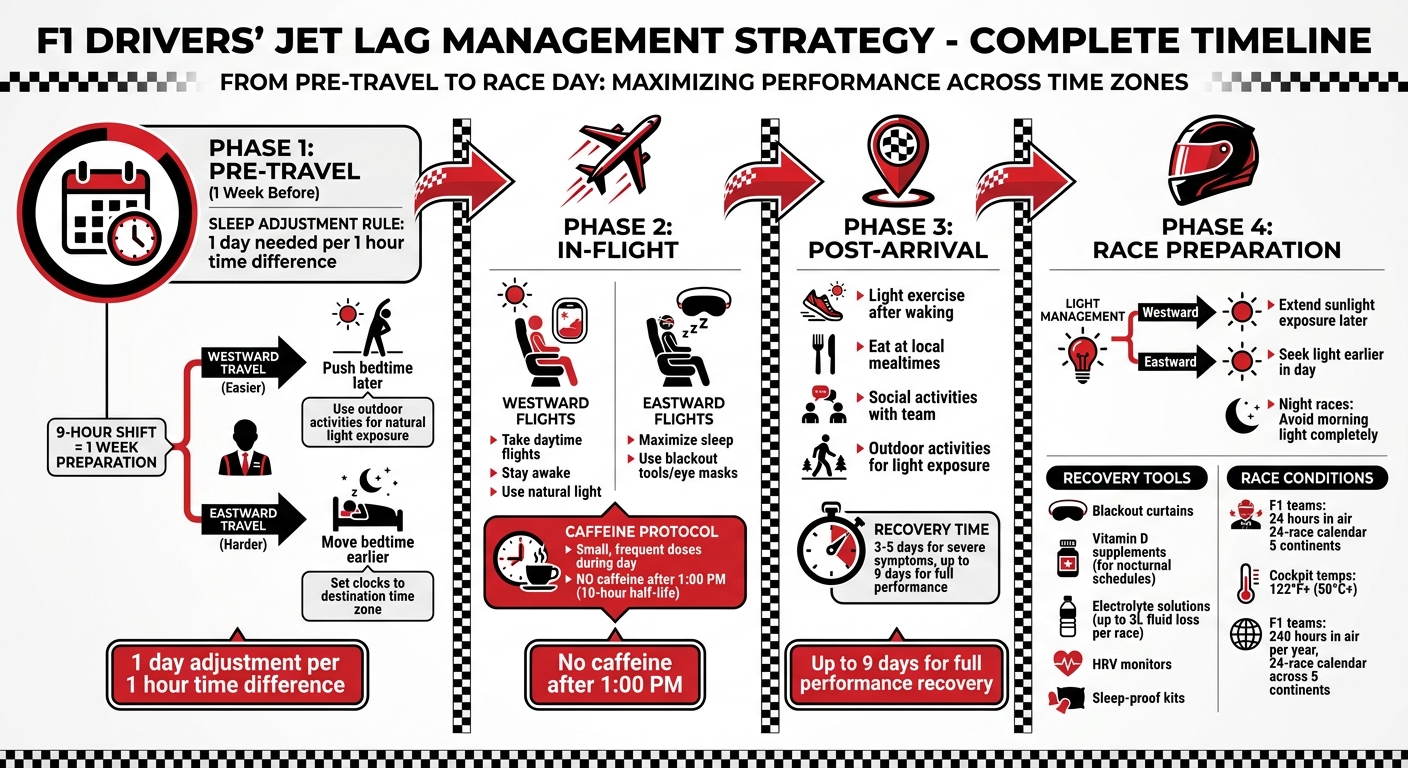
F1 Drivers' Complete Jet Lag Management Strategy Timeline
How Formula 1 Teams Approach Jet Lag And Travel Fatigue | Pete McKnight
sbb-itb-7c68254
Adjusting Sleep Schedules Before Travel
F1 drivers start preparing for time zone changes well before departure. Coaches and physiotherapists often follow the guideline that adjusting for each hour of time difference takes about one day. So, a 9-hour shift might require more than a week of preparation.
Gradual Shift in Sleep Timing
The main tactic is to gradually shift sleep patterns to align with the destination's schedule. Instead of making abrupt changes, drivers adjust their sleep window progressively, often starting at least a week before their trip. Teams also rely on "zeitgebers" - external factors like light exposure, meal timing, exercise, and social interactions - to help reset the body clock.
Interestingly, the direction of travel plays a big role in how easily the body adapts. Traveling west tends to be easier because it lengthens the day, while traveling east is harder since it shortens the day, something the body resists. For westward trips, drivers gradually push their bedtime later each night. Eastward travel involves moving bedtime earlier, which can be more challenging.
Drivers often set their clocks to the destination's time zone several days before leaving. This mental adjustment helps them start operating on the new schedule even before they get on the plane.
Driver-Specific Examples
In November 2024, Alpine driver Esteban Ocon faced a major challenge with the Las Vegas Grand Prix, requiring a 9-hour time adjustment from his home in Switzerland. Under the guidance of his performance coach, Tom Clark, Ocon began shifting his sleep and wake times progressively later a full week before traveling. Since the race took place at 10:00 PM local time, the aim was to make Ocon essentially nocturnal - sleeping during daylight hours to ensure peak performance during the late-night sessions.
Meanwhile, Carlos Sainz takes a slightly different approach with his physio, Rupert Manwaring. During his adjustment period, Sainz incorporates outdoor activities like golf, which provide carefully timed exposure to natural light. This helps reset his circadian rhythm without the physical toll of intense training, making the transition smoother.
These early preparations pave the way for smoother in-flight and post-arrival routines, ensuring drivers are ready to perform at their best.
Using Light Exposure to Reset the Body Clock
F1 teams use light exposure as a key tool to adjust drivers' internal clocks. By carefully managing when drivers are exposed to or avoid light, teams can influence their sleep and wake cycles. As Tom Clark, Senior Performance Coach for Alpine F1, explains:
"Light from the sun and light from electronic devices, and the absence of light - if we can manipulate those things in accordance to where we're trying to travel, we'll be able to shift the body clock closer to that given time zone".
This technique complements gradual sleep adjustments, offering an additional way to synchronize drivers' circadian rhythms. Both light exposure and avoidance are crucial to resetting the body's natural clock.
Using Natural and Artificial Light
Drivers rely on sunlight at specific times to help their bodies adjust. For westward travel, they extend their exposure to sunlight later in the day, which helps stretch their perceived day and makes it easier to stay awake. In contrast, for eastward travel, they seek light earlier in the day to advance their internal clock.
Jon Malvern, physio for McLaren's Lando Norris, highlights the importance of this practice:
"Light exposure, or avoidance of it, was 'another massive factor in helping you shift your body clock,' because it is effectively 'telling your brain and the hormones it releases that it is 'awake time.''".
Teams often pair this light management with gradual sleep adjustments, starting the process even before drivers board their flights.
Avoiding Disruptive Light Sources
Just as important as timed light exposure is avoiding light at the wrong times. For night races like the Singapore Grand Prix - where drivers keep a schedule of waking at 1:00 PM and sleeping at 6:00 AM - avoiding morning sunlight is critical. Exposure to early light could trigger an unwanted circadian reset. Strategies include using blackout curtains, preventing hotel housekeeping interruptions during the morning, and limiting screen time from devices that emit blue light during sleep hours.
For races like the Las Vegas Grand Prix, which starts at 10:00 PM, drivers often need to sleep during daylight hours. In these cases, they turn to Vitamin D supplements to compensate for the lack of natural sunlight.
Driver Case Studies
Lando Norris works closely with his physio, Jon Malvern, to follow strict light protocols during travel. For the Singapore Grand Prix, Norris adheres to a meticulously timed routine, avoiding all light exposure in the morning. He uses blackout curtains and limits screen usage until the afternoon. This disciplined approach ensures his body stays aligned with the race's nocturnal schedule, preventing any disruption caused by premature exposure to daylight.
In-Flight and Arrival Strategies
Sleep and Wake Timing During Flights
F1 drivers follow specific in-flight routines depending on whether they’re traveling east or west. For westward flights, staying awake is the priority, while eastward flights call for maximizing sleep.
Tom Clark, Senior Performance Coach for Alpine F1, explains:
"When traveling west, Clark wants his drivers to take daytime flights so that they stay awake. When flying east, he encourages them to sleep on flights".
This approach works because traveling west extends the day, making it easier for the body to adjust by staying awake longer. On the other hand, eastward travel shortens the day, requiring the body clock to shift forward - a much tougher adjustment.
Drivers also use light exposure as a tool during flights. They rely on natural light to stay awake and blackout tools like window covers or eye masks to sleep. Caffeine intake is another key factor: drivers consume small, frequent doses during the day but avoid caffeine altogether after 1:00 PM, given its 10-hour half-life.
By combining these strategies, drivers ensure they’re mentally sharp and physically ready to perform as soon as they land.
Stopover and Arrival Protocols
Once on the ground, drivers take additional steps to adapt quickly. Light exercise after waking - or mild activity before bed - helps regulate their body clocks. Activities like golf provide both physical movement and exposure to natural light, speeding up the process. Jon Malvern, physio for McLaren driver Lando Norris, highlights the importance of staying socially active with teammates as another way to adjust and combat fatigue.
A simple rule of thumb for recovery is one day of adjustment for every hour of time difference. Rupert Manwaring, physio for Ferrari’s Carlos Sainz, reinforces this:
"The simple rule is for every hour difference you need a day to adapt".
While the most severe jet lag symptoms usually subside within three to five days, the lingering impact on performance can last up to nine days. This is particularly challenging for F1 teams, who spend around 240 hours in the air each year.
Recovery Tools and Techniques
After adhering to strict in-flight and arrival routines, Formula 1 teams take recovery a step further by employing specific tools and methods designed to optimize performance.
Exercise and Physical Activity
Physical activity plays a crucial role in helping the body adapt to new time zones. Exercise shortly after waking can signal the body to stay alert, while light activity before bedtime can ease the transition to a later sleep schedule. Outdoor activities combine movement with exposure to natural light, which is a powerful way to reset the body's internal clock.
Rupert Manwaring, Carlos Sainz's physiotherapist, shared how golf serves as a helpful recovery activity during race transitions:
"Carlos loves playing golf, so it's a great thing to send him off to do - natural light and not too extensive, so we can fit in training around that. It's a good healthy hobby for shifting time zones."
_ - Rupert Manwaring, Physio for Carlos Sainz_
In November 2024, Alpine's performance coach, Tom Clark, used timed fitness sessions to help Esteban Ocon adjust his body clock by nine hours for the Las Vegas Grand Prix. This approach enabled Ocon to adapt to the nocturnal schedule required for the race.
Nutrition strategies work hand in hand with physical activity to better align drivers' internal rhythms.
Caffeine and Nutrition Strategies
Meal timing is another key tool for helping drivers adjust to a new schedule. Even if it feels unnatural initially, eating at local mealtimes helps synchronize the body's internal clock. Caffeine is used carefully to boost alertness without interfering with sleep. Teams closely monitor caffeine intake to ensure it supports, rather than hinders, recovery.
For races like Las Vegas, where drivers operate on a nocturnal schedule, Vitamin D supplements may be introduced to counteract reduced sunlight exposure. In extremely hot conditions - where cockpit temperatures can soar above 122°F (50°C) - drivers rely on specialized electrolyte solutions to replace the up to 3 liters of fluids lost during a race.
Monitoring and Support from Teams
Formula 1 teams provide comprehensive support to ensure drivers recover effectively. Dedicated performance coaches, doctors, and physiotherapists monitor crucial factors such as sleep patterns, light exposure, physical activity, and meal timing. These experts use this data to help drivers adjust their body clocks efficiently.
To maintain consistent sleep environments, teams supply "sleep-proof" kits, including blackout blinds, earplugs, window patches, and ergonomic pillows. Some teams also use Heart Rate Variability (HRV) monitors to track physiological stress in real time.
Tom Clark, Alpine F1 Team's Senior Performance Coach, underscores the importance of sleep:
"In the case of Formula 1 drivers, sleep is right up there as one of the main things we can control to put them in the best place possible to perform."
_ - Tom Clark, Senior Performance Coach, Alpine F1 Team_
Faith Fisher-Atack, physio for the Haas F1 Team, highlights the connection between jet lag and performance:
"There's a clear correlation between jet lag and then having poor performance. If you equate that to what [drivers] have to do on the car, there's a clear consequence."
_ - Faith Fisher-Atack, Physio, Haas F1 Team_
Conclusion: Lessons from F1 Drivers' Jet Lag Management
F1 drivers are masters of precision - not just on the racetrack but also in handling the challenges of jet lag across a demanding 24-race calendar that spans five continents. Their methods provide insights that anyone can apply, even outside the world of motorsport.
The key to managing jet lag effectively lies in proactive preparation. Instead of waiting to feel the effects of fatigue, drivers align their sleep patterns, light exposure, meals, and exercise schedules to match their destination's time zone well in advance. This forward-thinking approach sets the stage for using light as a critical tool in resetting the body clock.
Light exposure, timed strategically, plays a central role in adjusting circadian rhythms. When paired with well-planned physical activity and careful caffeine use - ensuring any caffeine intake ends by 1:00 PM - drivers create a comprehensive system to align their bodies with the new time zone.
F1 teams take this a step further by employing personalized strategies crafted by performance coaches. These experts consider every detail: flight direction, race schedules, and the individual physiology of each driver. The result is a tailored plan that combines sleep adjustments, light exposure tactics, and recovery techniques to optimize performance.
Ultimately, high-quality sleep is non-negotiable for F1 drivers. It directly impacts their ability to make split-second decisions and endure the physical demands of racing. By treating jet lag management as a core aspect of their performance strategy, drivers stay sharp and ready to compete at the highest level.
FAQs
How far in advance do F1 drivers start adjusting for a new time zone?
F1 drivers often start preparing for a new time zone days before they even travel. They rely on techniques like carefully timed light exposure to help reset their internal clocks. This proactive approach helps them reduce jet lag and stay in peak condition for race weekends.
What’s the fastest way to use light to beat jet lag?
The fastest way to tackle jet lag using light is to expose yourself to it at carefully chosen times. This approach helps realign your internal clock, making it easier to adjust to a new time zone. The trick? Focus on timing and stick to it consistently for the best results.
Do night races require a different jet lag plan?
F1 drivers often need to tweak their strategies for managing jet lag when preparing for night races. To handle the unique timing of these events, they typically focus on two key tactics: light exposure and sleep scheduling. These approaches are crucial for syncing their internal body clocks with the specific demands of nighttime racing.