F1 Red Flag Rules Explained
Red flags are F1's ultimate safety tool - how they stop races, reshape strategy, and govern restarts.
A red flag in Formula 1 signals the immediate suspension of a session or race due to unsafe conditions. It’s the most severe intervention, halting all track activity. Red flags are used in cases such as serious crashes, dangerous weather, or track hazards like debris or damaged barriers. Unlike yellow flags or Safety Car periods, red flags require drivers to return to the pit lane, where no overtaking is allowed.
Key points about red flags:
- Triggers: Crashes, severe weather, or technical issues (e.g., loose barriers).
- Driver Protocol: Slow down, no overtaking, and return to the pits.
- Team Actions: Tire changes, damage repairs, and other adjustments allowed.
- Restart Options: Standing or rolling restarts, depending on conditions.
- Timing Rules: The race clock pauses for track time but not for the total event duration.
Red flags significantly impact race strategies, as teams can perform repairs without losing position. For example, tire changes during a red flag fulfill mandatory pit stop requirements without time penalties. Restarts can also shake up race order, especially with standing starts, which simulate a race’s initial grid setup.
Understanding red flag rules is crucial for grasping how they influence race outcomes, strategies, and safety decisions.
Red Flags and Race Suspensions - the rules
sbb-itb-7c68254
What Triggers a Red Flag
After understanding what a red flag represents, let’s dive into the specific situations that lead to its deployment.
Track Incidents and Safety Risks
A red flag is issued when a significant on-track incident poses an immediate danger to drivers or officials.
"If competitors or officials are placed in immediate physical danger by cars running on the track, the race will be suspended." - Formula 1 Regulations
This can happen when debris obstructs the racing line or when a medical emergency requires the track to be cleared for emergency responders. For instance, 26 out of 87 red flag incidents have occurred during the opening lap, a period when cars are tightly packed and collisions are more likely. A notable example is the 2023 Australian Grand Prix, where Race Director Niels Wittich issued multiple red flags after debris from incidents created hazardous conditions and triggered chain reactions.
However, crashes aren’t the only factor - external conditions like weather also play a role in red flag decisions.
Weather Conditions That Cause a Red Flag
Severe weather that impacts visibility or track safety often leads to a red flag.
"The red flag is only shown when track conditions have become unsuitable for racing. This could mean something as simple as heavy rainfall, that is dangerous for reasons of visibility or driveability..." - PlanetF1
Heavy rain, for example, can cause spray that reduces visibility or lead to aquaplaning, making the track unsafe. Over the history of Formula One, 13 races have been abandoned entirely due to weather, crashes, or fatal accidents.
Technical and Procedural Triggers
Red flags aren’t limited to crashes or weather; technical and procedural issues can also bring a session to a halt.
"A red flag can even be shown for matters such as loose advertising hoardings, or if a piece of circuit infrastructure needs attention – anything that could be seen as a danger can trigger a red flag stoppage." - PlanetF1
For example, loose drain covers, blockages in the pit lane, or even unauthorized track access by spectators can prompt a stoppage. At the 2023 Australian Grand Prix, fans entered the track after the race ended, leading to an unofficial stoppage and highlighting Race Control’s authority to address safety concerns.
What Happens During a Red Flag Period
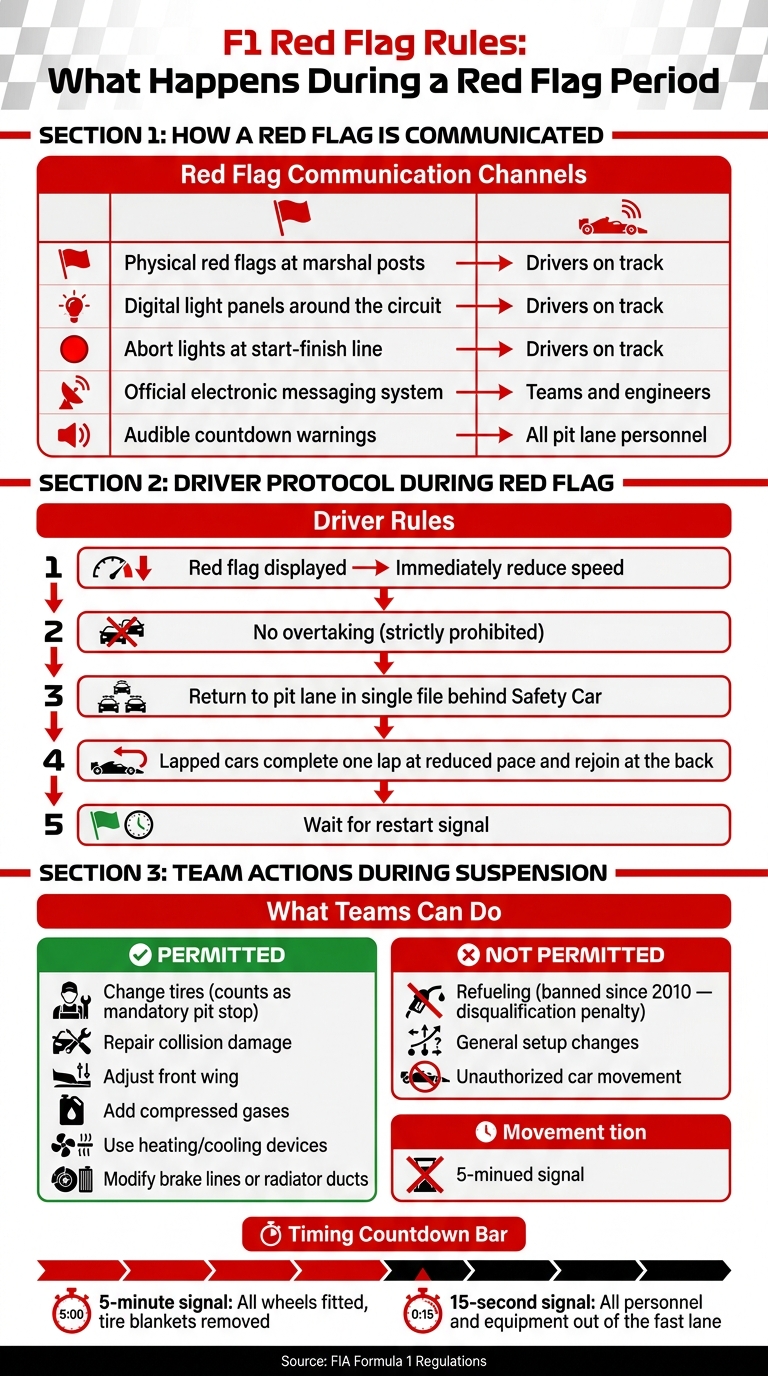
F1 Red Flag Rules: What Happens When the Race Stops
When a session is suspended with a red flag, a well-coordinated sequence of actions is triggered almost instantly.
How Race Control Communicates a Red Flag
The Race Director initiates the suspension, and the Clerk of the Course ensures red flags are deployed immediately. Marshals at every post around the track wave physical red flags at the same time, while digital light panels and flag lighting systems turn red. At the start-finish line, abort lights flash red to catch drivers' attention.
Teams are notified via an official electronic messaging system, which also provides restart details. Additionally, teams receive a countdown and audible warnings to prepare for the restart.
| Communication Method | Who It Reaches |
|---|---|
| Physical red flags at marshal posts | Drivers on track |
| Digital light panels around the circuit | Drivers on track |
| Abort lights at the start-finish line | Drivers on track |
| Official electronic messaging system | Teams and engineers |
| Audible countdown warnings | All pit lane personnel |
Once the communication is sent out, drivers must follow strict protocols without delay.
Driver Rules During a Red Flag
Drivers must immediately reduce their speed and head safely to the pits as soon as they see the red flag. Overtaking is strictly prohibited the moment the flag is displayed. During practice and qualifying sessions, drivers return to their garages, while in a race, they line up in single file behind the Safety Car at the pit exit. Entering the garage without authorization during a red flag can lead to a restart penalty.
Before the race resumes, lapped cars are usually allowed to leave the pit lane, complete a lap at a reduced pace, and rejoin the back of the field. This ensures that all cars are on the same lap when the race restarts. Meanwhile, teams use this pause to make crucial adjustments.
What Teams Can Do During a Suspension
During a red flag, teams can make various changes to their cars, including tire changes, damage repairs, and setup adjustments. These tasks include:
- Changing tires (which counts as a mandatory pit stop)
- Repairing collision damage
- Adjusting the front wing
- Adding compressed gases
- Using heating or cooling devices
For example, during the 2024 Monaco Grand Prix, Carlos Sainz benefited from a red flag to complete necessary repairs without losing his grid position.
To maintain safety, strict timing rules apply. By the five-minute signal, all wheels must be fitted, and tire blankets removed. By the 15-second signal, all personnel and equipment must be out of the fast lane. These measures ensure the race can restart smoothly and safely.
How Red Flags Affect the Race
This section dives into how red flag stoppages influence race timing, pit strategies, and repair limitations, building on established protocols.
Race Timing, Lap Counts, and Classification
When a red flag is issued, the race effectively splits into two timing categories: the event window, which continues ticking from the scheduled start, and the actual racing time, which pauses while the cars are stationary. Importantly, laps don’t count down while the cars are idle. However, the lap driven behind the Safety Car to return to the grid does count toward the total race distance.
If the race cannot be resumed, the final classification is taken from the end of the penultimate lap before the lap in which the red flag was shown. For example, during the 2023 Australian Grand Prix, a red flag on lap 57 of 58 resulted in the Safety Car lap being counted as the final lap, ending the race under parade conditions instead of a green-flag finish. Similarly, if a red flag occurs before the first timing sector is completed, the restart order defaults to the original grid positions. This rule came into play at the 2024 Monaco Grand Prix.
These timing rules can dramatically alter pit strategies, as teams must adapt quickly to the new circumstances.
Tire Changes and Pit Stop Strategy
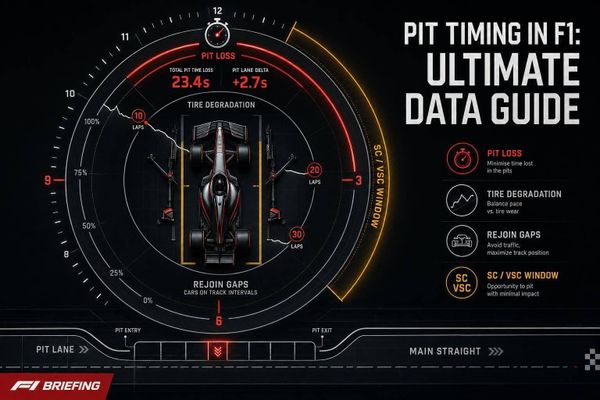
One major advantage of a red flag is the ability to change tires without losing track position. Unlike a green-flag pit stop, which typically costs 20–30 seconds, tire changes during a red flag carry no time penalty. Teams can take this opportunity to switch compounds, fit fresh tires, and recalibrate their strategies. For instance, a driver managing tire wear can switch to a more aggressive compound for a sprint to the finish, while any gaps previously built by the leader are erased. Additionally, a tire change during a red flag fulfills the mandatory two-compound rule.
This contrasts sharply with a Safety Car period. Under a Safety Car, tires can lose up to 40°F in temperature, and teams still face the time cost of a pit stop. During a red flag, tire blankets maintain optimal tire heat, and no track position is sacrificed.
Permitted and Restricted Repairs Under Red Flag Rules
Red flag conditions also allow limited repairs under strict parc fermé regulations. Teams may perform safety-related repairs, such as fixing collision damage, changing tires, adjusting the front wing, and modifying brake lines or radiator ducts. However, general setup changes or unauthorized car movement remain strictly off-limits.
A well-known example of permitted repairs occurred during the 2021 British Grand Prix. After a first-lap collision between Lewis Hamilton and Max Verstappen, the red flag allowed Mercedes mechanics to repair Hamilton’s car in the pit lane. Hamilton went on to restart the race and claim victory.
It’s worth noting that refueling is strictly forbidden under any circumstances during a red flag. This rule, implemented after F1 banned in-race refueling in 2010, ensures any attempt to refuel during a stoppage results in disqualification.
Restart Procedures After a Red Flag
When a red flag period ends, the process to resume the race follows clearly defined protocols. Depending on track conditions and visibility, the race can restart using either a standing restart or a rolling restart.
Standing Restarts
In normal, dry conditions, the standing restart is the default method. Drivers complete one formation lap behind the Safety Car before lining up on the grid for a five-light countdown, just like the start of a race.
The grid order is based on the running order at the time of the red flag. However, if the red flag is shown before the first timing sector is completed, the original starting order is reinstated.
Teams are notified of the restart with a minimum 10-minute warning, followed by signals at 5, 3, 1, and 15 seconds. Two minutes before the restart, any lapped cars are allowed to leave the pit lane, complete a lap, and rejoin the back of the field in the correct order.
Rolling Restarts
If conditions are too dangerous for a standing restart - such as during heavy rain or when visibility is poor - Race Control will opt for a rolling restart instead.
"A Rolling Start decision can be taken if circuit conditions are unsuitable, for reasons of safety, for a standing start. This refers to wet-weather conditions or concerns over visibility." - PlanetF1
In this scenario, cars line up single file behind the Safety Car. Once the Safety Car exits into the pit lane, the lead driver sets the pace until the green flag signals the race's resumption. Unlike a standing restart, there’s no light sequence or stationary start; the cars accelerate from a rolling speed. This method minimizes the risk of collisions and limits position changes.
Restart formats aside, the rules governing race timing also play a significant role in how red flag stoppages affect the event.
Race Distance Limits and Time Cutoffs
A red flag doesn’t stop the overall race clock. The FIA enforces two simultaneous time limits:
| Rule | What It Covers | Clock Behavior During Red Flag |
|---|---|---|
| 2-hour track time limit | Total time spent on track (racing + Safety Car laps) | Pauses |
| 3-hour total window | Total time elapsed since the race start | Continues running |
While the 2-hour track time clock pauses during a red flag, the 3-hour total window keeps ticking. This means extended stoppages reduce the remaining time available for racing. As journalist Brandon Sutton explained:
"During this period [red flag], laps will not tick down but the clock will continue to move towards the maximum permitted time and if the time expires then the race will be cancelled."
A clear example of how these rules can shape a race occurred during the 2023 Australian Grand Prix. A red flag on lap 57 of 58 led to a mandatory Safety Car restart lap, which ultimately served as the race's final lap. Instead of a competitive sprint to the finish, the event ended with a parade lap. This underscores how time and distance regulations can influence the outcome just as much as the on-track action itself.
Key Takeaways on Red Flag Rules
Red flags serve a critical purpose in Formula 1: they step in when even the Safety Car isn't enough to ensure safety. As TheF1DB explains, "The red flag is reserved for the moments when even a controlled circulation behind the Safety Car is not safe enough or not practical enough." This perfectly captures why red flags are so essential.
Here are some standout numbers: by late 2024, 87 Grand Prix events have seen red flags, with 30% of those - 26 out of 87 - occurring right on the first lap. Interestingly, nearly a quarter of all red flags in Formula 1 history have been issued since 2014. This highlights how the sport has increasingly prioritized safety. These statistics underline just how much red flags can influence the flow and outcome of a race.
The 2023 Australian Grand Prix is a prime example of the chaos red flags can bring. This race saw three stoppages: Albon's crash on Lap 7, Magnussen's debris on Lap 54, and a multi-car collision on Lap 57. These incidents turned what could have been a dramatic sprint finish into a subdued parade lap. It's a clear reminder of how red flag timing, restart procedures, and the strict 3-hour race window can combine to create completely unexpected results.
A few key rules to note during red flag periods: refueling is strictly prohibited, and if a race cannot resume, the final classification is determined based on the penultimate lap before the suspension.
FAQs
Can drivers change tires under a red flag?
During a red flag stoppage, cars head back to the pit lane, and teams are permitted to change tires. This allows drivers to make a "free pit stop" without sacrificing their position in the restart lineup.
How is the running order decided after a red flag?
When a red flag is issued, the running order is determined by the last position where all cars' placements were clearly recorded. If the field hasn’t yet passed the first timing sector, the original grid order is used, but any retired cars are excluded. During the suspension period, cars line up in the pit lane based on this order, and lapped cars might be given the chance to unlap themselves before the race restarts.
Why does the 3-hour limit keep running during a red flag?
In Formula 1, the race clock keeps ticking even during a red flag. This rule helps ensure the event stays within its maximum allowed time. By doing so, it prevents races from dragging on indefinitely due to delays like accidents or bad weather. If the time limit runs out before the race can restart, the event gets canceled. This approach keeps the Grand Prix structured and time-bound.