Graining vs. Blistering: Tire Temperature Effects
How cold tires cause graining and hot tires cause blistering, with practical fixes, telemetry and setup tips.
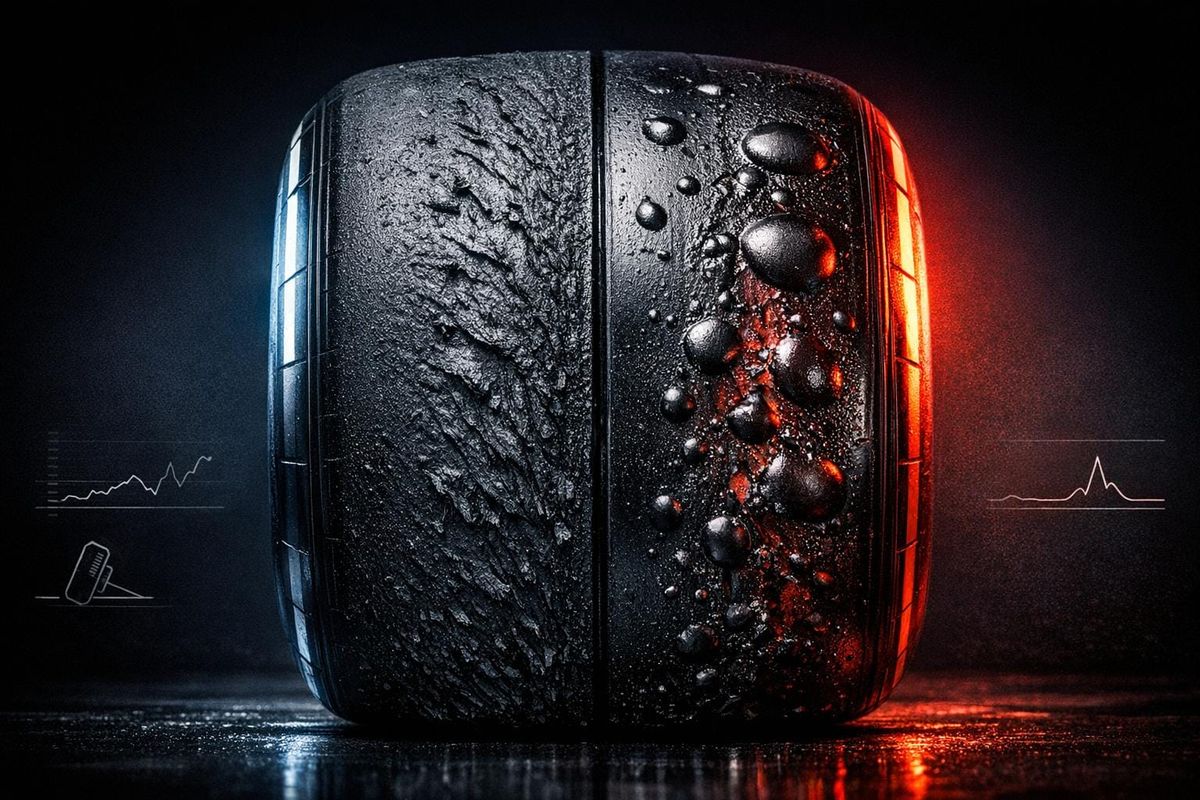
Tire temperature is the silent game-changer in Formula One. Whether your tires are too cold or too hot, you’re in trouble. Graining happens when tires are cold, causing the surface rubber to tear and stick unevenly. Blistering, on the other hand, occurs when tires overheat, creating bubbles that damage the rubber from the inside. Both issues hurt performance, but blistering is permanent and often forces pit stops.
Here’s the key difference:
- Graining: Cold tires lose grip, leading to surface tearing. It’s usually fixable with careful driving.
- Blistering: Overheated tires form internal bubbles, causing lasting damage that requires replacement.
Quick tips for teams and drivers:
- Monitor tire temperatures in real time.
- Adjust tire pressures and driving style to stay in the optimal temperature range.
- Choose the right compound for track and weather conditions.
Managing tire temperatures is one of the most challenging parts of Formula One strategy and can make or break a race.
Tire Temperature Basics in Formula One
How F1 Tires Generate Grip
F1 tires rely on two key mechanisms to create grip: indentation and adhesion. Indentation happens when the tire deforms to match the track's surface, while adhesion involves forming molecular bonds between the rubber and the asphalt. Both of these processes are highly dependent on temperature. When the rubber stays warm enough, it remains pliable, allowing for better contact with the track. But if it gets too cold, the rubber hardens, reducing grip significantly.
A key factor in this process is something called molecular hysteresis. This is the internal heat generated as the rubber flexes while the tire rotates. Without enough hysteresis, the tire can't perform at its best.
Tire Operating Window and Temperature Monitoring
Every F1 tire compound has a specific temperature range where it performs at its peak. For instance, Pirelli's soft tires operate best between approximately 90°C and 110°C (194°F to 230°F), while their harder compounds are optimized between 100°C and 120°C (212°F to 248°F).
To ensure tires stay within this narrow window, teams use advanced tools like infrared (IR) sensors, pyrometers, and real-time telemetry. Modern IR sensors can measure up to 16 points across the tire's surface, providing engineers with a detailed thermal map of the inner, middle, and outer sections. This data is logged at high frequencies - up to 25 Hz - so even brief moments like lock-ups or slides are recorded. Drivers also have live tire temperature readings on their steering wheel displays, allowing them to adjust their driving to maintain optimal performance.
External Factors That Affect Tire Temperatures
Several external factors can influence tire temperatures, starting with the weather. For example, an overcast day can lower track surface temperatures by as much as 20°C (68°F) compared to sunny conditions, which can cause tires to fall out of their ideal range.
Tire pressure is another critical variable. A small adjustment of just 0.1 bar can impact lap times by tenths of a second and affect how heat is generated and retained. Similarly, camber angle - the tilt of the tire relative to the track - determines how evenly the tire wears and heats. Too much camber can concentrate heat on the inner edge of the tire.
Track evolution also plays a role. Over a session, rubber builds up on the racing line, improving grip and making it easier for tires to maintain heat. However, rain or strong winds can wash away this rubber, resetting the track to a "green" state, where grip and heat generation drop back to early-session levels.
Understanding these principles is essential for managing tire issues like graining and blistering, which will be explored in the following sections.
sbb-itb-7c68254
Graining: Causes, Symptoms, and Fixes
What is Graining?
Graining is a surface-level tire issue where small rubber particles tear away from the tire's tread and then reattach unevenly. This creates a rough, sandpaper-like texture with tiny ridges and tears across the tire's surface. Unlike more serious problems like blistering, graining only impacts the outer tread layer, leaving the internal structure of the tire intact.
The term "graining" comes from the visual and physical effect it creates - the tire appears and feels "grainy" due to the uneven reattachment of these rubber particles.
What Causes Graining?
The main culprit behind graining is temperature. When a tire's carcass hasn't reached its ideal operating temperature, the rubber remains stiff and struggles to properly grip the track surface. Instead of gripping cleanly, it slides and scrubs, causing small chunks of rubber to tear off.
"Graining typically occurs when tires are too cold and haven't reached their optimal operating temperature." - Motorsports Calendar
Other factors can amplify the problem. Aggressive oversteer or understeer during early laps increases friction on under-warmed tires. Additionally, low-grip track conditions, such as a "green" track early in a session, make it harder for tires to bond with the surface. Incorrect tire pressures also play a role - if the pressure is off, the tire won't heat evenly across its contact patch, leaving some areas cooler and more prone to graining.
Understanding these causes is essential for identifying how graining impacts performance on the track.
How Graining Affects Performance and How to Fix It
Graining disrupts the tire's ability to grip the asphalt effectively, leading to a noticeable drop in performance. It increases lap times, makes the car harder to control in corners, and can shake a driver's confidence in the affected axle - whether it's the front or rear.
The upside? Graining is often temporary. Drivers can sometimes "burn off" the grainy layer by managing their tires carefully. This means smoother steering, gentler braking, and avoiding aggressive slides. Teams can also address graining during the race by adjusting tire pressures or tweaking suspension settings to influence how heat spreads across the tire.
Preventing graining starts with smart preparation. Selecting the right tire compound for the track conditions - especially one that warms up quickly - can make all the difference.
Blistering: Causes, Symptoms, and Fixes
What is Blistering?
Blistering is a serious internal issue that goes beyond surface-level problems like graining. While graining impacts only the outer layer, blistering begins deep within the tire. When internal temperatures soar, the rubber's structure weakens, leading to the formation of bubbles beneath the surface. As the tire continues to flex and rotate, these bubbles burst, leaving behind craters or gaps in the tread. This damage is permanent and cannot be undone. Understanding what triggers this internal breakdown is key to addressing the problem.
What Causes Blistering?
The primary culprit behind blistering is molecular hysteresis. This process occurs when rubber molecules flex and deform under pressure, producing heat as a byproduct. Normally, a tire can dissipate this heat. But when heat builds up faster than it can escape, the rubber starts to degrade from the inside.
Certain conditions make this worse. High-energy tracks with demanding braking zones and long, fast corners - like Silverstone or Spa-Francorchamps - put constant thermal stress on tires. When track temperatures are high, the tire's ability to cool off diminishes even further. Running low tire pressures exacerbates the issue because softer tires flex more, generating additional heat with every rotation. Using a soft compound for extended periods in hot conditions is a recipe for blistering.
How Blistering Affects Performance and How to Fix It
Once blistering occurs, the tire's performance takes a nosedive. As pieces of rubber separate from the surface, the already limited contact patch becomes even smaller. With less rubber gripping the track, drivers experience an immediate loss of traction. The consequences are hard to miss: lap times increase, the car becomes unstable in high-speed corners, and the chances of a sudden puncture rise significantly.
The only way to address blistering is a pit stop. Unlike graining, which drivers can sometimes manage on track, blistering cannot be "nursed" back to usability. Teams rely on tire temperature telemetry and driver feedback to catch early signs and plan pit stops to minimize the impact. Drivers can try to reduce energy input in high-speed sections to slow the damage, but this is only a temporary measure.
The best solution is prevention. This means selecting the right tire compound for the conditions, maintaining pressures within recommended limits, and crafting race strategies that avoid pushing tires beyond their thermal limits. Proper tire temperature management is critical to avoiding this irreversible damage during a race.
Tyre wear in F1 explained
Graining vs. Blistering: Direct Comparison
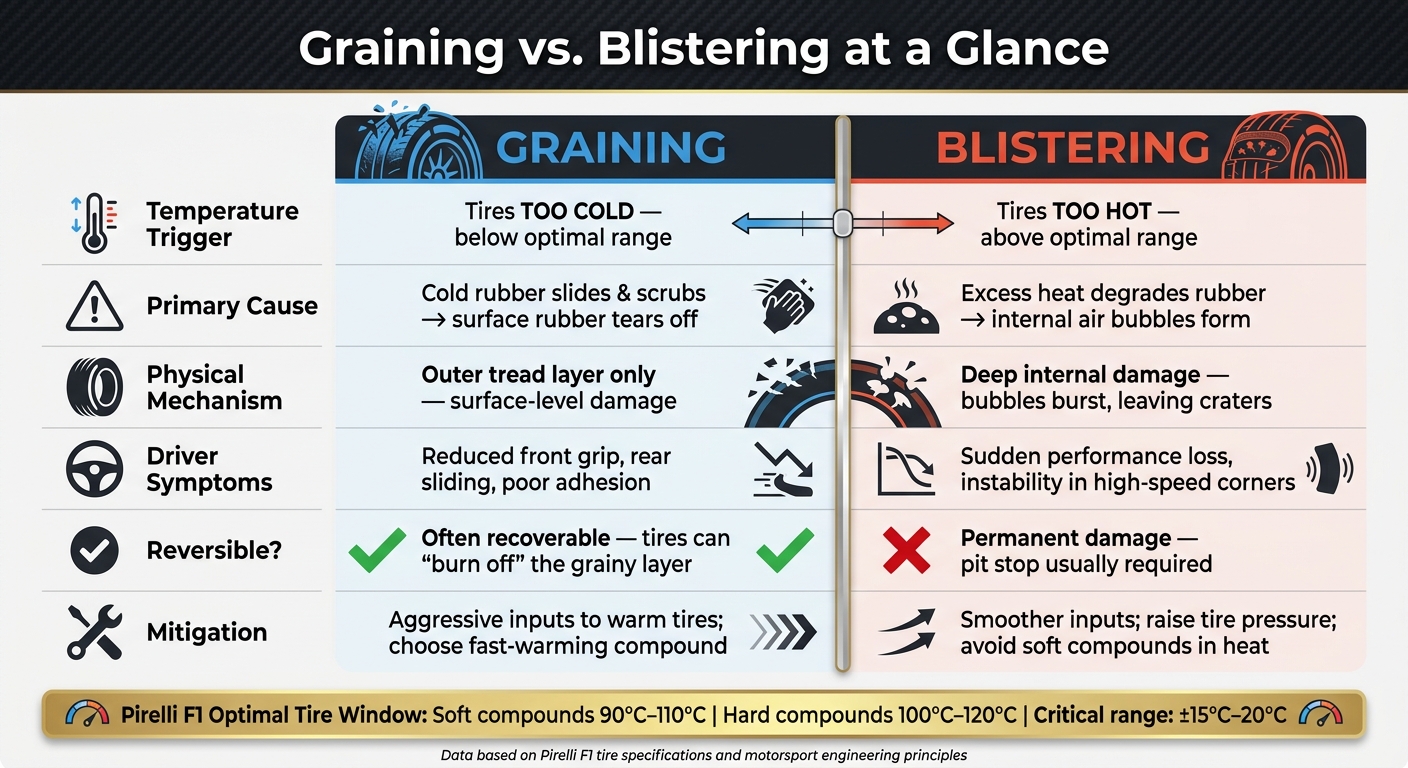
F1 Tire Graining vs. Blistering: Key Differences Explained
Graining and blistering are two tire-related issues that stem from the challenges of maintaining tire temperatures within a narrow 15°C–20°C range. When tire temperatures fall below this range, graining occurs. On the other hand, exceeding this range leads to blistering.
Comparison Table: Graining vs. Blistering
| Factor | Graining | Blistering |
|---|---|---|
| Temperature Profile | Happens when tires are too cold, below their optimal range | Happens when tires are too hot, exceeding their optimal range |
| Primary Cause | Lack of heat prevents proper grip, causing sliding and tearing of rubber strips | Excessive heat degrades the rubber, forming air bubbles (blisters) under the surface |
| Physical Mechanism | Surface rubber tears and may reattach to the tire | Internal heat softens the rubber, leading to blister formation |
| Driver Symptoms | Reduced front-end grip, rear sliding, and poor mechanical adhesion | Sudden performance loss and instability, especially in high-speed corners |
| Reversible? | Can often recover if the tires are brought back to the right temperature | Permanent damage usually requiring a pit stop |
| Mitigation | Aggressive inputs and adjustments to warm tires faster | Smoother inputs and higher tire pressures to reduce flexing and heat buildup |
This comparison highlights how the smallest changes in driving or setup can impact tire performance, as detailed below.
How Driving Style and Car Setup Influence Each Issue
Driving style and car setup are critical in determining whether a driver faces graining or blistering. For instance, aggressive steering and throttle inputs can help cold tires warm up quickly, reducing the risk of graining. However, when tires are already near their upper temperature limit, that same aggressive approach can push them over the edge, leading to blistering.
Car setup also plays a pivotal role. For example, running lower tire pressures increases the contact patch, improving grip but also causing the tire to flex more. This extra flexing generates heat, which can result in blistering if unchecked. On the flip side, a setup that doesn’t warm the tires effectively - like one with higher pressures or overly conservative suspension settings - can leave the tires too cold, making graining unavoidable. Even a small change in tire pressure, such as 0.1 bar, can significantly alter how a tire behaves thermally. That’s why teams obsessively monitor tire pressure and temperature data throughout a race weekend to fine-tune performance.
Driver Techniques and Team Responses
Driver Techniques for Managing Tire Temperature
How a driver handles the car on each lap directly affects whether the tires stay in their ideal performance range or veer into trouble like graining or blistering.
To avoid graining, drivers focus on reducing lateral scrubbing during cornering. On colder or more abrasive tracks, where heat builds slowly, excessive scrubbing can cause the loose rubber layers that define graining. The solution? Patience. Drivers need smooth, controlled inputs and must resist the urge to push too hard before the tires warm up to their optimal temperature.
Blistering demands a different approach altogether. When track temperatures soar or stints extend, drivers must dial back aggressive maneuvers to keep the tires from overheating. Sudden bursts of acceleration or heavy braking can cause sharp spikes in tire heat, leading to the formation of bubbles. Unlike graining, which can sometimes resolve itself, blistering usually results in lasting damage, often forcing a pit stop.
While drivers focus on these techniques, teams work behind the scenes with advanced tools and strategies to help keep tire temperatures in check.
Team-Level Tools and Decisions
Team decisions are just as important as driver techniques when it comes to managing tire temperatures. Using real-time data, teams monitor tire conditions closely, keeping tabs on grip levels and wear patterns as they evolve. During pit stops, mechanics verify sensor data with visual checks, looking for signs of blistering or other damage.
Tire pressure adjustments are another key factor. Incorrect inflation can lead to uneven heating inside the tire, pushing it beyond its narrow working range and increasing the risk of blistering. Even minor tweaks to tire pressure can change how heat spreads across the contact patch. If blistering is caught early, teams might call for an earlier pit stop to avoid catastrophic tire failure. On the other hand, if graining is detected and expected to clear, they may decide to keep the car on track and wait it out.
These combined efforts between drivers and teams are essential for keeping tires performing at their best.
Conclusion: Why Tire Temperature Management Matters
Graining and blistering present tough challenges for teams, as they must keep tires within a very specific temperature range. Graining happens when tires are too cold, causing surface rubber to tear, while blistering occurs when tires get too hot, leading to internal damage and bubble formation. Both hurt performance, but blistering is far riskier - in extreme cases, it can weaken the tire enough to cause a high-speed blowout.
Graining can sometimes resolve itself as loose rubber wears away after a few laps. Blistering, on the other hand, causes lasting damage, often forcing unscheduled pit stops and throwing race strategies into chaos. These differences impact not only immediate performance but also how teams plan for future races.
With advancements in real-time telemetry, pressure monitoring, and setup adjustments, engineers are gaining sharper tools for understanding tire behavior. As weather and track conditions become less predictable, the ability to quickly identify and address tire temperature issues will be even more critical.
For fans, tire temperature management might seem like a small detail, but it’s a crucial part of Formula One strategy. It’s not just about hitting top speeds - it’s about keeping tires performing at their best under extreme conditions. Striking the perfect balance between too cold and too hot often decides who crosses the finish line first. Mastering this art isn’t just technical; it’s a key ingredient for winning races.
FAQs
How can you tell graining from blistering on a tire?
Graining looks like small, rough, grainy textures on a tire's surface. This happens when the tire operates outside its ideal temperature or pressure range, leading to uneven wear. When graining occurs, the tire loses grip, affecting performance.
Blistering, on the other hand, appears as bubble-like bumps on the tire. It's caused by overheating, which softens the rubber and weakens the tire's structure. This issue often arises from aggressive driving, incorrect tire pressure, or tough track conditions.
What setup changes most affect tire temperature in F1?
Tire temperature in Formula 1 depends heavily on how the car's suspension is set up, as well as ride height, camber angles, and tire pressures. For instance, lowering the ride height increases the tire's contact with the track, leading to more heat. A stiffer suspension setup alters how the tire deforms, which directly affects how heat builds up. Camber adjustments play a role in distributing heat across the tire's surface, while tire pressures determine how much the tire deforms and how much of it touches the track. These elements work together to shape heat generation, grip levels, and overall performance on the track.
Why do some tracks trigger blistering more than others?
Blistering occurs when tires overheat, causing the rubber to degrade and form bubbles on the surface. This issue is more common on tracks with abrasive surfaces, high speeds, or challenging corners, as these factors push tire temperatures higher. For instance, circuits with long straights followed by heavy braking can lead to uneven heating across the tire. Keeping tire temperatures under control on such tracks is crucial because excessive heat weakens the rubber, increasing the likelihood of blistering during a race.