Evolution of Drone Use in F1 Broadcasting
Drones and FPV tech are changing F1 coverage with closer, immersive angles while safety, battery and latency limit full live use.
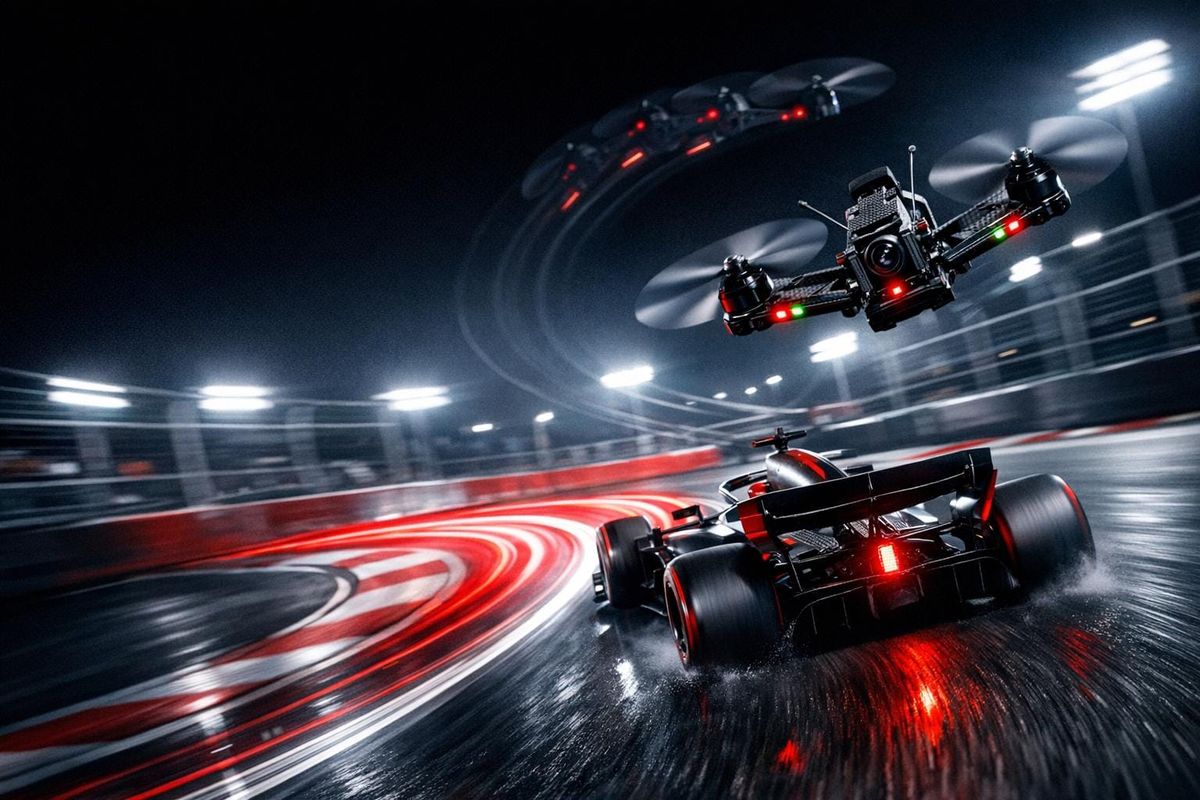
Formula 1 broadcasting has transformed with the use of drones, offering fans dynamic views that traditional methods like helicopters and cable-cams couldn't achieve. Drones deliver closer, more immersive footage, enhancing the viewing experience by showcasing the intensity of F1 racing. However, integrating drones into live broadcasts has been a complex process due to safety regulations, technical challenges, and the sport's high-speed nature. Here's a quick breakdown:
- Before Drones: Helicopters and cable-cams provided wide shots but lacked proximity and flexibility.
- Early Tests: Drone trials began in 2022, highlighting issues like short battery life, safety risks, and signal interference.
- Advancements: FPV drones now track cars at speeds over 186 mph, offering unparalleled angles, though battery life remains limited to about 10 minutes.
- Current Use: Drones are primarily used for pre-race footage, highlights, and controlled segments, with live race coverage still evolving.
While drones are not yet a full replacement for helicopters, their potential for cost savings and reduced emissions is driving further development. As technology improves, drones could redefine how F1 is broadcast in the future.
Aerial Technology in F1 Broadcasting Before Drones
Helicopters, Cable-Cams, and Cranes
Before drones became a part of the scene, helicopters were the go-to choice for aerial coverage in Formula 1. They provided stable, sweeping views of the track, showcasing everything from the full grid to pit lane activity and even the surrounding scenery. While their high vantage point was great for capturing the big picture, helicopters came with hefty costs, a significant environmental impact, and limitations in getting close enough to capture intense moments like cockpit action.
Cable-cams and crane-mounted cameras stepped in to complement helicopters by offering dynamic shots at specific track locations. However, these systems were static - they couldn't follow cars across multiple sectors of the track, especially at speeds reaching 186 mph (300 km/h). This left gaps in coverage, particularly in capturing the thrill of high-speed straights or dramatic overtakes. These limitations naturally led to the exploration of drones as a way to push the boundaries of F1 broadcasting.
Early Drone Tests in Motorsport
The push for better coverage led to early experiments with drones, driven by the need for more dynamic and closer-to-the-action shots. However, F1's strict in-season testing ban made it tricky to test drones in real race conditions. The breakthrough came in May 2022, when Formula 1’s Media and Technology Centre (MTC), under Managing Director Roberto Dalla, conducted public drone tests during the Spanish Grand Prix in Barcelona. This was done during actual F1 sessions to mimic race-day challenges instead of relying on controlled simulations.
While promising, these tests highlighted some serious hurdles. The drones used had a battery life of just 10 minutes, limiting their ability to provide sustained coverage. On top of that, they required special safety clearances from the FIA and geoblocking to avoid restricted areas. These early trials revealed just how complex integrating drones into F1 would be, especially when it came to meeting safety and regulatory standards.
Safety and Regulatory Barriers to Drone Use
Safety in F1 is paramount, and the use of drones comes with significant risks. As Dieter Rencken, Editorial Director of RacingNews365, put it:
"It is not difficult to imagine the potential dangers of a drone striking a driver at 300km/h, so it was not an easy sell."
One of the key safety measures introduced during these early tests was the 1:1 rule. This regulation requires drones to maintain a horizontal distance from people equal to their altitude. For instance, a drone flying 10 meters high must stay at least 10 meters away from spectators. This rule ensures that, in case of a malfunction, the drone would drop straight down rather than into a crowded area. With race weekends drawing crowds of over 400,000, creating safe flight paths for drones became a logistical puzzle.
Signal interference posed another challenge. Early wireless systems for drones struggled to deliver the ultra-low latency required for live F1 broadcasts, a reliability that helicopters had already mastered. These technical and safety challenges made F1’s adoption of drones a slow and deliberate process. However, these obstacles ultimately pushed for advancements in drone technology tailored specifically for the demands of F1 broadcasting.
sbb-itb-7c68254
How Drone Technology Advanced for F1 Coverage
From GPS-Stabilized Drones to High-Speed FPV Systems
In the early days, drones relied heavily on GPS for stability. While this worked well for controlled and steady shots, it fell short when it came to tracking F1 cars speeding at over 186 mph (300 km/h). Enter FPV (First-Person View) drones, which are controlled by pilots using live headset footage. These drones bring the agility needed to match the blistering speed of F1 cars, whether they're navigating sharp corners or flying down straightaways. However, FPV piloting is no easy task - it demands immense skill since there's no autopilot safety net.
Although GPS is no longer used for primary navigation in these cases, it hasn’t vanished. Instead, it plays a critical safety role, enabling geoblocking systems to ensure drones stay out of spectator areas and restricted zones. This is essential when a single race weekend can draw crowds exceeding 400,000 people. These advancements paved the way for FPV drones to take center stage in F1 coverage.
Key FPV Drone Projects in F1
One standout moment came in February 2024, when Dutch Drone Gods collaborated with Red Bull Racing and Red Bull Advanced Technologies to film Max Verstappen’s RB20 at Silverstone Circuit. The project, led by pilot Ralph Hogenbirk (aka Shaggy FPV), showcased what was described as the "world's first uninterrupted FPV one shot" of a modern F1 car completing a full lap at race speed.
This wasn’t just any drone. Engineers designed a custom model with lightweight aerodynamic fairings and specially crafted motor mount arms, reducing the drone’s weight by about 10%. These modifications allowed the drone to hit a top speed of over 217 mph (350 km/h) and accelerate to 186 mph (300 km/h) in just 4 seconds - twice as fast as the F1 car it was chasing.
Max Verstappen, a three-time F1 World Champion, shared his thoughts on the experience:
"I was really surprised at how quickly it could keep up, also how close it could get in the corners. It gives a bit of a different perspective to watching Formula One."
While this project demonstrated the potential of FPV drones, it also highlighted the technical challenges involved in capturing such high-speed footage.
Technical Challenges in High-Speed Drone Filming
Achieving record-breaking speeds with drones comes with its own set of hurdles. Engineers and pilots face three primary challenges:
- Battery Life: High-performance FPV drones drain their batteries in about 3 minutes when operating at full power. This limits filming to a single lap, leaving minimal room for repositioning or errors.
- Vibration Management: F1 circuits are tough on drones, with rapid direction changes and uneven surfaces causing vibrations that can damage sensitive camera equipment. While engineers use damping systems to minimize this, some vibration is often left intact to convey the raw intensity of the race.
- Video Transmission: For live F1 broadcasts, ultra-low latency is critical. Pilots need real-time video for precise control, and the footage must integrate seamlessly into the live feed. As Dean Locke, Formula 1’s Director of Broadcast and Media, explained:
"Drones are exceptional for post-produced sports content, but it's a bit trickier for us. Formula 1 is so fast, we're live, and we are very low latency."
Balancing speed, endurance, and signal reliability makes F1-grade drone filming one of the most demanding tasks in sports broadcasting today.
World's Fastest Camera Drone Vs F1 Car (ft. Max Verstappen)
How Drones Are Used in F1 Broadcasts Today
Drones have become an exciting addition to Formula 1 broadcasts, operating within strict safety protocols and carefully designed production workflows.
FIA Safety Rules and Drone Regulations

Getting drones approved for F1 events wasn’t easy. Formula 1 had to obtain special safety clearances from the FIA before flying drones over race circuits. To ensure safety, drones are equipped with geoblocking technology, which creates virtual boundaries and prevents them from entering restricted areas during live broadcasts. This technology directly influences how production teams plan camera positions and coverage windows. Dean Locke, Formula 1's Director of Broadcast and Media, explained:
"Formula 1 is so fast, we're live, and we are very low latency. Plus, we can have over 400,000 people turn up over a race weekend. So we also need to ensure we have created a safe area for spectators."
These safety measures not only protect the spectators but also define how drones can operate during events. For example, at the United States Grand Prix in Austin, drones must comply with FAA Remote ID rules, which require them to continuously broadcast their identification and location. This adds yet another layer of oversight.
Fitting Drone Footage Into Broadcast Workflows
The F1 Media and Technology Centre (MTC) plays a key role in managing live feeds, timing data, and production logistics. It coordinates a team of 320 staff - 180 on-site and 140 working remotely. This hybrid production model has allowed F1 to reduce traveling staff by 25% (around 70 people) and cut freight by 50%.
Since F1 prohibits in-season testing, new drone setups are tested during actual Grand Prix weekends rather than in private sessions. Roberto Dalla, Managing Director of the MTC, highlighted the long-term vision:
"The long-term objective is to replace helicopter footage with drone shots for both cost and sustainability reasons, but... current battery capacity suffices for a mere 10 minutes of flying at a time."
These operational adjustments showcase how drones are being integrated into the broader broadcast workflow, balancing their advantages with current technological limitations.
When Drones Work and When They Don't
Not all circuits are ideal for drone coverage. Tracks like Spa-Francorchamps, Zandvoort, and Circuit of the Americas (Austin) stand out as particularly well-suited for drone filming. Their layouts, with natural vantage points and elevation changes, make it easier to operate drones within the constraints of battery life.
Live broadcasts demand near-zero latency, which pushes FPV (First-Person View) pilots to their limits. Unlike post-production environments, live feeds leave little room for error. While FPV drones can be noisy, their ability to deliver immersive footage outweighs this drawback. FPV pilot Michael Trahan noted the unique perspective they bring to the table.
Currently, drones are most effective in controlled segments like pre-race footage, formation laps, and post-produced highlights. Using drones during live races is still a challenge, but progress in this area continues to evolve.
What Drones Have Changed in F1 Broadcasting
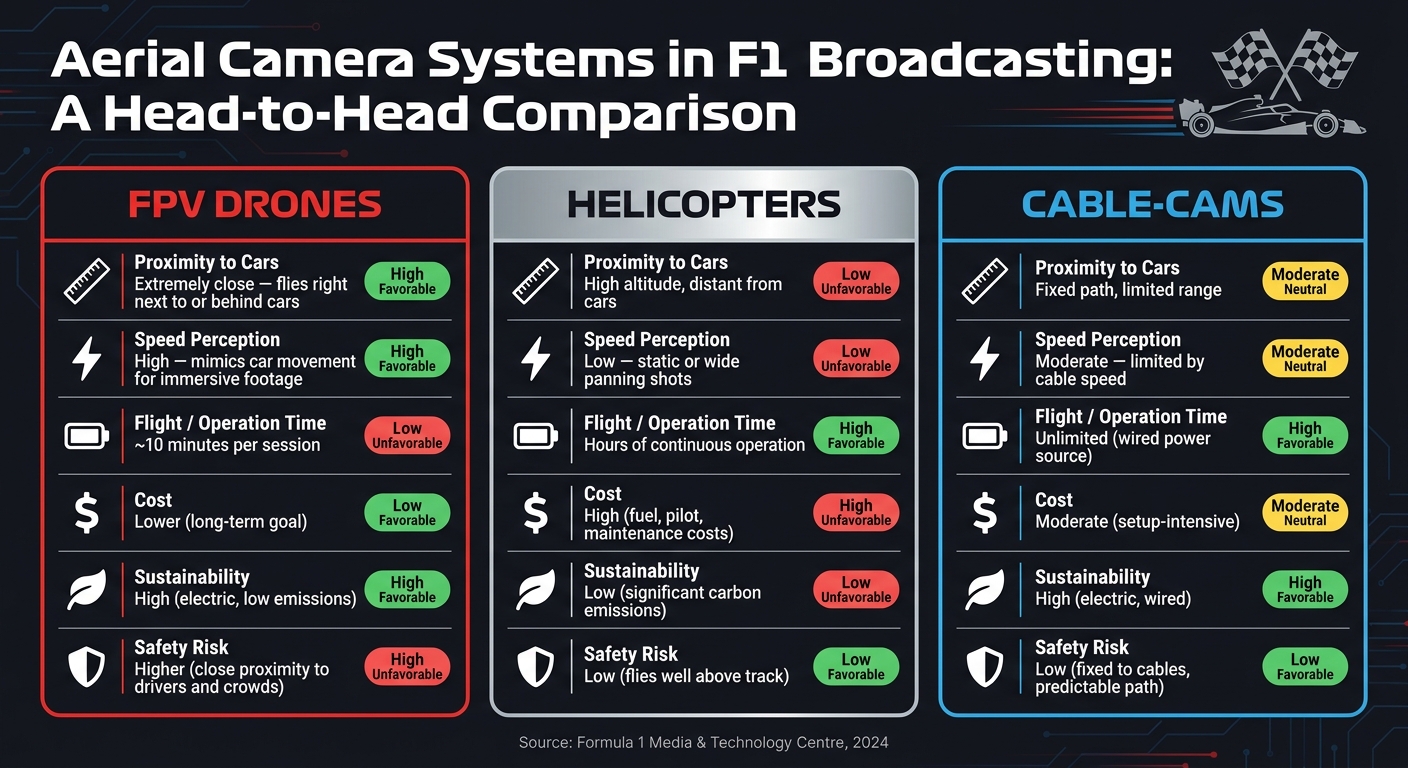
FPV Drones vs. Helicopters vs. Cable-Cams in F1 Broadcasting
New Camera Angles for Viewers
Drones have reshaped how F1 races are broadcast, offering thrilling, close-up views that were once out of reach. Unlike helicopters that capture footage from far above, drones can fly right next to or behind the cars, showcasing the raw speed and intensity of F1 machines like never before.
One standout moment happened in February 2024 when the Dutch Drone Gods teamed up with Red Bull to create what they called the world's first uninterrupted FPV one-shot. This continuous drone footage followed Max Verstappen's RB20 around Silverstone for an entire lap. The result? A jaw-dropping, immersive perspective that static cameras and cable systems simply can't match.
Drones vs. Other Camera Systems: A Comparison
Each camera system used in F1 broadcasts has its own strengths and weaknesses. Here's a quick look at how FPV drones stack up against helicopters and cable-cams:
| Feature | FPV Drones | Helicopters | Cable-Cams |
|---|---|---|---|
| Proximity to cars | Extremely close | High altitude, distant | Fixed path, limited range |
| Speed perception | High - mimics car movement | Low - static or wide panning | Moderate - limited by cable speed |
| Flight time | ~10 minutes per session | Hours | Unlimited (wired) |
| Cost | Lower (long-term goal) | High (fuel, pilot, maintenance) | Moderate (setup-intensive) |
| Sustainability | High (electric) | Low (carbon emissions) | High (electric) |
| Safety risk | Higher (close proximity) | Low (flies well above track) | Low (fixed to cables) |
While drones bring exciting new possibilities, they still face technical hurdles that limit their performance.
Current Limits and What Comes Next
Despite their potential, drones in F1 broadcasting are not without challenges. Limited battery life - around 10 minutes per session - and the difficulty of tracking cars at extreme speeds are two major obstacles. These issues are particularly noticeable on certain circuits, where conditions may not be ideal for drone use.
However, the future looks promising. Roberto Dalla, Managing Director of F1's Media and Technology Centre, has shared that the ultimate vision is to replace helicopter footage with drone shots entirely, citing both cost savings and environmental benefits. Advances in battery technology and signal transmission will be crucial in making this shift a reality. As these improvements come to fruition, drones are poised to play an even bigger role in delivering breathtaking F1 coverage.
Conclusion: Drones in F1 – Past, Present, and Future
Drone technology in Formula 1 has come a long way. What started with early tests in 2022 reached an exciting milestone in February 2024, with stunning FPV footage captured by Red Bull at Silverstone. While drones were once experimental, they’ve now become a valuable tool for race coverage, even if their current use is still somewhat limited.
The challenge lies in balancing cutting-edge technology with the sport’s rigorous safety standards. As Dean Locke highlighted:
"Formula 1 is so fast, we're live, and we are very low latency."
This delicate balance between innovation and safety is crucial for drones to become a regular feature in F1 broadcasts.
Roberto Dalla has suggested that drones could eventually replace helicopter footage, offering a more cost-effective and environmentally friendly solution. However, this vision depends on overcoming hurdles like battery life, signal latency, and the ability to track high-speed action seamlessly.
Looking ahead, the upcoming 2026 regulation changes, which include active aerodynamics, will likely increase the need for dynamic, real-time camera work. As drone technology continues to improve, it’s well-positioned to meet these demands and become an integral part of F1’s future.
FAQs
Why aren’t drones used during the full live race yet?
Drones haven’t yet become a staple in live F1 race coverage, mainly because of safety and regulatory hurdles. The fast-paced nature of F1 makes it risky for drones to operate close to the cars or trackside personnel. On top of that, strict aviation rules and the current state of drone technology restrict their use to controlled scenarios - like capturing specific angles or pre-planned moments.
As technology advances and safety standards become more accommodating, drones might eventually take on a bigger role in live race broadcasts.
What safety rules limit how close drones can fly to cars and crowds?
Drones must maintain a minimum horizontal distance of 50 meters from individuals and should never fly over crowds unless they are directly part of the activity being covered. In the U.S., the FAA enforces strict rules, including banning drone flights over stadiums during events. Additionally, operations near major sporting events are restricted to prioritize public safety.
What tech upgrades would let drones replace helicopters in F1 broadcasts?
Drones could potentially replace helicopters in F1 broadcasting, but they need some key upgrades first. Improvements like longer battery life, better stability at high speeds, and advanced obstacle avoidance systems are essential. Features such as AI-driven stabilization and autonomous controls can help capture smooth, professional-grade footage. Additionally, 5G connectivity plays a crucial role, allowing drones to deliver real-time, high-quality video feeds with minimal lag. With these advancements, drones offer a more flexible and cost-efficient way to provide dynamic race coverage.