Impact of Wet Tires on F1 Safety
How modern F1 wet tires reduce aquaplaning, manage spray, and shape safety and strategy in heavy rain.
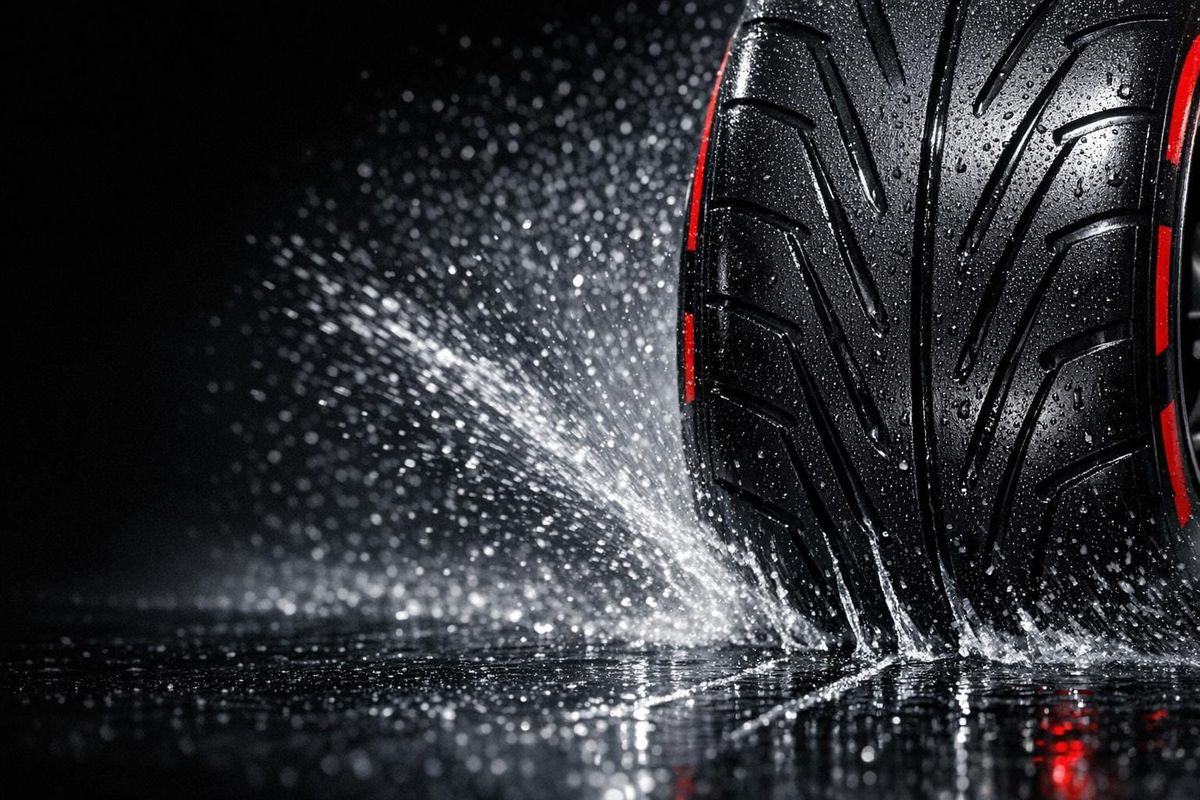
Wet tires in Formula 1 are not just about performance - they're a key safety feature. These tires can channel up to 85 liters of water per second, preventing aquaplaning and ensuring drivers maintain control in heavy rain. Modern wet tires have evolved to perform at 115–118% of dry lap times, narrowing the performance gap from earlier designs that required slowing to 120%. This improvement reduces risks during changing weather.
Key insights:
- Full wet tires: Designed for heavy rain, with deep grooves to clear water but prone to overheating on drying tracks.
- Intermediate tires: Better for damp conditions with less standing water, but less effective in heavy rain.
- Challenges: Managing spray that reduces visibility to as little as 65 feet, and balancing tire performance across varying conditions.
Pirelli's recent advancements aim to improve safety under the 2026 regulations, with tests focusing on cooler compounds and better grip. However, visibility and tire overheating remain challenges, shaping both team strategies and race control decisions during wet conditions.
Why The Correct Wet Tyre Is Key For Victory At The Nurburgring | Tech Talk | 2020 Eifel Grand Prix
sbb-itb-7c68254
Wet Tire Design and Function
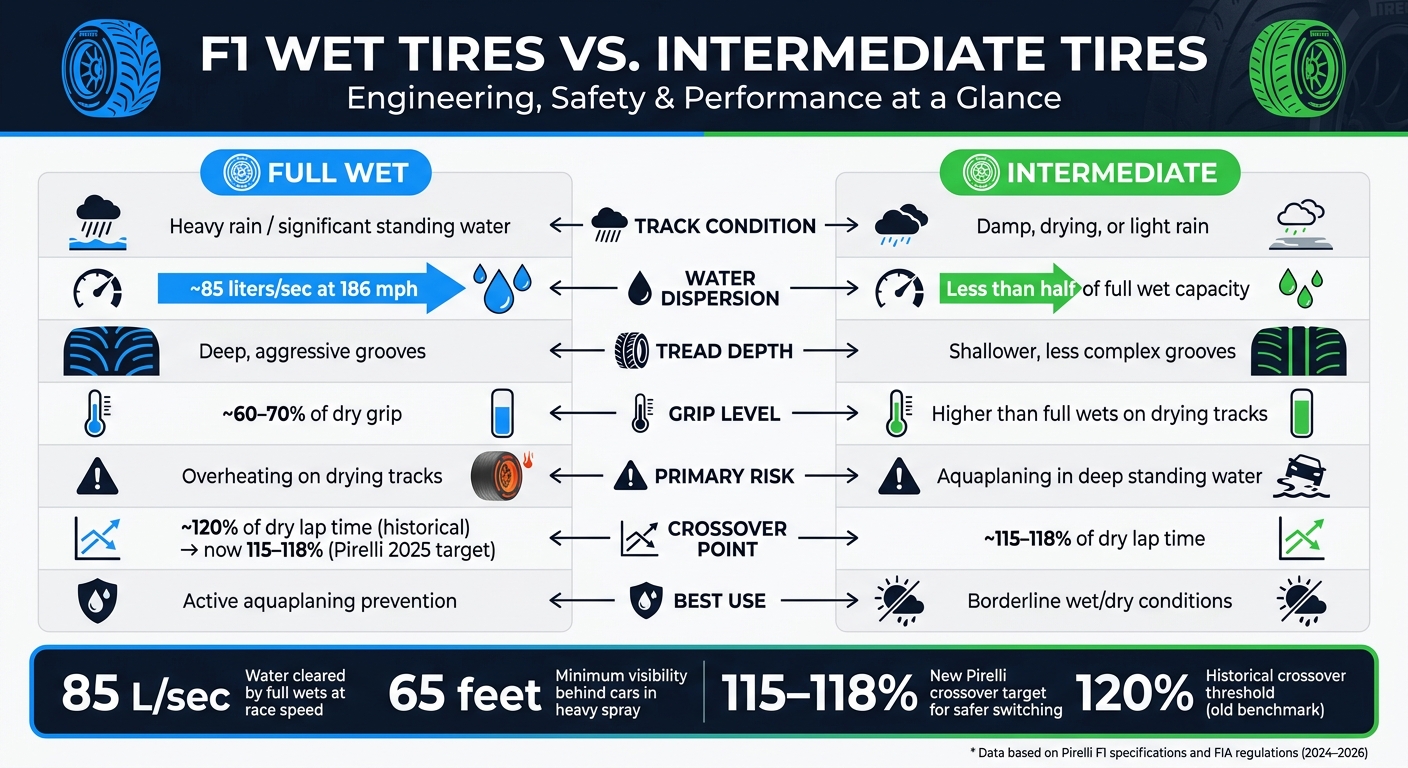
F1 Wet Tires vs. Intermediate Tires: Key Differences & Safety Stats
F1 wet tires are marvels of engineering, crafted to ensure maximum grip and safety in challenging conditions. Every groove, compound, and tread pattern is carefully designed to keep the tire in contact with the track, which is essential for reducing the risk of hydroplaning. These advancements not only improve performance but also play a crucial role in handling the dangers posed by extreme weather.
Wet Tires vs. Intermediate Tires: Key Differences
Though full wet tires (marked in blue) and intermediates (marked in green) may look alike, they serve very different purposes.
Full wet tires are made for heavy rain and significant standing water. Their deep, aggressive grooves are designed to quickly channel water away from the tire, keeping the car stable. Intermediate tires, however, are tailored for damp or drying conditions where standing water is minimal. With shallower grooves, intermediates offer better speed on lightly wet surfaces but fall short in handling heavy rain or puddles.
One of the biggest challenges with full wets is managing heat. On a drying track, these tires can overheat as water evaporates, leading to a drop in performance. Intermediates handle this better, making them the go-to choice when conditions are borderline between wet and dry.
This fundamental design difference is what allows full wets to combat aquaplaning effectively.
How Wet Tires Prevent Aquaplaning
Wet tires use their specialized design to tackle aquaplaning by efficiently channeling water away from the tire’s contact patch. Aquaplaning occurs when water builds up faster than the tire can clear it, creating a film of water that causes the car to lose grip entirely. At F1 speeds, this can be catastrophic.
The deep grooves on full wet tires are key to breaking through this water layer. These grooves direct water away from the contact patch - the part of the tire that touches the track. Smaller cuts in the tread, called sipes, add extra gripping edges for wet surfaces. This intricate design ensures the tire maintains contact with the road, even in heavy rain.
"The wet tyre disperses more than double the water flow of its intermediate counterpart at high speeds." - Jolyon Palmer, F1 Columnist and Former Driver
However, there’s a downside. The displaced water is flung into the air as spray, reducing visibility for drivers behind to as little as 65 feet at high speeds. This visibility issue often influences race control decisions more than the tire's grip itself. Despite this, these design features are critical for maintaining driver safety in wet conditions.
Comparison Table: Wet Tires vs. Intermediates
| Feature | Full Wet Tires | Intermediate Tires |
|---|---|---|
| Track Condition | Heavy rain/standing water | Damp, drying, or light rain |
| Water Dispersion | ~85 liters/sec at 186 mph | Less than half of full wet capacity |
| Tread Depth | Deep, aggressive grooves | Shallower, less complex grooves |
| Grip Level | ~60–70% of dry grip | Higher than full wets on drying tracks |
| Primary Risk | Overheating on drying tracks | Aquaplaning in deep water |
| Crossover Point | ~120% of dry lap time | ~115–118% of dry lap time |
How Wet Tires Improve Safety in Extreme Weather
Braking and Cornering Control in Wet Conditions
On a wet track, the margin for error becomes razor-thin. Wet tires, made with high-silica compounds, stay flexible even in temperatures below 45°F. This flexibility is crucial for maintaining shorter braking distances and reducing the risk of sliding through corners. Modern designs also focus on minimizing lateral movement within the tread blocks, ensuring the contact patch remains stable during high-speed maneuvers. Under the 2026 regulations, aerodynamic adjustments like "corner mode" enhance downforce, working hand-in-hand with tire flexibility to maintain control in wet corners. Preventing sudden shifts in grip is just as important for keeping drivers steady on the track.
Reducing the Risk of Sudden Grip Loss
Full wet tires are designed to combat the dangers of sudden grip loss by efficiently channeling water away, ensuring consistent contact with the asphalt. Choosing the right tire compound for changing weather conditions is critical. A poorly timed tire choice can leave drivers struggling for grip if the weather takes an unexpected turn.
Managing Spray and Visibility
While grip and control are essential, managing spray is equally important for driver safety. The same water displacement that prevents aquaplaning also creates dense spray clouds behind cars. At speeds exceeding 150 mph, this spray can cut visibility for following drivers to just 65 feet. To address this, race control has the authority to declare track conditions as "wet" and mandate specific tire compounds. For instance, during heavy rain, races that start behind the safety car require all cars to use wet tires until their first pit stop. In such cases, visibility concerns often outweigh grip considerations.
Additionally, the FIA can deploy the Safety Car to neutralize the field, allowing standing water to drain and reducing spray levels before racing resumes. While wet tires are vital for maintaining grip, the spray they generate presents a constant challenge for visibility and safety, a balance that race control must carefully manage.
The Development of Wet Tire Technology in F1
Key Moments in Wet Tire History
The evolution of wet tires in Formula One has always revolved around improving driver safety in rainy conditions. Early designs featured deep grooves to manage standing water, but they struggled to deliver competitive performance. For years, full wet tires were only reliable at about 120% of dry lap times, a conservative limit that often led to race stoppages.
This 120% threshold posed a persistent safety issue. The significant gap in performance between intermediate and full wet tires often forced drivers to gamble by staying on intermediates, even in hazardous conditions, to avoid the steep time penalty of full wets. This risky strategy sometimes led to serious incidents, including Lando Norris's crash during the 2021 Belgian Grand Prix, where aquaplaning played a major role. These challenges highlighted the need for innovation and set the stage for recent breakthroughs in wet tire technology.
Recent Advances in Wet Tire Design
In response to these longstanding issues, recent developments have narrowed the performance gap between tire types. Pirelli, Formula One's exclusive tire supplier, has worked to reduce the crossover point to 115–118% of dry lap times. This improvement offers teams a safer and more practical option for switching to full wet tires without sacrificing significant speed. By closing this gap, drivers are less likely to delay tire changes in dangerous conditions, improving overall safety.
One of the key advancements lies in overcoming thermal challenges. New compounds are engineered to keep the rubber cooler, minimizing lateral movement within the tread blocks. This not only extends the tire's lifespan on partially wet tracks but also prevents the overheating issues that previously forced premature switches back to intermediates.
In 2025, Pirelli conducted wet tire tests at the Fiorano circuit with drivers Charles Leclerc and Zhou Guanyu. Using "mule cars" designed to replicate the aerodynamic and mechanical loads expected in the 2026 F1 season, these tests focused on new tread patterns and compounds aimed at achieving the 115% crossover target. The goal is to create wet tires that perform effectively during active racing, rather than being limited to laps behind the Safety Car. These innovations are reshaping how teams approach wet weather strategy, offering better protection for drivers in unpredictable conditions.
Race Strategy and Safety Decisions with Wet Tires
Racing in wet weather shifts Formula 1 strategy from a precise calculation to a game of high-stakes judgment. Every call - whether it’s the timing of a pit stop, the choice of tire, or deciding to stay out - has implications beyond just points. Safety becomes a critical factor.
Choosing Between Full Wets and Intermediates
When the rain comes, teams face a key decision: Should they go with full wet tires, designed for heavy rain, or intermediates, which work better in damp conditions? The answer often hinges on a concept called the crossover point - the lap time where one tire compound starts outperforming the other. Historically, this point was around 120% of dry lap times, but Pirelli’s advancements have tightened the range to 115–118%, allowing drivers to switch sooner without sacrificing grip.
But it’s rarely a simple choice. Full wet tires excel at clearing water at high speeds, making them essential when there’s standing water on the track. However, they overheat quickly on a drying surface, forcing teams to switch to intermediates sooner. On the flip side, intermediates can be risky if standing water remains. Their shallower tread struggles to clear water, increasing the chance of aquaplaning and loss of control. Staying out too long on the wrong tires can cost drivers precious seconds - sometimes multiple seconds per corner.
In these moments, driver feedback often takes precedence over sensor data. Real-time input from the cockpit provides critical insights into grip levels as conditions change.
How Wet Tire Performance Affects Race Control
Advancements in wet tire design don’t just influence team strategies; they also shape how race officials manage safety during wet races. For instance, if conditions warrant a safety car start, FIA regulations require all cars to run full wet tires until their first pit stop. Race control relies on a mix of tools - driver radio communications, onboard cameras, track sensors, and feedback from the safety car - to assess whether conditions are improving or deteriorating.
Visibility often becomes the deciding factor for red flags, more so than the intensity of the rain itself. At speeds of 155 mph, heavy spray can reduce visibility to as little as 65 feet. When that threshold is breached, race control typically halts the race for safety reasons.
Case Studies: Wet Tire Decisions in Notable Races
Several recent races highlight how wet tire technology and strategy intersect with race outcomes.
The 2021 Belgian Grand Prix is a prime example. Severe spray conditions led Race Director Michael Masi to red-flag the event after just three laps under the safety car. No green-flag laps were completed, yet half-points were initially awarded, sparking criticism. This controversy prompted the FIA to revamp the points system for shortened races starting in 2022. The new system uses a graduated scale based on the percentage of race distance completed.
| Race Distance Completed | Points Eligibility | Scoring Scale |
|---|---|---|
| Less than 2 green-flag laps | No points | N/A |
| 2 laps to 25% | Top 5 finishers | 6–4–3–2–1 |
| 25% to 50% | Top 9 finishers | 13–10–8–6–5–4–3–2–1 |
| 50% to 75% | Top 10 finishers | 19–14–12–9–8–6–5–3–2–1 |
| Over 75% | Full points | Standard 25–18–15... scale |
The 2020 Turkish Grand Prix provided a different lesson. Lance Stroll, leading for Racing Point, stayed on intermediates for too long as the track dried, costing him a podium finish. In other cases, like recent races in Belgium and Brazil, drivers opted to stay on intermediates even in heavy rain because full wet tires overheated too easily. This tendency led to longer safety car periods. Addressing this issue is a key focus of Pirelli’s development program for 2026.
The evolving interplay between tire technology and race-day decisions continues to shape how F1 tackles wet conditions, balancing performance with safety.
Conclusion: What Lies Ahead for Wet Tire Technology in F1
Wet tire technology has come a long way, evolving from basic grooves to advanced compounds capable of displacing up to 85 liters of water per second. Yet, despite these advancements, there are still significant challenges to overcome.
One of the biggest hurdles on the horizon is adapting wet tires to the demands of the 2026 regulations. These changes introduce lighter chassis, reduced downforce, and a 50/50 power split between combustion engines and electric systems, with the electric component alone generating around 470 bhp. With less aerodynamic grip available, tires will need to handle more of the load during braking and cornering. To prepare for this, Pirelli is already testing new compounds at Fiorano. These updates require breakthroughs in tire design to ensure driver safety in low-grip conditions.
Thermal management is another key area of focus. Full wet tires tend to overheat quickly when conditions shift, which often pushes teams to rely on intermediates even in heavy rain. Pirelli is working on compounds that can stay cooler while maintaining lateral stability. The aim is to reduce the performance gap that has historically existed with full wets, making them more suitable for active racing rather than just safety laps.
Driver feedback highlights the ongoing struggle to find the right balance between safety and performance. Mercedes driver and GPDA Director George Russell has pointed out that "wet tires are unnecessary unless extreme standing water poses a risk of aquaplaning". Similarly, Ferrari’s Charles Leclerc has noted that while wet tires are effective at preventing aquaplaning, they "lack viability for racing due to poor grip". Bridging this gap remains a critical challenge for both Pirelli and the FIA as F1 moves into its next chapter.
If these innovations succeed, they could significantly reduce wet-weather risks and set new safety benchmarks for the sport.
FAQs
Why do F1 races still get stopped in heavy rain if wet tires clear water?
When heavy rain hits an F1 race, it's not just about wet tires doing their job. While these specialized tires are designed to clear water and minimize aquaplaning, extreme weather introduces challenges that go beyond what technology can handle. Reduced visibility, unpredictable grip levels, and the risk of aquaplaning at high speeds make racing in such conditions incredibly dangerous.
On top of that, wet tires can struggle during prolonged rain. They might overheat or degrade, which directly affects their performance and the drivers' ability to stay in control. To ensure the safety of everyone involved, race control steps in to delay or stop races when the weather pushes the tires - and the drivers - beyond their limits. Safety always comes first.
When should teams choose full wets instead of intermediates?
When the track is soaked, and the risk of aquaplaning is high, teams should opt for full wet tires. These are designed specifically for heavy rain, standing water, or situations where puddles are forming rapidly. In such conditions, intermediates can struggle - they may overheat or fail to provide enough grip. Thanks to recent improvements in wet tire technology, full wets now offer better water displacement and more consistent performance, making them the go-to option for maintaining control and ensuring driver safety during extreme weather.
How will the 2026 rules change wet-tire safety?
The 2026 rules focus on improving wet-tire safety with a new design that performs more effectively across a broader range of wet conditions. These updates aim to minimize overheating and tire wear, making racing in rainy weather safer and more tactical. With better-performing tires, drivers can expect greater control and stability even in extreme weather, tackling some of the biggest challenges of racing on wet tracks.