5 Lessons from SAFER Barrier Development
Five lessons from SAFER barrier development: data-led design, extend crash pulse, tailor placement, limit rebound, and continuous updates.
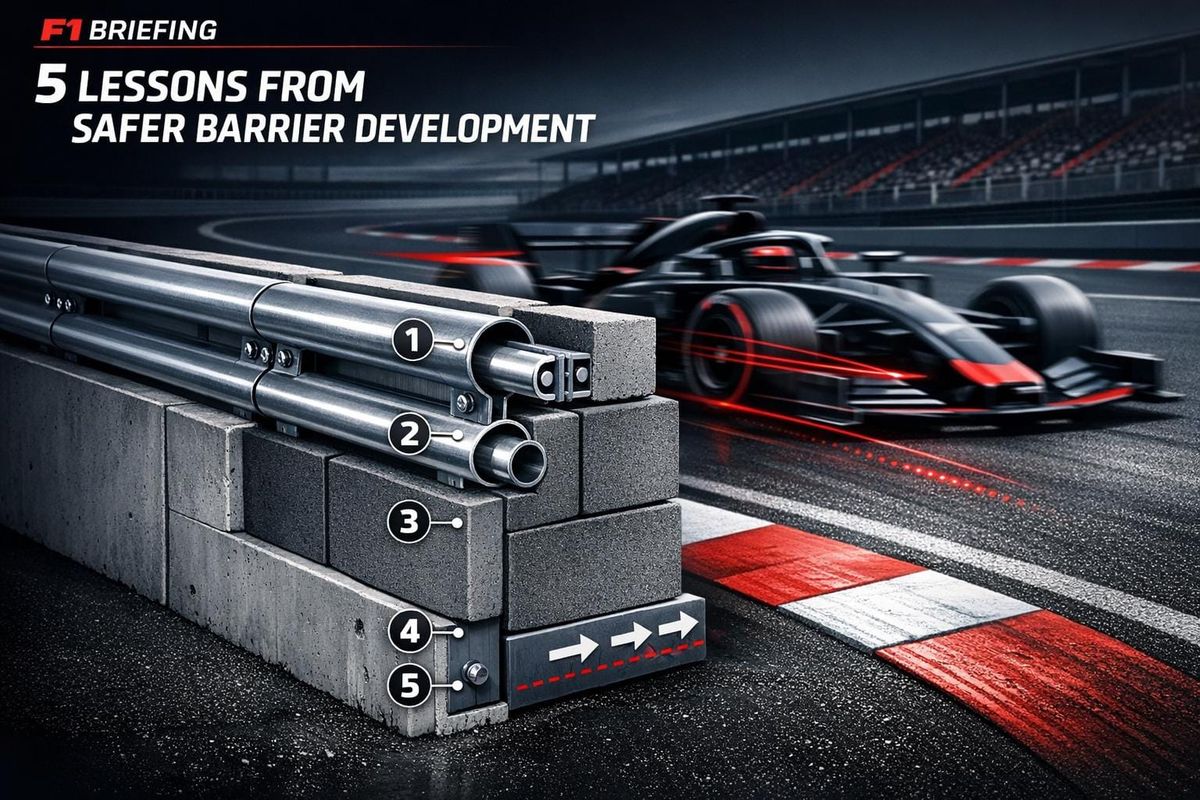
The SAFER barrier, or Steel And Foam Energy Reduction barrier, has transformed motorsport safety. Developed between 1998 and 2002, it combines steel and foam to absorb crash energy, reducing peak impact forces by 30% to 80%. First used at the Indianapolis Motor Speedway in 2002, it's now a key safety feature in motorsports worldwide, including Formula One tracks like Baku and Zandvoort. Here's what its development teaches us:
- Use Crash Data, Not Assumptions: Real crash data drives effective safety designs. Early trial-and-error methods, like hay bales or concrete walls, gave way to data-driven solutions after failures like the 1998 PEDS barrier incident.
- Extend the Crash Pulse: Spread impact forces over time to reduce peak deceleration, as the SAFER barrier does with steel and foam layers.
- Match Barriers to Track Layouts: Tailor barrier placement to track-specific hazards, such as high-speed corners or limited runoff areas.
- Minimize Rebound Risks: Reduce vehicle rebound to prevent secondary collisions with following cars.
- Continuous Updates Are Key: Regular maintenance and upgrades ensure barriers remain effective as cars and tracks evolve.
The SAFER barrier's success lies in its focus on data, adaptability to specific track needs, and commitment to ongoing improvement. These principles continue to guide advances in motorsport safety.
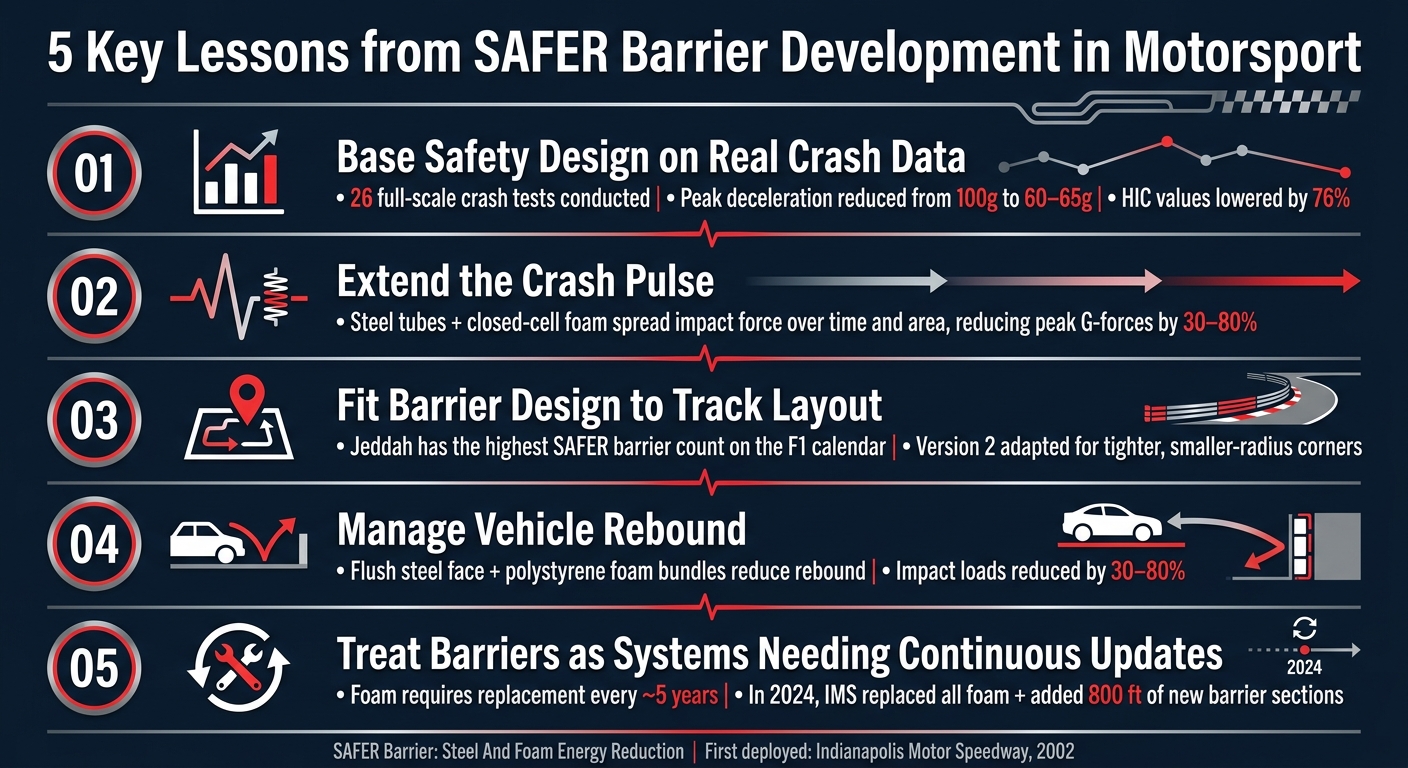
5 Key Lessons from SAFER Barrier Development in Motorsport
Brian Barnhart Discusses the PEDS and SAFER Barriers - Off Track with Hinch and Rossi
sbb-itb-7c68254
1. Base Safety Design on Real Crash Data, Not Assumptions
Protecting lives in motorsport requires more than just good intentions. Early F1 circuits relied on hay bales for barriers until Lorenzo Bandini’s 1967 crash exposed the fire risks they posed. Concrete walls came next, but while they shielded spectators, they transferred the full force of crashes directly to drivers. These early mistakes highlighted the need for safety measures rooted in real-world data rather than guesswork.
A pivotal moment in safety design occurred in July 1998 at Indianapolis Motor Speedway. During an IROC race, Arie Luyendyk collided with the PEDS (Polyethylene Energy Dissipating System) barrier. While the car itself remained intact, the barrier disintegrated on impact, scattering debris and causing the car to rebound dangerously. Engineers hadn’t anticipated this "catch and pivot" failure mode. This incident became the starting point for the development of the SAFER barrier, which revolutionized track safety.
More recently, after severe crashes involving Anthoine Hubert and Lando Norris at Spa-Francorchamps, Jarno Zaffelli, CEO of Dromo Circuit Design, used virtual simulations to investigate the causes. His analysis uncovered a bumpy patch on the track caused by flooding - a subtle yet dangerous flaw he called a "mistake generator." After fixing the surface, the circuit went nine months without any geometry-related accidents. This success underscored the importance of using data-driven simulations to identify and address hidden risks.
"The reason we achieved this result [at Spa] is because we virtually simulated a lot of scenarios to understand why accidents happened." - Jarno Zaffelli, CEO of Dromo Circuit Design
The SAFER barrier itself is a testament to the power of data-driven design. Engineers conducted 26 full-scale tests using sleds and race cars equipped with instruments. These efforts reduced peak deceleration from over 100g to 60–65g and lowered HIC (Head Injury Criterion) values by 76% compared to rigid walls. None of these advancements would have been possible without relying on real crash data to guide every step of the process.
2. Extend the Crash Pulse Instead of Just Hardening the Wall
When it comes to managing the energy from a crash, the focus shifts from simply reinforcing barriers to controlling how that energy is absorbed. Imagine catching a baseball: a stiff arm stops the ball suddenly, transferring all the force at once, while a flexing arm spreads the impact over time, reducing the peak force. This same principle is at the heart of extending the crash pulse, which inspired the construction of the SAFER barrier.
The SAFER barrier incorporates a combination of steel tubes and closed-cell foam inserts to create a layer that absorbs and spreads out the impact energy. When a car hits the barrier, the steel bends and the foam compresses, distributing the force over a larger area and longer time frame. This significantly reduces the intense G-forces experienced during a crash, even though the total energy remains unchanged. This design is particularly crucial in Formula One, where high speeds and limited runoff areas make minimizing peak deceleration a priority.
"The theory behind the design is that the barrier absorbs a portion of the kinetic energy released when a race car makes contact with the wall. This energy is dissipated along a longer portion of the wall." - Wikipedia
The flush steel surface was another intentional feature. It ensures that cars slide along the barrier in a controlled manner, avoiding sudden deflections back into the track - a critical safety measure identified during the barrier's development from 1998 to 2002. This combination of energy absorption and predictable car behavior has made the SAFER barrier a game-changer in crash safety.
3. Fit Barrier Design to Track Layout and Impact Angles
Each section of a racetrack comes with its own set of hazards, which is why SAFER barriers aren't installed uniformly around a circuit. Instead, their placement is customized to match the track's layout and the typical angles of impact. This approach highlights how barrier design has shifted from just absorbing crash energy to addressing the specific challenges of individual tracks.
"SAFER barriers are placed in long sweeping turns with a long impact angle where space is limited between the track and the wall." - RacingNews365
Take the Jeddah Corniche Circuit in Saudi Arabia, for instance. This track features the highest number of SAFER barriers on the F1 calendar. With its narrow layout and numerous high-speed turns, it creates scenarios where shallow impact angles and minimal run-off areas call for enhanced safety measures. Similarly, at the Baku City Circuit, SAFER barriers are strategically positioned at Turns 13 and 19 - locations where high speeds and limited space make traditional run-off zones impractical.
The design of these barriers has evolved significantly over time. Initially developed for large oval tracks, the system was later upgraded ("Version 2") to handle the demands of tighter, smaller-radius corners. A prime example of this adaptation can be seen at Circuit Zandvoort. During its 2020 redevelopment for the Dutch Grand Prix, SAFER barriers were added to the banked Turn 14 to better manage the unique impact trajectories associated with that corner.
Modern track design now relies heavily on technology to make informed decisions. Engineers use AI and virtual simulations to analyze crash data, identify high-risk areas, and determine the most effective locations for barrier placement. Jarno Zaffelli, CEO of Dromo Circuit Design, explains:
"The right approach is designing the most challenging track that you can do, and as soon as you have it, you can calculate the kind of run-off that you want."
For temporary street circuits, which often lack continuous concrete walls, SAFER barriers can be installed as freestanding units. This eliminates the need for additional structural support, making them a flexible solution for diverse racing environments. This adaptability ensures that safety measures continue to evolve alongside the ever-changing demands of motorsport.
4. Manage Vehicle Rebound to Reduce Risk for Following Cars
When a car crashes and rebounds back onto the track, the danger doesn’t stop with the initial impact. This rebound can lead to a secondary collision, often catching following drivers off guard with little time to react. A striking example of this occurred during the 1998 IROC race at Indianapolis. In that incident, a car hit a PEDS barrier and was violently thrown back into the path of oncoming traffic, amplifying the risk.
To tackle these risks, the SAFER barrier was designed with rebound reduction in mind. Its construction uses closed-cell polystyrene foam bundles that absorb the car’s kinetic energy rather than reflecting it. High-strength steel tubes then spread the impact force across a larger section of the wall. This combination reduces impact loads and vehicle deceleration by a significant 30% to 80%. By minimizing the rebound effect, these features play a critical role in improving track safety.
"They are designed to distribute the impact load across the barrier, reducing kinetic energy, lowering the chance of injury to the driver and avoid bounce-back onto the track." - RacingNews365
Another key component of the SAFER barrier is its smooth, flush steel face. A jagged or protruding edge could cause a car to snag and spin back into traffic, creating additional hazards. To prevent this, the steel tubes are welded into a seamless surface, allowing damaged vehicles to slide along the wall instead of hooking into it. This keeps the car near the track’s perimeter, leaving the main racing line unobstructed. Reinforcements like internal steel splices and 3/8-inch diameter cables ensure the barrier stays intact during a crash, reducing the risk of debris scattering onto the track.
5. Treat Safety Barriers as Systems That Need Continuous Updates
Safety barriers aren't a one-and-done solution - they need regular updates to stay effective. Crashes on the track often reveal weaknesses that controlled lab tests can't predict, and racing conditions are always evolving. A good example of this is the history of the SAFER barrier. Earlier versions, like the PEDS barriers, were retired after real-world crashes exposed critical flaws.
The evolution of the SAFER barrier itself tells the story. After Robby McGehee's 218 mph crash during a 2002 Indy 500 practice, engineers made significant changes. They added a fifth 8-inch steel tube, increasing the barrier height from 32 inches to 40 inches, and adjusted the foam placement. This shift from Version 1 to Version 2 was driven by the realization that every crash is a learning opportunity, not just an isolated event.
Racing vehicles also keep changing, which adds another layer of complexity. The heavier Formula 1 cars introduced in 2022 tested the limits of older barriers, forcing engineers to reassess whether these safety systems could handle the increased kinetic energy. The FIA's 3501-2017 standard for Grade 1 circuits now requires all barrier repairs to align with current safety benchmarks. These changes pushed the development of advanced simulation tools to identify risks before they become problems.
Simulations have become a game-changer for improving safety. At Spa-Francorchamps, thousands of simulated crash scenarios flagged a track bump as a hazard. This led to an immediate redesign of both the track surface and the surrounding barriers. Over the next nine months, there were no accidents unrelated to mechanical issues or collisions between cars.
"The reason we achieved this result is because we virtually simulated a lot of scenarios to understand why accidents happened." - Jarno Zaffelli, CEO, Dromo Circuit Design
It's not just about structural updates - materials need attention too. For instance, the closed-cell polystyrene foam inside SAFER barriers breaks down after about five years of UV exposure. To keep its energy-absorbing properties intact, the foam requires periodic replacement. In 2024, Indianapolis Motor Speedway replaced all the foam in its barriers and added 800 feet of new sections to improve performance in oblique crashes. Regular maintenance like this is a critical part of keeping safety systems effective.
Conclusion
The development of SAFER barriers highlights an undeniable truth: safety in motorsports is a precise engineering discipline, not something addressed after the fact. Key principles like starting with actual crash data, extending the crash pulse, adapting barriers to track geometry, controlling rebound, and treating barriers as dynamic systems have reshaped how modern F1 circuits are designed and maintained. These principles don't just influence current track designs - they also set the stage for future advancements.
The impact of these innovations is evident on circuits with challenging layouts, such as Jeddah and Zandvoort, where data-driven barrier designs have proven their worth.
What stands out is that this progress is a continuous journey. As Luca De Angelis, Deputy Manager at EM Motorsport, explains:
"Ideally, we would have a system that can integrate all these parts together. Using artificial intelligence to collect information from the different parts... will give us a better understanding of what's going on."
The shift from basic barrier solutions to sophisticated, data-informed systems - like SAFER and newer technologies such as Tecpro - marks a major step forward in motorsport engineering. Looking ahead, the integration of AI into safety systems promises even greater advancements for the industry.
For more updates on F1 safety developments, track design innovations, and the engineering driving the sport, visit F1 Briefing, where the focus goes beyond race results to uncover the technical forces shaping motorsport.
FAQs
Why isn’t a stronger concrete wall the safest option?
A more rigid concrete wall might seem like a safer choice, but it actually poses significant risks during crashes. Its inability to absorb impact energy means that the force of a collision is transferred directly to the vehicle and, ultimately, the driver. This lack of energy dissipation can result in more severe injuries for those involved.
How do engineers decide where SAFER barriers are needed on a track?
Engineers decide where to place SAFER barriers by focusing on sections of a track with the highest crash risks. These include sharp turns, high-speed straightaways, and areas with little to no runoff space. By examining crash data, studying track layouts, and evaluating potential impact risks, they identify spots where severe crashes are most likely. The aim is to absorb crash energy effectively and improve safety for drivers and spectators, all while ensuring the flow of race operations remains smooth.
How often do SAFER barriers need inspection or foam replacement?
SAFER barriers undergo regular inspections, with their foam being replaced either after impact events or during scheduled maintenance. Although exact intervals aren't specified, advancements in their design focus on enhancing both safety and durability, ensuring these checks remain an integral part of safety measures.