How F1 Sidepods Shape Airflow and Cooling
Explains how inlet size, undercut, radiator layout and exits trade cooling, drag and rear downforce on F1 cars.
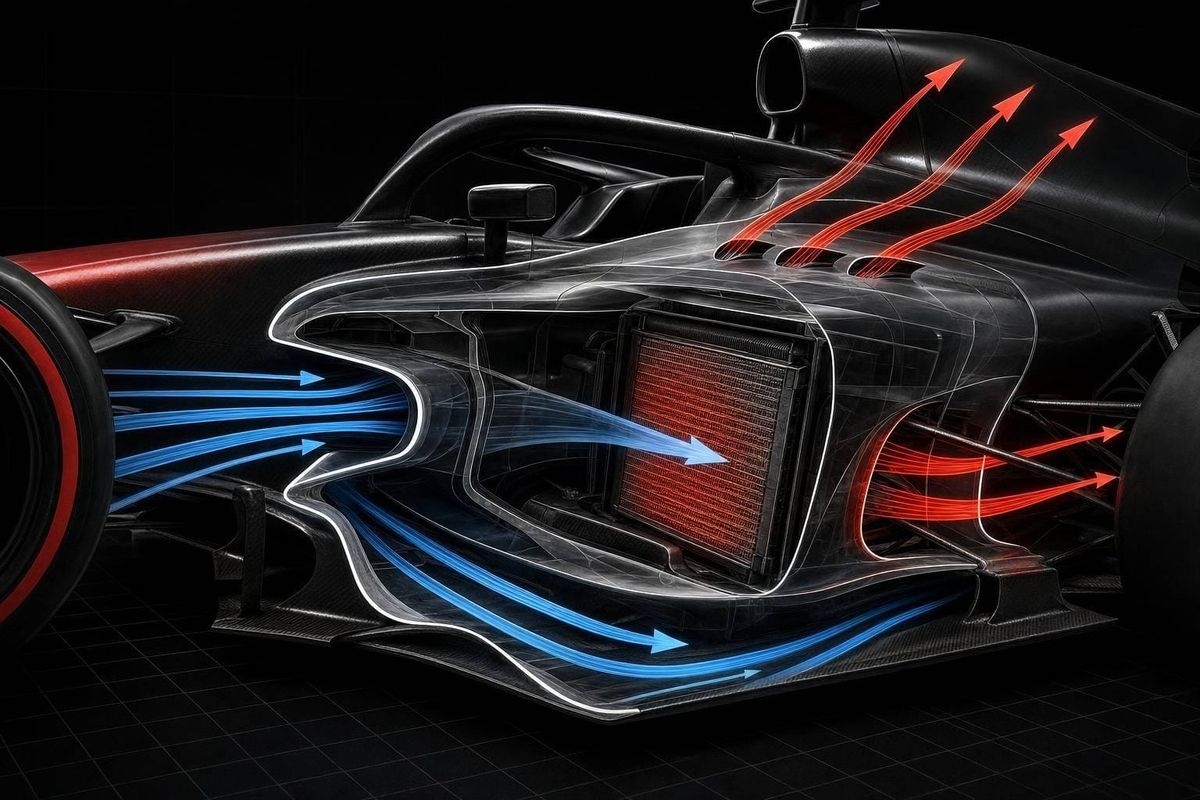
An F1 sidepod does two jobs at once: it cools the car and shapes the air that feeds the floor, diffuser, and rear wing. If I want to read a sidepod fast, I look at 4 things: the inlet size, the undercut, the radiator layout, and the heat exits.
Here’s the short version:
- Large inlets give more cooling margin, but they usually add drag.
- Small inlets can cut drag, but they leave less room for hot races and dirty air.
- A deep undercut pushes air along the floor edge and can help the car keep floor load.
- Radiator position and angle change the outside shape, which changes how cleanly air reaches the rear of the car.
- Louvers and rear exits dump heat, but each opening can hurt surface flow.
That’s why sidepods are never just “big” or “small.” They are a trade between heat control, drag, and rear downforce. In recent F1 design trends, teams have moved between ultra-slim ideas and more common downwash shapes because even a small airflow gain at the rear can be worth a lot over a lap.
| What I check | What it tells me |
|---|---|
| Inlet | How much cooling the car is set up to handle |
| Undercut | How hard the car feeds air toward the floor edge |
| Radiators | How tight the package is inside the bodywork |
| Exits / louvers | How the team dumps heat and what aero cost it accepts |
If you keep those four checks in mind, you can look at almost any F1 sidepod and spot the team’s main trade-off in seconds.
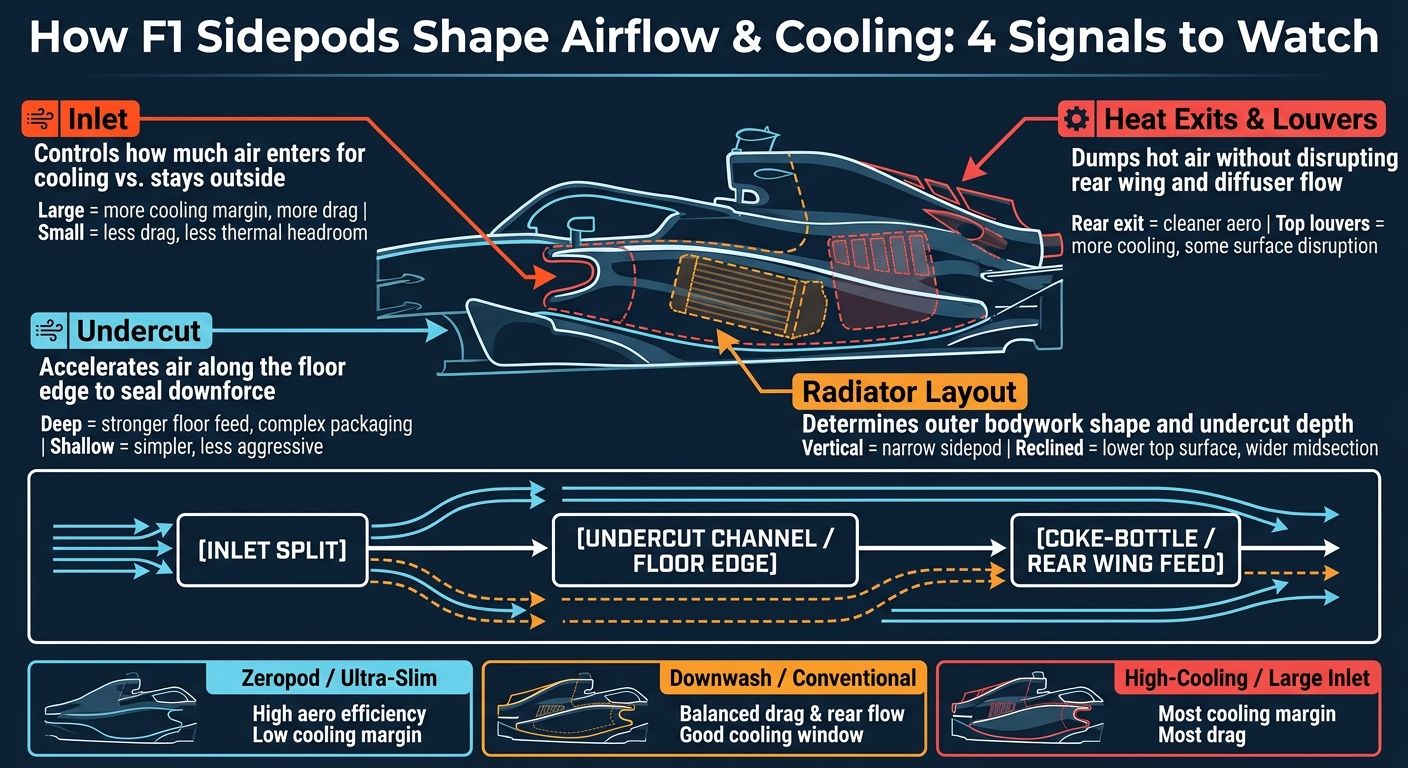
How F1 Sidepod Airflow Works: 4 Key Design Signals Explained
F1's Downwash Aero Tech Explained
sbb-itb-7c68254
Step 1: Follow the Airflow From the Inlet to the Rear of the Car
Start at the inlet. It sets the balance between air used for cooling and air kept on the outside of the car.
What the Front Inlet Takes In and What Stays Outside
The first thing to look at is the inlet. At the inlet lip, the flow splits. Air that gets captured goes to the radiators and intercoolers. Air that stays outside is pushed over the car’s outer surfaces.
That split matters a lot. Air sent through the radiators adds internal drag, so teams only take in the minimum amount needed for cooling. It’s a tight trade-off: enough air to keep temperatures under control, but not so much that the car pays for it in drag.
How the Undercut Speeds Up Flow Along the Floor Edge
Below the inlet, the sidepod curves inward and upward to form the undercut - the recessed channel along the side of the car. As that gap gets narrower, the air speeds up along the floor edge.
That faster flow helps seal the floor. In plain English, it helps stop the low-pressure area under the car from spilling out the sides, which helps keep downforce in place. That’s why teams work so hard to shrink cooling hardware: a smaller package opens up the undercut and gives that floor edge flow more room to do its job.
Why the Rear Bodywork Depends on Clean Sidepod Flow
After the air moves through the undercut, it feeds the coke-bottle area, where the bodywork tightens toward the rear. As the car narrows, the airflow speeds up into the space between the rear wheels. That gives more energy to the air reaching the beam wing and the top of the diffuser.
The beam wing needs a clean feed from the sidepod flow. At the same time, the sidepod bodywork helps push the wake from the spinning rear tires outward and away from the rear bodywork. If the flow breaks away before it reaches the coke-bottle area, rear-end efficiency drops fast.
Next, inlet size and undercut depth show how teams trade cooling margin for airflow.
Step 2: Compare Inlet Size and Undercut Shape
Now look at two clues you can spot right away: inlet size and undercut depth. Start with the inlet opening. Then check the undercut below it. Together, they show what the team is leaning toward.
Larger Inlets vs. Smaller Inlets
A larger inlet gives the cooling system more margin. Put simply, it helps the car deal with heat more safely. The trade-off is drag, plus a less efficient outer airflow.
A smaller inlet cuts drag, tightens packaging, and gives engineers more freedom to shape the outer bodywork cleanly. But there’s a catch: less thermal headroom. So if ambient temperatures climb or the car sits in dirty air, there’s less room for error.
Deep Undercuts vs. Shallow Undercuts
Undercut depth affects how hard the car pushes air toward the floor edge. A deep undercut makes a stronger channel, which can boost downforce from the floor and diffuser.
A shallow undercut gives up some of that force for stability and easier packaging. It’s simpler to route radiators and other internal parts when the bodywork isn’t carved away so aggressively. That kind of shape fits cars that need simpler packaging and a less aggressive floor-feed approach.
Comparison Table: Inlet and Undercut Design Effects
Use the table below to judge how each choice changes floor feed and cooling headroom.
| Design Choice | Cooling Capacity | Aerodynamic Effect | Packaging Complexity |
|---|---|---|---|
| Large Inlet | High; better for hot conditions and dirty air | Higher drag from a larger frontal opening | Larger internal packaging |
| Small Inlet | Lower; requires efficient heat exchange | Lower drag; allows cleaner outer shaping | Tighter; supports compact aero packaging |
| Deep Undercut | Neutral | High acceleration toward the floor edge; higher downforce potential | High; complex internal component routing |
| Shallow Undercut | Neutral | More stable, less aggressive flow | Lower; easier to package radiators and other components |
Teams pair inlet size and undercut shape based on cooling load and floor design. Next, radiator placement and heat exits show how they protect that airflow without overheating the car.
Step 3: Understand Radiator Layout and Hot-Air Exit Strategy
Once inlet size and undercut depth are locked in, the next limit is internal packaging. This is where the sidepod's shape gets decided. Radiator position, angle, and stacking affect two things at once: the outer bodywork that guides airflow around the car, and how much clean air still makes it to the floor and rear bodywork.
How Radiator Position Changes the Outer Bodywork
A vertical radiator can free up space across the car and help keep the sidepod narrow. A more reclined radiator can lower the top surface and form a ramp that guides air rearward.
That trade-off matters. A compact radiator package helps preserve the undercut. A larger or flatter setup pushes the bodywork outward and weakens that floor-edge channel.
Teams also stack more than one heat exchanger inside the same sidepod space. A forward-leaning layout can make room for a deeper undercut below it. A flatter layout usually leads to a wider middle section.
And that same packaging choice affects heat rejection too. If the layout is awkward, getting hot air out cleanly becomes much harder.
How Teams Vent Heat Without Disrupting Rear Flow
The main exit is usually at the rear of the sidepod, where heated air leaves through an opening in the bodywork. Where that exit sits matters a lot. If hot air is released in the wrong place, it can upset the flow heading toward the rear wing. That's why teams try to route the exit so it stays out of that path.
Louvres - the small slots you sometimes see on the upper surface - help release heat when cooling demand goes up, but they also disturb the surface flow. A car with most of its louvres sealed is leaning toward aero cleanliness. A car with several open is giving up some efficiency for more cooling headroom.
The goal is simple: get rid of heat without dirtying the flow going to the floor and rear wing. Those packaging calls shape the drag-versus-cooling trade-off that comes next.
Step 4: Balance Drag, Downforce, and Heat Control
Why the Best Sidepod Is Always a Compromise
Once you've looked at inlet size, undercut depth, and heat exits, the last step is simple: weigh the gains against the losses.
Every sidepod design is a trade-off between drag, downforce, and cooling. Push hard in one direction, and something else usually gives. A slim package may cut drag, but it can leave less room for heat control. A larger cooling setup may help in hot conditions, but it often adds drag.
That balance also changes from race to race. Temperature matters. Track layout matters. Traffic matters too. In hotter events, teams usually need more cooling margin even if it costs them some straight-line speed.
Trade-Off Table: Aero Efficiency vs. Cooling Margin
Use this comparison to judge what a team is prioritizing when weather, track demands, or traffic shifts.
| Sidepod Concept | Aerodynamic Efficiency | Cooling Margin |
|---|---|---|
| Zeropod / ultra-slim | Strong drag reduction; minimal bodywork volume | Low thermal headroom; sensitive to heat soak |
| Downwash / conventional | Slightly more drag; better rear airflow management | Better cooling window; more stable platform |
| High-cooling / large inlet | Most drag | Most cooling margin; aero efficiency sacrificed |
You can usually spot those priorities by looking at a few key areas:
- Inlet size
- Undercut depth
- Radiator packaging
- Outlet strategy
Conclusion: 4 Signals to Watch on Any F1 Sidepod
When you study an F1 sidepod, four signals reveal most of the idea behind it. Inlet size shows how much cooling the team has built in. Undercut depth shows how hard they're pushing airflow toward the floor edge. Radiator layout shapes the outer bodywork. And outlet strategy - whether heat leaves cleanly through the rear or through top louvers - shows where the team has chosen to sit between cooling needs and aero loss.
No single feature tells the whole story. The sidepod only makes sense when you judge how it works with the rest of the car's airflow and how well it keeps temperatures under control across different race conditions.
FAQs
Why do teams change sidepod cooling from race to race?
Teams adjust sidepod cooling to balance heat management with aerodynamic efficiency. Cooling demand shifts with ambient temperature and track layout, especially since power units and the high-energy-density batteries used under the 2026 rules produce a lot of waste heat.
By changing inlet sizes and bodywork, teams can pull heat out more effectively while keeping drag in check and protecting airflow to the floor and rear diffuser. That helps keep the aerodynamic platform stable and the car dependable through the full race weekend.
How do sidepods affect rear tire wake?
Sidepods help control airflow around the car. They guide air toward the floor, rear bodywork, and cooling inlets. Their shape also changes how that air deals with the messy wake coming off the rear tires.
Get that interaction under control, and the car can hold on to aerodynamic efficiency, keep its balance steadier, cut drag, and reduce the trouble caused by tire wake.
Why did some teams move away from ultra-slim sidepods?
Teams moved away from ultra-slim or zeropod designs because those concepts often didn't deliver enough performance or a steady operating window compared with more conventional layouts.
In the current ground-effect era, most of the gains come from the floor. So teams shifted to bodywork that supports the floor and diffuser more effectively. That change also helped give drivers more stable, predictable handling in different track conditions.