F1 Telemetry Systems: From Analog to Digital
How F1 moved from delayed analog logs to live digital streams from hundreds of sensors, reshaping strategy and reliability.
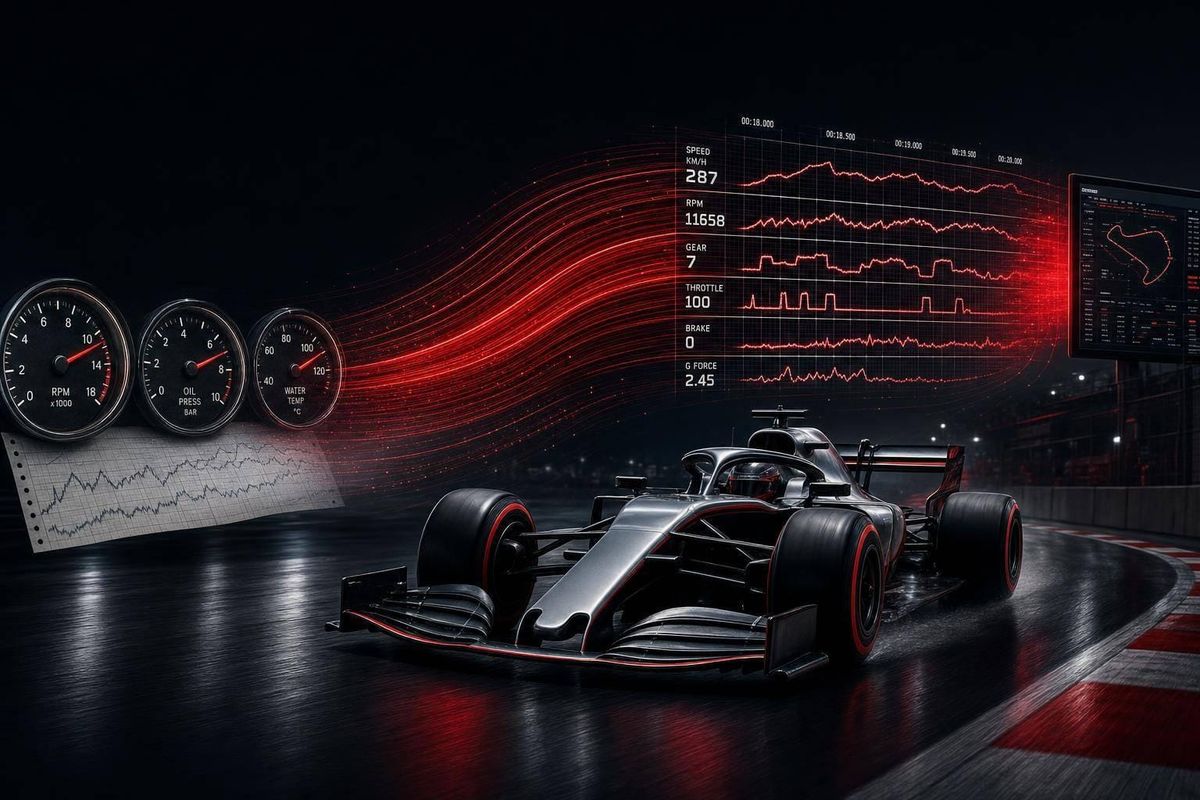
F1 telemetry changed the sport by turning delayed car data into live race information. In the analog days, teams mostly got small data samples after a run. In the digital era, they get live, time-stamped streams from hundreds of sensors while the car is still on track.
If I had to sum it up in plain English, it comes down to this:
- Analog telemetry gave teams limited data, often late
- Digital telemetry lets engineers watch the car live
- ECUs in the 1990s pushed the shift from recorders to steady data links
- Modern F1 cars use hundreds of sensors
- Data now reaches both the pit wall and factory rooms at the same time
- Teams use that data for setup, reliability, and race strategy
- FIA rules still keep telemetry one-way, so data leaves the car, but commands do not go back in
That change matters because timing matters. A brake temperature warning that arrives 10 laps too late is just a report. The same warning sent live, many times per second, can shape a pit call, engine mode choice, or risk call before a failure happens.
Explained | The evolution of telemetry in F1
sbb-itb-7c68254
Quick Comparison
| Area | Analog Era | Digital Era |
|---|---|---|
| Data flow | Short bursts or stored onboard | Live stream |
| Timing | Mostly after the run | While the car is on track |
| Channel count | Small number of signals | Hundreds of signals |
| Main inputs | Basic temps, pressures, tire data | Engine, brakes, suspension, steering, throttle, fuel flow, and more |
| Engineer response | Review later | Act during the session |
| Rule limit | Limited transmission | One-way live telemetry only |
I see the shift as more than a hardware update. It changed F1 from a sport where engineers often asked, “What just happened?” to one where they can ask, “What is happening right now?”
That is the core idea behind the move from analog to digital telemetry.
The analog era: onboard logging, tape systems, and burst telemetry
Before telemetry: lap times and driver feedback ran the show
Before onboard telemetry, engineers worked with a pretty small toolkit: lap times, pit boards, and whatever the driver could feel from behind the wheel. If the car started acting up, the driver had to notice it, make sense of it, and explain it over the radio - all while keeping an eye on dashboard gauges for warning signs like engine temperature.
That meant the driver was a huge part of the diagnostic process. The first step forward wasn't live telemetry. It was onboard recording.
Why analog systems fell short: limited data and delayed downloads
When early onboard loggers showed up in the late 1970s and 1980s, they helped - but only up to a point. These systems recorded just a handful of basic channels, such as engine temperature and tire pressure. Some stored data on magnetic tape inside the car. Others used short burst transmissions to send tiny packets of information back to the pits during a lap.
But teams still didn't get a live picture of what was happening. Engineers had to wait for the car to return, plug in their computers, and pull the data after the run. In plain terms, the data was there, but it arrived too late to help in the moment. Analysis happened after the session, not during it.
"If we didn't have telemetry we would have to wait until the car came in to the pits when we could plug our computers in and download the data." - Margret Geisert, Electronics Engineer, Panasonic Toyota Racing
Low bandwidth and signal interference also made live transmission shaky. That delay pushed teams toward continuous digital data links.
The digital shift: ECUs and continuous telemetry in the 1990s
The big change came when teams moved from simple recorders to ECUs that could capture, sort, and send data all the time. Where analog burst systems ran into bandwidth limits and signal noise, electronic control units fixed both issues at the source.
ECUs digitized engine and chassis signals right away, which made telemetry faster and more steady. Digital engine management also made continuous data collection practical. At that point, the car started to look a lot more like a rolling computer, and analog burst systems quickly fell out of use.
Instead of getting sparse snapshots in short radio bursts, teams could now receive a dense, structured stream of data on engine parameters, chassis behavior, and driver inputs - all in real time.
FIA rules on two-way telemetry meant live data still moved in one direction only. Even so, teams could stream far more information than before. That line in the rulebook shaped how the tech was used: engineers could watch and study the data nonstop, but they couldn't step in remotely from the pit wall.
That shift laid the groundwork for modern real-time telemetry, where the car's data stream almost never stops.
Modern F1 telemetry: sensors, networks, and real-time analysis
Once teams had solid digital links in place, telemetry moved far beyond basic engine checks and into full-car analysis. A modern F1 car carries hundreds of sensors that track power unit temperatures and pressures, brake temperatures, tire loads, suspension travel, steering inputs, throttle position, and fuel flow. Each data channel updates many times per second, creating a nonstop stream that shows engineers what the car is doing through every corner, braking zone, and straight.
That stream travels from onboard transceivers to receivers on the pit wall, and then through dedicated fiber and satellite links to remote operations rooms at team factories. Engineers at the circuit and back at base look at the same live feed at the same time. So if a powertrain specialist in Brackley or Maranello spots trouble building, they can flag it the moment the garage engineer sees it too. The FIA’s rule on two-way telemetry keeps that link one-directional: data can leave the car, but nothing can be sent back into it. Even so, the sheer volume and speed of that outbound feed is what lets teams do real-time engineering.
Teams lean on that stream in three overlapping ways:
- Strategy: Engineers monitor tire degradation lap by lap, then match it against fuel load and sector times to model pit stop windows.
- Reliability: They watch power unit temperatures and oil pressures against known thresholds, trying to catch issues before they turn into failures.
- Development: They compare sensor traces between drivers and across sessions to see where setup changes lead to measurable gains.
At the center of each call is the same thing: a sensor reading that, in the analog era, might have taken hours to pull and study.
Analog vs. digital telemetry: a direct comparison
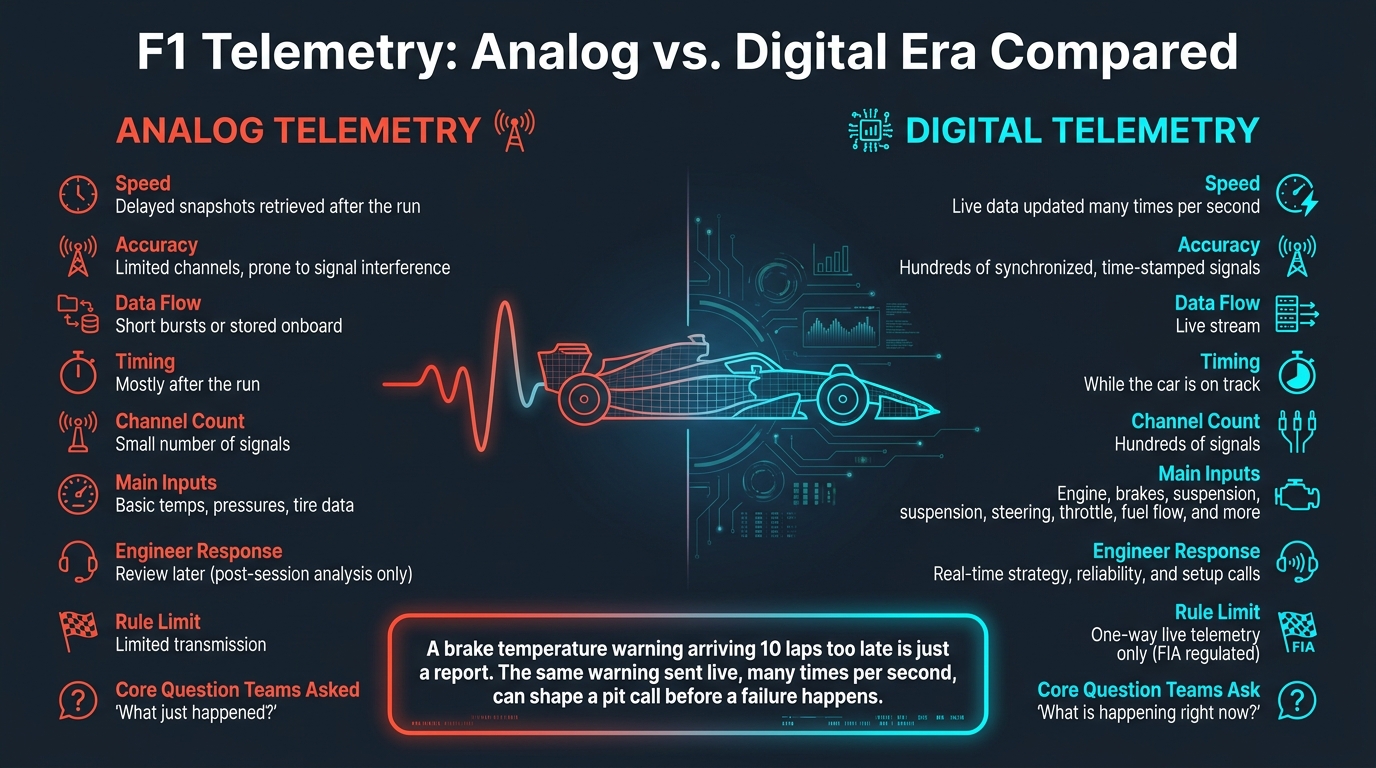
F1 Telemetry: Analog vs. Digital Era Compared
That shift changed more than the way teams got data. It changed how fast they could react.
Analog telemetry gave teams delayed snapshots from a small number of channels. That was useful, but only after the session was over. Digital telemetry changed the picture completely. Instead of waiting for the car to come back, engineers could watch live streams from hundreds of synced signals and make calls while the car was still out on track.
What looked like a hardware upgrade on paper turned into something much bigger on race weekends: an edge.
| Factor | Analog Telemetry | Digital Telemetry |
|---|---|---|
| Speed | Delayed snapshots retrieved after the run | Live data updated many times per second |
| Accuracy | Limited channels, prone to signal interference | Hundreds of synchronized, time-stamped signals |
| Decision-making | Post-session analysis only | Real-time strategy, reliability, and setup calls |
Conclusion: why the digital shift became central to modern F1 performance
Modern F1 telemetry came out of a simple but game-changing move: going from systems that told engineers what happened to systems that show them what is happening.
Analog tools still mattered. Onboard recorders and burst transmissions were a real step up from relying only on lap times and driver feedback. But there was a catch. The data showed up too late to alter the result in the moment.
Digital telemetry got rid of that lag. With steady data links, ECUs, and hundreds of onboard sensors sending live streams to the pit wall and remote operations rooms at the same time, engineers no longer had to sit back and wait. They could act as problems formed. Tire degradation, power unit stress, and brake temperatures became part of live race calls instead of after-the-fact reports.
The FIA’s ban on two-way telemetry kept the system one-directional, but that didn’t blunt its effect. Even without sending commands back to the car, the sheer volume, speed, and precision of outbound data reshaped how teams build cars, run races, and guard reliability over a full season.
If you want to understand how modern F1 teams work at the level of individual sensor traces and lap-by-lap strategy modeling, F1 Briefing covers the technical and strategic side of the sport with the depth that kind of analysis calls for.
Telemetry didn’t just improve data collection. It changed what teams were able to do with that data, and that difference sits at the heart of modern F1 performance.
FAQs
How does one-way telemetry change race strategy?
One-way telemetry gives F1 teams a live window into the car while it’s still out on track. Instead of waiting for the driver to come back to the pits, engineers get wireless data in real time and can check things like tire wear, engine behavior, and brake temperatures as laps unfold.
That steady flow of data lets the team run predictive simulations on the fly and make fast strategy calls. So when it’s time to decide whether to pit or tweak car settings, they’re not guessing - they’re working from what the car is telling them right now.
Why were ECUs important to digital telemetry?
The ECU sat at the heart of digital telemetry because it handled the car’s data before sending it out. Sensors placed across the car sampled key signals up to 1,000 times per second and fed that information to the ECU through the CAN bus.
From there, the ECU compressed and formatted that high-frequency stream in real time. That step turned raw sensor output into a standard data set that could be sent wirelessly to trackside systems and factory teams for performance and strategy analysis.
What sensors matter most on an F1 car?
The most important sensors track engine performance, tire pressure, and tire temperatures because those areas have a direct effect on wear, heat-related breakdown, and overall pace.
Teams also use sensors to watch aerodynamics, fuel use, throttle position, steering angle, and differential behavior. Data from the Standard Electronic Control Unit helps fine-tune setup, model race scenarios, and support FIA compliance.