Ultimate Guide to Safety Car Pit Stop Strategies
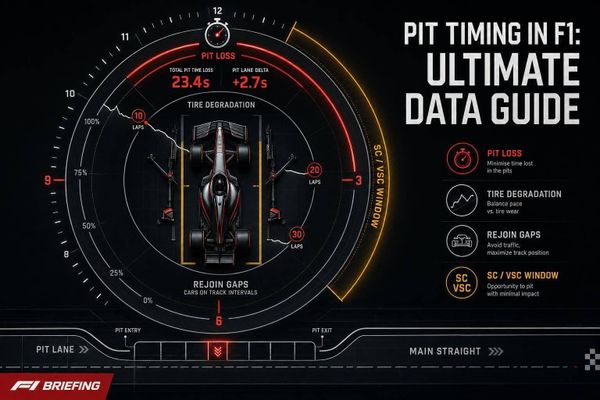
Decide whether to pit under Safety Car or VSC by weighing rejoin position, tire life, and pit-lane execution.
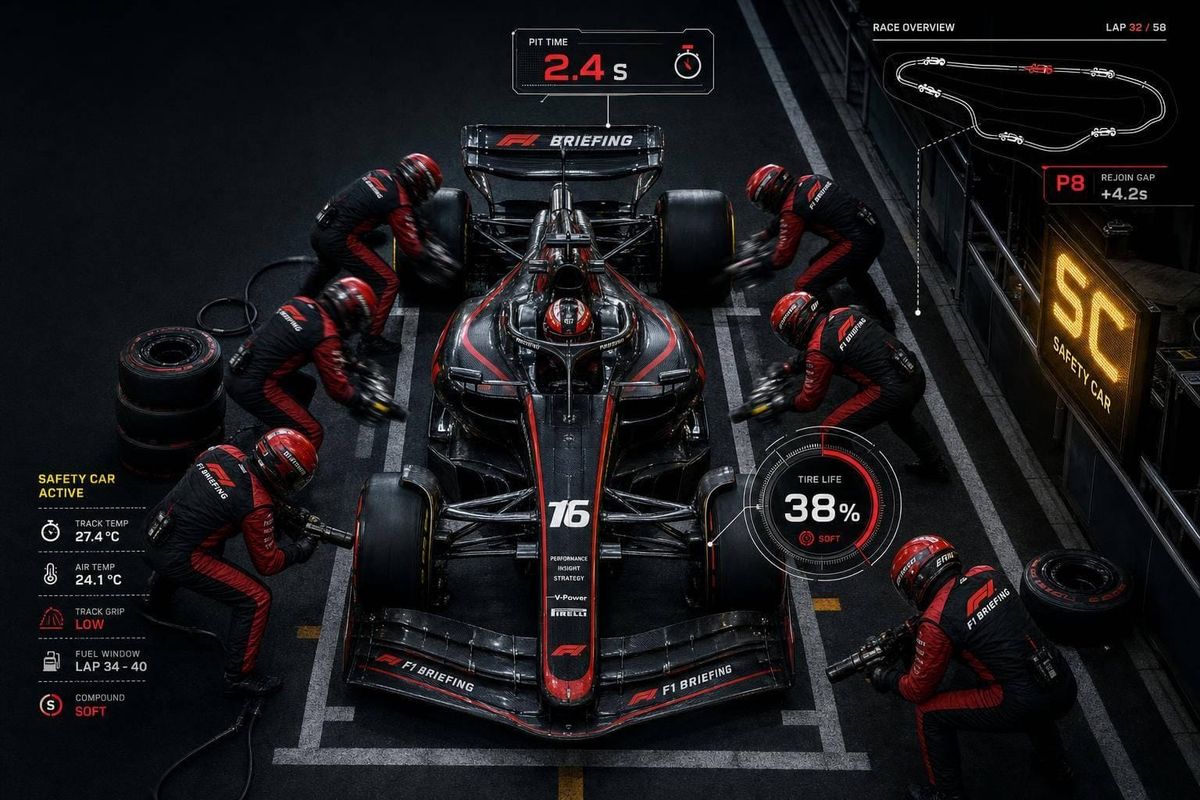
A Safety Car can cut pit-stop time loss by about 50% - from 20–25 seconds under green to around 10–12 seconds under a full Safety Car. That one change can flip a race.
If I had to boil this down to the main call, it’s this:
- Pit if the reduced time loss is worth the track position I may give up
- Stay out if restart position matters more than newer tires
- Watch VSC vs. full Safety Car, because the pit-stop saving is smaller under VSC
- Factor in tire age, traffic, and laps left
- Avoid messy team calls, since pit-lane traffic and double stacks can erase the gain
In other words: the cheap stop is only good if I rejoin in a spot I can still use.
Quick Comparison
| Race condition | Typical pit time loss | Main effect on the call |
|---|---|---|
| Green flag | ~20–25 seconds | Pitting costs a lot more track time |
| VSC | Less than green flag | Some saving, but not as much as full SC |
| Full Safety Car | ~10–12 seconds | Biggest chance to stop at lower cost |
The short version is simple: I look at rejoin position, tire life, stint plan, team timing, and teammate gap. If those line up, the Safety Car stop makes sense. If not, keeping track position is often the better move.
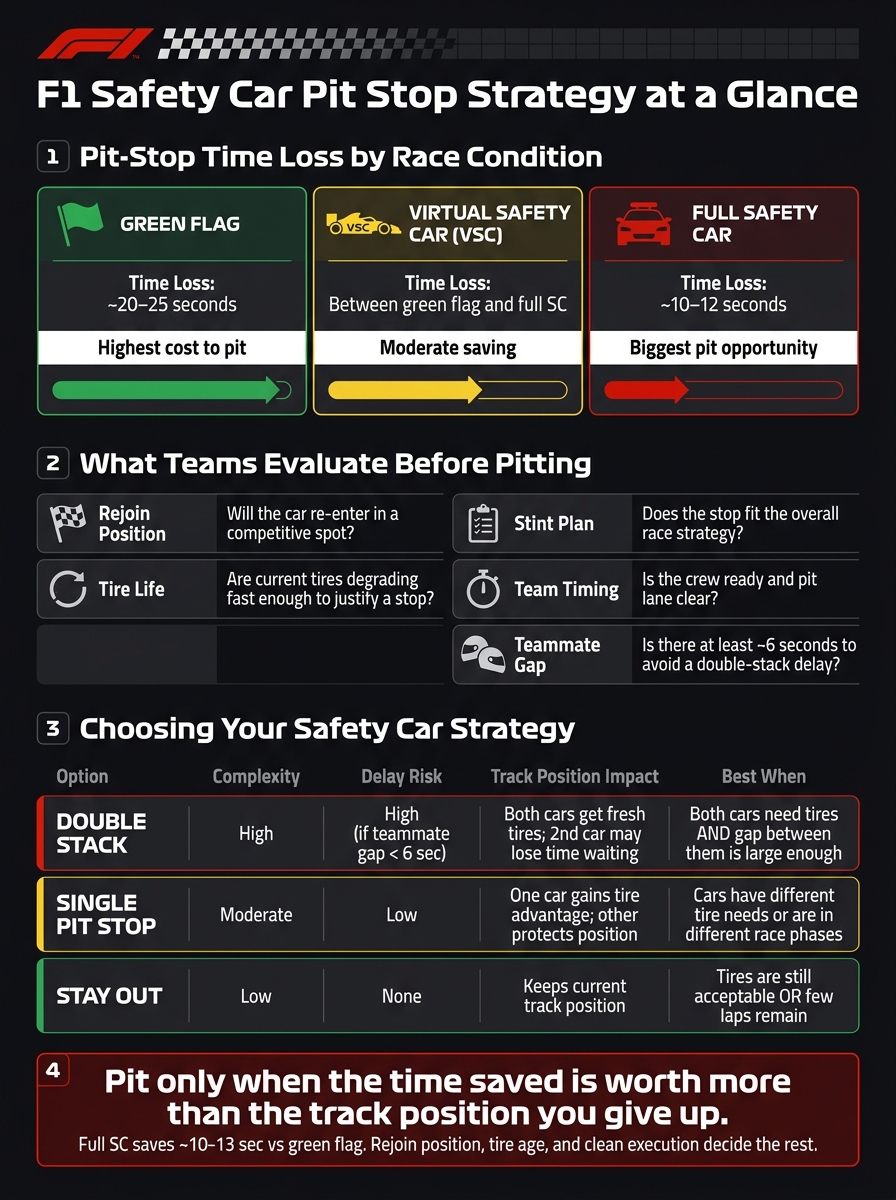
F1 Safety Car Pit Stop Strategy: Full SC vs VSC vs Green Flag
How do you get a 'free pit stop' under the Safety Car in F1?
sbb-itb-7c68254
Rules and Pit Lane Limits That Shape the Decision
Once the time discount is clear, the next step is simple: can the stop actually work under race-control rules?
A Safety Car stop isn't only about saving time in the pit lane. Teams also have to think about pit-lane traffic, restart timing, and the chance of tires cooling off before the green flag comes back. A stop that looks smart on paper can go sideways fast if the lane is packed or the restart catches a driver with cold rubber.
Those same pit-lane limits can cut both ways. They might help a race leader hang on to track position. Or they can wipe out the edge of a car running off-sequence. That's why teams don't treat every neutralized period the same.
Full Safety Car and Virtual Safety Car phases change the math in different ways, especially at pit entry, pit exit, and during the first laps after the restart. The split starts with one basic thing: how race control manages the field under a full Safety Car versus a Virtual Safety Car.
How Teams Decide Whether to Pit or Stay Out
Once teams know the pit-loss discount, the next call is pretty simple in theory and tricky in practice: is the rejoin cost still too high? At that point, they model whether the gap after the stop is worth the track position they’ll give away. The decision usually comes down to three things: rejoin position, tire life, and stint plan.
Pit Window and Restart Position
Teams work out the rejoin gap and look at the traffic a driver is likely to meet after the stop. If pitting drops the car into a tight pack, staying out is often the better move because restart position matters so much.
Tire Life, Future Stops, and Race Phase
The next piece is whether the stop fits the full tire plan. If fresh tires can add enough pace to cover the rest of the stint, the chance to pit starts to look a lot better. If the stop only gives away track position without helping the plan for the laps ahead, teams usually leave the car out.
This is where midfield cars get squeezed the most. A small drop in track position can turn into a long stretch stuck in traffic, and that can ruin the value of the stop. That choice then leads straight into the next problem: making the stop cleanly when the pressure is on.
Tire Strategy and Team Execution Under Pressure
How Safety Cars Disrupt Undercut and Overcut Plans
Once a team commits to a stop, the Safety Car window can change everything.
In green-flag running, the undercut is simple in theory: pit earlier, bolt on fresh tires, and use that extra pace to jump a rival before they make their stop. The overcut flips that idea. A driver stays out longer and tries to keep position while the rival gives up time after pitting.
A Safety Car cuts into both plans. The undercut loses much of the time edge it normally gets from fresh tires. The overcut also becomes less useful because the field is already bunched up.
That puts the spotlight back on tire life. If a set is already dropping off and the restart could decide the race, pitting right away starts to look a lot more tempting. If the tires still have something left, keeping track position may be the better play.
That same pressure shows up inside the team garage too. A well-timed call can turn into a clean stop. A late or awkward one can force the team into a double stack.
Double Stacking, Pit-Lane Traffic, and Communication Timing
Double stacking - servicing both cars from the same team in the same Safety Car window - can work well, but the margin for error is small.
Teams usually want about a six-second gap between teammates. If the gap is smaller, the second car can give away a lot of time just sitting there while the crew finishes the first stop, resets, and clears the box.
The gap, though, is only part of it. The pit wall has to make the call early enough for the crew to get set, while also judging pit-lane traffic and handling fast radio communication. Get one part wrong and the whole thing can unravel in a hurry.
Double Stack vs. Single Pit Stop vs. Staying Out
Each choice brings its own risk, and the best move depends on tire life, track position, and how many laps are left.
| Option | Operational Complexity | Pit Lane Delay Risk | Track-position impact | Best use case |
|---|---|---|---|---|
| Double Stack | High - both cars need to be managed in the same window | High when the teammate gap is too small | Both cars gain fresher tires, but the second car may lose time waiting | Both cars need tires and the gap between them is large enough |
| Single pit stop | Moderate | Low | One car gains the tire advantage while the other protects position | Cars have different tire needs or different race phases |
| Stay Out | Low | None | Keeps track position | Tire life is still acceptable or the remaining race distance is short |
On paper, those options look neat and tidy. In a race, they rarely are. Traffic, gaps, and split-second calls usually decide which one pays off.
Case Studies and Key Takeaways
What Past Races Show About Safety Car Strategy
The practical test is simple: pit only when the time saved is worth more than the track position you give up.
That’s the whole Safety Car call in one line. When the Safety Car comes out, the team has to judge whether the cheaper stop will still leave the car in a workable spot for the restart. If not, the time discount can look good on paper and still hurt the race.
The call turns on a few things: pit-loss, tire age, track position, and laps remaining. Put those together, and the picture gets clearer. Old tires can make a stop tempting. A bad rejoin can make that same stop a mistake.
Rules of Thumb for Reading the Next Safety Car Call
Every Safety Car call goes through the same filter. The reduced pit-loss lowers the cost of stopping, but that only helps if the car rejoins in a place where it can still fight. Tire age affects how much pace is left in the stint. Track position shows what’s on the line. And pit-lane execution - clean communication, fast crew work, and smart gap management - is often the part that makes or breaks the plan.
Three takeaways cover most situations:
- Pit when the discount is big enough to justify losing position. A full Safety Car cuts pit-stop time loss from roughly 20–25 seconds to around 10–12 seconds. If that saving is bigger than the gap to the car behind after the stop, pitting is the right call.
- Stay out when track position matters more than tire gain. If fresh tires won’t recover the positions lost on the restart, keeping the car out protects the race result.
- Nail the stop with clean communication and fast execution. Double stacking, pit-lane traffic, and late calls can wipe out the discount fast. The team that gets the radio call right and the crew ready in time is usually the one that turns the Safety Car into an edge.
Case Study Summary Table
That is the core filter for every Safety Car call.
FAQs
How do teams estimate rejoin position under a Safety Car?
Teams estimate rejoin position under a Safety Car with simulation software that blends past race data with live inputs. The goal is simple: work out whether a pit stop will drop a driver into traffic or bring them back out with clean air.
To do that, the software pulls in GPS, interval data, and live telemetry. It then compares the time lost in the pit lane with the time a driver might gain while the field is running at Safety Car pace.
Behind the scenes, strategists test thousands of virtual scenarios. That often includes Monte Carlo simulations, along with pit lane speed limits - usually around 50 mph - and the gaps to nearby rivals. Put it all together, and the team can make a fast call on whether the driver is likely to rejoin ahead of or behind key competitors.
When is staying out better than taking fresh tires?
Staying out is often the better call when track position matters a lot, tire wear is low, and passing is hard. It also works when the current tires can make it to the finish without a big drop in pace.
Teams might also stay out if the Safety Car window looks short, or when low track temperatures make it harder to get fresh tires up to speed on the restart.
Why is a VSC stop less valuable than a full Safety Car stop?
A VSC stop saves less time because the field only slows down. It doesn't bunch up fully. Drivers still lose less time than they would under green-flag running, but the gaps between cars mostly stay the same.
Under a full Safety Car, the entire pack is neutralized at much lower speeds. That cuts the time loss of a pit stop by a lot, and the field closes up at the same time. So the strategic upside is much bigger.