How F1 Engineers Guide Drivers Mid-Race
How race engineers turn telemetry and team strategy into short, well-timed radio calls that protect the car and improve lap times.
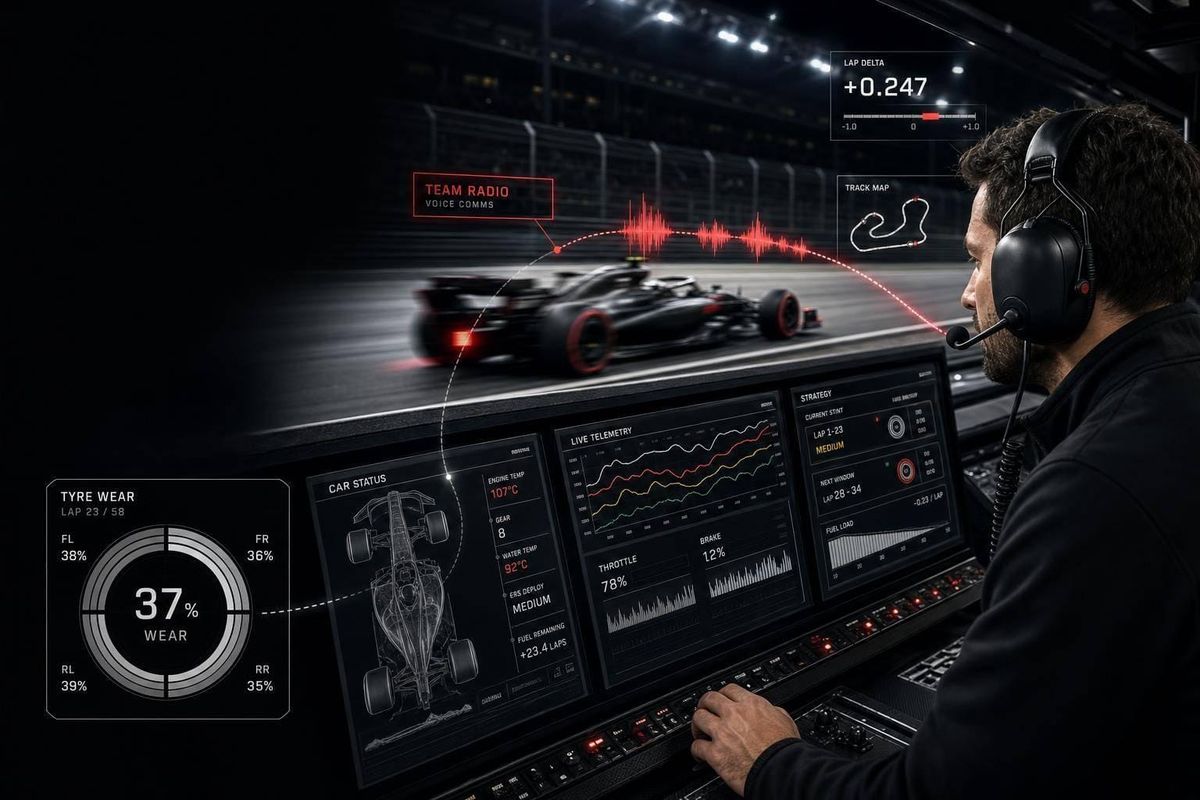
An F1 driver hears one voice for a reason: the race engineer turns a flood of live car data into a few short calls the driver can use at 200+ mph.
If I had to sum up the whole article in a few lines, it’s this:
- The engineer filters the data. The car sends live telemetry on tires, fuel, battery use, temps, and pace.
- The team helps from afar. Mercedes, for example, uses 15 to 30 engineers in its factory support room during races.
- The message must be short. Drivers can’t take in long explanations in braking zones or corner sequences.
- Priority matters. Safety first, then car protection, then pit calls and race plan, then pace tips.
- Timing matters too. A good call on a straight can help. The same call in a corner can hurt.
- FIA radio rules limit what can be said. Teams can discuss gaps, pit stops, tires, and penalties, but not give full step-by-step driving coaching.
- Driver feedback still matters. The engineer checks what the driver feels against the sensor data, then updates the plan.
What stands out most to me is how little of the raw data reaches the cockpit. Thousands of signals come off the car, but the driver may only hear a line like “Box, box,” “Cooling mode,” or “Target lap 1:23.0.” That’s the whole point: less noise, more action.
There’s also a human side to it. Engineers don’t just watch numbers. They listen for stress in the driver’s voice, trim the message, and keep the tone calm. In one example from the article, Ferrari’s engineer mixed battery checks with corner-by-corner guidance, and the driver’s pace improved by 0.4 seconds per lap in the final stint.
So the short answer is simple: I’d say race engineers guide F1 drivers by turning live telemetry, team analysis, and driver feedback into clear, well-timed radio calls that help with safety, car health, pit timing, and lap pace.
That’s what the rest of the article explains in plain terms.
GianPiero Lambiase & Max Verstappen’s Most Iconic Radio Moments
sbb-itb-7c68254
What the Race Engineer Handles During a Race
Once the engineer becomes the driver's filter, the next step is deciding what matters most right now. During a race, the engineer watches tire life, temperatures, energy deployment, fuel, gaps, and race-control status. But the job isn't to treat every signal the same. It's to spot the one thing the driver needs to act on this lap.
That’s where live data turns into action. The engineer takes a flood of inputs and boils them down into short radio calls like these:
| Monitoring Category | Specific Data Point | Radio Call Example |
|---|---|---|
| Reliability | High engine or component temperatures | "Cooling mode." |
| Pace | Slow exit compared to a rival | "Earlier throttle at Turn 2 exit." |
| Tire Management | Graining or abrasion detected | "Manage tire wear through Turn 12." |
| Strategy | VSC deployment or pit window open | "VSC mode. Box, box." |
| Car Balance | Rear locking on entry | "Brake-balance change for Turn 3 locking." |
How Information Flows From the Pit Wall to the Driver
At any race, teams are capped at 60 staff members at the track. That limit makes the remote Race Support Room (RSR) a big part of the operation. Mercedes, for example, runs its RSR in Brackley with 15 to 30 specialists running live simulations during the race. Strategy engineers, tire analysts, and safety car specialists all send their input to the pit wall.
Still, none of that goes straight to the driver. It all passes through one person. As Mercedes Trackside Engineering Director Andrew Shovlin explains:
"You try and brief the drivers in packets really, rather than throw everything at them in one go... just to avoid overloading them." - Andrew Shovlin, Trackside Engineering Director, Mercedes
So the race engineer takes the full stream of information and cuts it down to what the driver needs at that moment: a lap-time target, a mode change, or a note for one corner.
From there, the engineer has to judge whether the bigger issue is pace, reliability, or a mix of both.
Balancing Pace, Reliability, and Driver Focus
This is the hard part. Reading the data is one thing. Deciding which problem comes first is another.
A car running hot may need a cooling mode, but that can cost lap time. Tires showing early graining may need more care, but backing off too much can give away track position. The race engineer is making those calls in real time, with no pause button.
At the 2026 Australian Grand Prix, Ferrari race engineer Carlos Santi showed that balancing act at work. After confirming that battery deployment was "on target" through telemetry, he moved to corner-by-corner coaching. He pointed out a loss of one-tenth at the exit of Turn 2 and advised "entry 13, take it easy" to manage tire abrasion. Hamilton then became the fastest car on track in the final stint, lapping 0.4 seconds faster than the leaders.
Shovlin also says the high-quality intercom audio makes it easy to hear stress in a driver's voice, which helps engineers change the tone of their messages on the fly. When the pressure climbs, they cut the number of instructions and keep the tone calm.
How Telemetry Data Becomes a Radio Instruction
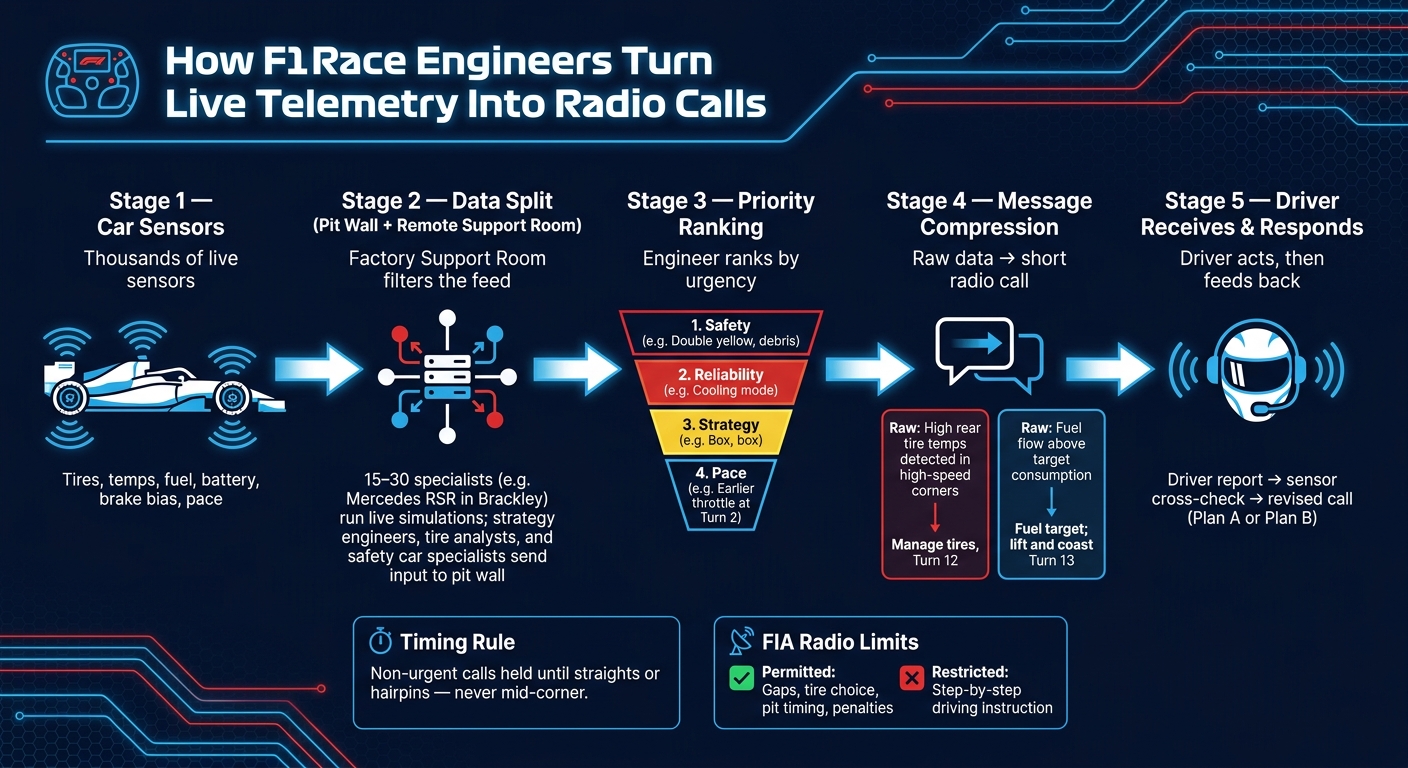
How F1 Race Engineers Turn Live Telemetry Into Radio Calls
From Car Sensors to Pit Wall Decisions
Once the engineer knows what matters most, the next step is simple in theory and hard in practice: turn telemetry into a call the driver can use right away.
Modern F1 cars send live telemetry from thousands of sensors to the pit wall and the factory support room. From there, specialists split the feed into pace, tire wear, and safety risk. Then they pass only the main point to the pit wall.
When the RSR spots a trend, the strategy lead decides whether to react. After that, the race engineer turns that decision into a radio instruction.
Turning Raw Data Into Short, Usable Instructions
This is where the job gets tough. A telemetry alert like rear brake temperatures running high or battery deployment missing target can't stay as a long data note. It has to become a short instruction the driver can act on in the middle of a corner sequence.
So engineers compress the message into brief, coded calls, such as earlier on the throttle, don't trail the brakes, or a mode change like Strat 2 or Mode K2.
Here are a few examples of how that works:
| Raw Telemetry Data | What It Signals | Radio Instruction |
|---|---|---|
| High rear tire temperatures | Thermal degradation risk in high-speed corners | Work on tire management, particularly Turn 12 |
| Rear brake temperatures exceeding limits | Brake bias or differential settings may be off | Adjust brake bias to reduce rear locking |
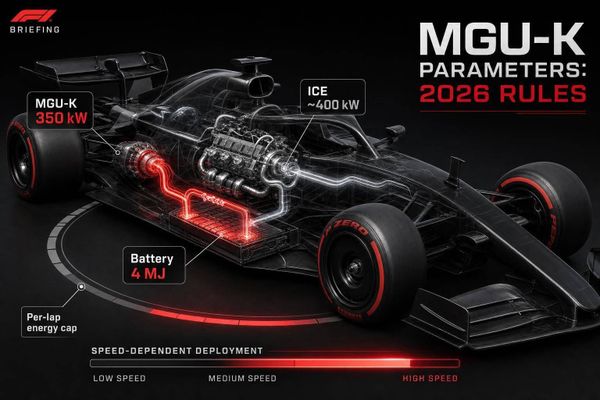
| Battery state of charge is low | Deployment is exceeding harvest | Limit deployment; use lower gears |
| Fuel flow above target consumption | The car may not finish without lift-and-coast | Fuel target; lift and coast through Turn 13 |
The driver also sends data back, just in a different form. Instead of numbers, it's feel. The loop goes one way, then back again: driver report → sensor cross-check → revised call.
When a driver says the front-left is graining or the rears are locking, the engineer checks that against the live sensor data. If the numbers line up, the team can change the race plan and switch from Plan A to Plan B when needed.
Pre-set modes help keep all of this short. Engineers use code words to trigger pre-programmed settings.
That speed matters because radio coaching is tightly limited.
How Engineers Communicate So Drivers Can Act Right Away
Ranking Messages by Safety, Reliability, Strategy, and Pace
Once telemetry looks like it may need a radio call, the engineer sorts the message by urgency. Safety comes first, always. Warnings like "Double yellow, double yellow" or "Debris, debris" go out at once.
After that comes reliability. If the car needs a mode change to protect the power unit, manage battery deployment, or get more cooling, that instruction takes priority over anything tied to lap time.
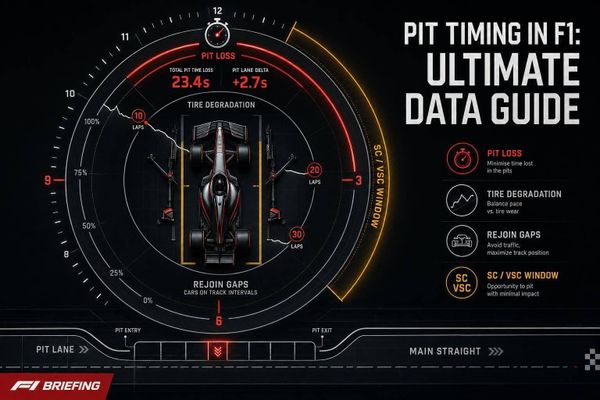
Only when the car is safe and stable does the engineer move to strategy. That includes pit calls, gap updates, and changes to the race plan. Pace coaching sits last and is usually saved for moments when the driver has enough mental space to take it in.
Timing and Tone When the Driver Is Under Pressure
Even the right message can fail if it lands at the wrong moment. Engineers hold back non-urgent calls when the driver is in a busy section of the track. Instead, they wait for hairpins or long straights to deliver instructions that take more thought.
"Don't talk to me into the corners mate, please." - Lewis Hamilton, Formula 1 Driver, Ferrari
Tone matters too. The best radio messages are calm and fact-based, not loaded or dramatic. As Dom Riefstahl, Race Support Team Leader at Mercedes, said:
"The discussions are all held in a gentlemanly manner; even if we disagree on something, we'll just be having a discussion of facts." - Dom Riefstahl, Race Support Team Leader, Mercedes
Short phrases help as well. A call like "Plan B" or "push hard now" can do the job of a much longer explanation. That saves time and lets the engineer react fast. A good example came in June 2019 at the Canadian Grand Prix, when Ferrari race engineer Riccardo Adami waited until Sebastian Vettel reached a straight on lap 58 to tell him about a 5-second penalty, rather than dropping that news in the middle of a corner.
That kind of brevity also has to work within FIA radio rules, which limit what engineers can say.
Comparison Table: Clear Radio Messages vs. Unclear Radio Messages
The gap between a useful message and a bad one often comes down to one thing: specificity.
| Message Type | Clear/Concise Example | Risk of Vague Messaging |
|---|---|---|
| Technical Change | "Switch position yellow" | Driver searches for the wrong dial under G-force. |
| Pace Instruction | "Target lap time 23.0" | "Push harder" is subjective and lacks a benchmark. |
| Track Condition | "Slippery track" | "Be careful" doesn't explain the specific hazard. |
| Pit Entry | "Box, box" | "We might need to pit" creates indecision. |
That level of clarity also has to fit FIA radio limits.
How Strategy Calls Are Made Within FIA Radio Rules
Once the engineer has trimmed the message down, FIA rules set the line on what can be said. The FIA draws a clear split between strategy guidance, which is allowed, and driving instruction, which is restricted.
What Engineers Are Allowed to Say and What They Must Avoid
Engineers can share things like gaps to other cars, tire choices, pit timing, and penalties. What they can't do is coach the driver on how to drive the car.
The Decision Loop: Plan, Feedback, Call
Inside those limits, the team works through a simple loop: plan, feedback, then call.
They begin with a plan, update it with live data and driver feedback, and then send a short radio message like "box this lap." Short, clear, and timed to the moment.
Comparison Table: Permitted Radio Guidance vs. Restricted Coaching
| Information Type | Allowed? | Why It Matters |
|---|---|---|
| Gap to other cars | ✅ Permitted | Helps the driver manage pace and strategy |
| Tire choice options | ✅ Permitted | Supports the race plan |
| Pit-stop timing | ✅ Permitted | Lets the team execute the strategy |
| Penalty information | ✅ Permitted | Keeps the driver aware of race obligations |
| Driving instruction | ❌ Restricted | FIA radio rules limit this kind of advice |
Conclusion: Why Engineer-Driver Communication Is One of F1's Key Competitive Tools
Engineer-driver communication is a performance tool. The race engineer takes telemetry, strategy, and input from the pit wall, then turns it into one clear call the driver can use right away. Remote support rooms add more analysis behind the scenes, but the race engineer is still the person who makes that input usable over the radio.
Tone matters just as much as the message itself. In a high-pressure moment, the engineer has to read the situation fast and keep the call calm, short, and easy to act on. Say too much, and the point gets lost. Say the right thing, in the right way, and it can show up on the stopwatch.
The best teams treat each race like a feedback loop: review, refine, repeat. That’s how data turns into lap time - not through more radio traffic, but through clear communication that lands when it counts.
FAQs
Why does the driver usually hear only one main voice on the radio?
In Formula One, the race engineer is the driver’s main point of contact. That keeps communication clear and efficient when the pressure is sky-high. At speeds above 200 mph, a driver doesn’t have time to sort through mixed signals. They need instructions they can act on right away.
The race engineer takes input from the rest of the team and turns it into short, firm messages. This one-voice setup cuts down on overload and confusion, which helps the driver keep full attention on the car and the track.
How much can engineers legally tell a driver during a race?
FIA rules give teams a lot of room to talk with drivers over the radio about race strategy, car reliability, and setup choices. Engineers can advise on tire management, engine modes, and tactical shifts to help get the most out of the car.
What they can't do is change the car from the pit wall through telemetry. And since corner-by-corner coaching was mostly banned in 2016, radio messages have to stay short. The driver still has to make every mechanical and electronic adjustment on their own.
How do teams decide when to prioritize pace over car protection?
Teams make that call by lining up live race data against pre-race simulations. Engineers watch telemetry like tire wear, brake temperatures, and engine health, then pass that input to the race engineer.
If a driver is off the planned strategy or slipping down the order, the team may ask for more pace. But if the sensors hint at a mechanical or electronic problem, the focus shifts to getting the car to the finish.