How F1 Teams Prepare for Hybrid Unit Inspections
How F1 teams prepare hybrid power units for FIA checks: parts traceability, fuel/ERS limits, parc fermé access, and post-race fixes.
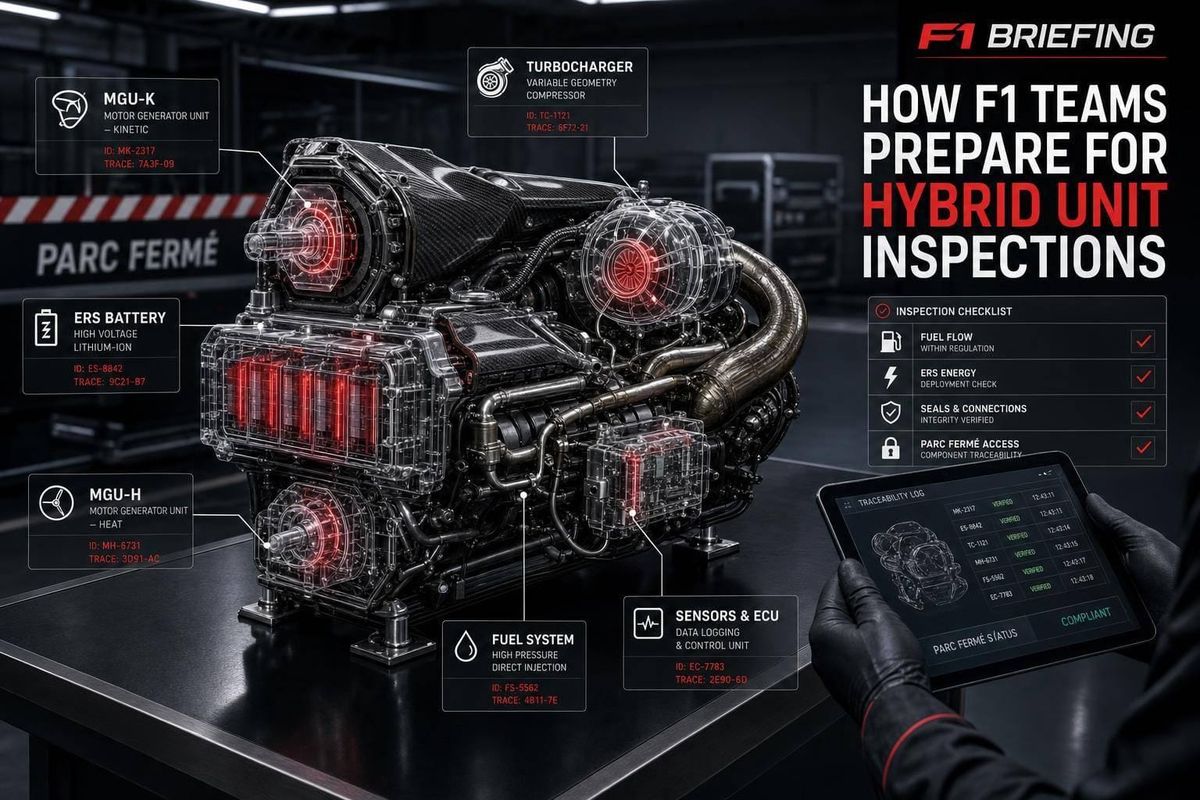
F1 teams don’t wait for scrutineers to find problems. They build the whole race weekend around passing inspection.
From what I see, the process comes down to 4 jobs: match every hybrid unit part to FIA records, keep fuel and ERS data inside limits, present the car in the right state under parc fermé, and use post-race findings to fix weak spots before the next event.
Here’s the short version:
- Before running: I’d make sure each part serial number, spec version, and seal matches the homologation file.
- During sessions: I’d track fuel flow, energy deployment, and battery state of charge against FIA numbers, with a margin instead of running at 100% of the limit.
- During scrutineering: I’d keep the car ready for inspection, with legal access points, intact seals, and safe high-voltage isolation.
- After the race: I’d review logs, seals, and returned parts to spot repeat issues, not just one-off events.
A simple way to think about it: inspection prep is part engineering, part record-keeping, and part risk control. If one part is off - even a serial number or sensor record - it can turn a clean weekend into a problem.
Main checks usually cover 6 areas:
- Legal hardware spec
- Homologated component status
- Fuel flow limits
- Total energy use
- Software legality
- High-voltage safety
So if you want the plain answer, it’s this: teams prepare by treating compliance like a session-by-session system, not a last-minute check.
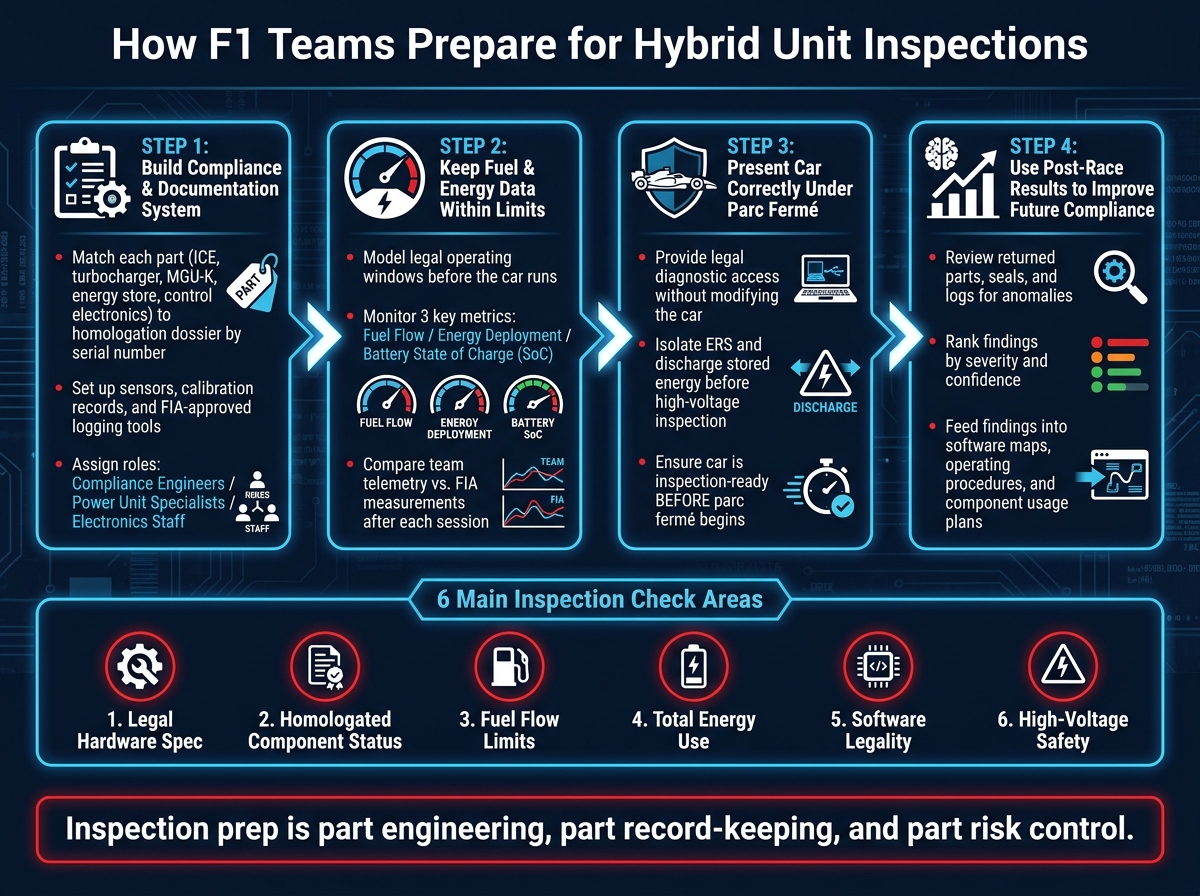
How F1 Teams Prepare for Hybrid Unit Inspections: 4-Step Compliance Process
Step 1: Build a Compliance and Documentation System Before the Weekend Starts
Teams weave compliance into the engineering workflow from the start. It’s not a side job you squeeze in later. It begins with a strict, part-by-part inventory.
Match each installed part to the homologation dossier
Each hybrid power unit part - ICE, turbocharger, MGU-K, energy store, and control electronics - should be matched by serial number to the homologation dossier. Log the installed ID, spec revision, and seal status for every item.
Then do the same check again after every component swap.
That might sound tedious, but it serves a simple purpose: catch any mismatch before scrutineering. A small serial-number error can turn into a big problem if nobody spots it in time.
Once the hardware is confirmed, the team needs to lock down the measurement system behind it.
Set up sensors, calibration records, and FIA tools
Before the car runs, teams keep calibration records ready and complete FIA-approved sensor and logging checks. Those records help the team line up its own data with FIA checks, which matters when numbers need to match under pressure.
Think of it like balancing two clocks. If your internal records and the FIA system don’t line up, even clean hardware can create headaches.
Assign inspection roles before track activity begins
Set clear ownership before any track activity starts. Paperwork, part ID checks, hardware inspection, and logging review should each sit with specific staff.
In most cases, that means:
- Compliance engineers handle documentation and sign-off flow
- Power unit specialists check installed hardware and part status
- Electronics staff review sensors, logging, and related tools
This setup lets inspections happen without slowing the track plan. It also gives the team a named sign-off chain, which speeds FIA responses and helps surface documentation mismatches before scrutineering.
With the paperwork and inventory in place, the next test is keeping fuel and energy data inside the legal window.
sbb-itb-7c68254
Step 2: Keep Fuel and Energy Data Within Regulatory Limits
Once the hardware is legal, the next task is keeping fuel and energy data inside FIA limits. Every session produces fuel flow readings, energy deployment figures, and battery state-of-charge traces that the FIA checks against its own measurements.
Model legal operating windows before the car runs
Before the car leaves the garage, engineers build a session model for how the power unit should behave across a stint. The goal is simple: map fuel use and ERS deployment in a way that stays inside FIA limits across likely race scenarios.
Teams usually don’t aim to run right on the edge. Instead, they set a buffer so normal variation during the run doesn’t push the car into trouble. That operating window becomes the reference point for each stint review.
Compare team telemetry against FIA measurements after each session
After each session, teams compare internal telemetry with FIA measurements to catch any anomaly or borderline event early in the weekend. The main checks are:
- Fuel flow
- Energy deployment
- Battery state-of-charge (SoC) traces
If anything starts to drift, engineers flag it before the next run.
Learn from borderline fuel-flow cases
When readings move toward the limit, engineers review the run before the next session. That early fix helps keep the car ready for the next inspection step.
Step 3: Present the Car Correctly Under Parc Fermé and During Scrutineering
After the fuel and energy checks, the next job is simple in theory but strict in practice: present the car so scrutineers can inspect it right away. Once parc fermé starts, the team must present the car for inspection without changing it.
Give scrutineers legal access without making changes to the car
Teams provide standard diagnostic connectors and test ports so scrutineers can check seals, connectors, and logs without removing bodywork. That matters because the goal is access, not adjustment.
Under parc fermé, any access to hybrid hardware has to happen under the direct supervision of an FIA technical delegate, often with FIA garage cameras in view, with seals intact, and without disturbing homologated components.
That access also needs tight control, especially once the inspection moves into high-voltage areas.
Handle high-voltage systems and damaged ERS parts safely
Before any inspection of high-voltage hardware, teams isolate the ERS and discharge stored energy. Isolate the ERS, discharge stored energy, and tag the system before any inspection or part removal. It’s a plain but serious step: it keeps the hybrid package in a verifiable state during the inspection process and supports the compliance record directly.
If scrutineers find an issue here, it flows straight into the post-race review of hardware condition and software settings.
Keep the setup inspection-ready before parc fermé
The cleanest approach is to have the car inspection-ready before parc fermé even begins. That means no extra intervention, no part changes that aren’t needed, and no unresolved logging issues sitting in the background.
A low-intervention setup before parc fermé lowers the chance of a review and helps keep the car’s sealed state intact for scrutineers.
Step 4: Use Post-Race Inspection Results to Improve Future Compliance
After parc fermé, the inspection report becomes the starting point for the next race weekend's compliance plan.
Check returned hardware and review post-race anomalies
Once the race weekend is over, engineers dig into returned parts and data to sort one-off anomalies from repeat compliance risks. The aim is simple: figure out whether something was a fluke or a pattern. They do that by comparing returned parts, seals, and logs against the weekend data.
From there, findings are ranked by severity and confidence. That helps the team focus on what failed, what almost failed, and what needs to change before the next event.
Apply findings to software maps, usage limits, and update planning
Those findings should feed straight into software maps, operating procedures, and component usage plans for the next event. If a risk shows up more than once, it shouldn't live in a post-event note. It needs to move into pre-race planning.
Conclusion: Consistent Inspection Results Come From Treating Compliance as an Engineering Process
Teams stay compliant by turning every inspection result into the next weekend's prep.
FAQs
What does homologation mean in F1?
In Formula One, homologation is the FIA approval process that confirms a part or system meets the sport’s technical, safety, and performance rules before it can be used in competition.
It usually involves technical documents, quality checks, and testing. Once a part is homologated, its design is basically locked, and teams can’t make unauthorized changes.
Why do teams run below FIA limits?
Teams stay below FIA limits to avoid compliance issues caused by manufacturing variation, part wear, and track conditions like temperature.
To give themselves some margin, they often build parts with internal tolerances that are 1–2 mm or 20–30% tighter than the official limit. That buffer helps cover wear over a race, heat-related changes, and small assembly errors.
The goal is simple: reduce the risk of disqualification from problems like too much skid block wear or fuel volume irregularities.
What happens if a hybrid unit fails inspection?
If a hybrid unit fails inspection, the car can't compete until the issue is fixed and the car meets the rules. FIA officials log any problems in their official reports and pass them on to the stewards.
If the team repairs or changes the car to fix the problem, the car has to go through scrutineering again. To do that, the team must send a written request to the stewards before the car can return to competition.