Night Racing: Evolution of F1 Track Illumination
How F1 night races recreate daylight: 3,000 lux, 5,700K, CRI 90, LED efficiency, uniformity, and layered redundancy for safety.
F1 night racing works because the track is lit almost like daylight: at least 3,000 lux, about 5,700 K color temperature, CRI 90, and backup systems built so one failure does not leave a dark section. That is a huge jump from street lighting at about 30 lux and far above a soccer stadium at about 800 lux.
If I had to boil the whole story down, it’s this:
- Night racing was blocked by safety limits, not by scheduling
- Singapore 2008 proved a full F1 race under lights could work
- LEDs cut power use by about 30% at Marina Bay
- Uniform light matters more than raw brightness
- Street tracks, desert circuits, and sunset races all need different lighting plans
- Redundancy is built into every layer: power, fixtures, and mast coverage
You can think of F1 lighting as a control problem, not just a brightness problem. Drivers need steady visibility at high speed, TV crews need flicker-free images, and race control needs every flag, curb, and runoff area to stay clear from start to finish.
| Topic | Main point |
|---|---|
| Brightness | Minimum 3,000 lux on the track |
| Color | Around 5,700 K for daylight-like light |
| Image quality | CRI 90 for clear colors on camera |
| Power demand | About 1 megawatt on a 6 km / 3.7-mile circuit |
| First full night race | Singapore Grand Prix, September 28, 2008 |
| Big system shift | From metal halide/HID to LED |
| Core safety rule | No single failure should darken part of the circuit |
So while night races look dramatic on TV, the main story is much simpler: F1 had to build a lighting system that feels steady to drivers at racing speed, not just bright to the eye.
Las Vegas F1 Grand Prix - How 1,548 Signify Lights Power the Night Race!
sbb-itb-7c68254
From Day Races to Singapore 2008: How F1 Night Racing Became Possible
Night racing in F1 didn’t happen just because it looked good on TV. The money side mattered. A race that starts at 8:00 p.m. local time in Singapore lands in prime time for viewers across several continents. That upside made it worth fixing a safety issue that had blocked night racing for years. In effect, the sport stopped treating darkness as a hard stop and started treating it as an engineering problem.
Early Lighting Systems and the Limits of Pre-2000s Technology
Other forms of motorsport had been racing under lights for a long time. Endurance races like Le Mans and U.S. oval racing had done it for decades. But there’s a big difference: those cars have headlights. F1 cars don’t, so the track itself has to do all the work when it comes to driver visibility and safety.
That’s why the FIA had long viewed night racing as too dangerous. And, at the time, that wasn’t an overreaction. Older metal halide and HID lighting systems just couldn’t provide even, high-CRI coverage across an entire circuit. For F1, that was the line. If a night race was going to get approved, it had to be no more dangerous than racing in daylight, and it also had to be clear enough for TV.
The 2008 Singapore Grand Prix: F1's First Full-Scale Night Race
Singapore was the first place to turn those FIA lighting standards into a full working setup on a street circuit. Because Marina Bay is built on city streets, permanent lighting masts weren’t an option. So the system used temporary 10-meter trusses instead. That’s much lower than the 30- to 40-meter masts used at permanent tracks.
To hit the FIA’s targets, Singapore built a temporary setup with 1,500 to 1,600 custom floodlights, 2 kW metal halide lamps, and more than 220 km of cabling. Before the FIA gave final approval, the whole system was stress-tested at a certified circuit near Melbourne with both race cars and MotoGP bikes, in wet and dry conditions. Altogether, the circuit’s lighting demand came to close to 1 megawatt.
How Modern F1 Track Lighting Works
The Move from HID Floodlights to LED Systems
Singapore showed that night racing was possible. LEDs made it easier to run, easier to control, and less wasteful.
The first Singapore setup used metal halide lamps. They did the job, but they came with headaches: long warm-up times, spill light that was tough to aim, and heavy maintenance needs.
LED systems solved most of that. Signify and DZE replaced the circuit's metal halide setup with 1,600 Philips ArenaVision LED gen3.5 floodlights mounted on 10-meter trusses. The result was a 30% cut in power use, along with tighter beam control that reduced light spill into the surrounding city.
"The Philips ArenaVision gen3.5 LED floodlights, which replaced the previous Philips system of conventional metal halide lights in 2023, has reduced power consumption at the Marina Bay Street Circuit by 30%." - Mathieu Sergent, Lighting Application Specialist, Signify
There was another big shift too: LEDs turn on instantly. And with digital controls, technicians can adjust fixtures one by one instead of treating the whole system like a blunt instrument. That helped move night racing from something that could work into something that could be repeated at scale.
Designing for Drivers, Cameras, and Race Control at the Same Time
Brightness matters. But on an F1 track, even lighting matters more.
Hitting 3,000 lux across the track surface is only one part of the job. The tougher part is keeping luminance even in the driver's field of view. If one section looks bright and the next dips, a driver can lose a clean sense of speed, braking point, or distance. As Signify puts it:
"The FIA considers uniformity of illumination to be more important than absolute illumination levels, as inconsistent lighting could hamper drivers' ability to accurately judge their speed and distance." - Signify
That is why modern systems use tightly directed LED beams to limit shadows, glare, spill light, and sky glow while still keeping the racing line and run-off areas evenly lit.
Then broadcast comes into play. Slow-motion cameras can pick up flicker that the human eye may miss, which is bad news for replays and race review. So modern LED systems are built to avoid flicker in slow-motion and high-frame-rate broadcasts. They are also tuned to a color temperature of 5,700 K and a color rendering index (CRI) of 90. In plain English, that helps car liveries, curbs, and track markings look right on screen and stay clear for race control.
Safety Architecture: Backup Power, Smart Controls, and Failure Planning
Once the track is visible, the next job is making sure it stays that way.
A dark patch during a green-flag lap is not a minor issue. It's a safety problem, full stop. So the whole lighting setup is built around one idea: no single failure should leave part of the circuit in the dark.
Urbain du Plessis laid out the redundancy built into the system:
"We set strict limits on maximum brightness, prescribed uniformity across track and run-off areas, and demanded redundancy at every level: Dual ring-feed power supplies to each mast; Redundant lamp arrays, so failure wouldn't alter lighting uniformity; Multiple mast coverage for every section of track, ensuring safety even if an entire mast failed." - Urbain du Plessis, Lighting and Technology Leader
In practice, that means dual power feeds, backup lamp arrays, and overlapping mast coverage so one failed part does not create a blacked-out section. And the system is not left alone once the lights are on. A dedicated maintenance crew - usually 15 to 20 people - monitors it through the race weekend.
Circuit Case Studies: How Different Venues Solve Different Lighting Problems
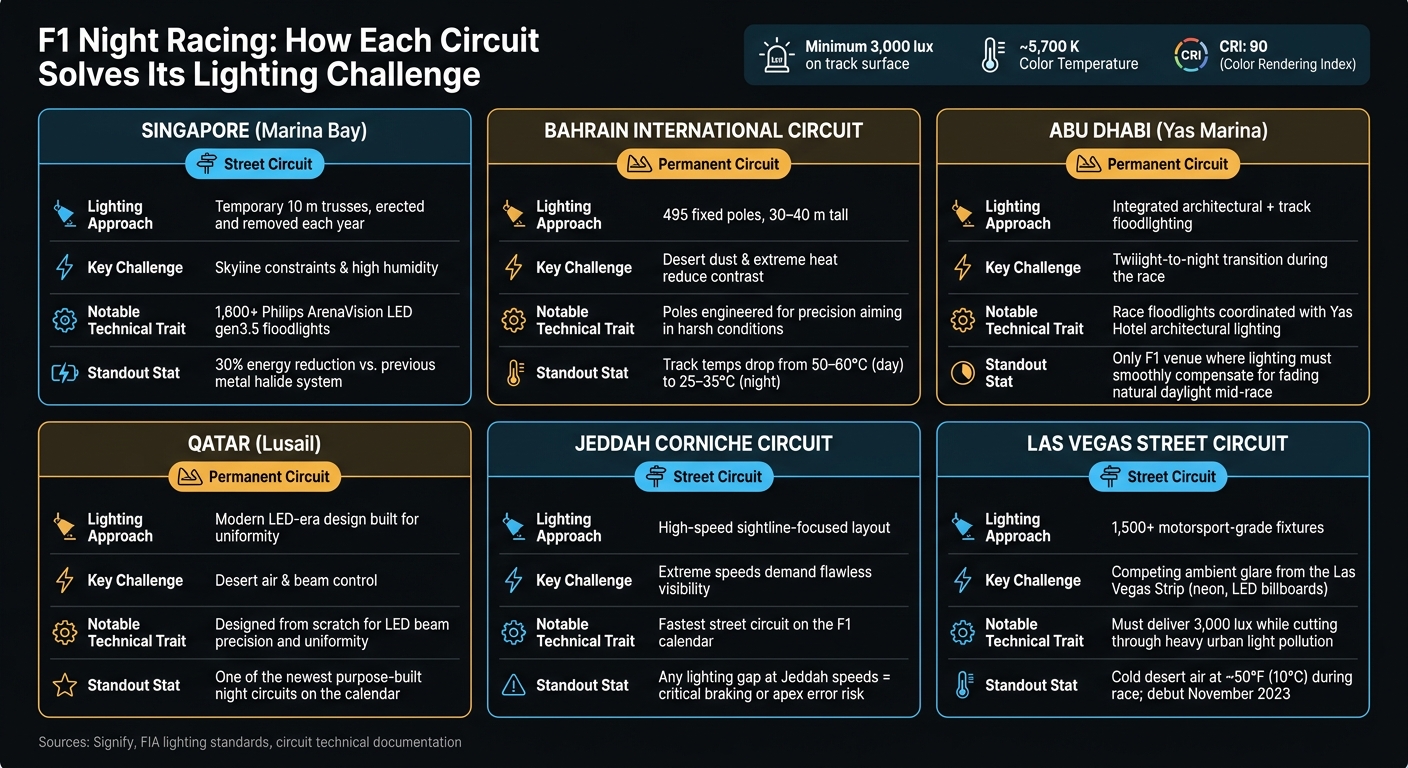
F1 Night Racing: Circuit Lighting Comparison by Venue
Those shared lighting targets don’t look the same at every circuit. A street track in a dense city, a permanent venue in the desert, and a race that starts at sunset all deal with the same basic job in very different ways.
Once the core lighting standards are in place, the differences show up from one circuit to the next.
| Circuit | Track Type | Lighting Approach | Key Challenge | Notable Technical Trait |
|---|---|---|---|---|
| Singapore | Street | Temporary 10 m trusses | Skyline constraints & high humidity | 1,600+ Philips ArenaVision LED gen3.5 floodlights; 30% energy saving |
| Bahrain | Permanent | 495 fixed poles (30–40 m tall) | Desert dust & extreme heat | 495 poles engineered for aiming precision in dust and heat |
| Abu Dhabi | Permanent | Twilight-to-night transition | Visual consistency during sunset | Integrated architectural and track floodlighting |
| Qatar | Permanent | Modern LED-era design | Desert air & beam control | Lusail was designed for LED-era beam control and uniformity |
| Jeddah | Street | High-speed sightline focus | Demanding visibility at extreme speeds | Fastest street circuit on the calendar |
| Las Vegas | Street | High ambient glare | Cold desert air (50°F/10°C) & neon glare | 1,500+ fixtures; must cut through Strip signage and LED displays |
Singapore, Jeddah, and Las Vegas: Street Circuits Under Artificial Light
Street circuits all run into the same wall: every lighting structure has to fit around public roads, city scenery, and space that wasn’t built for permanent race infrastructure.
In Singapore, that means temporary trusses go up each year and come back down after the race. Permanent tall masts, like the ones used at fixed circuits, would interfere with the Marina Bay skyline and make setup far more difficult. On top of that, Singapore’s high humidity makes it harder to keep illumination even across the circuit.
Jeddah deals with a different kind of stress. The Jeddah Corniche Circuit is the fastest street circuit on the F1 calendar, so driver sightlines matter even more under artificial light. At that pace, a small gap in lighting isn’t a minor flaw. It can turn into a braking mistake or a missed apex.
Las Vegas has a problem neither Singapore nor Jeddah has to face at the same level: too much competing light. The Las Vegas Strip is packed with neon signs, giant LED screens, and building lighting running at full blast all night. For the first November 2023 race, more than 1,500 motorsport-grade fixtures had to deliver 3,000 lux on the track surface while still cutting through all that visual clutter without blinding drivers.
Bahrain and Qatar: How Desert Conditions Affect Lighting Design
Permanent desert circuits have more freedom in how lights are installed, but the climate keeps pushing back.
Bahrain switched to night racing in March 2014, moving the race into cooler evening conditions. That shift usually drops track temperatures from 50–60°C in daytime desert racing to 25–35°C at night. To light the 5.412-km Bahrain International Circuit, the venue installed 495 permanent lighting poles.
Even with fixed infrastructure, desert conditions create problems. Dust and heat reduce contrast and soften beam edges. Airborne dust scatters light, which can lower the amount of usable illumination at track level, and extreme heat makes fine beam aiming harder to hold.
Qatar’s Lusail International Circuit came from a more modern design approach. It was planned with LED-era beam control and uniformity in mind, which gives it a better fit for desert-air conditions than an older circuit upgraded later.
Abu Dhabi: Handling the Shift from Sunset to Full Darkness
Yas Marina has a challenge none of the other night venues deal with in quite the same way: the race begins in daylight and ends in full darkness. That isn’t just something that looks good on TV. It creates a direct engineering problem. As natural light drops, the floodlights have to pick up the load bit by bit so drivers never hit a sudden change in brightness or contrast.
In Abu Dhabi, that job gets more complex because the track lighting has to work alongside the hotel’s architectural lighting. The Yas Hotel stretches over the circuit itself, so race floodlights and building illumination need to be handled together as daylight fades. The goal is a smooth visual shift from sunset to night for both drivers and broadcasters.
Abu Dhabi shows, maybe more clearly than any other venue, that night-race lighting isn’t just about raw brightness. It’s also about controlling changing ambient light from one lap to the next.
Where F1 Night Racing Goes from Here
Night racing has changed a lot since 2008. Back then, running a full F1 race under artificial light still felt like a gamble. Now, the lighting setup is every bit as demanding as aerodynamics or tire work. And that matters, because lighting at night changes the way grip, visibility, and race timing play off each other.
Track temperatures can drop from 50–60°C (122–140°F) in daylight to 25–35°C (77–95°F) after dark. That cooler surface makes it tougher to bring tires into their operating window, especially after safety car periods.
Efficiency, Light Pollution, and Smarter Control Systems
The next step for F1 circuit lighting isn’t more brightness. It’s better control.
What’s shifting is how light gets delivered, where it lands, and how tightly it stays inside the circuit. Modern setups are moving toward DMX-capable controls, which let lighting engineers fine-tune spill light and combine race lighting with fan-facing show lighting.
Singapore is a clear example. The Marina Bay upgrade in 2023 cut power use by 30% with Philips ArenaVision gen3.5 LED floodlights. On top of that, the Singapore GP promoter has set a goal to halve energy emissions by 2028.
As host cities pay closer attention to spill light, glare, and sky glow, lighting design is getting more precise. Highly directional optics help reduce sky glow and keep light inside circuit limits. That’s not just a nice extra. It’s now part of the job.
The Main Lessons from F1's Lighting History
Across different venues, the same three priorities keep showing up.
- Uniformity matters more than peak brightness. If lighting shifts too much from one section to another, drivers can struggle to judge speed and distance.
- LED systems have taken over from metal halide. They use less power, switch on instantly, and deliver flicker-free broadcast performance.
- Redundancy is mandatory. Dual ring-feed power supplies, redundant lamp arrays, and overlapping mast coverage make sure one failure doesn’t black out part of the circuit.
Put those ideas together and you can see the full story of F1 night racing: the sport moved from a setup that once looked too risky to try, to one that now supports a steady place on the modern calendar.
FAQs
Why does F1 need 3,000 lux at night?
F1 circuits need 3,000 lux at night to mirror daylight as closely as possible. That level of lighting helps drivers make precise visual calls at speeds above 185 mph. It also cuts eye strain and makes it easier to judge speed and distance lap after lap.
The lighting job doesn’t stop with the drivers. It also helps marshals do their work well around the track and supports the demands of global TV broadcasting.
Why is uniform lighting more important than brightness?
Uniform lighting matters more than sheer brightness. If the light shifts too much from one part of the track to another, drivers have a harder time judging position, speed, and distance.
At Formula 1 speeds, that split-second eye adjustment can cost time and add risk. Steady lighting cuts down on visual adaptation, so drivers can stay locked in and drive at their best.
How do track lights stay on if something fails?
Track lighting stays on through backup-by-design and live monitoring. FIA guidelines call for systems that avoid dark patches and cut safety risks.
Each part of the track is lit by more than one mast, with backup lamp arrays and dual ring-feed power supplies. During races, control rooms watch the system in real time, and on-site crews stand by to act at once.
Related Blog Posts
- Jeddah Corniche Circuit: The High-Speed Street Track Redefining Night Racing in Saudi Arabia
- Marina Bay Circuit: The Origins and Evolution of Singapore’s Iconic Night Grand Prix
- The Evolution of F1 Tracks: A Look at Changes Over the Decades
- 2025 F1 Circuits Deep Dive: History, Speed Stats, and Legendary Moments