Red Bull and AlphaTauri: Collaboration Explained
How dual team ownership works in F1, which parts can be shared or must remain independent, and why the FIA audits links.
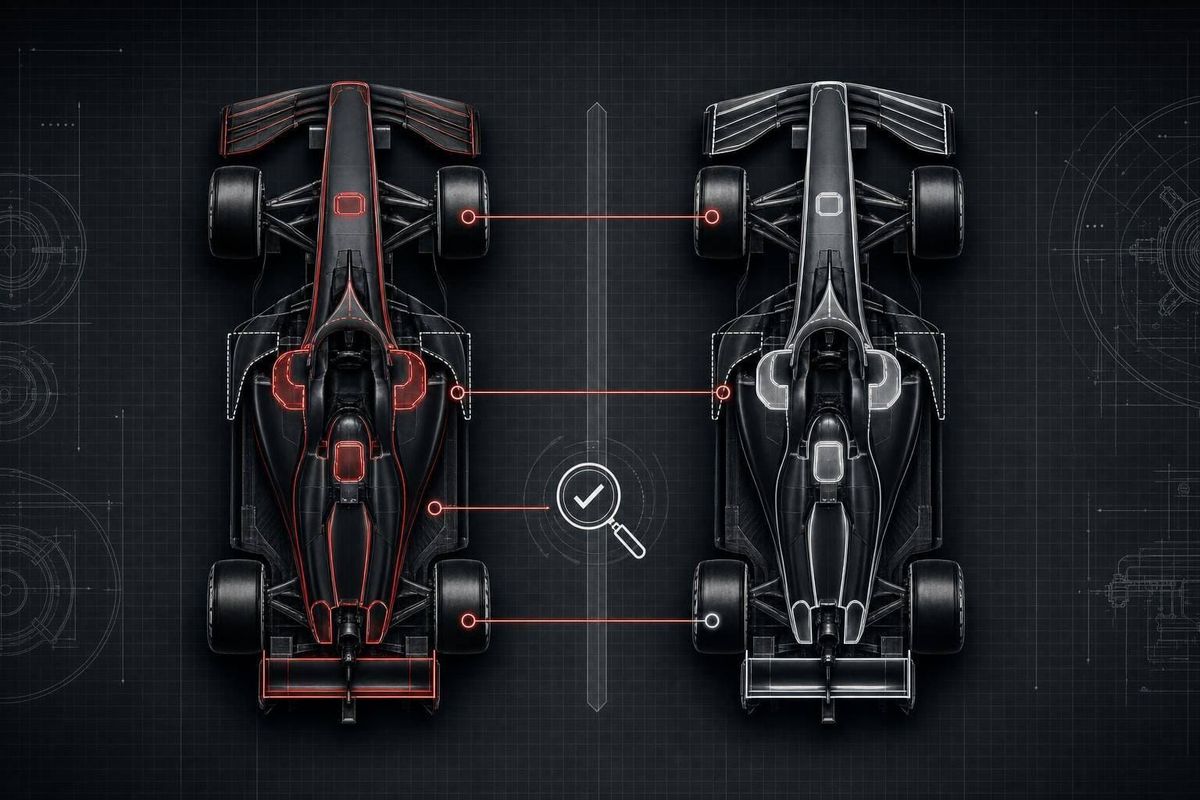
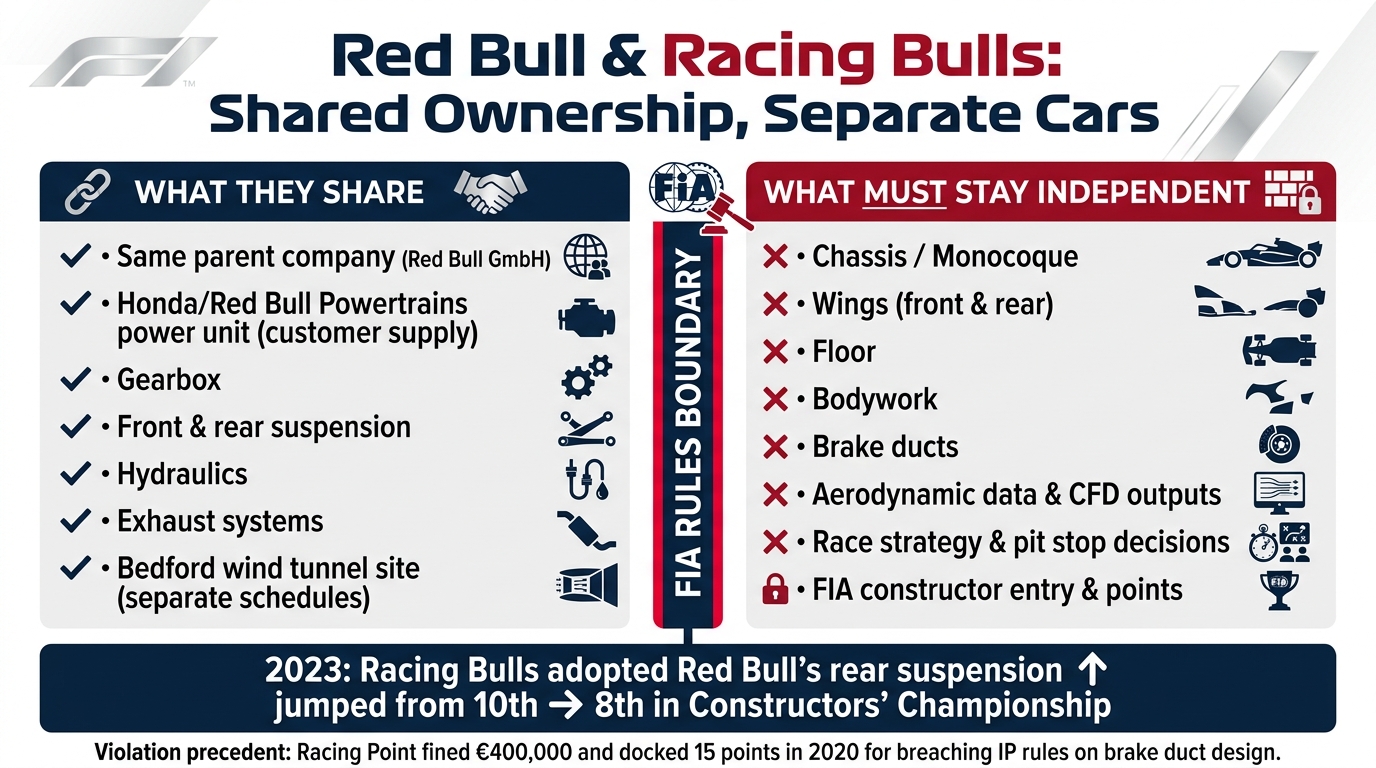
Yes - Red Bull can own two F1 teams, but it cannot run them as one team. That is the short answer. Under FIA rules, Red Bull Racing and Racing Bulls (formerly AlphaTauri/Toro Rosso) may share some parts like the gearbox, suspension, hydraulics, and exhaust. But each team must design its own chassis and aero parts, such as the floor, wings, and bodywork.
If you want the article in one view, here it is:
- Red Bull owns both teams, but each team has its own FIA entry and scores its own points.
- Some parts can be bought and shared under Transferable Component rules.
- Core car design areas must stay separate, especially the monocoque and aero surfaces.
- The FIA watches linked teams closely, especially around wind tunnel use, CFD, and design data.
- The model has helped the second team on track, including a jump from 10th to 8th in the 2023 Constructors’ standings after taking Red Bull’s rear suspension.
- Rival teams still question the setup, mainly because Red Bull has 4 cars on the grid through two owned teams.
I’d read the setup like this: shared ownership is legal; a shared car is not. That’s why the debate never goes away. You have one company, two teams, one rulebook, and a narrow line on what can pass between them.
Quick comparison:
| Area | Red Bull Racing & Racing Bulls |
|---|---|
| Ownership | Same parent company |
| FIA status | Separate constructors |
| Can share | Gearbox, suspension, hydraulics, exhaust, some other permitted systems |
| Cannot share | Chassis, wings, floor, bodywork, brake ducts |
| Power unit | Allowed as customer/common supply |
| Wind tunnel | Same site can be used, but with separate schedules and isolated data |
| Race day | Each team makes its own setup, pit, and Sunday calls |
| Main concern from rivals | Whether two linked teams blur the constructor model |
So if you’re asking whether this partnership breaks the rules, the article’s answer is no. If you’re asking why people still argue about it, the answer is simple: the line between legal cooperation and too-close teamwork is very thin.
Red Bull vs Racing Bulls: What F1 Teams Can and Cannot Share
Alpha Tauri’s COPY OF RED BULL REVEALED!
sbb-itb-7c68254
Team structure: Ownership, roles, and why the link exists
Red Bull moved to a two-team Formula 1 setup in 2006 when it bought Minardi and launched Toro Rosso. That gave the company two F1 teams and four cars on the grid. So yes, the teams are connected through ownership. But they are not treated as a single entry.
How are Red Bull Racing and AlphaTauri connected?
The link starts with shared ownership, but FIA rules require the teams to run separately. Each one has its own FIA entry, its own leadership, and its own race-day operation. Christian Horner runs Red Bull Racing from Milton Keynes. The Faenza-based team is led by Laurent Mekies as Team Principal and Peter Bayer as CEO.
That setup matters for points, too. Each team handles its own Constructors' Championship result.
Why is AlphaTauri called Red Bull's sister team?

For much of its early history, the team worked as a driver development program. It helped bring through drivers like Sebastian Vettel, Daniel Ricciardo, and Max Verstappen.
The 2020 rebrand from Toro Rosso to AlphaTauri changed how the team was presented. The new name promoted Red Bull's fashion brand and framed the outfit as a sister team rather than just a feeder team. As Peter Bayer explained:
"The definition of a junior for us is a driver that ultimately is ready to jump into the Red Bull Racing car." - Peter Bayer
Today, the team races for its own results while still helping develop Red Bull drivers. That history matters, because the technical link between the two teams is kept on a tight leash by the rules.
Technical collaboration: What the two teams can and cannot share
That ownership link matters because the FIA puts tight limits on technical cooperation. In F1, not every part is treated the same. Some items can be bought and shared. Others have to be designed in-house and owned by the team using them.
Which parts and systems can legally be shared?
Some parts fall under Transferable Components (TRCs). That means one team can legally buy them from another team.
These parts include:
- Gearbox
- Front and rear suspension
- Hydraulics
- Exhaust systems
The power unit sits under a different set of rules. AlphaTauri and Red Bull Racing are both supplied by Honda/Red Bull Powertrains, and that is allowed as a standard customer supply.
Which areas must stay independent?
The chassis, or monocoque, and all aerodynamic surfaces, including the wings, floor, bodywork, and brake ducts, are classed as Listed Team Components (LTCs). Each team has to design and own these parts on its own. So no, AlphaTauri can't just take Red Bull's aero package and run it.
That rule sits at the heart of F1's constructor model. And the FIA doesn't treat it lightly. The 2020 "Pink Mercedes" case shows that pretty clearly: Racing Point was docked 15 points and fined €400,000 after being found guilty of breaching IP rules over the design of its rear brake ducts.
| Category | Examples | Sharing Status |
|---|---|---|
| Listed Team Components (LTC) | Monocoque, wings, floor, bodywork, brake ducts | Must be independently designed |
| Transferable Components (TRC) | Gearbox, suspension, hydraulics, exhaust | Can be purchased from another team |
| Power unit | Customer supply | Permitted |
How do wind tunnel access, simulation tools, and data rules apply?
The teams may share the Bedford wind tunnel, but they have to use separate schedules. On top of that, aerodynamic data must stay fully isolated. The FIA also checks these technical links to make sure CFD outputs, aero maps, and other design data remain siloed, even when linked teams use the same software or the same site.
Those rules don't just shape how the car gets built. They also affect race-day pace and the balance of competition across the grid.
Performance impact: Power units, strategy, and competitive concerns
How do power unit supply and shared components affect performance?
Once the rules allow shared hardware but not shared aero, the key issue is pretty simple: where does working together save time, and where does that line end?
Shared power-unit data and operating limits give RB a base to work from, and buying transferable parts from Red Bull Racing lets the team put more of its effort into aero and chassis work. That kind of split matters. If a team doesn’t have to spend as much time on parts it can legally buy, it can focus harder on the areas that still have to be its own.
There’s a clear recent example. In 2023, AlphaTauri adopted Red Bull Racing's rear suspension and moved from last to eighth in the Constructors' Championship.
How does the partnership affect drivers and race operations?
This setup also works as a driver pathway, not just a technical one. Drivers like Yuki Tsunoda and Liam Lawson get Grand Prix experience in competitive conditions through the same route that once developed Red Bull Racing talent.
On race weekends, though, the two teams still operate on their own. Setup calls, pit stop timing, race strategy, and other decisions stay with each team's own engineers and strategists. So while the link between the teams is close, the day-to-day choices on Sunday still sit with each garage.
Why do rival teams question this model?
McLaren CEO Zak Brown has been one of the loudest critics, saying the level of integration weakens the idea of two separate constructors. That’s the heart of the argument: does this setup give Red Bull an edge, or does it simply keep a midfield team alive under FIA rules?
| Debate Area | Critics' Concern | Supporters' Argument |
|---|---|---|
| Competitive balance | Dual ownership can create conflicts of interest on and off the track. | Shared parts can help a smaller team stay financially sustainable. |
| Technical independence | Sharing facilities and staff can blur the line between separate constructors. | Listed aero parts still have to be designed independently. |
| Data and development | Two teams could be used to test different concepts and converge faster. | The FIA audits close relationships and requires distinct aerodynamic solutions. |
| Strategic influence | Critics worry about coordination in strategy or governance. | Each team controls its own race-day operations. |
That tension - legal cooperation versus perceived advantage - still sits at the center of the Red Bull model today.
Conclusion: How to read the Red Bull and AlphaTauri model today
The simplest way to read this partnership is straightforward: shared ownership does not mean a shared car. Teams can share permitted parts. They cannot share the chassis or aero.
Critics like Zak Brown and Toto Wolff are not saying Red Bull and Racing Bulls are flat-out breaking the rules. Their point is narrower than that. They are asking whether the idea of two independent constructors still stands when both teams have shared ownership and wind-tunnel access. That's the main reason the FIA watches close ties more carefully.
The FIA has answered by tightening its audits of teams that operate close to one another. Single-Seater Director Nikolas Tombazis made that clear:
"We check teams that are in close proximity to each other a lot more closely than we check completely independent teams... to make sure this thing doesn't happen."
So the model remains legal and efficient, even as it keeps drawing scrutiny.
FAQs
Why is it legal for Red Bull to own two F1 teams?
It’s legal because Formula 1’s current technical and sporting rules let teams share certain non-listed parts, including gearboxes and suspension systems, while still racing as separate constructors.
The FIA keeps a close eye on how this works. Teams can’t share sensitive information or aerodynamic data. As long as they stay inside those limits, Red Bull’s dual ownership is fully compliant with the rules.
How does the FIA stop teams from sharing too much?
The FIA limits collaboration by keeping team operations strictly separate and auditing development work to stop illegal information sharing.
Teams have to design their own aerodynamic surfaces on their own. And if they use shared facilities like wind tunnels, they must do so on separate schedules.
The FIA also reviews design data and development changes for signs of banned cooperation. That can be hard to police in practice, so the FIA gives teams direct guidance and watches closely linked outfits more carefully.
Could Red Bull gain a competitive edge from having four cars?
Red Bull can cut costs by owning two teams, mainly through shared resources and smart coordination that still fits within F1 rules. Shared infrastructure, along with allowed off-the-shelf parts, can help the sister team make the most of its budget and car development.
That said, there are clear limits. Regulations ban the sharing of aerodynamic surfaces and chassis designs. The FIA keeps a close watch on both teams to make sure they stay separate, independent constructors and do not exchange banned data or development plans.