10 Challenges Team Principals Face with Driver Rivalries
Driver rivalries are a leadership problem: unchecked teammate fights cost points, money, and team cohesion unless principals set clear rules.
When two F1 teammates fight each other, the team principal can lose points, money, trust, and control at the same time.
I’d sum up the whole article like this: the job is not just about letting two fast drivers race. It’s about stopping that fight from hurting the team. One crash can cost millions of dollars, wipe out a strong Sunday, and damage a Constructors’ campaign. In one famous case, McLaren’s 2007 fallout ended with a $100 million fine and Constructors’ exclusion.
If you want the short version, these are the 10 problems the article covers:
- balancing team points vs. a driver’s title push
- giving team orders without losing driver buy-in
- controlling media fallout and bias claims
- splitting upgrades, parts, and engineering time without angering one side
- handling contracts while both drivers fight for status
- protecting mental state and keeping pressure from boiling over
- setting clear racing rules before contact happens
- keeping staff, sponsors, and bosses on the same page
- knowing when to split the driver pairing
- using data without ignoring the human side
What stands out to me is this: most rivalry damage starts off the track before it shows up on the track. It shows up in radio messages, debriefs, part allocation, and private meetings. By the time the cars touch, the problem is often already in motion.
Quick comparison
| Challenge | Main risk | What the principal must do |
|---|---|---|
| Points vs. title fight | Lost Constructors’ points | Pick team-first calls at the right time |
| Team orders | Driver resentment | Explain calls fast and clearly |
| Public narrative | Brand damage | Keep one message inside and outside |
| Upgrades/resources | Bias claims | Use a clear process for parts and support |
| Contract pressure | Power shifts in the garage | Keep talks away from race stress |
| Mental strain | Mistakes and emotional blowups | Deal with issues early |
| Racing rules | Teammate contact | Set limits before the weekend |
| Staff/sponsor alignment | Garage split | Keep all sides moving together |
| Split decision | Long-term team damage | Act before the pairing breaks the team |
| Data vs. people | Cold or biased calls | Use numbers, then apply judgment |
Bottom line: I see this as a leadership problem first and a racing story second. The best principals don’t stop rivalry. They keep it inside clear limits so the team still scores on Sunday.
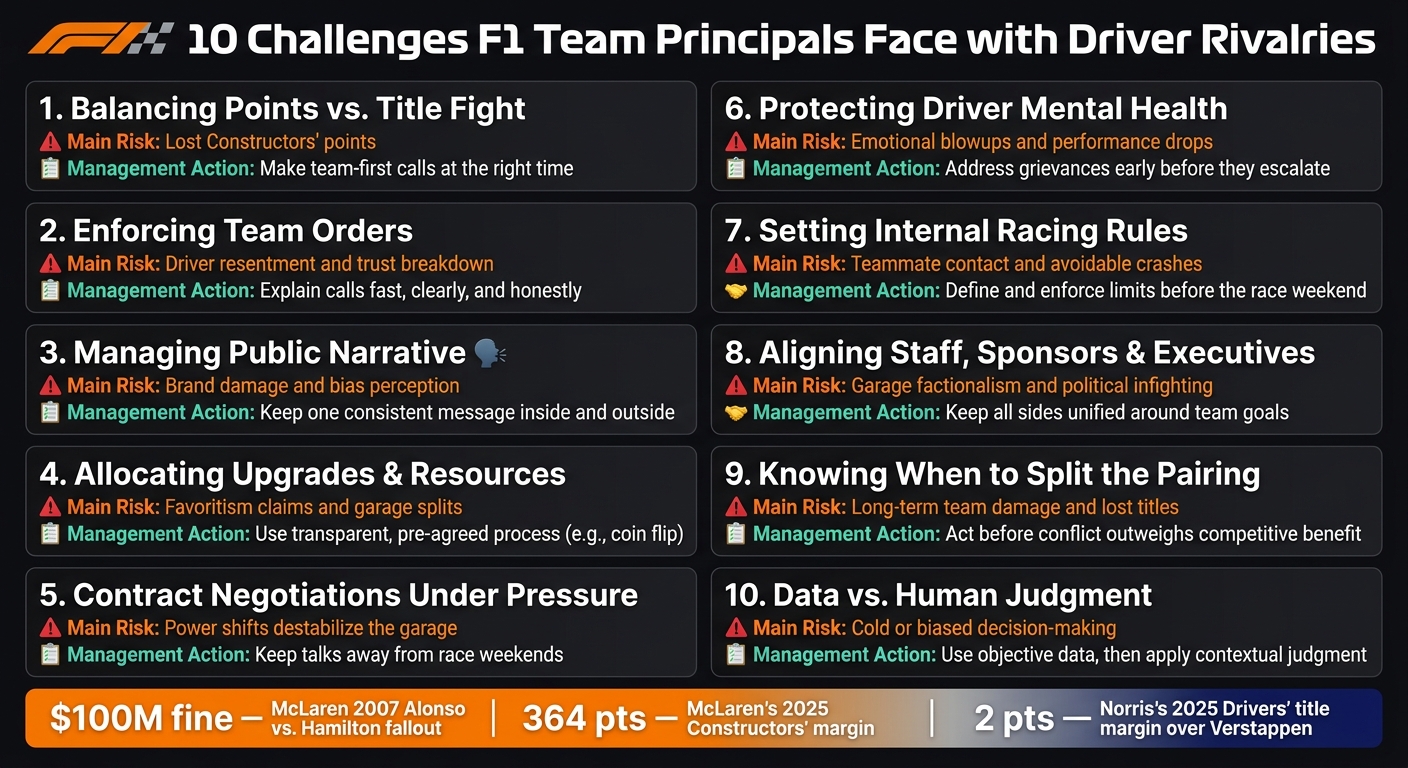
10 F1 Driver Rivalry Challenges: Risks & Management Strategies
Why Driver Rivalries Are a Management Problem, Not Just a Racing Story
Inside a Formula 1 team, a driver rivalry isn't just drama for fans. It's a management problem built around control, trust, and competing priorities. The second two teammates start racing each other as hard as they race the rest of the grid, the team principal's job changes. At that point, they're not just running a race team. They're trying to hold the whole operation together.
One crash between teammates can burn through millions of dollars in damage and wipe out points in a Constructors' Championship battle. That isn't a small headache. It's the kind of mistake that can swing a season. In 2007, the clash between Fernando Alonso and Lewis Hamilton at McLaren played a part in the team being thrown out of the Constructors' Championship and hit with a $100 million fine. A title push can turn into a major financial blow fast. Once points and prize money are on the line, every rivalry becomes a set of hard trade-offs.
And it doesn't stop at the cars. Each driver has their own engineers and mechanics, which means the garage can start splitting into camps. When that happens, the damage spreads. Data sharing gets tighter. Strategy calls get messier. Race execution slips. It starts to feel less like one team and more like two small teams working under the same roof.
Sponsors see that risk right away. So do team leaders. One radio argument blasted across a race broadcast can hurt confidence in the brand and put extra pressure on everyone inside the organization.
That's why team principals can't brush off rivalries as background noise. Andrea Stella said it clearly when he explained McLaren's approach:
"We want to give our two drivers the possibility to express their talent... but this needs to be done within the principles and the approach that we have contributed to build together... Fairness, sportsmanship, and respect for one another."
Those words sound good on paper. The hard part is making them stick when the pressure spikes and both drivers want the same piece of track.
Over a long season, drivers often test the limits their team sets. And that's usually where the real strain shows up first: in the way a team principal tries to balance team results with driver ambition.
sbb-itb-7c68254
1. Balancing Constructors' Points Against Individual Title Ambitions
The Constructors' Championship is the team's main financial prize. So the first call usually isn't just about raw pace. It's about how much freedom each driver gets.
At the center of it is a simple problem: even small clashes between teammates can throw strategy off course. When the points fight tightens, the team principal has to make tough calls fast. Who gets the undercut? Who gets the quicker pit stop? If a safety car changes everything, does the team back the driver higher in the standings, or the option that brings home more total points? That's the moment an internal rivalry stops being background noise and starts affecting race execution.
Timing matters just as much as the call itself. Early in the season, teams often let both drivers race freely and wait to see if a pecking order forms on its own. Later, once the title picture comes into focus, that freedom can shrink. In May 2026, after only five rounds, 43 points separated Mercedes teammates Kimi Antonelli and George Russell, which led Toto Wolff to hold a formal rules of engagement meeting. The point was plain: race hard, but don't hurt the team's points haul.
Push too hard from the pit wall, and you can choke off pace. Let too much slide, and you risk contact, bad strategy splits, and dropped points. The right move depends on the gap in the standings, the point in the season, and what's at stake in both championships. Once a team sets that line, the next challenge is making it stick without losing driver trust. And that line tends to shape everything that follows, from team orders to contract talks.
2. Enforcing Team Orders Without Destroying Trust
Once the rules are in place, the harder part starts: enforcing them in the middle of a race without losing the drivers. A team order can make perfect sense on paper and still do damage if it's handled badly. That’s the part that matters most. Trust is the limit.
Mercedes and McLaren show two very different ways to handle this. Under Toto Wolff, Mercedes leaned on a firm style. He described it as managing drivers "sometimes with an iron fist, and they understood that they couldn't let us down, they couldn't let Mercedes down." That approach helped Mercedes win eight straight Constructors' titles. But it also brought enough tension that sporting penalties, and even dismissal, were used to keep the rivalry under control. McLaren went another way. Andrea Stella took a more direct approach, with flashpoints reviewed openly in debriefs and formal meetings instead of being brushed aside.
The "Multi 21" incident at the 2013 Malaysian Grand Prix is the clearest case of a driver flat-out ignoring an order. Red Bull told Sebastian Vettel to stay behind Mark Webber. Vettel passed him anyway and took the win. Christian Horner later said the situation became "tougher and tougher" to manage, and the trust between the two drivers never fully recovered before Webber retired. The fallout split the garage and took time to calm down.
Stella put it plainly:
"We talk to the driver - straight talking. And if we get something wrong now, it needs to be, 'We didn't think about it.' But it can't be because we haven't talked openly and straight and honestly enough." - Andrea Stella, Team Principal, McLaren
When that conversation is delayed, or skipped, a team starts losing standing with its drivers. If a driver thinks a call was unfair and no one explains it, that frustration doesn't just fade away. It sits there and comes back under pressure, often at the worst time, like during a race or in the middle of a title fight. Once trust starts to slip, every radio message, every interview, and every public reaction adds more strain.
3. Managing Public Perception and Media Narratives
When a driver rivalry turns into a headline, the team principal starts to lose the story. Every radio message, every interview, every offhand comment can feed the next news cycle. And once the battle is out in the open, even routine team calls can look like proof of bias.
Live broadcasts make this worse. Team radio is public by design, so any call made in the middle of a race can become a problem in real time. During the 2026 Canadian Grand Prix weekend, Kimi Antonelli asked the stewards to investigate teammate George Russell. That led to immediate rules-of-engagement talks as Mercedes tried to stop the situation from spilling further into public view.
"When you're sitting on the pit wall like Toto, of course it's so stressful and tense – because you can't control what is about to happen and you want to be able to control it." - George Russell, Driver, Mercedes
Then there’s the favoritism problem. A team can be fair behind closed doors and still look biased from the outside. McLaren ran into exactly that during the 2025 season. Its "papaya rules" race guidelines were meant to give Lando Norris and Oscar Piastri a shared framework for racing each other. Instead, they pulled media attention away from results and toward team politics. Zak Brown later had to publicly brush off claims of bias as "nonsense" to shield the team’s internal culture.
"I've definitely come to the conclusion there's too many fans with too many views that we've just got to be comfortable with how we're going racing inside McLaren." - Zak Brown, CEO, McLaren Racing
That’s what makes this so hard: the public version of the story can last longer than the conflict itself. Mercedes’ 2016 Hamilton-Rosberg rivalry is a clear case. Public threats of sanctions kept driving coverage long after the actual flashpoints had passed.
McLaren’s own internal meetings in 2025 stayed calm and constructive, even while outside coverage claimed the team was favoring one driver over the other in races like Hungary and Italy. In other words, the garage and the headlines can tell two very different stories at the same time. Keeping those stories aligned means staying steady, saying the same thing inside and outside the team, and dealing with issues before they blow up in public. That gets even tougher when the next dispute is about upgrades, data, and engineering priority.
4. Allocating Car Upgrades and Engineering Resources Fairly
Deciding which driver gets a new upgrade package first is one of the hardest calls a team principal makes. It can change race results, swing championship points, and shape how each driver sees their standing inside the team. So this isn’t just an engineering call. It’s a test of trust.
The best way to handle it is to set the rule before the season starts and let simulations and performance models make the first call. That moves the debate away from preference and toward lap time. Championship position matters too: the driver with the strongest mathematical path to the title is often given priority.
There’s another layer here, and it’s easy to miss from the outside. Each driver has a small dedicated crew, usually about four engineers and 8–10 mechanics. Those groups work closely with their side of the garage, and of course they want their car to come out ahead. That means one upgrade decision doesn’t stay small for long. It can spread through the whole support group and turn a technical choice into a political problem.
Ron Dennis used a blunt but clear method at McLaren when Honda engine allocation became a flashpoint. He had two witnesses watch a coin flip to decide who got which unit. It wasn’t fancy, but it made the process visible. That was the point. The same idea applies to upgrades: both sides need to see that the method is fair, not just be told that it is.
Once a driver starts to believe the upgrade order is fixed, every later call can feel loaded. A setup change, a parts delay, a test plan - suddenly it all looks like favoritism. And once those calls start to look like status judgments, the fallout doesn’t stop at the garage door. It can spill into contract talks and change the tone of the whole team.
5. Handling Contract Negotiations Under Rivalry Pressure
That same battle for status doesn’t stop when the helmets come off. It follows the drivers straight into contract talks.
And that’s where things can get shaky.
Negotiations tend to get unstable when they happen at the same time as an active title fight. A driver who’s winning races has more pull, and at that point, seat threats don’t land the way they might have before.
Mercedes' 2026 points gap is a good example of how fast that balance can flip. After only five rounds, Kimi Antonelli was 43 points ahead of George Russell, which put instant pressure on management to deal with the team’s internal balance. In that kind of fight, drivers are far less likely to accept restrictions.
"You can't really put a leash on a driver that is fighting for wins and championships. You can't really tell him 'Oh, just sit back'." - Kimi Antonelli, Driver, Mercedes
If team management seems to lean toward one driver, the damage can spread fast. The other driver may start to lose confidence, and that can spill into mind games or pointed comments in public.
That’s why timing matters just as much as the contract itself. Sensitive talks should stay far away from the pre-race window.
"The drivers need to have a clear mind and know what they can and cannot do... it's not Sunday morning in pre-race meetings." - Gary Anderson, Former F1 Technical Director
Handle contract talks well, and you’re not just sorting out paperwork. You’re also protecting the driver’s mental state, which becomes the next problem to manage.
6. Protecting Driver Mental Health and Psychological Safety
Once rivalry pressure stops feeling abstract and starts shaping split-second choices, the cost goes far beyond lap time. It changes how drivers think, react, and recover from mistakes. That’s why mental health needs to be part of the debrief.
If a driver feels undermined by perceived favoritism, that strain can wear them down mentally. Focus starts to slip. Then a small error turns into a bigger drop in performance. And when that pressure keeps stacking up, emotional control is often the next thing to go.
At that point, the team principal can’t sit back and hope it blows over. If drivers lose emotional control, leadership has to step in before the rivalry becomes dangerous. McLaren’s 2007 season is a clear example of how fast this can spread from the garage to the whole organization: the Alonso-Hamilton rivalry contributed to a $100 million fine and disqualification from the Constructors' Championship.
For a team principal, this isn’t about personalities. It’s about performance. Andrea Stella has been clear on that, and his approach is the opposite of letting tension sit in the background until it erupts:
"If issues are not discussed when they arise, they are likely to pop up the next time there is a moment of stress, when they are more likely to be expressed in a negative way, and so become harder to control." - Andrea Stella, Team Principal, McLaren
The message is simple: deal with grievances early, draw clear lines, and treat psychological safety like any other factor that affects results.
7. Setting Clear Internal Rules for Racing Each Other
Ambiguity is a team principal's worst nightmare when both drivers are fighting for the same bit of asphalt. If the team doesn't draw the line, the drivers will. And when that happens, the limit tends to move lap by lap.
That's why internal rules matter more than outright speed once teammates start racing each other.
McLaren's Papaya Rules are a good example of how a team can let drivers race hard without letting things spill into avoidable contact. At the 2025 U.S. Grand Prix sprint, Piastri's cut-back move wiped out Norris and ended both races. Even with that flashpoint, McLaren still won the Constructors' Championship by 364 points, and Norris edged Max Verstappen by just 2 points for the Drivers' title.
"We want to give our two drivers the possibility to express their talent... but this needs to be done within the principles and the approach that we have contributed to build together... Fairness, sportsmanship, and respect for one another." - Andrea Stella, Team Principal, McLaren
Mercedes took a more formal route with its Rules of Engagement. After the final-lap collision at the 2016 Austrian Grand Prix, Toto Wolff tightened the framework. That meant warnings about sporting and financial sanctions, plus a private email stating that repeated contact could bring race bans or even contract termination. The message was simple: race each other, but respect the team and stay inside the agreed limits.
What matters most isn't just having rules on paper. The test is whether those rules are clear before the race begins and whether they're enforced the same way every single time. Set them before the weekend. Then don't move the goalposts.
These cases show a few different ways teams have handled the same line between freedom and control.
| Team | Era | Rule Framework | Outcome |
|---|---|---|---|
| McLaren | 2024–2025 | Papaya Rules - race hard, race clean, avoid contact | 2025 Constructors' title by 364 points; Norris won the Drivers' title by 2 points |
| Mercedes | 2014–2016 | Rules of Engagement plus deterrents for contact | Multiple titles; high internal tension |
| Red Bull | 2010–2013 | Minimal interference; the "Multi 21" order was ignored | 4 consecutive title doubles |
| Williams | 1986–1987 | "May the best man win" - no clear No. 1 driver | Lost the 1986 Drivers' title despite a dominant car and no clear No. 1 driver |
The next issue is whether those rules still hold once strategy calls, contracts, and pressure start squeezing everyone at once.
8. Aligning Rival Drivers With Team Staff, Sponsors, and Executives
Once the race rules are in place, the rivalry doesn’t stay on the track. It spills into the garage, reaches sponsors, and lands on the desks of team executives. That’s why internal alignment matters just as much as the wheel-to-wheel fight.
Each side of the garage will naturally back its own driver. On paper, that sounds normal. In practice, it can turn routine calls into factional arguments. When a rivalry gets toxic, that same competitive instinct can spark political infighting, where almost every call is seen as favoritism.
And it doesn’t stop with the trackside crew. During the 2014–2016 Lewis Hamilton-Nico Rosberg rivalry, Toto Wolff went as far as threatening both drivers with redundancy and briefly telling them by email that they were no longer part of the team.
Sponsor pressure can also shape the driver lineup itself. Williams showed that in 1986–87, when Honda pushed for changes. At that point, the rivalry is no longer just a sporting issue. It becomes an executive one too.
When things spread that far, engineers and team leaders can end up spending more time dealing with politics than finding lap time.
The principal’s job is to keep drivers, engineers, sponsors, and executives moving in the same direction before the rivalry pushes the team toward a split. Once that alignment starts to crack, the next issue is whether the pairing can survive at all.
9. Knowing When to Break Up a Driver Pairing
Once the cracks in alignment start to show, the issue isn’t just discipline anymore. The real question is whether the pairing can still work.
The warning signs are usually pretty plain: unauthorized engine-mode use, radio complaints aimed at a teammate, and garage crews drifting into separate camps. One bad moment can be managed. When the same signs keep showing up, though, the team has to ask a harder question: is the conflict now bigger than the drivers themselves?
Waiting too long can get expensive fast. It can lead to sanctions, a lost title, or both. McLaren in 2007 showed how quickly internal conflict can spiral into sanctions. Williams in 1986 showed the price of letting a pairing run without firm internal control. In both cases, team principals are left with the same problem: how many repeat incidents do you tolerate before the pairing itself becomes the issue?
Most principals try deterrents first. They usually go with financial penalties, sporting sanctions, or direct warnings in the hope of resetting behavior before a split becomes the only option. If that still doesn’t work, the team has to face the fact that the pairing may be the problem.
A breakup can stop the rivalry, but it doesn’t wipe away the damage. When Prost left McLaren for Ferrari, he brought institutional knowledge to a direct rival and changed the competitive balance for years after. So yes, separating drivers can fix one mess. It can also hand another team an edge.
The cases below show how delay, deterrence, and separation can push events in very different directions.
| Rivalry | Breaking Point | Outcome of Delay |
|---|---|---|
| Hamilton vs. Rosberg | Double DNF at the 2016 Spanish GP | Financial sanctions, strict rules of engagement |
| Alonso vs. Hamilton | Internal disputes and media warfare | $100 million fine, Constructors' disqualification |
| Mansell vs. Piquet | Public insults and no communication | Drivers' title lost to Prost |
| Vettel vs. Webber | "Multi 21" defiance | Owner Dietrich Mateschitz intervened directly |
10. Using Data to Make Rivalry Decisions Without Losing the Human Element
Data helps, but it doesn't make the call on its own. The principal still has to know when to follow the numbers and when to step in. Set that line too far in either direction and things go sideways. Lean too hard on models, and drivers start to look like entries in a spreadsheet. Ignore them, and bias creeps in.
The issue isn't telemetry itself. It's the way rival camps read the same information and come away with different views. The numbers may be objective. The read on those numbers isn't. As Amy Laun-Achenbach put it:
"When decisions are based on objective criteria, they are easier to justify and accept. The focus shifts from who is right to what is right."
McLaren's 2025 season gives a clear example of that balance. In Hungary, when Lando Norris and Oscar Piastri ended up in a strategy clash, Team Principal Andrea Stella let Norris try a one-stop plan - a "free punt" that went against the team's main model but still had enough data behind it to make sense. Norris beat Piastri that day. That's where things get tense, and it's why the McLaren and Mercedes disputes have drawn so much attention. Stella kept returning to one point: transparency.
"If we get something wrong now, it needs to be, 'We didn't think about it.' But it can't be because we haven't talked openly and straight and honestly enough. Because that's the recipe to have a problem."
The stakes were no small thing. McLaren won the 2025 Constructors' Championship by 364 points, and Norris took the Drivers' Championship by only 2 points over Max Verstappen in Abu Dhabi. That's a razor-thin margin. It shows how fast a team can move from fair process to lost points, or the other way around. The harder question comes later, when those data-led calls don't stay in the garage and start shaping the team's politics.
Patterns and Case Studies From Modern F1
These examples show the same problems coming back again and again. The details change, but the pattern doesn’t. Rules get left too vague. Teams don’t enforce them hard enough. Drivers push their case over team radio in public. And action often comes late, after the damage is already done.
Mercedes (2014–2016) tried to put structure around the Lewis Hamilton and Nico Rosberg fight with a formal "Rules of Engagement" document. That gave the team a line in the sand. But paper rules only go so far when both drivers are under pressure and fighting for the same prize. After the collision at the 2016 Spanish Grand Prix, Toto Wolff ended up threatening redundancy. Even with that tension, Mercedes still won eight straight Constructors' Championships in that era. The bigger lesson is simple: writing rules is one thing; getting both drivers to follow them in the heat of battle is another.
Red Bull (2013) is the clearest example of what happens when a team doesn’t back up its own orders. At the Malaysian Grand Prix, Sebastian Vettel ignored the "Multi 21" call and passed Mark Webber for the win. That moment did lasting damage to their relationship and exposed the price of team orders that exist in theory more than in practice. McLaren later went the other way, with clearer limits, more direct talks, and much faster conflict review.
McLaren's 2024–25 approach took that opposite path. Andrea Stella and Zak Brown leaned on transparency and regular debriefs. Their "Papaya Rules" told the drivers to race hard, race clean, and stay out of each other’s way. There were still tense moments, including contact in Canada and Austin, so this wasn’t some perfect system. But McLaren kept the rivalry from turning poisonous. In 2025, the team won the Constructors' Championship by 364 points, and Lando Norris beat Max Verstappen to the Drivers' title by only 2 points. Now comes the next pressure test: whether the same model holds up with a younger, less settled pairing.
Mercedes in 2026 shows how fast the same management issue can return. After George Russell and Kimi Antonelli touched wheels at the Canadian Grand Prix, Wolff called a "clear the air" meeting. He repeated that they were free to race, but only if they stayed out of situations that could damage one or both cars. That sounds simple enough. In practice, it shows the limit of control when drivers hear "race freely" and believe they still have room to push right to the edge.
| Rivalry | Key Flashpoint | Management Response | Outcome |
|---|---|---|---|
| Mercedes – Hamilton/Rosberg (2014–16) | 2016 Spanish GP collision | "Rules of Engagement" document; threats of redundancy | Eight straight titles |
| Red Bull – Vettel/Webber (2013) | "Multi 21" ignored at Malaysia | Public "no team orders" stance; owner intervention | Relationship broke down |
| McLaren – Norris/Piastri (2024–25) | Contact in Canada and Austin | "Papaya Rules" and open, transparent debriefs | Both 2025 titles |
| Mercedes – Russell/Antonelli (2026) | Canadian GP wheel-to-wheel contact | "Clear the air" meeting; race freely, but avoid damage | Ongoing |
Supporting Tables and Data Breakdowns
The tables below compare the main management calls behind driver rivalries. Most of those calls land in three buckets: race freedom, race control, and breakup timing.
The first decision is simple on paper, but messy in practice. Do you let drivers race each other, set a clear pecking order, or land somewhere in the middle? Each path shifts the tradeoff between speed, control, and trust. And it ties straight back to the earlier problem: balancing constructors' points with driver ambition.
| Approach | Main Benefits | Primary Risks | Best Situation |
|---|---|---|---|
| Free Racing (Equal Status) | Maximizes driver motivation; preserves fairness and transparency; attracts sponsors and fans through entertainment | On-track collisions; points lost to external rivals | Dominant car; two evenly matched elite drivers |
| Strict Hierarchy (No. 1 and No. 2) | Clear strategic focus; avoids strategic confusion; maximizes championship points for the lead driver | Demotivates the second driver; risk of disobedience; negative public/media perception | One driver clearly superior; an extremely tight external title fight |
| Rules of Engagement (Hybrid) | Clear boundaries; protects team assets while allowing competition | Hard to enforce in high-pressure moments; requires constant management | Two ambitious, alpha personalities in a championship-winning car |
Once that setup is in place, race-day decisions come down to one thing: what protects the team best right now.
| Scenario | Primary Decision Levers | Management Action |
|---|---|---|
| Tire/Pace Offset | Tire age/compound, pace delta, remaining laps | Order the slower car to yield to maximize the team's finishing position |
| Championship Protection | Points gap to external rivals, season stage | Prioritize the driver with the realistic title shot on pit strategy |
| External Threat | Gap to chasing rival, pit window, undercut risk | Freeze positions to prevent time loss from internal fighting |
| Car Damage/Safety | Mechanical health, weather volatility, fuel levels | Issue a "hold position" order to ensure both cars finish |
| Uneven Resource Allocation | New upgrades, spare parts availability | Use a transparent coin toss or alternating priority to prevent favoritism |
Some of these calls are obvious. If one car is on older tires and holding up the faster one, the team has to act. Others are more political. New parts, spare components, or pit strategy can turn into flashpoints fast if one driver feels boxed out.
The hardest choice, though, is whether the pairing still works at all. At some point, the issue stops being a tense but useful rivalry and starts hurting race execution. This table shows the warning signs that push a team principal toward action.
| Signal | Threshold for Action |
|---|---|
| Performance Trend | Consistent points loss to external rivals traced to internal conflict |
| Trust Level | Repeated order violations or data withholding with no resolution |
| Leadership Burden | Rivalry consumes management time that should go toward race execution |
A pairing can survive a lot of tension. What it usually can't survive is repeated points loss, broken trust, and a management group that spends more time putting out fires than running the team.
Conclusion
A team principal's job goes far beyond choosing the faster driver or making the right pit call. At its core, the role is about keeping two elite racers pulling in the same direction long enough for the team to win, even as the pressure shifts from one race weekend to the next.
The real test isn't whether rivalries show up. They almost always do. The hard part is keeping the price of that rivalry under control. That means stepping in before the damage costs points, with trust, clear rules, and consequences that actually stick. A rivalry helps only when leadership keeps it boxed in, and handling that well matters just as much as the car itself.
FAQs
Why are driver rivalries such a big risk for team principals?
Driver rivalries can turn into a serious problem fast. What starts as healthy competition can spill over into conflicts that hurt the entire team. That can mean on-track collisions, poor communication, and a split inside the garage that throws off race strategy.
The bigger issue is the pull between personal ambition and the team’s push for championships. Drivers want to win for themselves. Teams need both cars and both drivers working toward the same goal. If the rules aren’t clear and transparent, it becomes much easier for a driver to chase individual results at the team’s expense.
When should a team principal use team orders?
Team principals turn to team orders when a fight between teammates starts to hurt the bigger picture. That usually happens in a title battle, or when hard racing on track starts flirting with the kind of contact that can cost the team a pile of points.
They can also step in when one driver plainly has the stronger pace, or when the standings make it clear that backing the lead contender gives the team its best shot. The goal is simple: protect points, set limits, and keep the team together.
How do teams decide when to split a driver pairing?
Teams don’t follow one fixed playbook here. The call depends on the title picture, the drivers involved, and where the team stands at that point in the season.
Most of the time, management steps in only when a rivalry starts to damage team goals, like race wins or the constructors’ championship. Before backing one driver, teams usually try simpler fixes first: clear rules, open communication, and well-defined roles. Picking a lead driver tends to be the last move, not the first.