Red Flag Pit Stops: Rules and Controversies
Red-flag pit stops protect safety but often erase pit-time costs, creating a free strategic advantage that skews race results.
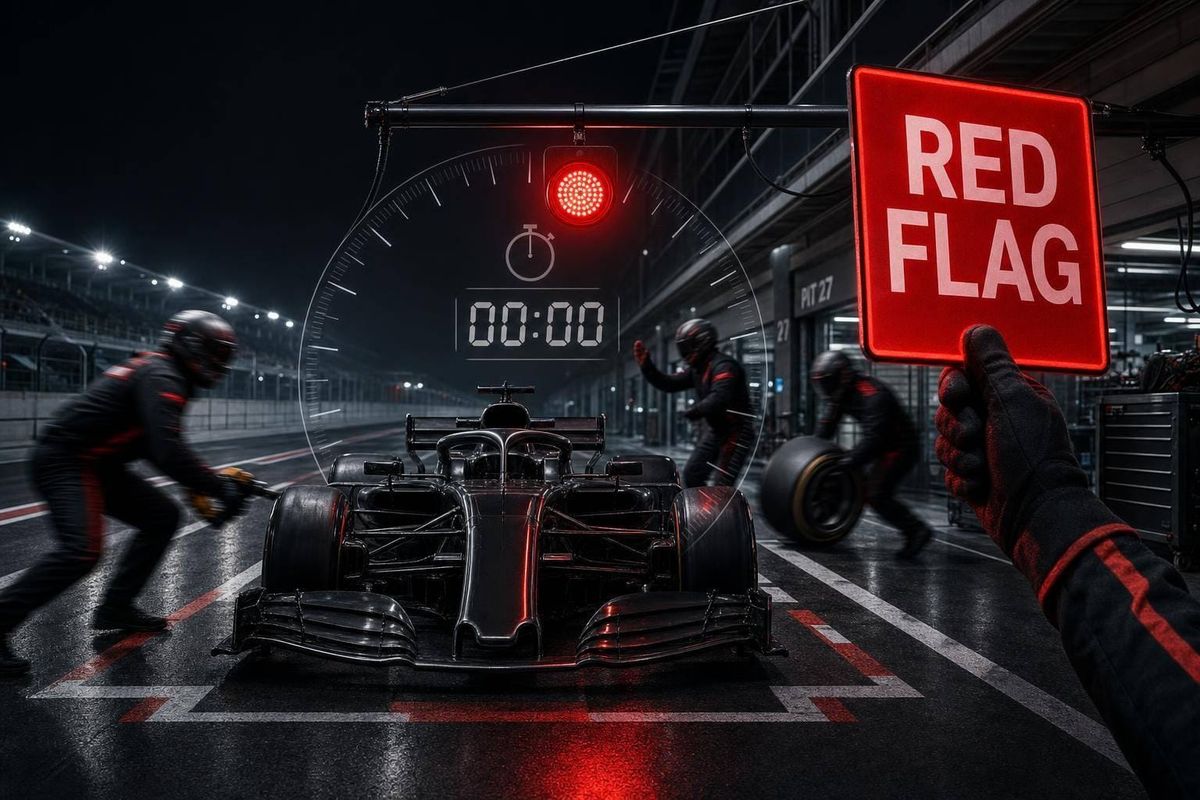
A red flag can change a race in seconds. Teams can swap tires and repair damage while the field is stopped, which can erase a normal 20–25 second pit-loss and flip the result.
If you want the short answer, here it is:
- Yes, teams can change tires under a red flag
- Yes, they can repair crash damage
- No, they cannot refuel
- No, they cannot use the stop for setup changes meant to add pace
- The main problem is simple: a safety stop can turn into a free race swing
Since 2020, F1 has had 17 red flags, almost matching the 19 seen from 2000–2019 combined. That helps explain why this rule keeps getting attention.
The big points are easy to spot:
- A normal pit stop costs track time
- A red-flag stop removes that cost
- Tire changes can also satisfy race tire rules in some cases
- Repairs can keep damaged cars alive when they might otherwise retire
- Recent races like São Paulo 2024, Monaco 2024, and Silverstone 2021 put the issue in plain view
| Issue | What happens under a red flag |
|---|---|
| Tires | Teams can change them |
| Damage | Teams can repair approved crash damage |
| Refueling | Not allowed |
| Setup for pace | Not allowed |
| Time loss | About 0 seconds versus rivals during the stop |
I see the rule this way: it exists for safety, but it can still skew the race. The best fixes are the ones that keep safe restarts while cutting the free gain - such as not counting red-flag tire changes toward the two-compound rule or adding a restart penalty for optional tire swaps.
That’s the core of the debate, and it frames everything else in this article.
Red Flags and Race Suspensions - the rules
sbb-itb-7c68254
The Rulebook: What Teams Can and Cannot Do During a Red Flag
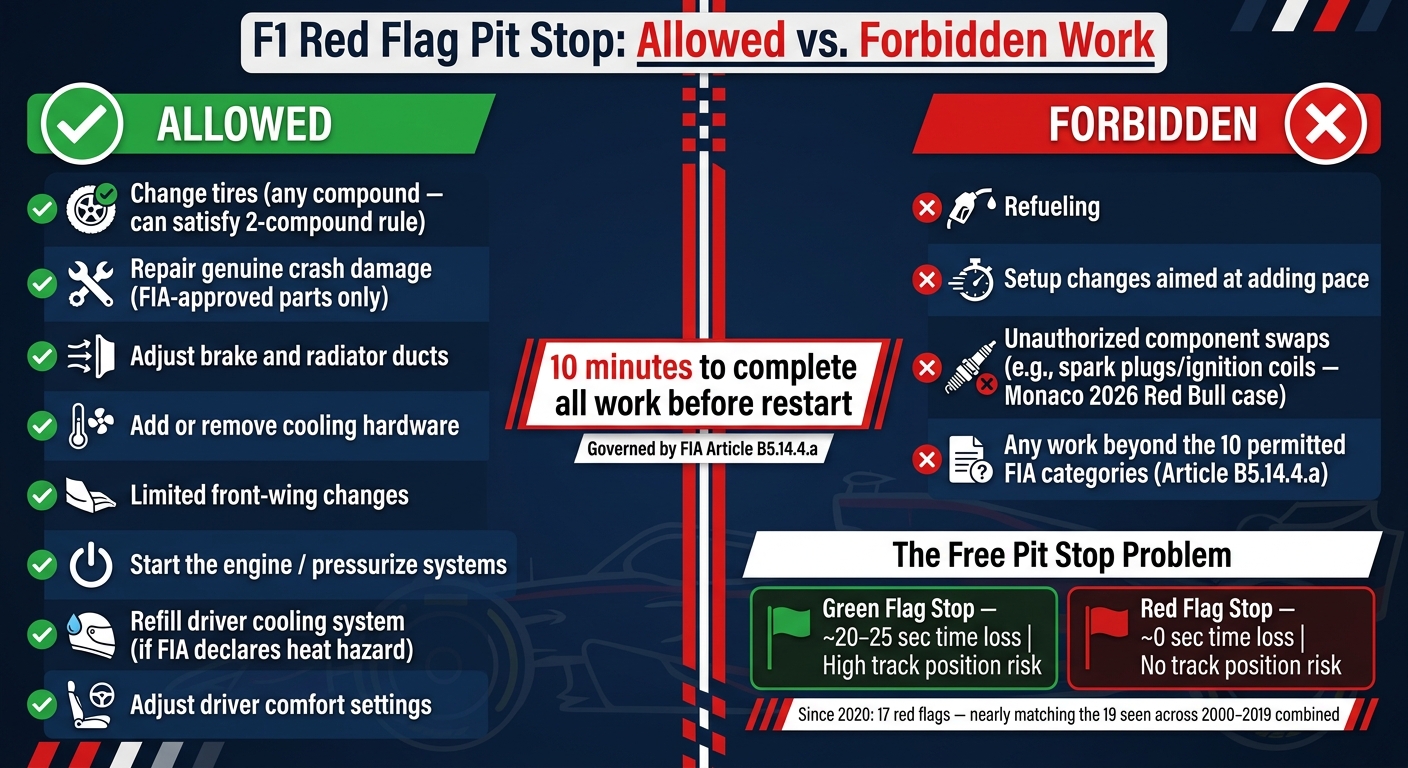
F1 Red Flag Pit Stop Rules: What's Allowed vs. Forbidden
When a red flag stops the race, every car has to head straight back to the pit lane. The FIA handles this under Article B5.14.4.a of the Sporting Regulations, which lists exactly 10 categories of permitted work. The goal is safety first, not free lap time. And that’s where the arguments usually start: what counts as a repair, and what crosses the line into an advantage?
Allowed work: tires, repairs, and limited adjustments
Teams are allowed to fit any tire compound they want, and that can also cover the mandatory two-compound rule. They can also adjust ducts, add or remove cooling hardware, and make limited front-wing changes.
If a car has genuine damage, teams can repair it. But there’s a catch: any replacement part has to match the original spec and must be approved by the FIA Technical Delegate. Teams are also allowed to start the engine, pressurize the car for the restart, and tweak driver comfort settings. If the FIA declares a heat hazard, they can also refill the driver cooling system.
That sounds clear on paper. In practice, it gets messy fast. The hard part is deciding where a needed repair ends and a speed boost begins.
Forbidden changes: refueling and setup changes for performance gain
What teams can’t do is just as important. They cannot refuel the car, and they cannot use the stoppage to make setup changes aimed at making the car faster.
A good example came at the 2026 Monaco Grand Prix. Red Bull tried to change the spark plug and ignition coil on Isack Hadjar's car, but the work was stopped and the car had to be put back into its original state before the restart.
That gets to the heart of the rule: fix what’s damaged or unsafe, but don’t treat a red flag like a free pit stop for extra pace.
Why the restart procedure matters
These limits matter even more right before the race gets going again. Teams have 10 minutes to secure the driver and finish any allowed work before the restart.
Tire temperature is a big part of this. Cold tires mean less grip, and less grip can turn the first few corners after a restart into chaos. That’s why teams often bolt on fresh rubber before the field goes back out. It’s not just about pace. It’s also about keeping the restart under control for as long as possible.
The Controversy: Why Red Flag Pit Stops Feel Unfair
The free pit stop effect versus normal race strategy
This is where a safety rule turns into a sporting fight.
A red flag feels unfair because it wipes out pit-lane time loss without reshuffling the order. In plain English: teams get the upside of a stop, but not the usual downside.
Under a green flag, a pit stop can cost a driver track position in a heartbeat. Under a red flag, the field is frozen, and teams can bolt on fresh tires with no time loss compared with the cars around them. On top of that, a red flag can also satisfy the two-compound rule without a live stop.
| Condition | Time Loss (Approx.) | Track Position Risk | Strategic Benefit |
|---|---|---|---|
| Green Flag | 20–25 seconds | High | Fresh tires at a real time cost |
| Red Flag | 0 seconds | None | Free stop; compound requirement can be met |
That difference is the heart of the argument. In a normal race flow, strategy has a price. Under a red flag, that price can vanish.
When repairs change the race result
Repairs add another sore point.
Under the rules, teams can fix genuine accident damage during a red flag. That can keep a damaged car in the race instead of forcing a retirement. And this is not some edge-case from one odd weekend. The rule has swung multiple races.
A well-known example came at the July 2021 British Grand Prix. Mercedes repaired Hamilton's car during the stoppage, and he stayed in the race and went on to win.
For rivals, that's hard to swallow. Damage that might have ended a race under green conditions can suddenly become fixable once the session is stopped.
Recent race flashpoints and why they triggered debate
One of the clearest recent examples came at the November 2024 São Paulo Grand Prix. Norris and Russell pitted for intermediates under a Virtual Safety Car, while Verstappen and the Alpine drivers stayed out. Then Colapinto crashed, the race was red-flagged, and Verstappen plus the Alpines got a free stop. Verstappen, who had started 17th, went on to win, while Norris finished 6th.
The 2024 Monaco Grand Prix showed the same issue in a different way. A lap-one crash brought out a red flag, which let the whole field change compounds while stationary. And because overtaking at Monaco is so tough, the race more or less locked into place. The top 10 finished in the same order they restarted, with zero overtakes across the final 77 laps.
That is why officials see the rule as a safety measure, while rivals see it as a roll of the dice. The core problem is the gap between safety logic and sporting fairness.
Why the Rules Exist: Safety, Operations, and Technical Limits
Why some car work is necessary after a stoppage
Critics aren’t wrong. But the people who wrote the rules aren’t wrong either.
A full ban sounds neat on paper. On track, it gets messy fast. Brake assemblies can hit 1,832°F (1,000°C) under heavy braking, and once a car stops, that heat doesn’t just vanish. It lingers. That heat soak can create trouble when the race restarts. So instead of a total freeze, the rules allow limited work.
Tires are the other big issue. After slow laps behind a Safety Car or under a Virtual Safety Car, tire temperatures can fall off a cliff. And cold rubber offers very little grip. As Bernie Collins, former head of race strategy at Aston Martin, explained:
"It would be quicker to change the tyres, put on a fresh hot set which they can keep on the car and that's obviously a lot safer to restart the race than it is on cold intermediates."
There’s also the debris problem. A car that passed through a crash scene may have picked up carbon fiber or taken a hidden tire cut. That’s the kind of issue you might not spot until it’s too late. Collins pointed out why a “prove the damage first” rule sounds better than it would work:
"If you didn't have the current rule and instead you said teams had to prove accident damage before they could change tyres under the red flag, the teams would find a way to prove there was accident damage in order to change them."
The line between safety repairs and competitive advantage
This is where things get tricky. Some work during a red flag is plainly about safety. Some is about safety and lap time. And some sits right in the middle.
The FIA tries to separate those cases through the permitted-operations list in Article B5.14.4.a, but doing that in real time is tough. A rule can look clear until a team finds the edge of it.
That happened at the June 2026 Monaco Grand Prix, when Red Bull was investigated for unauthorized red-flag work on spark plugs and coils. Stewards took no action because the team stopped and restored the car before the restart. The case showed how fast safety-related work can drift toward a race edge. It also showed something else: if there’s daylight in the rule, teams will look for it.
Here’s where that gray zone shows up most clearly:
| Operation | Allowed? | Safety rationale | Performance risk |
|---|---|---|---|
| Changing wheels and tires | Yes | Protects against debris damage, punctures, and unsafe cold or worn rubber | Can be a major strategic gain |
| Repairing genuine accident damage | Yes | Restores structural safety after contact or crash damage | May also recover lost pace |
| Fitting cooling devices | Yes | Prevents overheating during stationary periods | Can improve thermal performance |
| Adjusting brake and radiator ducts | Yes | Helps manage heat soak risk on restart | Can also improve brake consistency |
That’s the core problem. The same step that makes a restart safer can also make a car faster or more reliable. Any rule change has to deal with both sides at once: keep the restart safe, while cutting down the room teams have to turn a stoppage into an edge.
Possible Fixes and Conclusion: More Fairness Without Compromising Safety
3 realistic reform options
The aim is pretty simple: keep red-flag work in place for safety, but stop teams from turning it into a free strategy play. Three rule changes go straight at that issue.
The most direct fix is removing compound credit from red-flag tire changes. Teams could still swap tires during a stoppage if safety calls for it, but that change would not count toward the mandatory two-compound rule. In practice, every driver would still need to make at least one green-flag pit stop.
A second option is a restart penalty. If a driver changes tires under red-flag conditions, they would restart from the pit lane or the back of the grid. That keeps the safety reason in place, while making sure there is still a sporting cost.
The third option is a same-compound rule. Teams could change tires, but only to the same compound they were already using. So there would be no switch from Mediums to Hards in the middle of a race under a red flag. That shuts the strategy loophole without getting in the way of safety work.
Which solution best balances safety, fairness, and ease of enforcement
These ideas do not all solve the problem in the same way. Some do more to fix the sporting side. Others are simpler for officials to handle.
| Proposal | Safety | Sporting Fairness | Ease of Enforcement |
|---|---|---|---|
| No compound credit | High - fresh tires still allowed | High - forces a green-flag stop | High - simple rule change |
| Restart from back | High - repairs still permitted | High - removes track position gain | High - clear grid procedure |
| Same-compound only | High - safe rubber for restart | Medium - doesn't address wet-weather loopholes | Medium - requires tracking tire sets |
A red flag should keep drivers safe. It should not wipe out strategy cost. That is why the no-compound-credit rule looks like the best place to start. It does not limit safety work, it is simple to monitor, and it goes right at the main complaint: a red flag can wipe away an edge built over dozens of laps.
The restart penalty stands out most in wet races, because the two-compound rule does not apply there.
Key takeaway
These tire changes exist for a good reason. Restarting on cold, debris-damaged, or worn tires can be dangerous. The issue is that the same work that keeps drivers safe can also hand over a 20–25 second strategy gain for free. Under normal race conditions, that would cost real time in the pit lane.
The best fixes are the ones that keep the safety function while cutting down the sporting reward. Removing compound credit and adding restart penalties for non-essential changes would do exactly that, without forcing race control into messy, split-second judgments about what counts as "genuine damage." As Lando Norris put it plainly:
"I think it's just a very unfair rule that should be taken away."
He is not completely wrong. But a full ban is not the answer. Better rules can stop a safety measure from turning into a free strategy reset.
FAQs
Why are tire changes allowed under a red flag at all?
The main reason is safety.
If a race is stopped after a major crash, cars may already have passed through debris on the track. That debris can puncture tires or cause damage that isn't easy to spot right away. Letting teams change wheels lowers the risk of sending drivers back out on damaged tires.
Wet conditions add another issue. During a stoppage, tires can lose a lot of temperature. And cold wet-weather tires don't work the same way warm ones do. Fresh, warm tires are seen as the safer option than restarting on cold, ineffective rubber.
How does the FIA determine what counts as a legal repair?
During a red flag, teams can only carry out work that the Sporting Regulations specifically allow. That includes changing wheels and tires, adjusting ducts, changing driver-comfort settings, adding compressed gases, and using heating or cooling devices.
If the car has accident damage, teams may repair only genuine collision damage, including replacing damaged assemblies. The FIA technical delegate watches that work closely, and anything beyond those limits can be investigated and penalized.
Which rule change would best prevent free pit stop advantages?
There’s no one fix that everyone agrees on. But some drivers and analysts have floated one idea: require teams to run two different tire compounds during a race. That would likely cut down the upside of getting a free tire change under a red flag.
The catch is that the current rules are built mostly around safety. For example, they allow teams to replace tires that were damaged by debris. That makes any rule change tough, because no one wants to mess with a safety measure just to close a loophole.