How Media Shapes F1's Female Audience
Docuseries, social clips and plain-language race analysis drove F1’s surge in female viewers—and media must adapt to keep them.
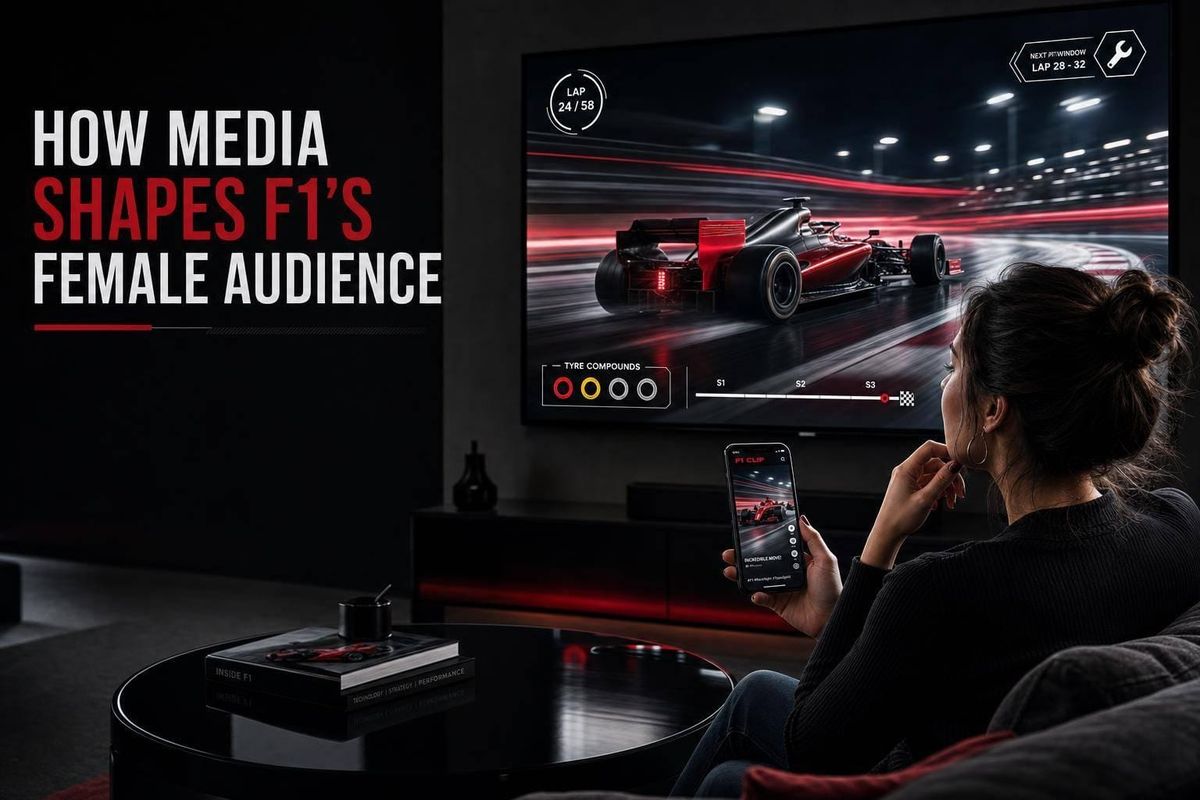
F1’s female fanbase grew from about 8% in 2017 to 42% today because the media entry point changed. I’d sum it up like this: less insider-first coverage, more story-first content, more social video, and more plain-language race analysis.
If you want the short answer, here it is:
- Docuseries and social media brought more women into F1
- Older coverage often framed F1 as a male space
- Women are still too often treated as casual fans
- Clear race explainers, data-led coverage, and visible women in expert roles help turn interest into long-term fandom
- Community behavior matters just as much as media reach
A few numbers make the shift clear:
- Women now make up 42% of F1’s global fanbase
- Three out of four new fans last year were women
- Formula1.com saw a 73% jump in female visitors in one year
- Women ages 25–34 on Formula1.com grew by 670%
- In the U.S., 60% of F1 fans are Gen Z and millennials
What stands out to me is simple: the racing didn’t change nearly as much as the way people found it. Media now leads with emotion, people, and easy entry points. Then it gives fans room to learn strategy, tire calls, and team dynamics without talking down to them.
That also means growth can stall if coverage keeps falling back on old habits like appearance-first stories, “DTS fan” labels, or lifestyle-only angles for women. If F1 media wants this audience to stay, it has to treat women as part of the sport’s core audience, not as side viewers.
| What helps growth | What hurts growth |
|---|---|
| Story-first entry points | Male-first framing |
| Plain-language analysis | Jargon used as a test |
| Women shown in expert roles | Novelty-first coverage |
| Data-led fan spaces | “Not a real fan” gatekeeping |
So my takeaway is direct: media doesn’t just reflect F1’s audience. It helps decide who joins, who stays, and who feels like they belong.
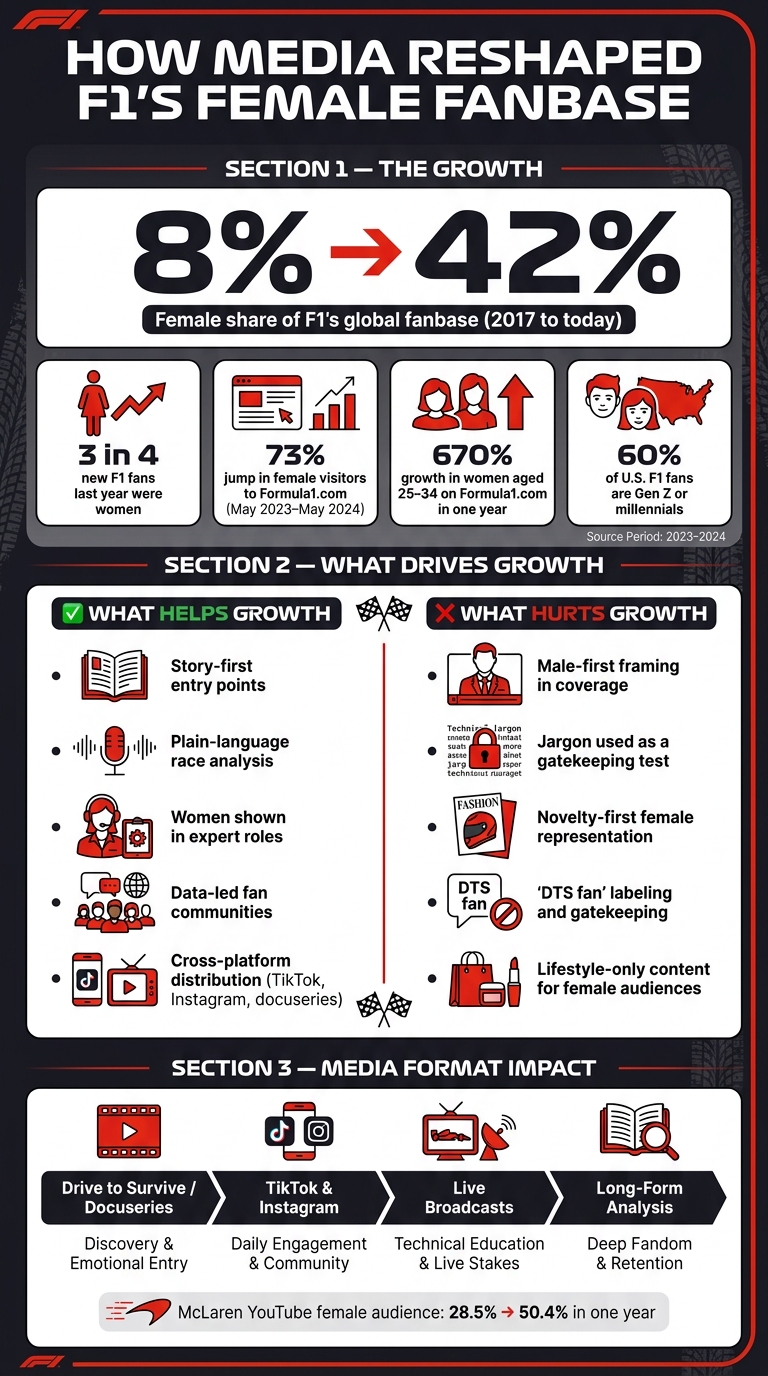
F1's Female Fanbase Growth: Key Stats & Media Drivers (2017–2024)
F1 target FEMALE FAN growth in 2026!
sbb-itb-7c68254
Problem: Legacy coverage still frames F1 through a male lens
A lot of older F1 coverage was built for hardcore fans, with dense technical talk and a tone aimed at lifelong male viewers. That bias doesn't just shape how the sport gets explained. It shapes which stories get told in the first place.
Stereotypes in broadcast storytelling
One clear example is the old grid girl setup, where women were treated like decoration instead of part of the sport. That kind of framing still lingers. As F1 journalist Sheona Mountford said:
"Women still tend to act as 'window-dressing' for F1, but Liberty Media have triggered a shift that shows no sign of stopping anytime soon."
The issue goes well beyond what appears trackside. A stubborn idea in F1 coverage is that female fans are mostly there for driver looks, personalities, or "WAG drama" instead of race strategy, lap times, and the sport's history. Eleanor Roberts and Nikki Bosier pushed back on that directly:
"While there is a persistent myth that women are only watching or following F1 for the 'hot drivers or the WAG drama', there remains a whole collection of women who purely love the racing and the history of F1."
That same bias also shows up when women get treated as new fans by default, or written off as Drive to Survive viewers no matter how long they've followed F1. And when women want strategy breakdowns or data-led analysis, they're often served lifestyle content instead. That's not just patronizing. It can turn informed fans away and shrink the path from casual viewer to long-term supporter.
Low visibility for women in technical and competitive roles
The problem isn't only about what gets covered. It's also about who viewers see doing the work.
When broadcasts rarely show female engineers, strategists, or executives in serious on-screen roles, they send a quiet message: F1 knowledge belongs to men. For new female viewers hoping to see someone like themselves in the technical side of the sport, there are often very few reference points. When women are shown in those roles, the picture changes. It becomes easier to imagine joining F1's deeper conversations.
Novelty-first coverage shows how even well-meaning reporting can miss the point. If a woman's presence is framed as unusual instead of normal, she's still being kept just outside the sport's core identity. The response to Jessica Hawkins showed there is demand for a different angle. When coverage focused on her technical feedback during Aston Martin's 2023 test session, one post drew nearly 1.5 million likes. That wasn't interest in novelty for novelty's sake. It was clear interest in skill-based female representation.
Broadcast and marketing teams still often work from older assumptions about a male fan base. So editorial choices keep reflecting the audience F1 used to center, not the one that's growing now.
Comparison table: gendered framing vs. performance-based framing
The gap between older and newer editorial approaches comes down to a set of repeated choices. Each one sends a signal about who F1 is for. Side by side, the contrast is hard to miss.
| Coverage Element | Gendered Framing | Performance-Based Framing |
|---|---|---|
| Primary Focus | Appearance, "WAG" drama, and novelty | Lap time analysis, strategy, and engineering |
| Narrative Hook | Novelty-first tropes and decoration | Competence, professional roles, and technical impact |
| Driver Image | Focus on personal life or physical appearance | Driving style, race pressure, and career trajectory |
| Audience Perception | Women as "guests" or unserious fans | Women as core stakeholders and technical experts |
Performance-based framing can still leave room for personality. The difference is that it keeps the sport itself - the racing, the pressure, and the technical side - at the center.
Solution: Streaming, social media, and analysis as entry points
Streaming platforms, short-form video, and easy-to-follow analysis make F1 less intimidating for new fans, especially women. They work because they swap insider language for clearer entry points. And that matters long before someone sits down to watch a full Grand Prix.
How docuseries and short-form video changed the entry funnel
Drive to Survive changed the way F1 introduced itself. Instead of opening with lap times, aero packages, and pit wall jargon, it opened with people: rivalry, pressure, failure, and ambition. That made the sport easier to step into for viewers with no motorsport background. The pattern is pretty simple: emotional storytelling pulls first-time viewers in.
Formula1.com saw a 73% increase in unique female visitors between May 2023 and May 2024, and the 25–34 age group grew by 670% in that same period.
TikTok and Instagram also changed the game. They turn F1 into something fans see every day, not just during a race broadcast. That makes the sport feel social instead of distant. In the U.S., that matters a lot, since 60% of fans are Gen Z or millennials, and 61% of fans engage with F1 content daily.
Once that first spark is there, the next challenge is different: helping people follow strategy and technical detail without making them feel lost.
Making technical content accessible without oversimplifying
Getting someone interested through a docuseries is one thing. Keeping them with the sport through a full race weekend is another. Tire strategy, race rules, undercuts, setup choices - F1 gets dense fast. The goal isn't to strip that away. It's to explain it clearly.
Broadcasters are starting to use tech to bridge that gap. On-screen graphics, live data overlays, and tools like ghost cars help viewers see what's happening in the moment without needing an engineering degree. As F1 broadcaster Ariana Bravo explained:
"Technology helps you bring it closer... whether it's graphics that we're putting up and different things such as ghost cars, all of these different elements bring Formula 1 to life." - Ariana Bravo, F1 Broadcaster
Publishers are doing the same thing in articles and video. Explaining tire strategy doesn't take a chemistry degree. It takes plain language and a willingness to answer the questions newer fans are already asking. That's the approach F1 Briefing uses: breaking down race strategy, aerodynamic ideas, and team dynamics in simple terms so readers can move from casual interest to real technical understanding without slamming into a wall of jargon.
Comparison table: live broadcasts, docuseries, social clips, and long-form analysis
Each format plays a different part in the path from first-time viewer to committed fan. No single one does it all, which is why the best media mix uses them together.
| Format | Discovery Value | Technical Education | Emotional Connection | Repeat Engagement |
|---|---|---|---|---|
| Live Broadcasts | Moderate - needs some existing interest | High - live data, graphics, ghost cars | Moderate - driven by live stakes | High - tied to the race calendar |
| Docuseries (Drive to Survive) | Very High - main entry funnel | Low - simplifies rules for access | Very High - character-driven storytelling | Low - seasonal release |
| Social Clips (TikTok/Instagram) | High - strong reach on TikTok and Instagram | Moderate - short explainers and highlights | High - community and driver connection | Very High - daily, always-on feed |
| Long-Form Analysis | Low - works best for fans already deeper in | Very High - deep dives into strategy and aero | Moderate - builds intellectual buy-in | High - builds trust over time |
Format alone doesn't keep people around. The next test is whether online spaces make new fans feel like they belong.
Problem and solution: online communities can gatekeep or build belonging
How gatekeeping reduces trust and retention
Media may bring fans through the door. Community often decides if they stick around.
One pattern shows up again and again: women get dismissed as "DTS fans" even if they've followed F1 for years. As writer and podcast host Lily Herman put it:
"Women are too often told they are not real fans and many who have been watching the sport for decades are labeled DTS fans purely based on their gender." - Lily Herman, Writer and Podcast Host
That kind of labeling chips away at trust. It also makes people less likely to return, join the discussion, or invest more time in the sport.
Spotlighting female expertise through data and visible authority
A better approach is simple: make expertise easy to see and easy to enter. Put the focus on knowledge, not identity. That means giving female engineers, analysts, and creators visible roles where their technical skill leads the story, not their gender.
McLaren offers a strong example. Between May 2023 and May 2024, its female audience share on YouTube rose from 28.5% to 50.4%, with much of that growth tied to the Unboxed series.
Community spaces should follow that same model. When discussion is grounded in data, like telemetry, lap time comparisons, and strategy breakdowns, people share a common language. That shifts the focus away from who someone is or how long they've watched. It makes room for female fans to speak up and be taken seriously.
"Female fans are often more emotionally invested, digitally fluent and community-oriented in how they engage with the sport. But they are rarely asked what they want." - Toni Cowan-Brown, Tech and Motorsports Commentator
Community behavior tends to reflect media framing. The same sport can feel welcoming or shut off based on how knowledge gets shared. That helps explain why fan-led groups like Parc Femme and Off to the Races have stepped in where many mainstream forums fall short. These spaces show that community norms can be built around access instead of exclusion.
Comparison table: community behaviors that block vs. support participation
You can see the split in how communities talk, moderate, and reward participation.
| Behavior | Gatekeeping (Blocks Participation) | Supportive (Builds Belonging) |
|---|---|---|
| Labeling | Dismissing women as "casual" or "DTS fans" regardless of knowledge | Validating all entry points, including docuseries |
| Technical Discussion | Using jargon as a knowledge test to exclude newcomers | Expert-led explainers and data-driven visuals that reward curiosity |
| Narrative Focus | Stereotyping female interest as driver-focused or appearance-based | Performance-based discussion centered on strategy and engineering |
| Campaign Design | Creating campaigns for women without their input | Co-creation with fans, like Aston Martin's "FanMade" campaign |
| Community Spaces | Stereotype policing and "knowledge tests" in comment sections | Moderated watch parties and mentorship-driven spaces |
Conclusion: Media choices will decide whether audience growth lasts
Women now account for about 42% of F1’s global fanbase, up from roughly 8% to 10% in 2017. That didn’t happen by accident. It came from the way F1 has been presented, shared, and explained across media. The growth is clear. But clear growth and lasting growth are not the same thing.
What matters now is conversion. A bigger audience means little if casual viewers never become race viewers, technical readers, or active members of the fan community. If that next step doesn’t happen, the growth stays thin.
Across every channel covered above, the same pattern shows up. Lasting audience growth depends on four things: inclusive storytelling, accessible technical coverage, visible female expertise, and cross-platform distribution. Those aren’t side issues. They’re the same changes needed to move past old framing. And they don’t water F1 down. They make the sport easier to follow for more people.
That’s why the right metrics matter. Track female audience share, digital watch time, and the split between performance-based coverage and lifestyle-only coverage. Those numbers show whether this growth has depth or whether it fades as soon as the hype does. The audience is already here. What happens next comes down to what F1’s media system chooses to build.
FAQs
Why did F1 become more appealing to women?
Formula One became more appealing to women in large part because Liberty Media made the sport easier to access after 2017. A broader push across TikTok, Instagram, and YouTube, along with Drive to Survive, helped put a human face on the drivers and made the sport simpler for new fans to follow.
Community-led efforts also played a big part. So did the extra attention on F1’s lifestyle side and the scene around the races, which helped more fans feel like there was a place for them in the sport.
How does media gatekeeping affect female fans?
In Formula One, media gatekeeping has long catered to a narrow slice of the audience. You can see it in insider-heavy jargon and old visual habits like grid girls. The message, even when unspoken, is pretty clear: some people belong here, and others are just visiting. For many women, that has meant feeling shut out or treated like outsiders instead of being seen as part of the fan base.
In the U.S., some older coverage still leans on the “new fan” storyline. On the surface, that might sound harmless. But it can slip into casual sexism fast, framing female fans as if they’re less informed, less serious, or only here because Formula One is having a moment. That kind of coverage doesn’t just flatten people’s interest. It also brushes aside the fact that many women know the sport inside and out.
What kind of coverage turns new fans into long-term fans?
Coverage should move away from dense jargon and lean into human-centered storytelling that builds an emotional connection. When the focus shifts to driver personalities, rivalries, and behind-the-scenes drama, new fans have something immediate to latch onto before they learn the sport’s more complex parts.
To hold that attention, media needs a mix. Newcomers need easy-to-follow updates, while longtime fans still want deeper technical breakdowns. On top of that, community-driven social content can make complicated rules feel more relatable and a lot less intimidating.