Driver Head-to-Head: 2026 Aero Rule Adaptation
2026 F1 aero and PU changes reward energy management and consistency—active aero, override boosts and revived turbo lag reshape driving.
The 2026 Formula One season introduced game-changing aerodynamic rules that are reshaping driver performance. Key updates include active aerodynamics, allowing drivers to switch between high-downforce (Z-mode) and low-drag (X-mode), and the removal of the MGU-H, which now requires manual turbo and energy management. These changes have made cars faster on straights but less stable in corners, emphasizing driver consistency over raw speed.
Key Changes:
- Active Aerodynamics: Drivers control Z-mode (cornering) and X-mode (straight-line speed).
- Override System: Provides a 0.5 MJ energy boost for overtaking within 1 second of rivals.
- Car Dimensions: Shorter wheelbase, reduced width, and lighter weight.
- Turbo Lag: Manual control with increased MGU-K output (350 kW, up from 120 kW).
- Tires: Narrower tread, reducing grip and stability.
Key Driver Insights:
- Max Verstappen prioritizes straight-line speed but struggles with consistency.
- Lando Norris excels in stability and smooth transitions between aero modes.
- Lewis Hamilton and Charles Leclerc focus on maintaining balance in reduced-downforce conditions.
- Oscar Piastri shows steady performance, while George Russell trades consistency for top speed.
- Fernando Alonso adapts quickly, delivering stable lap times, while Sergio Perez faces challenges with Red Bull's setup.
Quick Comparison:
| Driver | Strengths | Challenges | Style |
|---|---|---|---|
| Max Verstappen | Straight-line speed | Inconsistent lap times | Aggressive |
| Lando Norris | Stability, smooth control | Managing turbo lag | Measured |
| Lewis Hamilton | Mid-corner speed | Balancing grip with power | Progressive Throttle |
| Charles Leclerc | Throttle control | Tire management | Steady |
| Oscar Piastri | Consistent energy usage | Turbo lag on exits | Smooth |
| George Russell | Top speed | Lap-to-lap variability | Aggressive Harvesting |
| Fernando Alonso | Stable execution | Team limitations | Precise |
| Sergio Perez | Straight-line bursts | Car instability | Reactive |
The season so far highlights that consistent performance and precise energy management are critical under the new rules. Drivers who adapt quickly to the technical demands are gaining an edge, while others face a steep learning curve.
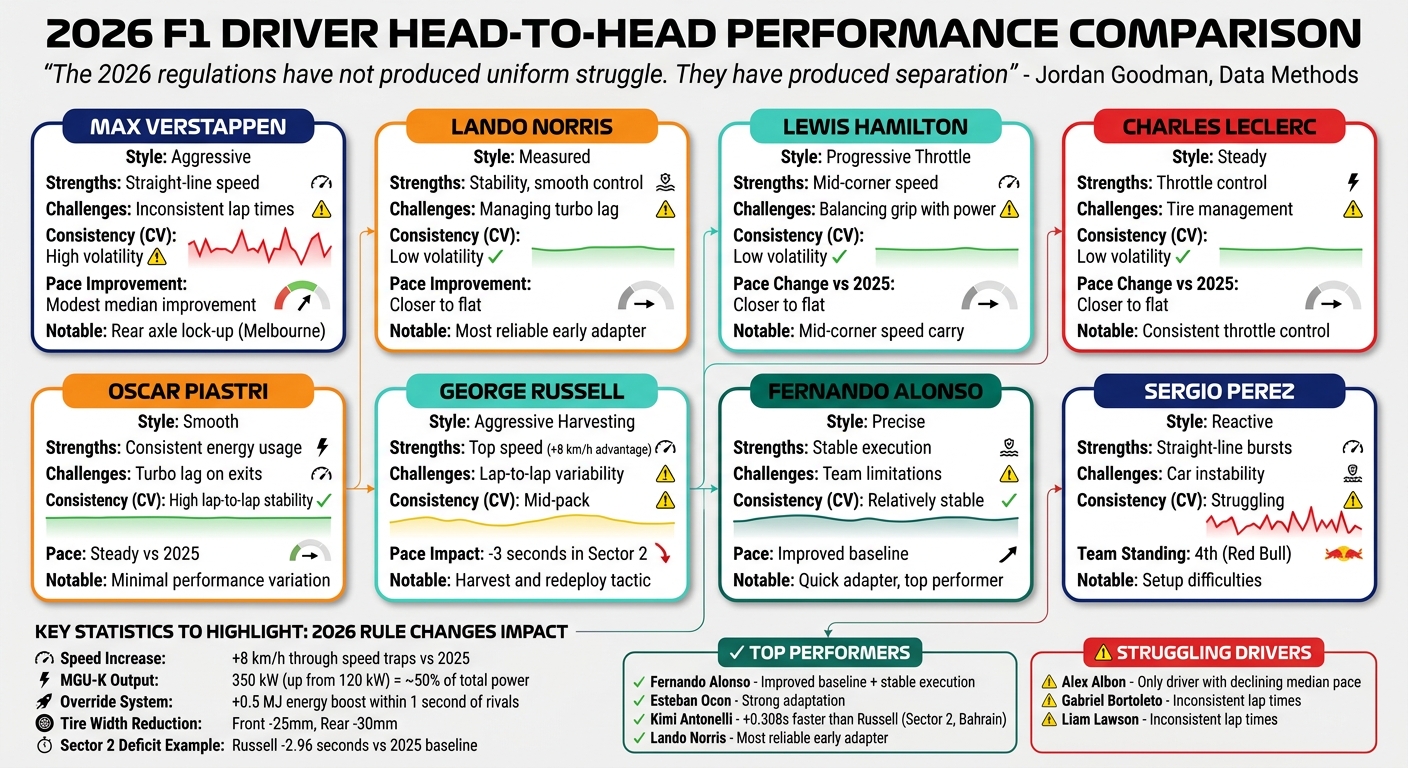
2026 F1 Driver Adaptation Comparison: Performance Metrics and Strategies
Active Aero, Weight Reduction and More - 2026 F1 Regulations: You Asked, We Answered
sbb-itb-7c68254
Max Verstappen vs. Lando Norris: Active Aerodynamics Performance
The rivalry between Max Verstappen and Lando Norris showcases two distinct approaches to the new 2026 active aero regulations. While both drivers rely on the same advanced technology, their strategies and results highlight the contrast in how they adapt under pressure.
Straight-Line Speed vs. Cornering Stability
Verstappen has leaned heavily into maximizing straight-line speed, pushing the limits of X-mode deployment to gain an edge. With the 2026 cars clocking speeds approximately 8 km/h faster through the traps compared to 2025, Verstappen takes full advantage of this boost. However, this aggressive strategy has come at a cost. His focus on outright pace has led to inconsistent lap times, reflected in higher CV metrics and notable issues like a rear axle lock-up during the Melbourne qualifying session in March 2026.
On the other hand, Norris has opted for a more measured approach. While he isn't among the fastest in terms of raw pace, he excels in stability and consistency, ranking as one of the most reliable early adapters. His consistency metrics have shown minimal variation compared to his 2025 performance. The key lies in Norris's ability to manage the transition between X-mode's low-drag configuration and Z-mode's high-downforce setup. By timing these switches perfectly, he maintains balance even as the wings adjust during braking or throttle lift-off.
| Driver | Adaptation Style | Pace Improvement | Consistency (CV) | Notable Challenge |
|---|---|---|---|---|
| Max Verstappen | Aggressive, pace-focused | Modest median improvement | High volatility | Rear axle lock-up (Melbourne) |
| Lando Norris | Stable, repeatability-focused | Closer to flat | Low volatility | Managing turbo lag smoothly |
These differences in adaptation styles are further emphasized by their use of the Override system.
Override System Usage
The Override system, which provides a +0.5 MJ energy boost when within one second of a competitor, reveals even more about their contrasting strategies. Verstappen uses the Override aggressively, often pairing it with X-mode on long straights to maximize his overtaking potential. However, this approach demands meticulous energy management, as the tripled MGU-K output can quickly deplete the battery if not carefully monitored.
Norris, in contrast, employs the Override system more strategically for defensive maneuvers rather than outright attacks. His telemetry shows smooth and controlled power delivery, particularly on corner exits, which helps mitigate turbo lag. As Jordan Goodman observed, "The cars are not simply slower or faster. They are different to operate, especially over multiple laps". This consistency gives Norris an advantage in endurance scenarios, where reliability and repeatability often outweigh sheer speed.
Lewis Hamilton vs. Charles Leclerc: Handling Reduced Downforce
Lewis Hamilton and Charles Leclerc are already showing strong adaptability to the new 2026 regulations. Both drivers have managed to achieve steady gains in lap times while keeping lap-to-lap variability in check. Their focus on repeatability is setting them apart in this transitional phase.
The 2026 season introduces two major regulation changes that have significantly altered car dynamics: narrower tires - front tread reduced by 0.98 inches (25 mm) and rear by 1.18 inches (30 mm) - and the removal of Venturi tunnels in favor of a flatter floor design. This shift has drastically reduced mechanical and aerodynamic grip, making stability through high-speed sections more reliant on Z‑mode (Corner Mode) active aerodynamics . Both Hamilton and Leclerc have quickly learned to operate within the narrow setup windows required to keep the cars balanced. This has allowed them to sustain a "clean pace", avoiding the erratic performance swings seen in some less experienced drivers. Their technical approach is helping them tackle the unique challenges posed by reduced tire grip.
Tire Grip Control with Less Downforce
Tire management has become a much tougher task in 2026. With lighter cars and smaller tire contact patches, drivers now need a more delicate touch. Adding to the complexity, the removal of the MGU‑H has brought back turbo lag, something no current driver had previously dealt with. This makes controlling rear tire grip - especially during corner exits - more challenging than ever.
"The automation is gone. The judgment call now sits with the person in the cockpit."
- Terry Widdows
To adapt, both Hamilton and Leclerc have turned to a progressive throttle strategy. By maintaining smooth and continuous power delivery, they avoid aggressive lift-and-coast techniques. This not only helps them manage turbo lag but also keeps rear tire temperatures stable, ensuring consistent grip. Telemetry data shows that both drivers have seamlessly adjusted to the increased MGU‑K output, now at 350 kW - roughly half of the car's total power - without compromising tire durability.
High-Speed Corner Performance by Sector
Hamilton and Leclerc's refined tire management has translated into impressive performance through high-speed corners. Early 2026 data highlights their mastery of Z‑mode transitions, where wing flaps close to maximize downforce during corner entry. On corner exits, both drivers carefully modulate the throttle, avoiding the mistake of fully lifting off, which could trigger turbo lag and lead to time losses.
At Bahrain, sector two data revealed that while George Russell's 2026 performance lagged by 2.96 seconds compared to his 2025 benchmark, Hamilton and Leclerc maintained stable times relative to their previous season baselines. Their ability to keep the car balanced in these demanding sections, despite the reduced ground-effect downforce, underscores their superior adaptation to the new grip dynamics .
| Driver | Adaptation Category | Pace Change vs. 2025 | Consistency (CV) | Primary Strength |
|---|---|---|---|---|
| Lewis Hamilton | Stable | Closer to flat | Low volatility | Mid‑corner speed carry |
| Charles Leclerc | Stable | Closer to flat | Low volatility | Consistent throttle control |
Hamilton and Leclerc have shown that in 2026, success hinges on consistency rather than outright speed. As Jordan Goodman put it, "The early effect of the 2026 rules is not outright pace loss, but consistency. The challenge is not just going fast once, but repeating it". Their ability to adapt and maintain balance reflects the precision and consistency needed in this evolving technical landscape.
Oscar Piastri vs. George Russell: Drag Reduction and Top Speed
This section dives into how drivers are adapting to the 2026 aero rules, focusing on energy management and consistency during race stints. Oscar Piastri and George Russell provide two very different approaches to handling the new active aerodynamics package, particularly with X-Mode - the low-drag configuration for straight-line speed. Their strategies highlight the increased demand for manual decision-making under these regulations.
Russell has adopted an aggressive "harvest and redeploy" tactic. Telemetry from Bahrain shows him lifting off the throttle entirely in technical sections to conserve energy for straight-line speed bursts. This method gives him an 8 km/h advantage in speed traps but costs him nearly 3 seconds in Sector 2, resulting in a 4.4-second overall lap deficit.
Piastri, on the other hand, takes a more measured approach. His pace remains steady compared to 2025, as seen in Melbourne qualifying data, which shows high lap-to-lap stability and minimal variations in performance. Instead of focusing on aggressive energy harvesting, Piastri relies on smoother throttle inputs, ensuring consistent energy deployment across laps.
X-Mode Acceleration Data
With the shift to manual energy management, X-Mode acceleration has become a key indicator of driver skill. Russell’s strategy of conserving energy in slower sections allows him to unleash impressive straight-line speeds, as evidenced by his 8 km/h advantage in Bahrain.
Piastri's approach, while not delivering the same top-end speeds, emphasizes consistency. The removal of the MGU-H means drivers must now manage turbo lag directly, and Piastri’s smooth throttle control helps him avoid gaps in power delivery, especially on corner exits. His steady median pace showcases his ability to adapt to the quirks of the new power unit. This consistency is particularly valuable during race stints, where managing energy over multiple laps can be the difference between success and failure.
Race Stint Performance and Drag Control
The contrast between these strategies becomes even clearer during full race stints. Russell’s aggressive energy harvesting introduces variability, as frequent throttle lifts in technical sections tend to disrupt his rhythm over 20 to 30 laps. Melbourne qualifying data places him mid-pack in terms of lap-to-lap consistency, while Piastri shows far less variation.
"The early effect of the 2026 rules is not outright pace loss, but consistency. The challenge is not just going fast once, but repeating it."
- Jordan Goodman, Data Methods
Piastri’s ability to maintain a clean, repeatable pace also helps him avoid overworking the rear tires - an important factor given the narrower contact patches and reduced mechanical grip in 2026. As the season unfolds, this focus on consistency may prove to be more critical than outright top speed in determining race results. This analysis lays the groundwork for exploring how experienced drivers like Fernando Alonso and Sergio Perez are navigating the challenges posed by these new regulations.
Fernando Alonso vs. Sergio Perez: Overall Performance Metrics
The comparison between Fernando Alonso and Sergio Perez highlights that experience alone doesn’t guarantee success under the challenging 2026 regulations. Alonso has shown himself to be a quick adapter, delivering improved baseline pace and maintaining consistent lap execution. On the other hand, Perez has struggled to find his footing, compounded by Red Bull's current difficulties, which place them fourth in the team standings.
With Consistency (CV) now the key measure of performance, the differences in how these two veterans handle the unpredictable nature of the 2026 cars are stark. Alonso stands out for his ability to deliver fast laps with minimal variation. This consistency is particularly impressive in a field where many drivers are grappling with increased volatility, a clear sign of how demanding the new cars are to control. Alonso’s steady performance is a testament to his adaptability and aligns with earlier observations about the importance of consistency in this evolving technical landscape.
Lap Time Recovery and Error Rates
Alonso’s strategy focuses on stable execution rather than chasing peak speed on individual laps. Data analyst Jordan Goodman highlights this approach:
"Alonso and Ocon stand out here, improving baseline pace while maintaining relatively stable execution across laps".
This method is especially effective under the 2026 regulations, which require drivers to manually manage energy deployment due to the removal of the MGU-H. Without the MGU-H, turbo lag has returned, forcing drivers to adjust manually - a challenge Alonso has handled with precision.
Perez’s situation is more nuanced. Red Bull’s struggles make it hard to isolate his personal adaptation from the car's limitations. The team’s inconsistent performance highlights how even seasoned drivers can struggle when the car doesn’t provide a reliable platform for learning the new rules. The tripled MGU-K output, increased from 120kW to 350kW and now contributing around 50% of total power, demands exceptional throttle control. This becomes even more difficult when the car’s balance is unstable, creating additional hurdles for Perez. While lap recovery has improved, the focus is now shifting toward optimizing braking performance with the updated setups.
Braking Performance with Smaller Discs
The 2026 regulations have introduced new challenges in braking, stemming from lighter cars with reduced weight and smaller aerodynamic components. These changes have fundamentally altered braking dynamics. Drivers must now manage turbo lag during corner entry while carefully timing throttle application to avoid power gaps. At the same time, they must adapt to reduced mechanical grip caused by smaller aerodynamic surfaces and narrower tires.
Alonso has adjusted effectively, recalibrating his brake points and corner-entry speeds to suit the new dynamics. This gives him an edge over Perez, who faces difficulties with Red Bull's unstable setup, making it harder to showcase his individual skills. The contrast between Alonso and Perez underscores that succeeding under the 2026 regulations requires a balance of consistency and technical precision, not just raw speed.
Summary of 2026 Driver Performance Comparisons
The opening races of the 2026 season have made one thing clear: success hinges more on adaptability than outright speed. Jordan Goodman, a data analyst at Data Methods, put it succinctly: "The 2026 regulations have not produced uniform struggle. They have produced separation". Drivers who excel are not necessarily the fastest over a single lap but those who can deliver consistent performance while managing the updated power units.
Top Performers in the 2026 Season
Early results have highlighted a few standout drivers. Fernando Alonso and Esteban Ocon have emerged as frontrunners, thanks to their ability to adapt to the new power delivery system. With the removal of the MGU-H, which previously mitigated turbo lag, these seasoned drivers have adjusted their throttle inputs to prioritize smooth, progressive control over aggressive techniques like lift-and-coast.
Kimi Antonelli has also shone, particularly in technical sectors where the new regulations present the toughest challenges. During Bahrain testing, he outpaced George Russell by 0.308 seconds in Sector 2, even though they were driving identical cars. Antonelli’s edge comes from staying in higher gears and maintaining steady throttle application, avoiding the turbo lag triggered by full lifts. His approach underscores how the 2026 cars reward drivers who can sustain mid-corner speed rather than relying on traditional energy recovery strategies.
On the flip side, Gabriel Bortoleto and Liam Lawson have shown flashes of speed but struggle with inconsistent lap times. Alex Albon, notably, is the only driver showing a clear decline in median pace so far this season, suggesting that certain driving styles may clash with the unpredictable handling of the 2026 chassis.
Impact on the Rest of the Season
These early trends offer a glimpse into how the rest of the season might unfold. Driver skill in energy management appears to be more critical than mechanical upgrades as the year progresses. Teams with drivers who excel at manually managing energy systems have a clear edge. Terry Widdows, founder of Coffee Corner Motorsport, captured this dynamic perfectly:
"A fast lap with messy traces is a driver finding a ceiling. A slower lap with clean, deliberate traces is a team building a foundation".
The updated regulations, which increase straight-line speeds by 8 km/h, have enhanced overtaking opportunities. However, the deficits drivers face in technical sectors suggest that the championship could hinge on minimizing time loss in high-downforce corners while maximizing gains on straights. Drivers like Alonso and Antonelli, who have already adapted their throttle control and braking strategies, are well-positioned to maintain consistency throughout the season. Meanwhile, those still grappling with these adjustments face a steep learning curve, as the narrower setup windows leave little room for experimentation during race weekends.
FAQs
When should a driver switch between X-mode and Z-mode?
Drivers will need to toggle between X-mode and Z-mode depending on the track's demands and the balance required between performance and stability. These modes are linked to active aerodynamics, which play a crucial role in improving overtaking opportunities and managing straight-line speed.
To stay competitive, drivers must use these modes strategically. By switching at the right moments, they can adapt to the car’s sensitivity, varying track conditions, and specific strategies for different sectors. This approach ensures they maintain both control and peak performance throughout the race.
How does the Override energy boost change overtaking strategy?
The 2026 Override energy boost changes the game for overtaking by offering drivers a controlled power boost they can deploy for extra speed during laps. This system replaces the traditional DRS and works alongside active aerodynamics, giving drivers the ability to strategically adjust downforce or reduce drag. As a result, overtaking now hinges on smart energy management, precise timing, and aerodynamic tweaks, making race strategies more tactical and less reliant on track position or designated DRS zones.
Why did removing the MGU-H make turbo lag a bigger driver skill factor?
The upcoming 2026 power units will no longer include the MGU-H, a change that has brought back increased turbo lag. The MGU-H used to minimize lag by harnessing excess turbo heat to speed up the turbo's response. Without this system, drivers must now contend with a less predictable throttle response. This demands greater precision in throttle control and timing to manage power delivery effectively. These adjustments put a bigger spotlight on driver skill in handling turbo lag under the revised regulations.