How F1 Teams Manage Vendor Relationships
Top F1 teams balance cost, reliability and sustainability using multimodal logistics, cargo prioritization, and long-term vendor contracts.
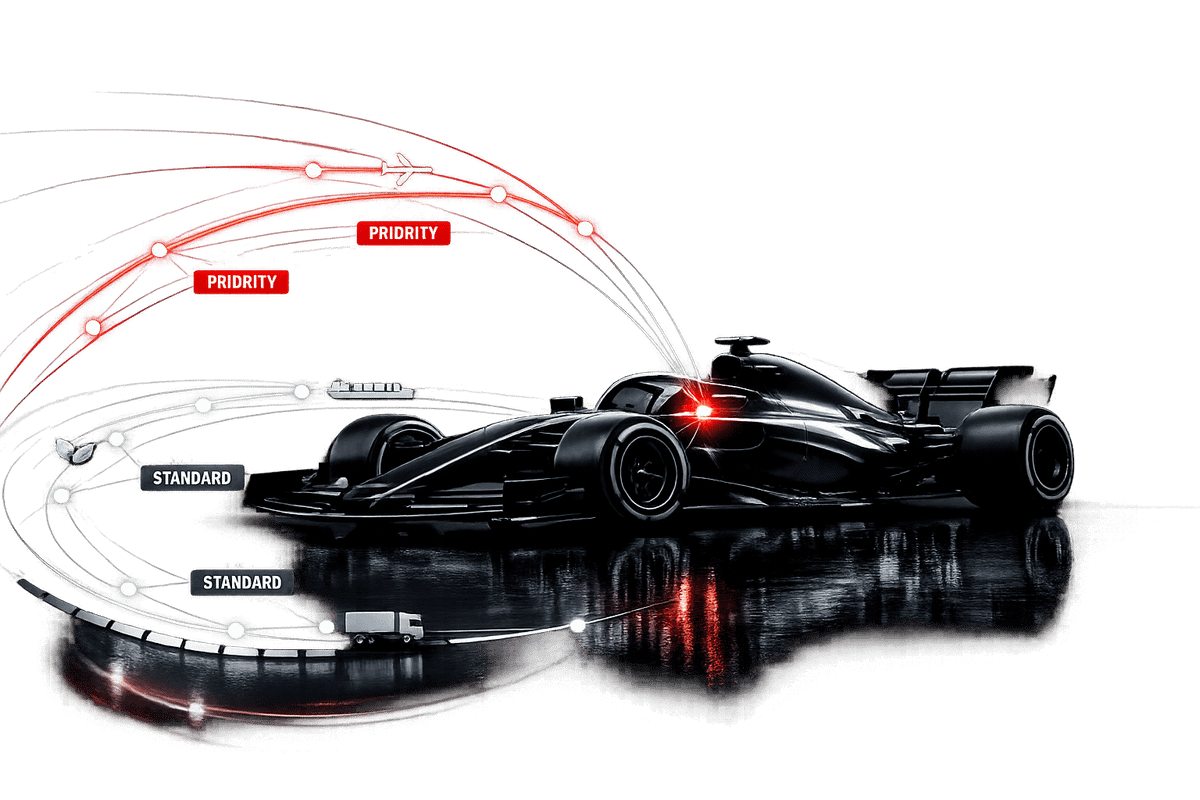
Formula 1 teams face immense logistical challenges, moving up to 2,000 tons of freight across 24 races spanning five continents each season. Here's how top teams like Mercedes, Red Bull, and Ferrari ensure smooth operations through vendor management:
- Mercedes: Uses a mix of air, sea, and road freight with "leapfrogging" equipment sets to cut costs. They also integrate biofuel-powered trucks and Sustainable Aviation Fuel (SAF) to align with environmental goals.
- Red Bull: Implements a "cargo-first" strategy with a tiered system prioritizing mission-critical items. Their robust vendor selection process includes RFPs and performance monitoring.
- Ferrari: Focuses on long-term partnerships with trusted vendors like DHL, combining multimodal transport methods with contingency plans for disruptions.
Each team balances cost, reliability, and performance, tailoring strategies to meet Formula 1's demanding schedule and strict cost cap rules.
1. Mercedes-AMG Petronas F1 Team
Logistics Optimization
The Mercedes-AMG Petronas team relies on a multimodal transport strategy to juggle four key factors: speed, volume, cost, and sustainability. Partnering with DHL, they manage the movement of an impressive 1,200 metric tons of equipment per event in 2025, using a mix of air, sea, and road freight.
A standout element of their system is the "leapfrogging" method for non-essential equipment. This involves rotating five or six identical sets of hospitality suites and garage kits through ocean freight. These containers operate on a three-race cycle, arriving at different events in sequence, which significantly reduces the reliance on costly air transport. At the same time, race-critical items like chassis, engines, and telemetry systems are flown directly after each race, ensuring they reach the next circuit by Monday morning.
To avoid potential delays caused by airspace closures or other disruptions, Mercedes also prepositions equipment early. This proactive strategy builds time buffers into their logistics plan, ensuring smoother operations. Altogether, this approach combines efficiency with cost control.
Cost Management Strategies
Mercedes-AMG Petronas extends its logistical efficiency into cost management by carefully choosing the right freight method for each type of cargo. Bulky, less critical items are shipped via sea freight, while high-priority, performance-related equipment is transported by air. This strategy not only trims expenses but also strengthens their long-term relationships with vendors and partners.
For European races, the team utilizes 51 biofuel-powered trucks, which cut carbon emissions by an average of 83% per trip. The regionalized race calendar helps reduce travel distances, making road freight a more viable and cost-effective option. For international events, the team turns to Sustainable Aviation Fuel (SAF) for charter flights, achieving up to an 80% reduction in carbon emissions per flight. This aligns with Formula One's Net Zero 2030 goals while keeping operational expenses in check.
sbb-itb-7c68254
2. Red Bull Racing
Logistics Optimization
Red Bull Racing has developed a cargo-first logistics strategy, prioritizing equipment as the core of their operations while treating personnel as a more adaptable component. This approach proved essential during the April 2026 Australian Grand Prix, when an aviation crisis forced last-minute adjustments for staff travel. Thanks to early equipment deployment, the team kept the race on schedule despite the challenges.
To streamline logistics, Red Bull uses a three-tier triage system:
- Tier 1: Mission-critical items, such as chassis, engines, and pit equipment.
- Tier 2: Key personnel, like race engineers, whose presence is time-sensitive.
- Tier 3: Non-critical assets that can tolerate delays.
The team also enforces the "Red Lane" Rule, which prioritizes any item or personnel that could disrupt 24-hour operations.
In February 2026, Red Bull promoted Hannah Schmitz, a Cambridge-educated engineer, to Head of Race Strategy. Known for her expertise in optimization theory and statistical modeling, Schmitz has been instrumental in securing key race wins. Her leadership reflects Red Bull's dedication to operational precision and highlights their focus on well-executed logistics, which also supports their vendor management practices.
Vendor Selection Processes
Red Bull's vendor selection process is meticulous, involving formal RFPs (Request for Proposals), detailed contract negotiations, and a structured onboarding phase. When evaluating vendors, the team considers several factors, including market demands, available storage facilities, financial implications, and past performance. Vendor performance is closely monitored through market visits, audits, scorecards, and data analytics.
To mitigate risks, Red Bull works closely with their Legal and Risk teams. They oversee master services agreements and insurance policies, ensuring both financial and operational stability. This rigorous approach aligns with the team's goals of maintaining cost control and high performance.
Cost Management Strategies
Building on their efficient vendor selection, Red Bull strategically partners with suppliers to manage costs while maintaining top-tier performance. A key example is their "works" partnership with Honda, which provides free engines, commercial backing, and factory-level technical integration. This relationship began after Red Bull observed Honda's RA618H power unit development with their junior team, Toro Rosso, in 2018. By switching from Renault to Honda in 2019, Red Bull sought seamless integration between the chassis and power unit, achieving a competitive edge.
Additionally, long-term sponsorships like their multi-year deal with Oracle, renewed in May 2024, ensure consistent funding and access to cutting-edge resources. Oracle's cloud infrastructure has enhanced race strategy and improved cost efficiency through advanced data analytics. These partnerships are a cornerstone of Red Bull's ability to balance financial discipline with racing excellence.
3. Scuderia Ferrari
Vendor Selection Processes
Ferrari's approach to selecting vendors is deeply rooted in aligning with the team's core principles and long-term vision. The organization prefers partners with a proven track record in motorsport, such as TAG Heuer, which has been a trusted collaborator for years. This emphasis on enduring relationships ensures that vendors fully grasp the unique and demanding nature of Formula One operations.
When it comes to logistics, Ferrari prioritizes vendors who excel in multimodal transport solutions. DHL, for example, manages the critical task of transporting race equipment. They use air freight for essential hardware and rely on ocean and road freight for less time-sensitive items. Paul Fowler, Head of Global Motorsports Logistics at DHL Global Forwarding, highlights the precision required for this task:
The complexity of Formula 1 logistics requires precision and dedication. Together with F1, our teams work around the clock to ensure that every piece of equipment – from cars to engines to broadcast equipment – arrives on time and in perfect condition.
Ferrari's vendor selection also reflects Formula One's commitment to achieving Net Zero by 2030. Vendors are now expected to provide environmentally conscious solutions, such as biofuel-powered trucks for European races and Sustainable Aviation Fuel for charter flights. These choices not only align with sustainability goals but also support Ferrari's operational and financial strategies throughout the demanding race calendar.
Contract Negotiation Techniques
Ferrari's meticulous vendor selection is matched by its strategic approach to contract negotiations, ensuring both cost efficiency and operational flexibility. Long-term agreements are a key focus, allowing Ferrari to maintain stability while adapting to changing needs. For example, Ferrari assigns distinct roles to vendors with overlapping capabilities. AWS handles race-critical telemetry and simulations, while IBM focuses on enterprise-level operations and fan engagement. This clear division of responsibilities helps avoid conflicts and ensures each partner delivers their specialized expertise.
Multi-year contracts are central to Ferrari's commercial approach. Key partnerships with companies like HP (title partner), Shell (fuel and lubricant partner), and CEVA Logistics (global freight provider) are designed to prioritize operational integration over mere branding. For instance, HP plays an integral role in providing the technological infrastructure that supports real-time decision-making during races.
Ferrari also incorporates contingency measures into its contracts, such as pre-approved fallback plans. These provisions allow for immediate rerouting during unexpected disruptions, eliminating the need for renegotiation. This level of foresight ensures smooth operations across the 24-race global calendar, addressing the logistical hurdles that come with Formula One's fast-paced environment.
How Formula 1 Travels Across The World | F1 Logistics Explained | DHL
Strengths and Weaknesses
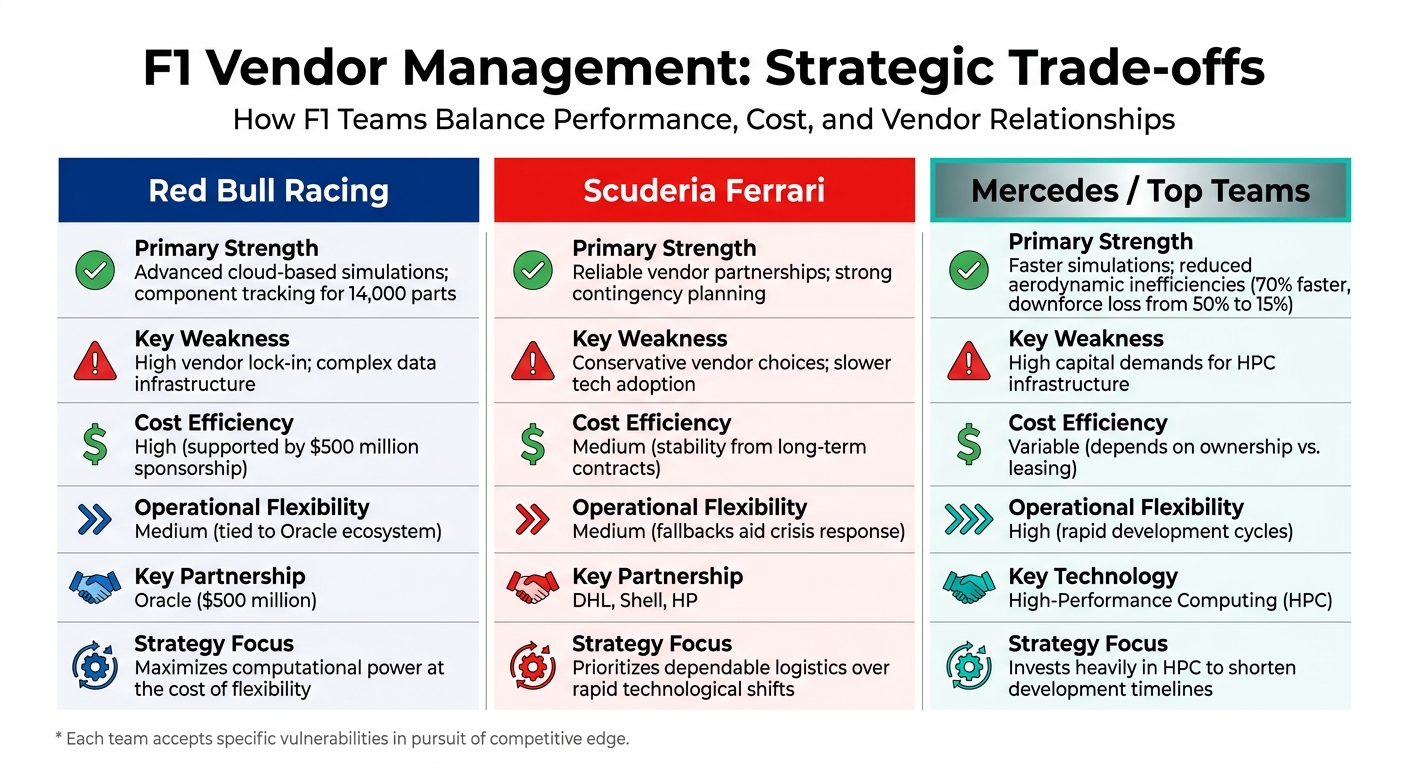
F1 Team Vendor Management Strategies Comparison: Red Bull, Ferrari, and Mercedes
Each Formula 1 team navigates a unique balancing act when managing vendors, weighing costs, flexibility, and performance. For example, Red Bull Racing's $500 million Oracle partnership has revolutionized their real-time race simulations. However, this deep reliance on Oracle creates significant vendor lock-in - switching cloud providers mid-season could completely disrupt their intricate data pipelines. Across the grid, teams are adopting increasingly granular data tracking systems, but handling such detailed data often requires highly specialized staff, which can create bottlenecks.
Ferrari takes a different approach, focusing on long-term relationships with trusted motorsport vendors like DHL. This ensures reliability throughout the demanding 24-race calendar while also incorporating a multimodal logistics strategy to reduce emissions. Yet, their preference for established partners over newer, cutting-edge technologies can limit their agility. While Ferrari’s fallback plans provide solid contingency coverage, maintaining these dual-track agreements adds layers of administrative complexity and cost.
Mercedes and other top teams, on the other hand, rely on High-Performance Computing (HPC) to speed up aerodynamic simulations by 70%, cutting downforce loss from 50% to 15%. This accelerates development cycles but comes with steep capital costs. Some teams mitigate these costs by using "pay-as-you-go" models like HPE GreenLake, which transforms upfront expenses into manageable operational costs. However, this flexibility often comes at a premium compared to owning the infrastructure outright. As Alessandro Alunni Bravi of Sauber Group explains:
"It helps us reduce our capital expenditure, giving access to state-of-the-art high performance computing technology in a pay-as-you-go model".
To better understand these trade-offs, the table below highlights the strengths, weaknesses, cost efficiency, and operational flexibility of each team's strategy.
| Team | Primary Strength | Key Weakness | Cost Efficiency | Operational Flexibility |
|---|---|---|---|---|
| Red Bull Racing | Advanced cloud-based simulations; component tracking for 14,000 parts | High vendor lock-in; complex data infrastructure | High (supported by $500 million sponsorship) | Medium (tied to Oracle ecosystem) |
| Scuderia Ferrari | Reliable vendor partnerships; strong contingency planning | Conservative vendor choices; slower tech adoption | Medium (stability from long-term contracts) | Medium (fallbacks aid crisis response) |
| Mercedes / Top Teams | Faster simulations; reduced aerodynamic inefficiencies | High capital demands for HPC infrastructure | Variable (depends on ownership vs. leasing) | High (rapid development cycles) |
Red Bull maximizes computational power at the cost of flexibility, Ferrari prioritizes dependable logistics over rapid technological shifts, and Mercedes invests heavily in HPC to shorten development timelines. These strategies reflect deliberate trade-offs, with each team accepting certain vulnerabilities in pursuit of their competitive edge.
Conclusion
Formula 1 vendor management showcases three key strategies that can be applied across high-pressure industries: focusing on irreplaceable assets, pre-positioning equipment, and categorizing shipments by their importance. During disruptions, F1 teams prioritize race-critical hardware - like cars, engines, and telemetry - over personnel, ensuring operations stay on track. This "cargo-first" mindset is just as relevant in industries like manufacturing or healthcare, where specialized equipment is essential for generating revenue.
Structured planning further strengthens these operations. A standout method is the "two-lane" planning model, which ensures every critical shipment has both a primary route and a backup plan ready to go. For instance, F1 teams ship non-essential items months in advance via sea freight, saving premium air freight for the most critical items. By setting internal deadlines earlier than necessary, teams gain a time buffer that becomes a strategic advantage.
Another effective strategy is using a tiered classification system to streamline decisions during disruptions. Shipments are pre-labeled as Mission-Critical, Operational, or Flexible, so teams can respond quickly when something goes wrong. Anything that could cause a 24-hour delay is escalated immediately. This system is essential when managing the logistics of moving 1,200 metric tons of equipment across five continents.
F1 teams also benefit from treating vendors as collaborative partners. Long-term relationships, like Red Bull's partnership with Oracle for race simulations or Sauber's use of HPE GreenLake to convert capital expenses into operational costs, highlight the value of integrating vendors into the broader strategy. While this approach requires upfront investment - such as robust data systems and standardized protocols for customs and rerouting - it eliminates delays when the supply chain is under pressure.
Teams like Mercedes, Red Bull, and Ferrari exemplify how these strategies blend tactical execution with a broader commitment to operational reliability. As Paul Fowler of DHL Global Forwarding explains:
The complexity of Formula 1 logistics requires precision and dedication. Together with F1, our teams work around the clock to ensure that every piece of equipment... arrives on time and in perfect condition.
The same level of precision, applied to the most vulnerable points of your supply chain, can transform vendor management into a competitive advantage.
FAQs
What is “leapfrogging” freight, and why does it cut costs?
“Leapfrogging” freight is a logistics approach that involves moving equipment straight to its next destination without unnecessary stops or extra handling. This method helps cut costs by simplifying the supply chain, reducing storage and handling expenses, and ensuring deliveries stay on schedule. This efficiency is especially crucial for the demanding timelines and complex logistics of F1 races.
How do F1 teams decide what must fly vs. ship by sea?
F1 teams carefully weigh their options between air and sea transport, depending on how urgent, valuable, or logistically complex the shipment is. High-priority items like spare parts, telemetry equipment, and tires are typically flown to guarantee they're ready for race day. On the other hand, less critical or non-essential gear is sent by sea to cut down on expenses. This approach helps teams manage costs while ensuring that key components arrive on time, even when faced with logistical hurdles or unexpected disruptions.
How do teams avoid vendor lock-in while using cloud and HPC?
Formula 1 teams steer clear of vendor lock-in in cloud services and high-performance computing (HPC) by working with a variety of vendors and logistics partners. They rely on advanced planning tools to seamlessly combine multiple providers, which helps them stay flexible and avoid being tied to any single supplier. By using multimodal transportation and creating resilient routing strategies, these teams ensure smooth operations, adapt to unexpected disruptions, and align with sustainability goals - all while maintaining their independence from specific vendors or technologies.