How F1 Radios Handle Emergencies on Track
How F1 teams use radios, telemetry, code phrases and visual alerts to detect and manage on-track emergencies and keep drivers safe.
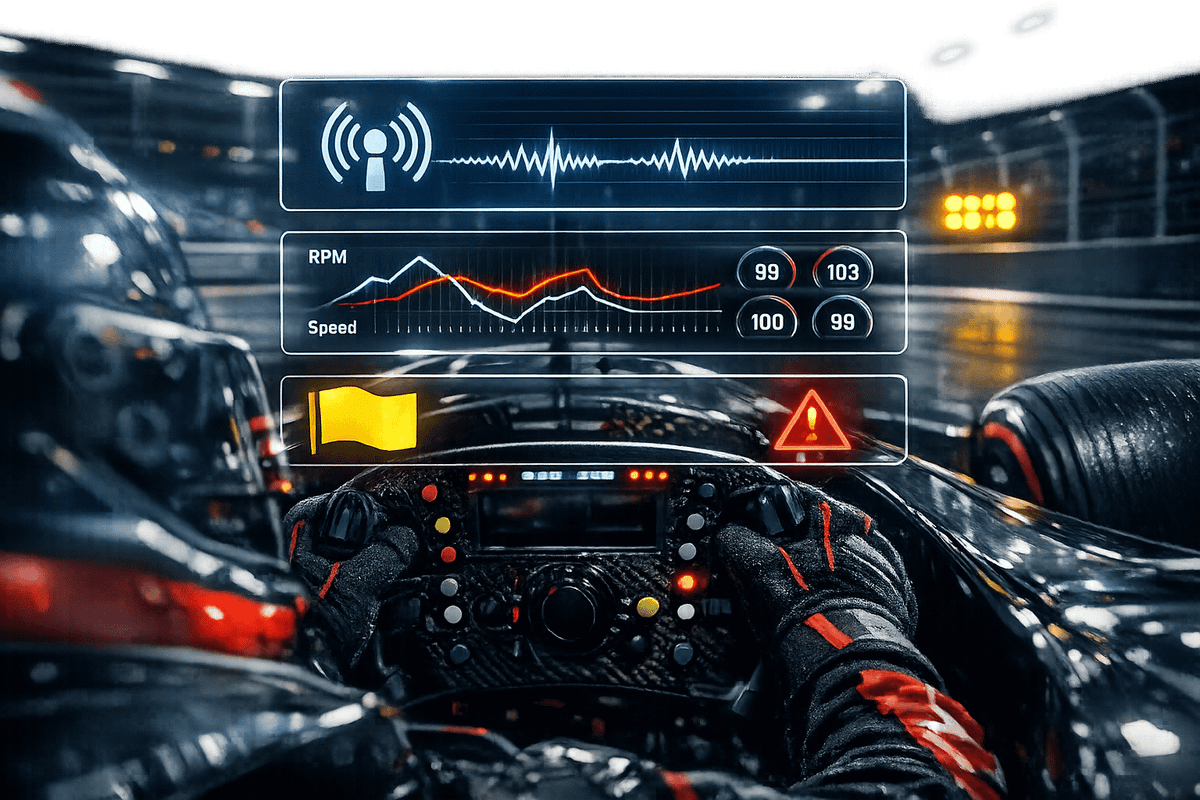
Formula One radio communication is a lifeline for drivers, especially during emergencies. It ensures safety and quick decision-making at speeds exceeding 220 mph. Here's how F1 teams use radios to manage critical situations:
- Real-Time Alerts: Telemetry detects issues like energy loss or mechanical faults before drivers notice, enabling engineers to warn them immediately.
- Safety Protocols: Drivers receive instructions during crashes, sudden power drops, or weather changes to prevent accidents.
- 2026 Updates: New rules include visual warnings for low-power states and restrictions on boost modes to address risks like "super clipping."
- Clear Communication: Teams use code phrases like "Mode 7" for energy settings to simplify complex instructions under pressure.
- Structured Roles: Engineers, strategists, and FIA officials coordinate responses to ensure drivers' safety and race integrity.
F1 radio systems combine advanced technology, precise communication, and strict protocols to handle emergencies effectively, keeping drivers safe in high-pressure situations.
F1 Radio Systems: How They Work and What the Rules Say
Radio Hardware and Infrastructure
F1 radio systems are a blend of real-time telemetry and remote operations, allowing teams to monitor vehicle data and address potential issues - like ERS cooling problems or sudden battery performance drops - before the driver even notices. This integration acts as a crucial safety layer, especially with the increased demands of the 2026 power units. To enhance safety further, new rules require visual warnings, such as flashing rear and side lights, to alert drivers when a car is in a low-power state. These warnings can indicate power differences of up to 470 horsepower. Together, these automated systems and radio communications create a more secure environment on the track.
FIA Rules on Radio Communication
The FIA has strict guidelines about what teams can communicate via radio. Messages related to safety - like retirement calls, energy management updates, or Red Flag instructions - are always allowed. However, direct coaching, such as advising on cornering techniques or offering lap-by-lap performance tips, is off-limits. To stay compliant, teams use code phrases like "mode 7" or "harvest phase" to relay information about battery deployment and energy recovery while managing the balance between the combustion engine and the electric system's output.
To further support communication, blue flashing panels provide a five-second warning on the grid. Additionally, the 2026 low-power start detection system can automatically activate the MGU-K if a car shows unusually low acceleration. This feature reduces the risk of rear-end collisions by offering timely visual alerts without relying solely on radio instructions. These advancements ensure that both automated and verbal communication work hand-in-hand to maintain safety.
Team Roles During Radio Emergencies
The combination of technical tools and FIA regulations ensures teams have well-defined roles during emergencies. When something goes wrong on the track, the radio channel operates under a clear hierarchy. The race engineer is the driver’s primary point of contact, delivering essential updates and instructions in a concise manner. Meanwhile, strategists focus on broader decisions, like deploying the Safety Car or Virtual Safety Car, while remote operations teams analyze telemetry data to detect potential issues early.
This structured approach was evident during the April 2026 Japanese Grand Prix. A high-speed accident involving Haas driver Oliver Bearman and Alpine's Franco Colapinto highlighted the importance of coordinated communication. Bearman’s full-power deployment into a slower car prompted the FIA to cap boost mode at 150 kW in specific zones and upgrade visual warning systems. Engineers, strategists, and the FIA technical team worked together seamlessly to address the situation.
"We all share the same objectives. It's how can we improve the product, make it out-and-out racing, and look at what can improve in terms of safety." - Toto Wolff, Team Principal, Mercedes-AMG PETRONAS F1 Team
The race engineer’s role goes beyond technical knowledge - it’s also about keeping the driver calm and focused during high-pressure moments. Clear and firm communication during mechanical issues is essential for ensuring safety and maintaining control on the track.
sbb-itb-7c68254
How Teams Detect and Classify On-Track Emergencies
Telemetry and Real-Time Alerts
Telemetry is the backbone of how teams stay ahead of potential issues during a race. Engineers monitor live data streams, tracking critical factors like engine temperatures, brake performance, tire conditions, and energy output, all updated in real time. This constant flow of information often alerts the pit wall to problems before the driver even notices. When something goes wrong, telemetry data ensures that radio instructions are precise and timely.
One challenge teams face in 2026 is Super Clipping - a sudden drop in acceleration caused by the MGU-K reaching its battery deployment limit. This issue can easily be mistaken for a mechanical failure, making it crucial for engineers to quickly differentiate between the two. Since the MGU-K is vital for power delivery, any disruption needs immediate attention.
A great example of telemetry in action occurred during the April 2026 Chinese Grand Prix. Red Bull Racing's Gianpiero Lambiase identified an ERS cooling issue affecting Max Verstappen’s car at Turn 6. Thanks to live data, the team recognized the problem and classified it as terminal, retiring the car on Lap 44 - before Verstappen could fully describe what was happening:
"Max, our main loss to car ahead and car behind is actually braking and exit of Turn 6."
Visual and Trackside Indicators
While telemetry provides early warnings, visual confirmation is often necessary to validate the data. Engineers rely on onboard cameras, GPS positioning, and live broadcast footage to verify what the numbers suggest. Drivers also play a role in this process, occasionally asking their engineers to "check my onboard" when something feels wrong but is hard to articulate.
One particularly dangerous issue in 2026 involves MGU-K energy harvesting. When a car enters harvest mode, it can lose between 25–31 mph (40–50 km/h) without activating the brake lights. This creates a significant risk for following drivers. A stark example of this occurred during the April 2026 Japanese Grand Prix at Spoon Curve. Haas driver Oliver Bearman collided with Alpine’s Franco Colapinto due to a 31 mph (50 km/h) speed difference caused by harvest mode:
"It was a massive overspeed, 50 kph... I think as a group we warned the FIA what can happen and this has been a really unfortunate result of a massive delta speed."
Although low-power starts now include flashing light warnings, deceleration in harvest mode still lacks a clear visual signal. This gap is something teams and drivers are urging the FIA to address.
How Teams Rank Emergency Severity
Once a problem is detected, teams must quickly assess its severity and decide how to respond. Not every issue warrants immediate communication with the driver. Instead, teams prioritize based on the risk of mechanical failure, performance impact, or potential safety hazards.
| Emergency Category | Primary Detection Method | Key Prioritization Factor |
|---|---|---|
| Mechanical Fault | Telemetry (temp/pressure) | Risk of terminal failure or fire |
| Energy Loss | Real-time battery monitoring | Impact on critical power delivery |
| Safety (closing speed) | GPS and onboard camera | Speed deltas exceeding 25 mph (40 km/h) |
| Tactical (Overtake) | Timing data | Strategic position vs. energy recovery |
Incidents involving closing speeds - like the Bearman-Colapinto crash - are among the most severe because of their immediate physical danger. On the other hand, an energy clipping event, while disruptive, is often manageable through mode adjustments. By relying on data-driven assessments, engineers ensure that decisions are logical and focused, avoiding emotional reactions in high-pressure situations. This structured approach helps teams deliver the right instructions at the right time.
HOW does Team Radio work in F1?
Step-by-Step: Handling On-Track Emergencies via Radio
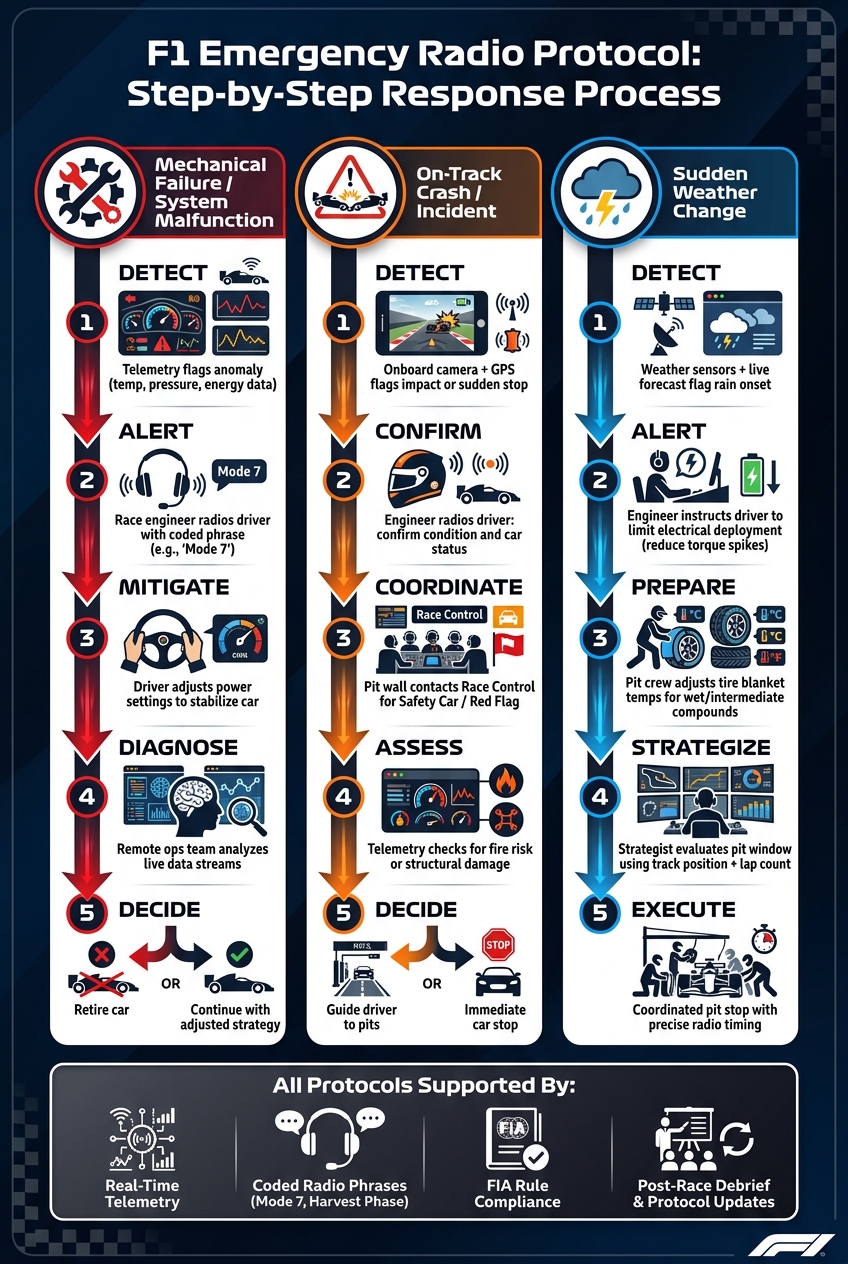
F1 Emergency Radio Protocol: Step-by-Step Response Process
Mechanical Failures and System Malfunctions
When a mechanical failure arises, the race engineer uses radio communication to deliver clear, escalating instructions to the driver. This process typically follows three steps: mitigate, diagnose, and decide.
Take the March 2026 Chinese GP as an example. Max Verstappen faced an issue with his boost button, and the team managed it using this structured approach. They relied on coded radio messages like "mode 7" to tweak power settings and maintain safety while keeping the car competitive.
In the event of a crash, however, priorities shift. The immediate focus is no longer on the car but on ensuring the driver’s safety and coordinating with Race Control to manage the situation effectively.
Crash Responses and On-Track Incidents
In crash situations, radio communication becomes a lifeline. The first priority is always to confirm the driver’s condition. Once the driver responds, the team evaluates the car’s status and collaborates with Race Control.
The pit wall serves as the hub for this coordination, relaying critical updates like Safety Car deployments or Red Flag decisions in real-time. If the car is still drivable, the engineer will guide the driver to either return to the pits or park in a safe location. However, if telemetry flags a severe post-impact issue - such as a fire risk or significant structural damage - the directive is immediate: stop the car.
An incident at the April 2026 Japanese GP highlighted the importance of this process. Quick checks on the driver and seamless communication were key to managing the crash effectively.
Responding to Sudden Weather Changes
Weather emergencies add another layer of complexity, requiring rapid, coordinated action over the radio. Unlike mechanical failures or crashes, these situations demand managing a series of simultaneous decisions rather than reacting to a single event.
For instance, when rain begins, engineers instruct drivers to switch to settings that limit electrical deployment, reducing the chance of sudden torque spikes on slick surfaces. As technical analyst Craig Scarborough explains:
"With hybrid power, delivery can be too sudden and break traction in wet conditions. Therefore, the more controllable combustion engine will become more important in these conditions."
At the same time, the pit crew is notified to adjust tire blanket temperatures for intermediate or wet tires. This step has become even more critical under 2026 regulations, which allow higher-temperature blankets for wet compounds. Meanwhile, the strategist evaluates factors like track position, lap count, and live weather updates to determine the best pit window. Every second counts, and clear, precise radio communication ensures the team can execute these decisions without delay.
How Teams Improve Their Emergency Radio Protocols
Standardized Scripts and Code Phrases
In high-pressure situations, clear and concise communication is crucial. To achieve this, F1 teams rely on pre-planned code phrases that cut down on lengthy explanations. These standardized scripts help engineers and drivers exchange critical information quickly and accurately.
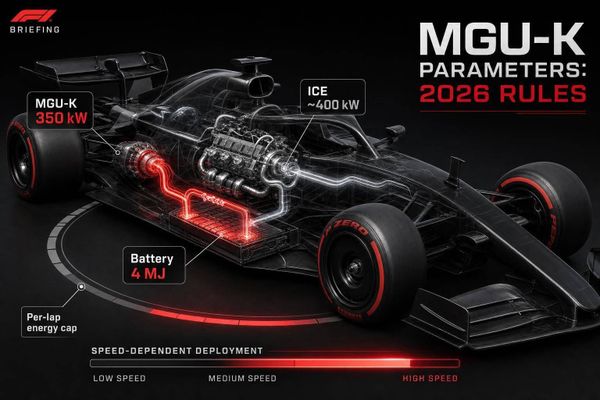
This need for precision has only grown in 2026. The new power units now split their output nearly equally between the internal combustion engine (ICE) and the electrical systems, with the electrical component alone producing 350kW - nearly triple the 120kW of previous seasons. Managing this complex system in real time demands instant, unambiguous instructions. For example, phrases like "Mode 7" (a specific battery deployment setting) or "Harvest Phase" (indicating a focus on energy recovery when battery levels are critically low) allow teams to communicate intricate strategies in just a few words.
One major challenge teams face is "Super Clipping" - a phenomenon where the electrical boost abruptly cuts out at around 180 mph (290 km/h), causing a sudden loss of acceleration. To prepare for this, teams have developed specific code phrases and protocols to ensure drivers are ready when it happens, whether mid-corner or on a straight.
| 2026 Radio Code | Meaning | When It's Used |
|---|---|---|
| Mode 7 | Battery deployment setting | For energy management in attack or defense |
| Harvest Phase | Focus on energy recovery | When battery levels are critically low |
| Super Clipping | Electrical boost limit reached | Sudden acceleration loss at ~180 mph (290 km/h) |
| Power Unit Driving | Managing ICE-electric balance | Used in practice and race energy strategies |
These codes are the backbone of a system that ensures drivers and engineers can respond instantly to changing conditions, setting the stage for rigorous training and preparation.
Training and Simulation Drills
In 2026, McLaren's engineering team has prioritized "power unit driving" in their training sessions. Drivers spend time in simulators practicing energy recovery techniques, such as timing their lifts to optimize battery performance during races. This hands-on preparation helps them internalize these processes so they can execute them instinctively when it matters most.
Engineers also undergo intensive training to maintain calm and clarity under pressure. Communication discipline - staying focused on data and avoiding emotional responses - has become as critical as any technical skill for ensuring smooth operations during emergencies.
"The more time we can give the drivers to understand what we are calling 'power unit driving,' the better we will be. That's still a high-priority thing." - Will Joseph, Race Engineering Team, McLaren
Learning from Past Incidents
Incidents from previous races often serve as valuable lessons for improving protocols. For instance, after a crash at the April 2026 Japanese Grand Prix involving Oliver Bearman and Franco Colapinto, the FIA and teams analyzed radio logs and telemetry data. The investigation revealed that performance gaps between cars in different power modes created dangerous closing speeds - problems that radio communication alone couldn't address quickly enough.
By the May 2026 Miami Grand Prix, the FIA introduced new measures to tackle these issues. They limited boost mode to 150kW in specific track zones and simplified rear light signals to give drivers clearer visual warnings. Similarly, a near-miss at the Australian Grand Prix led teams to test a "low-power start detection system" - an automated alert that flashes lateral lights when a car accelerates unusually slowly off the line, reducing the need for engineers to manually identify and communicate these situations.
"These measures are designed to reduce excessive closing speeds while maintaining overtaking opportunities and overall performance characteristics." - FIA Statement
After every race, teams review radio transcripts and telemetry to identify gaps in communication or response protocols. These findings lead to new code phrases, automated systems, or even rule changes, ensuring that emergency radio protocols continue to evolve and improve.
Conclusion: Why Precision in F1 Emergency Radio Communication Matters
F1 radio operates as a finely tuned system where every word - and even silence - carries weight. By 2026, with electrical power contributing nearly 47% of an F1 car's performance, the stakes for flawless communication will be higher than ever.
Consider the scenario of a car suddenly losing 350kW of power. In moments like these, engineers must deliver clear, actionable instructions instantly. A delay or miscommunication could lead to dangerous situations caused by rapid changes in speed. Beyond the technical data, the human aspect plays a vital role in maintaining reliability. Engineers like Red Bull's Gianpiero Lambiase have shown exceptional skill in managing driver focus during mechanical challenges, all while staying in sync with the pit wall team.
This level of precision in emergency communication isn't just about avoiding accidents - it's about maintaining control in the most high-pressure moments. Everything from protocols and code phrases to simulations and post-race debriefs is designed to ensure that the right information reaches the driver without delay. Whether it's a technical update or a critical safety alert, this seamless coordination reflects the disciplined safety-first mindset that defines modern F1. For fans, those brief radio snippets during a race offer just a glimpse into the complex, highly organized system working tirelessly behind the scenes.
FAQs
What counts as an “emergency” on F1 radio?
In Formula 1, a radio "emergency" signals a critical situation that could affect safety or the car's performance. This might involve incidents like on-track accidents that call for a safety car, mechanical problems such as ERS cooling failures, or notable speed differences between vehicles. Drivers and engineers rely on radio communication to handle these risks - whether it's warning about slower cars ahead or tweaking electrical deployment during wet conditions to prevent potential dangers.
What can teams legally tell drivers over the radio?
Teams rely on radio communication to exchange essential strategic and technical updates during a race. Through these channels, they share legal data on car performance, including energy management strategies such as lift-and-coast. Drivers and engineers often use code words to coordinate battery usage and recovery plans. Radios also play a key role in reporting on-track incidents to race control and providing tactical insights, like a driver's position relative to competitors.
How will the 2026 low-power warnings prevent crashes?
Starting in 2026, a new safety feature will address low-power situations by detecting cars with unusually sluggish acceleration after the clutch is released. When triggered, the system automatically engages an MGU-K boost to assist with acceleration. At the same time, flashing rear and side lights will activate, alerting nearby drivers to the power issue. This setup aims to reduce the risk of collisions during race starts by improving both visibility and reaction times for other drivers.