Lifecycle Emissions of F1 Engines
Explains F1 engine lifecycle emissions, 2026 advanced sustainable fuels, hybrid efficiency gains, and recycling challenges.
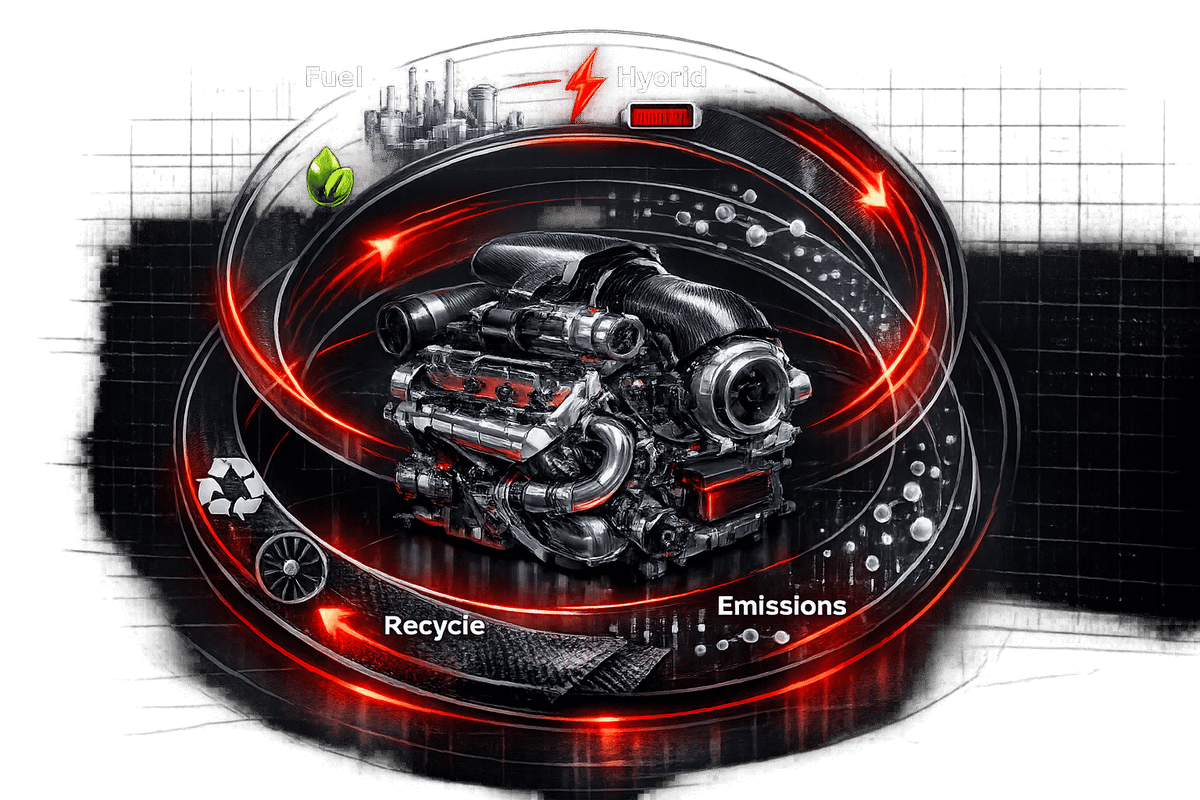
Formula One engines are engineering marvels, but their environmental impact extends beyond the racetrack. Lifecycle emissions, which include everything from raw material extraction to manufacturing, fuel production, usage, and disposal, are now a critical focus for F1's sustainability goals. Here's a quick breakdown:
- Lifecycle Emissions: These account for all emissions, not just those from fuel combustion. Manufacturing processes like CNC machining, material extraction (e.g., titanium, carbon fiber), and global logistics contribute significantly.
- Fuel Production: Starting in 2026, F1 cars will use 100% Advanced Sustainable Fuel, aiming for a 65% reduction in lifecycle emissions compared to traditional fuels.
- Hybrid Technology: Modern engines now achieve over 50% thermal efficiency, reducing on-track emissions. The 2026 regulations will increase electric power usage, cutting fuel consumption further.
- End-of-Life Management: Recycling engine materials like titanium and aluminum, as well as managing larger lithium-ion batteries, are key challenges.
While direct emissions from races are minimal, the sport's innovations in fuel and hybrid systems aim to influence cleaner technologies globally. However, achieving these goals comes with challenges like high costs and complex supply chains.
Why F1’s 2026 Sustainable Fuels Matter More Than You Think
sbb-itb-7c68254
Manufacturing Emissions of F1 Engines
The process of manufacturing F1 engines creates a significant emissions footprint, starting long before the engines ever roar to life on the track. From raw material extraction to precision machining and global supply logistics, the environmental cost of these engines begins to add up early in their lifecycle.
Key Materials and Their Extraction Costs
F1 engines are crafted using some of the most advanced materials available, including titanium, carbon fiber, and high-strength alloys for critical parts like cylinder heads and engine blocks. However, sourcing these materials comes with a steep environmental price. For instance, refining titanium into a form suitable for engine-grade components is an energy-intensive process. Similarly, producing carbon fiber requires high-temperature manufacturing techniques that consume large amounts of energy.
On top of that, specialized surface treatments like nitriding and thermal barrier coatings are applied to enhance durability and heat resistance. Even lubricating oils must be carefully engineered to interact safely with materials like titanium and carbon fiber, preventing issues like corrosion or material breakdown. This intricate, material-heavy production process demands significant energy input right from the start.
Energy Use in Precision Manufacturing
Once the raw materials are ready, manufacturing takes over as another major source of emissions. As Zbigniew Stepien from the Oil and Gas Institute - National Research Institute explains:
"The design of F1 engines requires advanced manufacturing and technological processes. Component parts are machined with tight tolerances via CNC machines, ensuring peak performance."
Achieving these precise tolerances involves energy-intensive processes. CNC machining, casting, forging, and advanced methods like Selective Laser Melting (SLM) - which uses high-powered lasers to fuse metal powders - are all part of the production equation. These techniques, while essential for creating high-performance components, demand significant energy.
Take the now-phased-out MGU-H, for example. This component was a standout for its manufacturing complexity. Its removal from the 2026 regulations is, in part, a move to reduce the energy and emissions burden associated with its production. Beyond the factory floor, the global transportation of these finely crafted parts adds another layer of emissions to the mix.
Supply Chain and Logistics Emissions
The environmental impact doesn’t stop once the components leave the factory. F1 operates on a global scale, with parts and materials traveling across continents. This reliance on international logistics adds a considerable emissions footprint to the process.
Recognizing this, the 2026 regulations include measures to address emissions at every level of the supply chain. For example, the Sustainable Racing Fuel Assurance Scheme (SRFAS) mandates a verified chain of custody for all ingredients in advanced sustainable fuels.
Toto Wolff, Team Principal of Mercedes-AMG PETRONAS F1 Team, sums up the challenge:
"What makes it so expensive is that the whole supply chain and energy contribution needs to be green."
Until cleaner energy powers every stage of sourcing, manufacturing, and transportation, the production phase will remain a major - albeit often overlooked - contributor to F1's overall emissions. The combined impact of material extraction, precision manufacturing, and global logistics highlights the scale of the challenge, which is further explored in discussions about emissions during engine use.
Use-Phase Emissions and Fuel Pathways
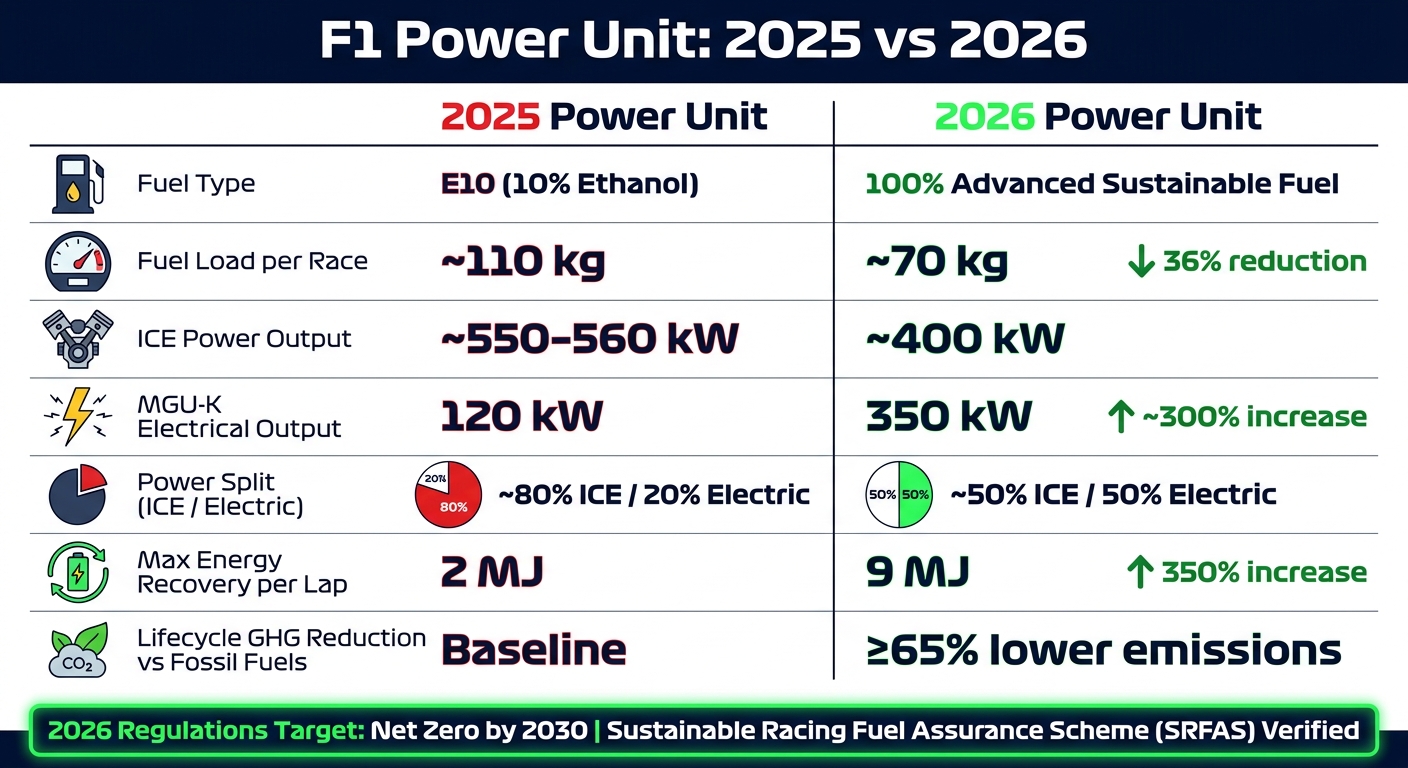
F1 Power Unit: 2025 vs 2026 Key Specs & Emissions Impact
After examining manufacturing emissions, the use phase of F1 vehicles highlights additional opportunities for reducing environmental impact, thanks to advancements in fuel technology and hybrid systems.
Fuel Combustion Emissions During Races
While F1 engines release CO2 during races, the direct emissions from combustion make up only a small portion of the sport's overall carbon footprint. Surprisingly, the larger environmental concern lies in the production of the fuel itself, not its combustion. This shifts the focus from race-day emissions to the processes involved in creating the fuel.
Lifecycle Impact of Sustainable Fuels
Starting in 2026, all F1 cars will run on 100% Advanced Sustainable Fuel, which contains no fossil components. These fuels are produced from innovative sources like municipal waste, non-food biomass, and atmospheric carbon capture. The key difference? The CO2 released during combustion is carbon that was recently absorbed from the atmosphere or biological sources, rather than ancient carbon stored underground. This makes the combustion process nearly carbon-neutral.
The real environmental test lies in the entire lifecycle of these fuels. To meet FIA standards, lifecycle greenhouse gas emissions - including feedstock sourcing, production, processing, and transportation - must be at least 65% lower than those of traditional fossil fuels. Jennifer Kroeger, a PhD candidate in Environmental Science, emphasizes this point:
"The life cycle greenhouse gas emissions associated with the fuels - including the emissions from feedstock sourcing, production, processing, and transporting - must be 65% less than a comparable fossil fuel."
Fuel suppliers are also phasing out food-crop-based feedstocks to avoid ethical concerns. As Matti Alemayehu, Global Motorsport Technology Manager at ExxonMobil, succinctly stated:
"The message is if you can eat it, don't burn it, so that it doesn't compete with the food source."
This transition to second-generation feedstocks - such as manure, forestry waste, and other non-food biomass - ensures these fuels meet emissions goals without competing with global food supplies.
Hybrid Systems and Fuel Efficiency Gains
In addition to cleaner fuel options, advancements in hybrid technology have significantly cut emissions. Since the introduction of the 1.6-liter V6 turbo-hybrid engine in 2014, thermal efficiency has improved from 30–33% to 45–52%, reducing CO2 emissions per kilometer by roughly 35%.
Upcoming 2026 regulations aim to push these gains even further. The MGU-K's electrical output will rise from 120 kW to 350 kW, a nearly 300% increase, creating a nearly 50/50 power split between the internal combustion engine (ICE) and the electric systems. This shift means the ICE will consume less fuel while maintaining the same performance. Additionally, the maximum energy recovery per lap will jump from 2 MJ to 9 MJ, giving teams more electric energy to use during a race.
Here’s a quick comparison of the 2025 and 2026 power units:
| Feature | 2025 Power Unit | 2026 Power Unit |
|---|---|---|
| Fuel Type | E10 (10% Ethanol) | 100% Advanced Sustainable Fuel |
| Fuel Load per Race | ~110 kg | ~70 kg |
| ICE Power Output | ~550–560 kW | ~400 kW |
| MGU-K Power Output | 120 kW | 350 kW |
| Power Split (ICE/Electric) | ~80% / 20% | ~50% / 50% |
| Max Energy Recovery per Lap | 2 MJ | 9 MJ |
Innovations like Turbulent Jet Ignition (TJI) help maximize combustion efficiency, squeezing more power from less fuel within strict fuel-flow limits. Additionally, the switch from a mass-based fuel flow limit (kg/h) to an energy-based limit of 3,000 MJ/h ensures consistent performance across various sustainable fuel types, which can differ in energy density. Altogether, these changes mean less fuel is burned while delivering even greater power on the track.
End-of-Life Management of F1 Power Units
Component Lifespan and Durability
F1 power units are built with precision engineering, using tight tolerances and advanced coatings to ensure durability and minimize the need for frequent replacements during a season. The removal of the complex MGU-H system has further simplified the design, reducing the total number of parts to manage. This change not only extends the lifespan of individual components but also makes the entire end-of-life process more efficient by leaving fewer materials to track and recycle when a power unit retires.
Recycling Engine Materials
The materials used in F1 power units include titanium, carbon fiber, and aluminum alloys, all chosen for their strength and performance. Both aluminum and titanium are recyclable, and recovering these metals from decommissioned components can help offset the environmental impact of their initial production. However, not all materials in a power unit are easy to recycle.
One of the biggest challenges lies with the lithium-ion battery packs used in the hybrid systems. Recycling and reprocessing these batteries require specialized facilities, and with the planned 300% increase in battery power for 2026 power units, the size and complexity of these packs will grow. Managing these larger, more energy-dense batteries at the end of their life will be critical to meeting sustainability goals tied to lifecycle emissions.
Designing Engines for Easier Disassembly
Modern F1 engine designs now emphasize ease of disassembly, making it a core design principle rather than an afterthought. Efforts like the "Circularity Handbook", developed by McLaren, Deloitte UK, and the FIA, guide material selection and assembly techniques to simplify the recovery of components in Formula 1.
Advancements in manufacturing, such as Selective Laser Melting (SLM) and other 3D printing methods, allow engineers to combine multiple parts into single, precisely crafted components. Fewer parts mean simpler teardown processes, which, when paired with the streamlined architecture of the 2026 regulations, make material recovery more straightforward.
Additionally, aligning the MGU-K technology used in F1 with systems found in commercial hybrid vehicles takes advantage of existing recycling and maintenance infrastructure already established for road cars. This synergy helps bridge the gap between high-performance motorsport technology and everyday automotive practices, creating opportunities for more efficient end-of-life management.
Conclusion: What Comes Next for F1 Engine Emissions
The 2026 regulations represent a transformative moment in F1's approach to engine emissions. With a 53/47 power split between the internal combustion engine (ICE) and electrical systems, alongside the introduction of 100% sustainable fuel, the sport aims to tackle emissions across the entire engine lifecycle. Key changes include a boost in MGU-K output from 120 kW to 350 kW, an increase in energy recovery per lap from 2 MJ to 9 MJ, and a requirement for fuels to achieve at least a 65% reduction in greenhouse gas emissions compared to traditional gasoline. These developments redefine how F1 engines operate.
Equally important is ensuring transparency in how these emissions reductions are measured. The Sustainable Racing Fuel Assurance Scheme (SRFAS), introduced by the FIA in collaboration with the Zemo Partnership in December 2025, provides third-party verification to track every Advanced Sustainable Component throughout the supply chain. From feedstock sourcing to exhaust emissions, this independent auditing ensures the integrity of lifecycle data and supports future advancements in technology and regulations.
However, achieving these goals comes with financial hurdles. Sustainable fuels are currently priced between $200 and $500 per liter, creating significant cost challenges for teams and suppliers. Mercedes-AMG Petronas Team Principal Toto Wolff highlighted this issue:
"What makes it so expensive is that the whole supply chain and energy contribution needs to be green. To achieve all of that, you need a certain specification of ingredients that is very expensive – and it's coming in much more expensive than anyone thought."
Bridging this cost gap will require scaling production and refining synthesis methods like Fischer-Tropsch processes and carbon capture technologies. These efforts are vital if F1's sustainability initiatives are to extend beyond motorsport and influence broader commercial transportation. They also play a critical role in supporting the sport's overarching goal of achieving Net Zero emissions by 2030.
FAQs
What are an F1 engine’s lifecycle emissions?
The lifecycle emissions of an F1 engine account for its overall impact, from fuel production to combustion. Beginning in 2026, Advanced Sustainable Fuel will need to derive its carbon exclusively from non-fossil sources like waste biomass or carbon capture technologies. Additionally, the FIA mandates that the production process must reduce greenhouse gas emissions by more than 65% compared to traditional fossil fuels. This ensures a cleaner and more responsible approach throughout the entire fuel supply chain.
How will 2026 sustainable fuel emissions be verified as “65% lower”?
By 2026, Formula 1 aims to verify a 65% reduction in greenhouse gas emissions, using a certification process supervised by the FIA. To meet this goal, fuel suppliers will need to provide detailed chain-of-custody documentation that proves their production process aligns with strict sustainability standards.
Independent certification bodies will play a key role in this process. They will assess the lifecycle carbon balance of the fuels, ensuring they come from approved non-fossil feedstocks. These include materials like waste biomass, captured carbon, or fuels produced through synthetic processes. Additionally, the production methods must avoid reliance on high-emission fossil energy to qualify under these standards.
This rigorous approach underscores Formula 1's commitment to reducing its environmental impact while maintaining its focus on innovation.
Will the bigger 2026 hybrid system make battery recycling harder?
The 2026 hybrid system will see a jump in battery power from 120 kW to 350 kW, boosting the role of electrification in racing. To tackle waste and resource concerns, the FIA’s Constructors Circularity Handbook offers teams standardized guidelines for measuring resource reuse, cutting waste, and handling materials like batteries at the end of their lifecycle. Additionally, the elimination of the MGU-H simplifies the hybrid system, making it more aligned with technologies used in everyday vehicles while supporting broader sustainability efforts.