Lotus vs Ferrari: Clark, Hill, Andretti, Lauda
A 1962–1978 analysis of Lotus vs Ferrari: how car pace, engineering and reliability decided championship outcomes.
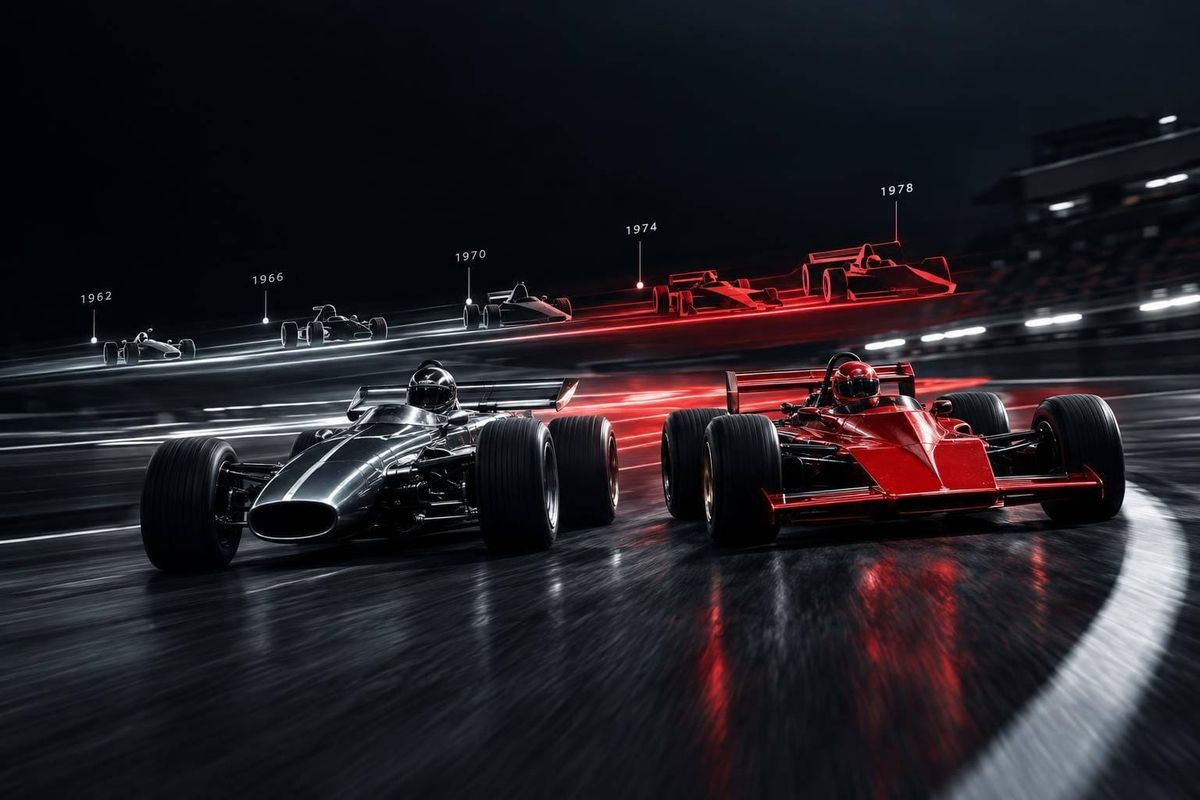
I see the Lotus–Ferrari story as a contest between speed and finishing races - not a four-way driver rivalry. Across 1962–1978, these four drivers won six titles in the campaigns covered here. To compare them, I look at the cars, rivals, retirements, and each season’s points rules.
- Jim Clark: Lotus pace brought titles in 1963 and 1965, but mechanical failures hurt his 1964 bid against Ferrari’s John Surtees and BRM’s Graham Hill.
- Graham Hill: He challenged Ferrari with BRM in 1964, then won the 1968 title with Lotus against Jackie Stewart’s Matra.
- Mario Andretti: Lotus’s ground-effect cars challenged Ferrari in 1977 and carried him to the 1978 title.
- Niki Lauda: Ferrari’s testing, car development, and steady results helped him win titles in 1975 and 1977; his main 1976 rival was McLaren’s James Hunt.
My takeaway: <u>compare results, not just pace</u>. From rough-track failures to Ferrari’s flat-12 and Lotus’s ground effect, the fastest car still had to finish.
Quick Comparison
| Driver | Team and seasons covered | Main car or team factor | Titles in those campaigns |
|---|---|---|---|
| Clark | Lotus, 1962–1965 | Lotus 25/33 pace and reliability | 1963, 1965 |
| Hill | BRM, 1964; Lotus, 1968 | Consistency and race finishes | 1968 |
| Andretti | Lotus, 1977–1978 | Lotus 78/79 ground effect | 1978 |
| Lauda | Ferrari, 1974–1977 | Testing, flat-12, transverse gearbox | 1975, 1977 |
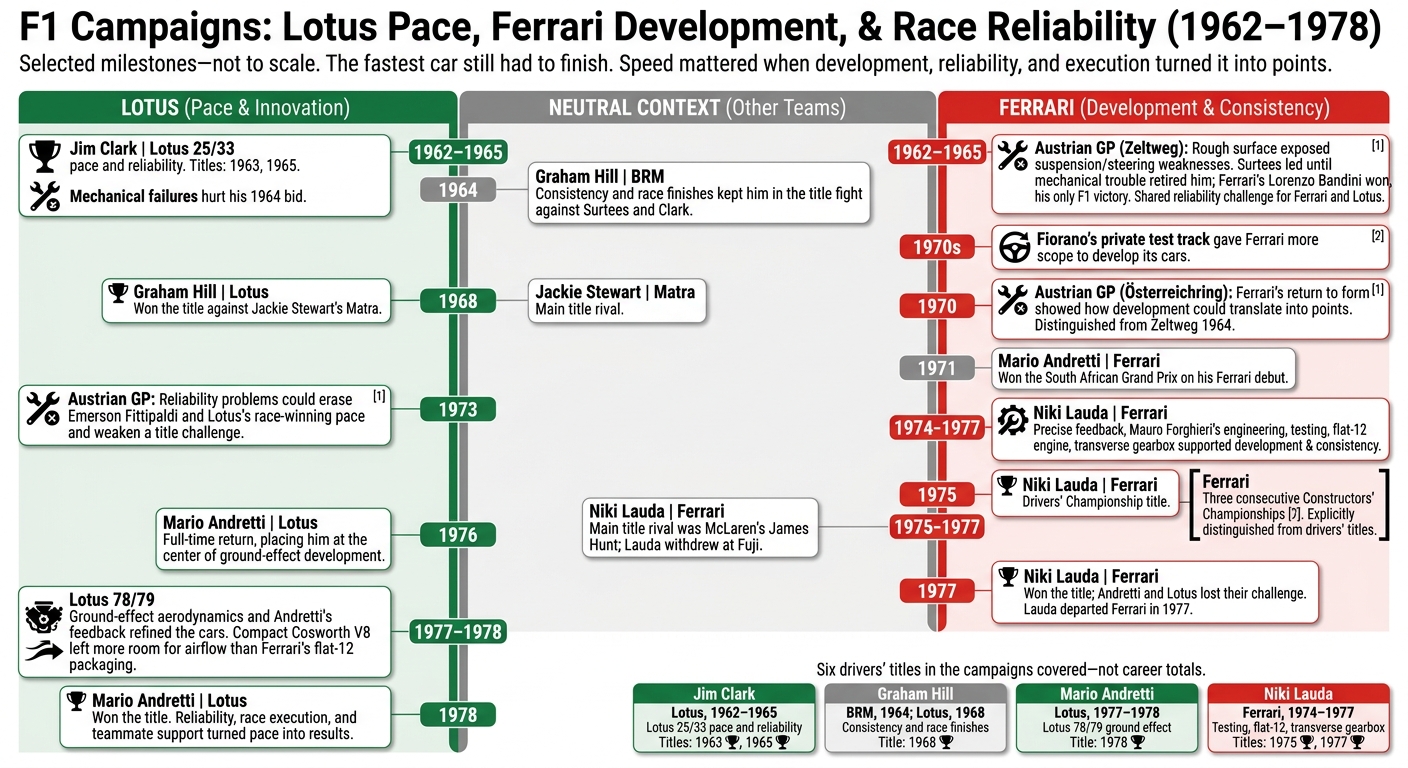
Lotus vs Ferrari: Speed, Reliability and Titles, 1962–1978
F1's Aero Master | The story of the Lotus 49
sbb-itb-7c68254
Jim Clark: Lotus Pace and Ferrari Opposition
Clark’s Lotus had the pace to beat Ferrari - provided the race didn’t become a test of survival.
Lotus 25 and 33: Design and Reliability
Speed wasn’t enough. Lotus had to finish. Early-1960s F1 cars were fragile, and rough tracks exposed weaknesses in suspension and steering.
At Zeltweg, that risk applied equally to Ferrari and Lotus.
Zeltweg’s rough surface made reliability a race-deciding factor in 1964.
Clark’s Campaign Against Ferrari
Ferrari challenged Clark in 1964 with John Surtees and Lorenzo Bandini.
Surtees led at Zeltweg until mechanical trouble retired him; Bandini won, his only Formula 1 victory.
Surtees had the pace to fight at the front, while Bandini could take advantage when rivals failed to finish.
Graham Hill: From BRM Contender to Lotus Leader
Hill’s 1964 campaign with BRM showed the other side of the title fight: Ferrari had speed, but consistency still mattered. Hill’s steadier results kept him in contention, while Lotus and Ferrari were heading into a phase of their rivalry shaped more by engineering.
The balance between speed and durability would shift again as Lotus moved toward a more decisive technical edge.
Mario Andretti: Lotus Ground Effect Takes on Ferrari
By 1977, Lotus was using ground effect to gain an aerodynamic edge over Ferrari. Andretti’s full-time return to Lotus in 1976 put him at the center of that effort.
He also knew Ferrari firsthand, winning the 1971 South African Grand Prix on his Ferrari debut.
Lotus 78 and 79: Aerodynamics and Engine Layout
The Lotus 78 and 79 put ground-effect aerodynamics at the heart of the team’s challenge. Andretti’s development feedback helped refine both cars. Their compact Cosworth V8 also gave Lotus a packaging advantage over Ferrari’s flat-12, leaving more room for airflow beneath the car.
1977–1978: Andretti’s Path to the Title
That aerodynamic edge put Andretti in a direct title fight with Ferrari and Niki Lauda in 1977. Andretti and Lotus lost that battle, then won in 1978.
The turnaround showed that reliability, race execution, and teammate support mattered as much as speed. Lotus’s technical ambition made its cars fast, but that pace didn’t always translate into the finishes needed to win.
Niki Lauda: Ferrari Development and Title Execution
Lauda’s precise feedback worked hand in hand with Mauro Forghieri’s engineering. Ferrari’s Fiorano test track also let the team test updates faster than Lotus could. Lauda translated that development edge into points and titles in 1975 and 1977.
Ferrari’s Flat-12, Transverse Gearbox, and Reliability
The 312 T series combined a flat-12 engine with a transverse gearbox to improve weight distribution and consistency. Ferrari won three consecutive Constructors’ Championships from 1975 through 1977. But Lotus was starting to respond with ground-effect design rather than relying on mechanical grip alone.
Lauda’s withdrawal at Fuji in 1976 and departure in 1977 marked the final chapter of his Ferrari career. His years with the team set the benchmark for Lotus’s next challenge.
Conclusion: Why the Lotus–Ferrari Balance Changed
Neither team held a permanent edge: Lotus usually found speed first, Ferrari usually answered with development, and reliability decided the rest.
Key Races and Car Developments, 1962–1978
| Period | Driver or team under pressure | Decisive race or development | What it showed |
|---|---|---|---|
| 1964 | John Surtees and Ferrari | Austrian GP at Zeltweg | Reliability could decide the result in short order. |
| 1970 | Ferrari | Austrian GP at the Österreichring | Ferrari’s return to form showed how development could soon translate into points. |
| 1973 | Emerson Fittipaldi and Lotus | Austrian GP | Reliability problems could erase race-winning pace and weaken a title challenge. |
| 1970s | Ferrari | Fiorano testing advantage | Ferrari’s private test track gave the team more scope to develop its cars. |
| 1977–1978 | Mario Andretti and Lotus | Lotus 78 and 79 ground-effect development | Ground effect made aerodynamic grip a major strength for Lotus. |
Across 1962–1978, the pattern stayed the same: speed mattered only when development, reliability, and execution turned it into points.
FAQs
How did dropped-score rules shape the 1964 title fight?
The provided search results don’t cover the 1964 Formula 1 season or explain how dropped-score rules shaped that year’s title fight.
Why did Ferrari’s flat-12 complicate ground-effect design?
Ferrari’s flat-12 engine was too wide to leave enough room for underbody venturi tunnels. These tunnels needed clear channels to speed up airflow beneath the car and generate downforce. With the engine taking up that space, engineers couldn’t build the full-length, high-efficiency tunnels available to competitors with narrower engines.
How did Ronnie Peterson help Andretti win in 1978?
The provided search results don’t explain how Ronnie Peterson helped Mario Andretti win the 1978 Formula One World Championship.