F1 Net Zero 2030: Report Card
F1 cut ~35% of 2018 emissions but still needs a 50% absolute cut by 2030; freight, travel and calendar growth are the main barriers.
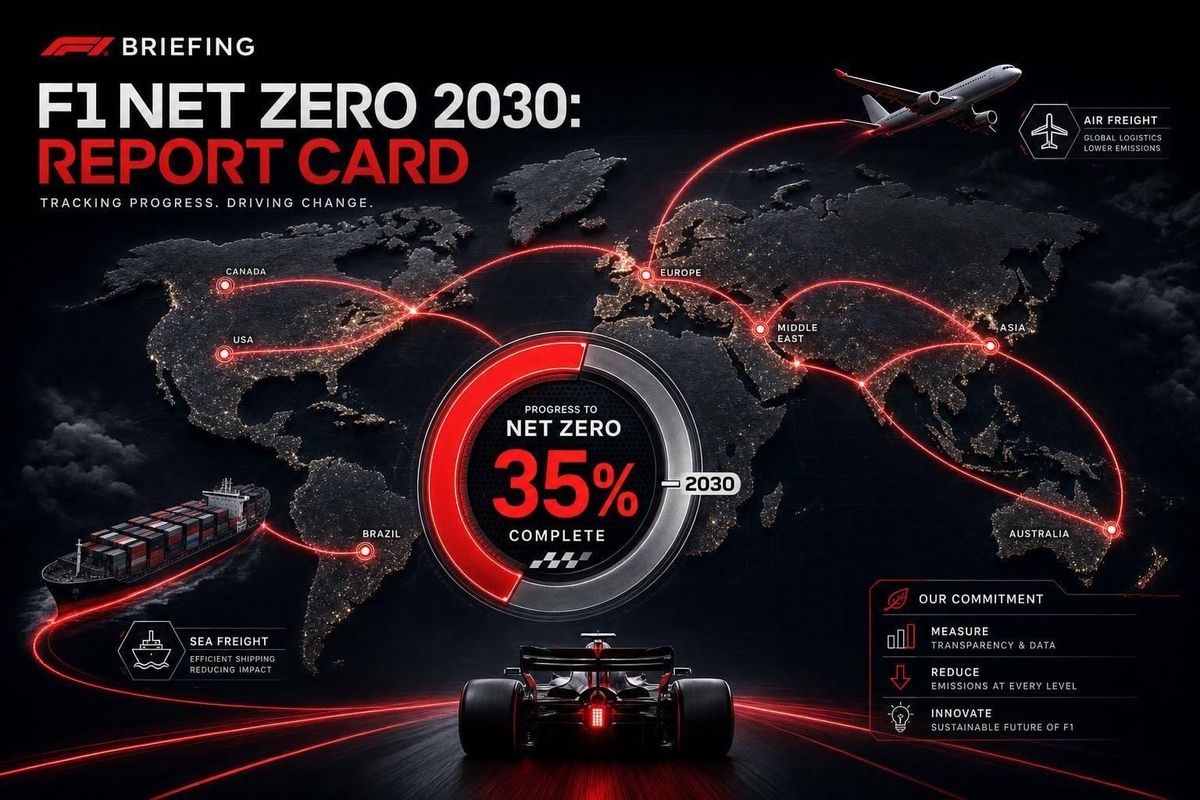
F1 is down about 35% from its 2018 carbon baseline, but it still is not at the minimum cut it needs before 2030. From 228,793 tCO2e in 2018 to about 148,805 tCO2e in 2025, the sport has cut 79,988 tCO2e. That sounds good. But the key line is a 50% absolute cut, which means F1 still needs to remove about 34,408 tCO2e more.
Here’s the short version:
- Best-reported progress: factories and facilities
- Hardest problem: freight, logistics, travel, and race weekends
- Main risk: a bigger calendar can wipe out cuts made elsewhere
- Main gap: public reporting still does not cleanly prove every claimed cut by category
- Bottom line: progress is there, but the hardest part is still ahead
If you want the plain answer, it’s this: I’d score F1 as partway there, not on track yet. The sport has cut emissions in areas it controls more directly, especially power use in buildings. But transport-heavy parts of the business still look like the main barrier, and calendar growth keeps adding pressure.
| Metric | Where F1 stands |
|---|---|
| 2018 baseline | 228,793 tCO2e |
| Latest public total (2025) | 148,805 tCO2e |
| Cut so far | -34.95% |
| Minimum 2030 cut before offsets | -50% |
| Gap left to close | 34,408 tCO2e |
What stands out to me is simple: per-race gains are not enough if the full-season total stays too high. That is the main test from now to 2030.
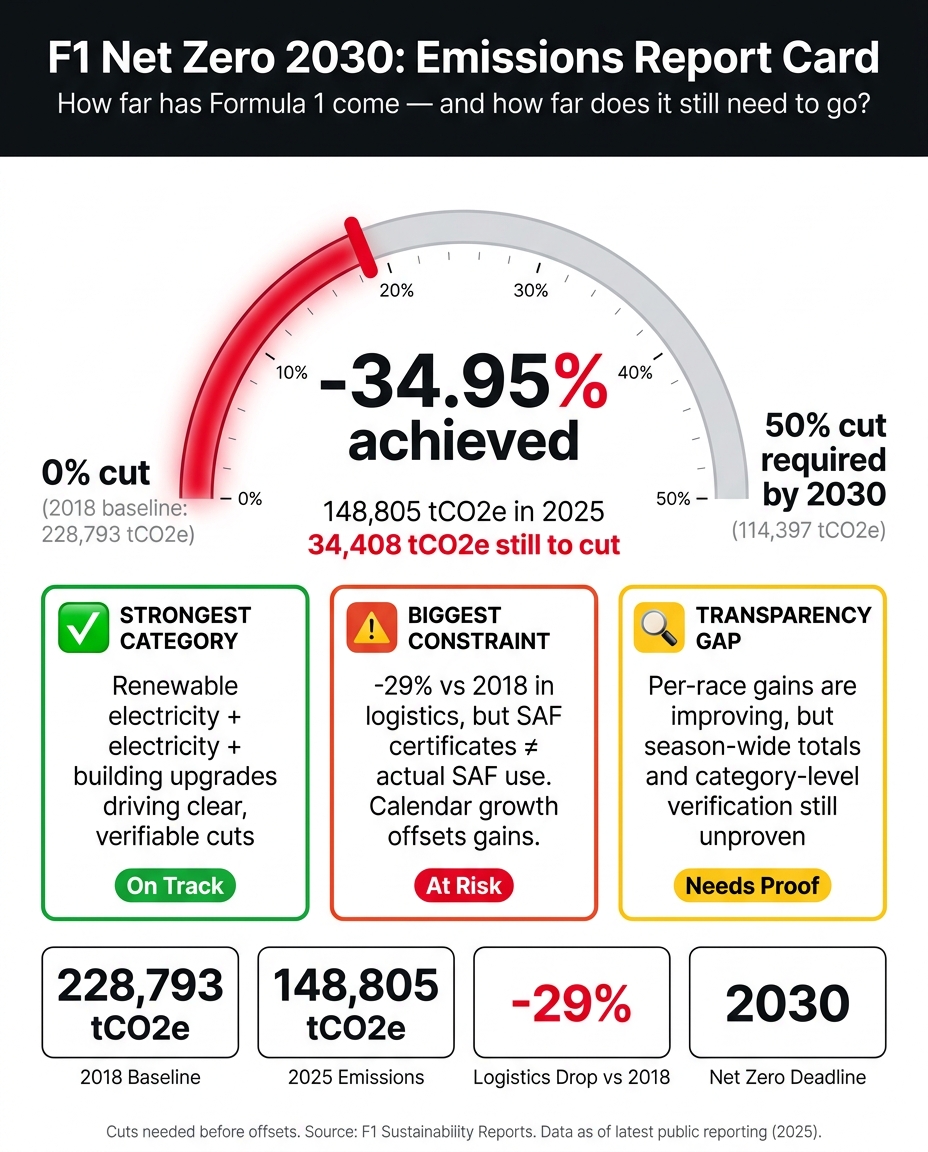
F1 Net Zero 2030: Emissions Progress Report Card
Fleet and factories: where the clearest gains appear
Fleet and race-car technology: strong narrative, narrow emissions impact
The 2026 power-unit rules lift the sport’s technical bar. But they don’t count as current emissions cuts. That matters.
F1’s cleaner-car push gets a lot of attention, and the move to 50% electrical deployment with 100% sustainable fuels is a real shift in direction. Still, it’s a future-facing play, not proof of lower emissions today. Put simply: the story is moving faster than the scorecard.
| Dimension | Assessment |
|---|---|
| Verified contribution to cuts so far | None yet |
| Scalability of sustainable fuel | Unproven at championship scale |
| Emissions sources outside the car | Non-car emissions still dominate |
| Reporting granularity on fleet | Limited public breakdown |
And that’s the key tension here. The race car is the headline act, but it’s not where F1 has shown its clearest results so far.
Factories and facilities: the strongest reported case study
This is where the numbers look most solid.
Reported factory and facility emissions have gone down in the latest updates. The main drivers are pretty straightforward: renewable electricity, better energy use, and building upgrades. That makes sense. F1 has direct control over power use and buildings, so it can act here in a more direct way than it can with freight and travel.
| Category | Assessment |
|---|---|
| Factories & facilities | Clear improvement in the latest reporting |
| Renewable electricity | A major driver of the reported reductions |
| Energy efficiency / building upgrades | Another source of savings |
| Disclosure quality | Better than other areas, but not fully standardized across sites |
There’s still a catch. Disclosure is uneven, so the progress looks real, but site-to-site comparisons aren’t fully clean. That’s why freight and travel remain the harder test for F1’s 2030 target.
sbb-itb-7c68254
Can Formula 1 Go Green? Net Zero Goals & Synthetic Fuel
Freight, logistics, and travel: the hardest part of the pathway
Freight and travel are the toughest parts of F1's Net Zero 2030 plan because they rely on constant global movement, not controls at a single site.
Logistics is the main pressure point in the plan. For years, it has made up a big share of F1's carbon footprint. Moving cars, equipment, and staff across the world is a huge job. And the latest public updates make one thing clear: this is where decarbonization gets hard fast.
Logistics progress: real reductions with important caveats
The top-line numbers look good. F1's latest reporting shows a 29% drop in logistics-related emissions versus 2018, and a 21% drop versus 2024.
Those cuts came from a few concrete shifts: more sea freight, remote operations, and tighter freight planning. These aren't minor tweaks. They change how the sport moves, and that has a direct effect on emissions.
But there is a catch. SAF certificates can back lower-emission fuel claims, but they do not show that the specific cargo flight actually used SAF.
| Period | Logistics Emission Change | Key Drivers / Caveats |
|---|---|---|
| 2018 to latest reporting | −29% | More sea freight, remote operations, and SAF certificates |
| 2024 to latest reporting | −21% | Freight planning improvements and calendar expansion offsets |
So the reported drop comes from two places: operations and accounting. That doesn't mean the gains are fake. It means the next big test is what happens in event operations and how clearly F1 reports it.
Travel and calendar design: where scheduling choices can cancel out gains
Freight is only one side of the story. Team staff and engineers travel on their own schedules, and the calendar shapes how far and how often they need to move.
This is where things can unravel. A better freight plan can help, then the calendar gives some of that back. An expanding schedule and scattered flyaway races add travel emissions on top of freight. F1 now openly points to calendar expansion as a main challenge in its sustainability pathway.
Regional clustering of flyaway races can cut travel distances. On paper, that sounds like common sense. In practice, the business logic behind the calendar doesn't always match that goal.
Calendar design now affects both event emissions and how easy those emissions are to explain. So this isn't just a scheduling problem. It's also a disclosure problem.
Race events and transparency: per-race improvement versus total footprint
Calendar growth also shapes how F1 reports race-event emissions.
Event operations: modest aggregate progress in a larger championship
F1's reporting shows that individual Grands Prix can improve. But that alone doesn't prove the championship is cutting total emissions at the pace it needs. Put plainly: a cleaner race weekend is good news, yet the full-season total is still what counts.
Per-race gains matter. The season total decides the grade.
That's why reporting quality matters just as much as day-to-day operational changes.
Disclosure quality: the biggest test between now and 2030
The credibility test is whether F1 can keep showing season-wide cuts while the calendar keeps expanding. In practice, that means publishing clear, comparable, season-wide emissions data year after year as the calendar grows.
The new Concorde Agreement gives F1 a stable governance framework through 2030. But stable governance and transparency are not the same thing. That gap still needs work if race-event claims are going to carry weight.
| Topic | What the public data can show | What still needs to be proven |
|---|---|---|
| Event operations | Individual Grands Prix can improve operations | Whether per-race gains reduce the season-wide total |
| Calendar design | Growth is the central tension | Whether expansion is outpacing absolute emissions cuts |
Conclusion: F1 has made real progress, but the hardest categories still lack full public proof
The report card points to a pretty clear pattern: F1 has cut emissions in some areas, but the pace isn't the same across the board. The sport has done best in areas it can control more directly, like buildings and power use. It has had a much harder time in areas tied to moving people and equipment around the world.
That split lines up with the scorecard above. Factories and facilities stand out most, because public reporting gives the clearest sign of lasting cuts there. Freight, logistics, travel, and race operations are a different story. Those are still the hardest categories to clean up, and a bigger calendar keeps making the job tougher.
The next big test is the 2026 power unit rules, with a 50-50 split between internal combustion and electric power, plus 100% sustainable fuels. The Concorde Agreement brings stability through 2030, but stability alone doesn't prove results. The open question is simple: Can F1 show clear cuts in each category before 2030?
Key takeaways from the report card
| Category | Status |
|---|---|
| 2018 baseline vs. latest total | Real progress since 2018, but not yet fully verified in public reporting |
| Strongest category | Factories and facilities - clearest public evidence of lasting cuts |
| Biggest constraint | Freight, logistics, travel, and race-event operations - structurally hardest to decarbonize |
| Transparency gap | Season totals matter more than per-race gains; clear year-over-year, category-level verification is still needed before 2030 |
FAQs
Why isn’t F1 on track for Net Zero 2030 yet?
F1 still isn’t on track because high-performance engineering runs into the current limits of more sustainable materials. The 2026 power units bring more electrification, but heavier batteries and added safety structures make cutting weight even tougher.
Circularity is another sticking point. Core parts like the monocoque still rely on virgin carbon fiber, while recycled options don’t yet deliver the durability or production volume teams need. On top of that, teams have to juggle sustainability work with on-track performance, budget caps, and tight testing limits.
Which emissions cuts seem most credible so far?
The biggest cuts so far have come from plain, workable changes in engineering and transport.
McLaren’s move to sea freight cuts emissions per kilogram by 97%. For road transport, HVO biofuel cuts outbound journey emissions by up to 90%. Those aren’t small tweaks. They show that a lot of progress can come from changing how things move from one place to another.
Recycled carbon fiber looks strong too, with lifecycle emissions cut by 90%. That matters because carbon fiber sits at the heart of modern race car design, so any drop there can add up fast.
On the power-unit side, turbo-hybrid engines have already cut CO2 emissions by 26% compared with the older V8 era. And the 2026 rules are set to push that even further, with more energy recovery and the use of sustainable fuels.
How much does calendar growth hurt F1’s carbon target?
Calendar growth puts real pressure on F1’s 2030 net-zero target. A bigger schedule means more travel, more freight, and more moving parts across the season. Put simply, as the calendar expands, the sport’s logistics load gets heavier.
Public updates so far don’t clearly spell out how much that growth changes the path to the 2030 goal. But the tension is hard to ignore: F1 says it wants to cut emissions while also running more races. That gap remains a major point of scrutiny.