2026 F1 Rules: Study on Hybrid Efficiency
2026 F1 rules make energy control decisive: 350 kW MGU-K, no MGU-H, 9 MJ recovery cap, 4 MJ battery deploy.
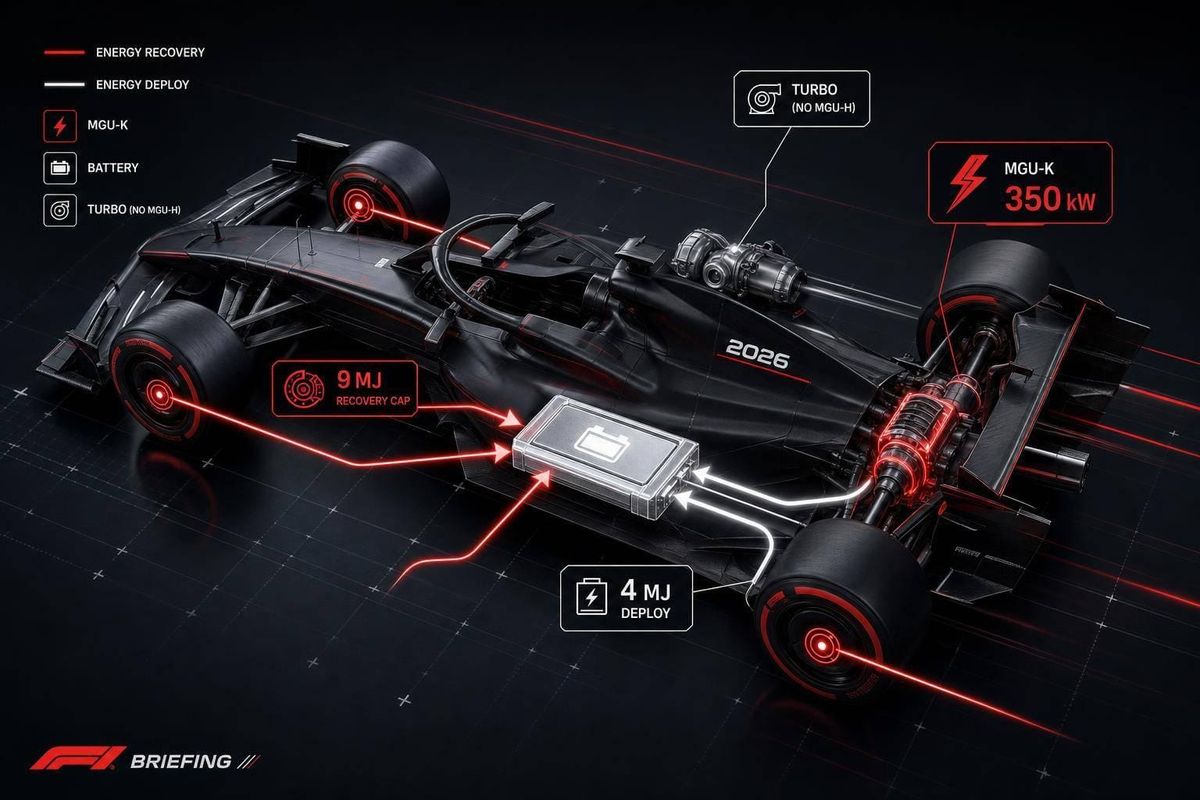
The short answer: the 2026 F1 rules shift the fight from pure engine output to energy control. I’d sum it up like this: teams that recover, store, and deploy electrical energy best will have the edge, especially because the MGU-H is gone, the MGU-K jumps to 350 kW, recovery is capped at 9 MJ per lap, and usable battery deployment sits at 4 MJ per lap.
Here’s what matters most to me:
- Power balance changes a lot: F1 moves from roughly 80/20 ICE-electric to near 50/50.
- The MGU-H is removed: that cuts one recovery path and can bring back turbo lag.
- The MGU-K becomes the core hybrid part: it now does far more of the work in both recovery and deployment.
- Fuel is measured by energy content: about 2,700–3,000 MJ/h, not just by mass flow.
- ICE output drops: from about 550–600 kW today to around 400 kW.
- Track layout matters more: heavy-braking tracks should suit recovery better than fast tracks with fewer braking zones.
- Overtaking may change shape: deployment tapers above 180 mph (290 km/h) and is near zero by about 220 mph (355 km/h), while the following car can get full 350 kW override in some cases.
If you want the main takeaway in one line, here it is: 2026 hybrid efficiency is less about fuel alone and more about when and where a car turns recovered energy into lap time.
| Area | 2026 rule or trend | What I’d watch |
|---|---|---|
| Hybrid layout | No MGU-H, 350 kW MGU-K | Corner-exit response, lag control |
| Energy use | 9 MJ recovery cap, 4 MJ battery window | Per-lap deployment timing |
| Engine side | ICE around 400 kW | Combustion and heat losses |
| Fuel rule | Energy-based cap at about 2,700–3,000 MJ/h | How fuel blends affect output |
| Racing effect | High-speed taper plus override | Passing on long straights |
So while the rulebook sets the limits, I’d say the main story is simple: the best 2026 power unit may be the one that wastes the least energy across a lap, not the one with the biggest headline power number.
F1 2026 Regulations Explained - "The Biggest Changes in F1 History"
sbb-itb-7c68254
2026 Hybrid Architecture and Energy-Flow Limits
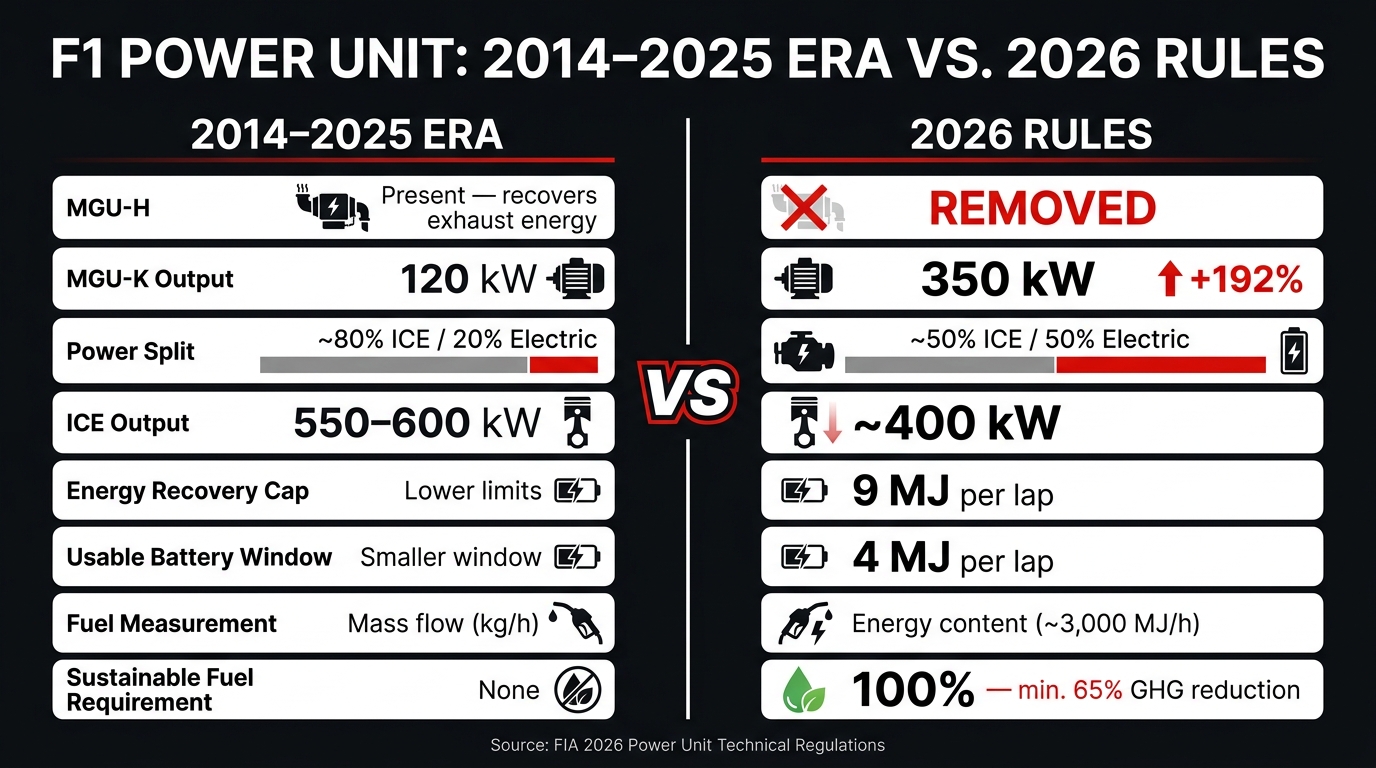
F1 2026 Hybrid Rules vs. 2014–2025 Era: Key Power Unit Changes
The 1.6-liter V6 turbo stays in place, but the balance of power is changing in a big way. Under the 2026 rules, the electrical side now carries close to half of the total power budget, pushing F1 toward an almost 50:50 split between the ICE and electric power. So the main limit is no longer just the hardware itself. It’s how energy moves through the car.
| Feature | 2014–2025 Era | 2026 Rule | Change |
|---|---|---|---|
| MGU-H | Present (recovers energy from exhaust) | Removed | Complete elimination |
| MGU-K Output | 120 kW | 350 kW | Large increase |
| Power Split | ~80% ICE / 20% Electric | ~50% ICE / 50% Electric | Major shift to electric |
| Energy Recovery | Lower limits | 9 MJ ceiling | Higher recovery limit |
From MGU-H to a 350 kW MGU-K System
With the MGU-H gone, the power unit gets simpler on paper. But there’s a catch: turbo lag comes back into play. That means teams will have to rely more on anti-lag software and carefully tuned MGU-K deployment maps when exiting slow corners.
At 350 kW, the MGU-K becomes the heart of the electrical system. It no longer plays a supporting role. It handles both energy deployment and recovery, which makes it the main electrical component in the entire power unit.
Recovery Limits, Battery Window, and the Move Toward a 50:50 Power Split
The FIA puts a hard cap of 9 MJ on energy recovery per lap, while the battery works within a 4 MJ usable energy window.
That creates a tight box for teams to work in. They can’t just recover energy whenever possible and spend it anywhere on the lap. Instead, lap time depends on when energy is harvested and when it’s deployed. In plain terms, timing becomes everything.
This is why deployment strategy will matter so much in 2026. The battery is no longer just there to help the engine. It becomes a major source of lap time on its own. That puts energy recovery rates and deployment efficiency right at the center of car performance.
Those limits lead straight into the next issue: how teams convert recovered energy into usable lap time.
Fuel Efficiency, Sustainable Fuel, and the New Energy Accounting
One of the biggest changes in 2026 is the way the FIA measures fuel. Instead of limiting fuel flow by mass, in kilograms per hour, the rules now cap it by energy content at roughly 3,000 MJ/h. That’s a big deal because sustainable fuels don’t all carry the same amount of energy per unit of mass. Their chemistry can vary, and so can their energy density.
By measuring energy instead of mass, the FIA gives teams a more even playing field across different fuel blends. Paired with the recovery cap, this creates the total energy budget teams can use each lap.
At the same time, ICE output drops from the current 550–600 kW range to around 400 kW (536 hp). So the engine does less of the heavy lifting, and energy deployment does more.
Why Lower ICE Power Does Not Mean Lower Overall Performance
Lower ICE power doesn’t automatically mean slower cars. Under an energy-based fuel cap, the game changes. What matters now is how well a team turns each megajoule into lap time.
Even if thermal efficiency reaches 45%–50%, about half of the fuel’s energy still disappears as heat. Then the electrical side brings its own losses through the inverter, motor, battery, and drivetrain. In plain English: not all stored or burned energy makes it to the wheels.
That’s why the fight won’t be just about peak power figures. It’ll be about:
- combustion efficiency
- deployment timing
- cooling layout
- software control
- how tightly the whole system is packaged
A car that uses its energy at the right moments can make up for a lower raw ICE number.
What Published Studies Say About Sustainable Fuel and Thermal Efficiency
The FIA’s sustainable-fuel mandate adds another layer. E-fuels and advanced biofuels can differ in chemical composition, which means combustion calibration becomes a key differentiator between manufacturers. Small changes in calibration can affect how much of the allowed energy budget turns into usable power at the wheels.
There’s also a climate requirement built into the rule set: sustainable fuels must deliver at least a 65% cut in greenhouse gas emissions compared with fossil-derived gasoline.
The table below shows where energy enters and leaves the system, and which numbers are fixed by the rules versus still based on targets or estimates.
| Component / Stage | Value | Category |
|---|---|---|
| Fuel Energy Input | ~2,700–3,000 MJ/h | Rule (Energy Flow Limit) |
| ICE Power Output | ~400 kW (536 hp) | Target / Limit |
| ICE Thermal Efficiency | 45%–50% | Target |
| MGU-K Max Deployment | 350 kW (469 hp) | Rule |
| MGU-K Max Recovery | 9.0 MJ / lap | Rule |
| Usable battery deployment | 4.0 MJ / lap | Rule |
| Inverter / Motor Efficiency | 92%–97% | Estimate |
| Battery Round-Trip Efficiency | 85%–90% | Estimate |
| Drivetrain Losses | 1%–2% | Estimate |
Those gaps between input, conversion, storage, and delivery will shape how teams handle packaging, cooling, and control in 2026.
How Teams Are Likely to Respond to the Efficiency Rules
The big 2026 task is pretty clear: turn stored and recovered energy into rear-wheel output with as little loss as possible. That pressure hits the rear of the car first, where cooling and energy recovery are both fighting for room.
Packaging, Cooling, and Rear-Axle Energy Recovery
With the MGU-H gone, rear-axle recovery becomes the main energy route. And because recovery and deployment are limited to 9 MJ and 4 MJ per lap, teams can't just chase more harvested energy and call it a day. They have to decide exactly where that energy should be used.
That creates a tight trade-off. Push harder on recovery, and you also have to deal with more heat, battery state-of-charge control, and how the car behaves on corner exit. In plain English: every gain costs you something, whether that's heat, weight, or drivability.
| Efficiency Opportunity | Packaging & Mass Cost | Cooling & Reliability Risk | Drivability Challenge |
|---|---|---|---|
| Higher electrical deployment demand | Larger battery volume and possible mass increase | More heat to remove from the battery and electrical parts | Harder deployment mapping to balance energy saving with attack |
| Loss of exhaust-side energy recovery | Simpler power unit and less heat-recovery hardware at the rear | Turbo lag comes back into play | Softer corner-exit torque unless software helps fill the gap |
| Rear-axle energy recovery | More demand on recovery hardware and rear packaging space | More stress on the electrical system as recovery climbs | Harvesting and deployment have to be balanced across the full lap |
Controls Software, Deployment Maps, and Energy Management
Once the hardware is locked in, software becomes the biggest performance tool. Without the MGU-H constantly smoothing the energy flow, the MGU-K has to handle most of the recovery work, while the driver also has to manage state of charge and deployment through a stint.
That puts SoC prediction and torque blending right at the center of lap time. Teams that can call the timing well - when to save energy, when to spend it - will be able to deploy more aggressively without reaching the end of a stint short on output. Teams that get that balance wrong will either leave pace unused or run into corner-exit trade-offs.
Racing Effects, Open Questions, and Conclusions
Race results will show how the 2026 rules play out in the only place that matters: on track. That final test comes down to performance in traffic, where deployment taper and override can change the shape of a battle.
Under the 2026 rules, MGU-K deployment starts tapering above 180 mph (290 km/h) and drops to near zero by about 220 mph (355 km/h). The FIA's override rule gives the following car access to the full 350 kW when the leading car is already in the taper zone.
How Circuit Type Could Change the Real Efficiency Picture
This taper won't affect every circuit in the same way. At Monza, it turns into a straight-line fight, with taper and override likely deciding who carries more speed at the end of long runs. At Monaco, the focus shifts. There, the bigger story is energy recovery under braking and how teams deploy power out of slow corners.
That split matters. On fast tracks, straight-line speed becomes a major race variable - not just how much energy a car can recover.
Key Takeaways: Confirmed Rules vs. Projections
The big open question is simple: how much lap time can teams actually find within these limits? The table below separates what the rules already lock in from what only 2026 race data can answer.
| Category | Confirmed Rule | Expected Effect | Data Still Needed |
|---|---|---|---|
| Recovery | 350 kW MGU-K; no MGU-H | Higher braking-load recovery demand; more dependence on traffic position | Real-world recovery consistency in traffic |
| Fuel Consumption | 100% sustainable fuels | Lower energy density; focus on thermal efficiency | Final combustion characteristics of e-fuels under race load |
| Overtaking | MGU-K Override concept | Speed delta at the end of straights favoring the following car | Frequency and duration limits of override use in race conditions |
| Top-Speed Effect | Deployment taper (about 180–220 mph / 290–355 km/h) | Long straights lose more electrical assist without override | Sensitivity of lap times to drag settings versus deployment maps |
The framework is set. What still needs proof is whether the efficiency gains projected in FIA papers and engineering work show up in race conditions - and which teams deal with these limits best.
FAQs
Why does removing the MGU-H matter so much?
Removing the MGU-H is a big part of the 2026 rules change. The goal is simple: make power units less complex and cut costs. It drops a tricky heat-recovery system that has little use for road cars, and it also trims the extra cooling, inverter, and cabling parts tied to it.
That simpler setup helps balance out the added weight of larger batteries. But there’s a trade-off. More of the energy recovery job now lands on the MGU-K, which means more heat, more stress, and a whole new energy-management puzzle for teams.
Which tracks will favor the 2026 hybrid rules most?
Tracks with heavy braking zones should fit the 2026 hybrid rules better. They give teams more chances to recover energy, which helps support the 50:50 split between the engine and electric motor.
Tracks with long straights could be tougher. On those layouts, teams will need to manage energy with care so they don't end up relying too much on downshifts mainly to regenerate power.
Could the 2026 energy limits affect overtaking?
Yes. The 2026 rules are meant to affect overtaking by adding much more electrical power and making deployment more of a tactical tool. The MGU-K output jumps to 350 kW, and the new Boost and Overtake modes are there to help drivers get past.
There’s also MGU-K Override for a car running within one second of the car ahead. That system gives full power up to about 209 mph and adds 0.5 MJ of energy. Some doubts are still out there, but the FIA says its simulations point to overtaking that should still work in practice.