Mercedes F1 Engine: Thermal Efficiency Milestones
An F1 power unit crossed 50% thermal efficiency, converting fuel, heat and braking energy into measurable lap-time gains.
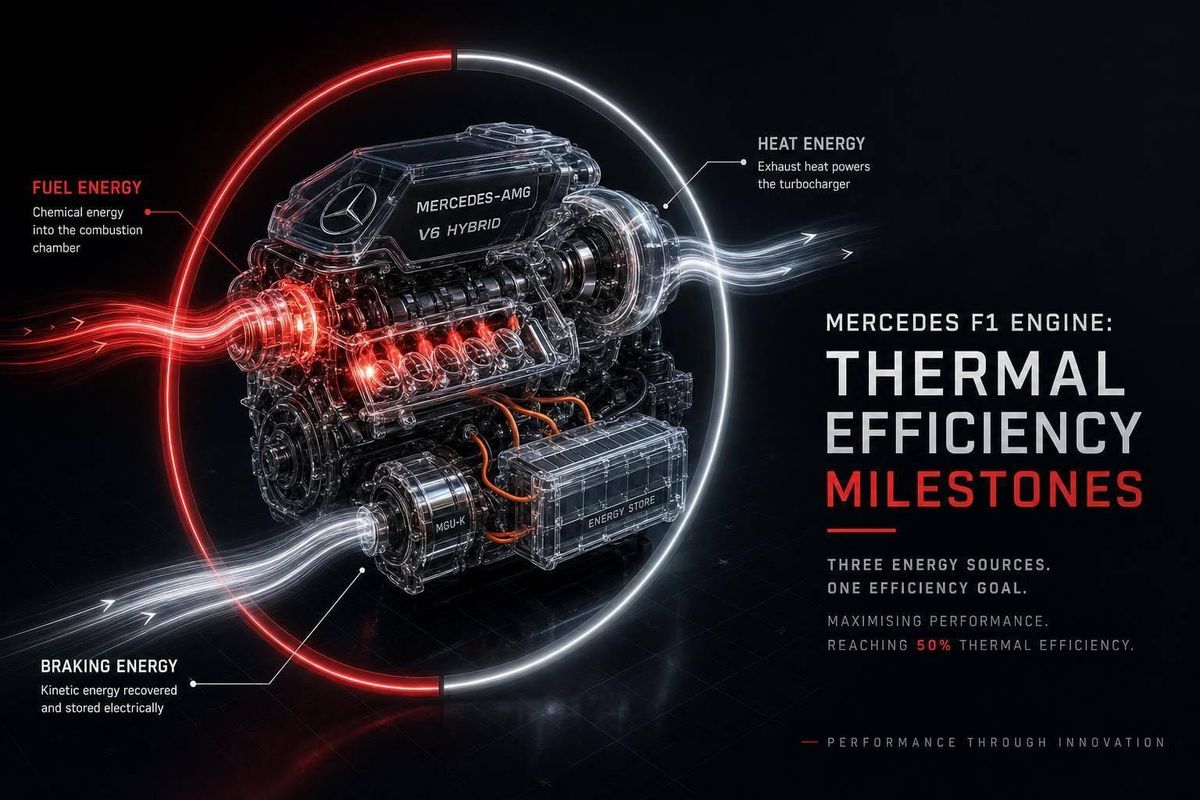
Mercedes crossed 50% thermal efficiency in 2017, and that changed what F1 engine performance meant. In simple terms, Mercedes got more power from the same fuel limit: about 109 extra horsepower from 2014 to 2017 while staying under the 100 kg/hr fuel-flow cap.
If you want the short version, here it is:
- 2014: Mercedes started the hybrid era at about 44% efficiency
- 2016: It moved to about 47%
- September 2017: The M08 EQ Power+ went past 50% on the dyno
- 2018: Mercedes held about 50% on track while also pushing engine life by about 40%
- The gains came from better combustion, the split turbo layout, MGU-H exhaust energy recovery, MGU-K braking recovery, and tight heat control
- On track, that meant lighter fuel loads, less need to save fuel, and more ERS freedom on tracks like Spa and Monza
One point matters most: this was not just about raw horsepower. It was about turning more of the fuel’s energy into lap time through the full power unit, not only the engine.
| Area | What changed |
|---|---|
| Fuel use | More output from the same fuel limit |
| Power | 109 hp more in 2017 vs. 2014 |
| Efficiency path | 44% → 47% → 50%+ |
| Best tools | TJI combustion, split turbo, MGU-H, MGU-K |
| Track effect | Better pace, more full-throttle time, stronger ERS use |
If you’re reading this to understand why Mercedes led the hybrid era, this is the answer: it converted fuel, heat, and braking energy into usable power better than anyone else.
F1 Explained: The Most Powerful Mercedes F1 Engine Ever Made!
sbb-itb-7c68254
Mercedes thermal efficiency milestones from 2014 to the 50% mark
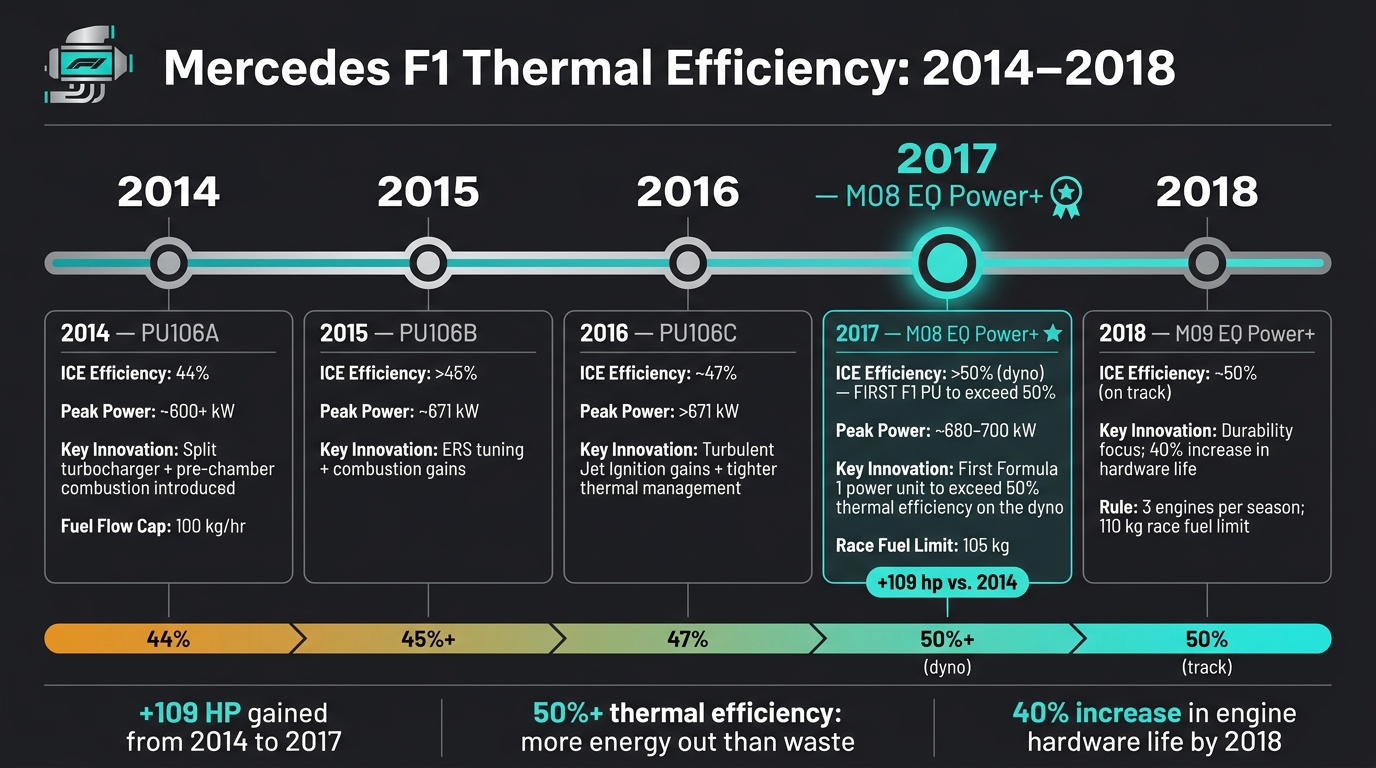
Mercedes F1 Thermal Efficiency Milestones: 2014–2018
Mercedes got to the 50% mark by stacking gains in three connected areas: combustion, energy recovery, and thermal control. The path wasn’t one big leap. It came in stages: first combustion, then hybrid recovery, and after that, making the package last.
| Season | Power Unit | Reported ICE Efficiency | Approx. Peak Power | Overall System Notes | Regulatory Context |
|---|---|---|---|---|---|
| 2014 | PU106A | 44% | ~600+ kW | Split turbocharger and pre-chamber combustion introduced | 100 kg/h fuel-flow limit; 100 kg race fuel limit |
| 2015 | PU106B | >45% | ~671 kW | ERS tuning; combustion gains | Development tokens still limited hardware changes |
| 2016 | PU106C | ~47% | >671 kW | Turbulent Jet Ignition gains; tighter thermal management | 100 kg/h fuel-flow limit |
| 2017 | M08 EQ Power+ | >50% (dyno) | ~680–700 kW | First Formula 1 power unit to exceed 50% thermal efficiency on the dyno | 105 kg race fuel limit; token system removed |
| 2018 | M09 EQ Power+ | ~50% (track) | - | Focus on durability; 40% increase in hardware life | 3 engines per season; 110 kg race fuel limit |
2014 to 2016: early gains under the new hybrid rules
From 2014 to 2016, Mercedes moved from 44% efficiency to about 47% by combining a split-turbo layout with Turbulent Jet Ignition and tighter thermal management. That mix mattered. The split turbo helped packaging and response, while combustion work and better heat control pushed more of the fuel’s energy into useful output instead of waste.
By 2016, the trend was clear: Mercedes wasn’t just adding power. It was getting more work from the same fuel flow under the hybrid rules. That laid the groundwork for what came next.
2017 dyno milestone: passing 50% thermal efficiency
The big 2017 moment came on the dyno, where the M08 EQ Power+ cleared the 50% thermal efficiency mark. That’s the headline number people remember, and for good reason. In Formula 1 terms, crossing 50% meant the engine package was turning more than half of the fuel’s energy into output, at least in controlled test conditions.
The dyno mattered because it stripped away some of the messiness of race weekends. Wind, track layout, traffic, cooling demands, and setup choices can all blur the picture. So this result showed what the package could do at its best before those outside factors pulled the number down.
Post-2018: confirming the 50% benchmark
In 2018, the M09 EQ Power+ backed up that mark under race conditions, with approximately 50% efficiency on track. That’s a different kind of proof. Hitting a number on a dyno is one thing. Holding close to it across a season, with stricter life demands, is where it starts to mean more.
Mercedes also aimed for a 40% increase in hardware life in 2018. That was a big deal because the rules allowed only three engines per season, with the race fuel limit set at 110 kg. So the challenge wasn’t just speed. It was speed that could survive.
"We can get 1,000 hp on the track if that is what we want to do, but our goal is to win races and championships... It's not a dyno-derby." - Andy Cowell, Managing Director, Mercedes-AMG HPP
That comment gets right to the point. The job wasn’t to post a flashy lab number. The job was to keep that efficiency working when the car had to finish races, week after week.
The next test was whether that efficiency could hold under race conditions.
How Mercedes reached 50%+ efficiency
Mercedes got past the 50% mark by tying three things together: combustion, hybrid recovery, and thermal control.
Combustion design and the split turbo layout
On the combustion side, the big idea was Turbulent Jet Ignition (TJI). This is a pre-chamber ignition setup where about 3% of the fuel charge is ignited in a small separate chamber. That spark creates high-pressure plasma jets, which fire through tiny holes into the main combustion chamber. Those jets ignite a much leaner fuel-air mix than a normal spark plug could handle by itself.
Why does that matter? Because a leaner mixture can burn faster and more completely. In plain English, Mercedes was able to get more power from the same fuel.
But there was a catch. This ultra-lean setup only works when the pre-chamber and the main chamber are both supplied cleanly from a single injector. And since F1 rules allow only one injector per cylinder, Mercedes had to solve both the combustion side and the packaging side at the same time.
The split turbo helped too. Mercedes placed the compressor at the front and the turbine at the rear. That layout cut heat soak into the intake air. Cooler intake air carries more oxygen in each charge, which helps support leaner combustion and lets the team use smaller intercoolers.
MGU-H, MGU-K, and system-level energy recovery
Mercedes made its biggest gain in hybrid energy recovery. The MGU-H sits between the turbine and compressor. It recovers exhaust energy and controls turbo speed, which gets rid of lag.
"The MGU-H... means that we have speed control of the compressor and the turbine. That means we can optimize the efficiency around a narrower operating point." - Andy Cowell, Managing Director, Mercedes-AMG HPP
The MGU-K handles braking energy. It recovers kinetic energy under braking, turns it into electricity, and then sends that stored energy back to the crankshaft. That adds about 161 horsepower for roughly 33 seconds per lap.
There was an important rules angle here. The MGU-K had tight FIA limits on how much energy it could recover and deploy per lap. The MGU-H, on the other hand, was mostly unrestricted when it came to energy recovery. That made it the main reason Mercedes could get to the 50% efficiency mark.
Put together, these systems turned heat and braking losses into extra speed.
| Component | Engineering Trade-offs |
|---|---|
| Turbulent Jet Ignition | Requires precise injector timing; pre-chamber cooling is complex |
| Split Turbo Layout | Reduces heat soak but adds shaft length and vibration risk |
| MGU-H | Reduces turbo lag but adds thermal stress and electronic complexity |
| MGU-K | Adds direct torque but subject to FIA harvest/deployment limits |
| Control Software | Optimizes energy maps but software errors can trigger reliability failures |
Control software, reliability, and thermal management
Hardware alone wasn't enough. To keep 50% efficiency in race trim, Mercedes had to back it up with control software. That software managed the ICE, MGU-H, and MGU-K in real time. It handled energy deployment maps, controlled turbo speed, and kept the whole power unit stable under changing race conditions.
Thermal management made the job even harder. Mercedes ran the cooling system at 3.75 bar, which pushed the coolant boiling point to around 248°F (120°C). That gave the team room to use smaller radiators with less aerodynamic drag. Nice in theory. Tough in practice.
The trade-off was that the engine had to run closer to its material limits. And the penalty for getting too aggressive was clear: every 9°F (5°C) increase in water temperature used to shrink radiator size cost more than 1 hp in output.
That meant cooling decisions directly affected how much power Mercedes could use without overheating. And that, in turn, shaped race pace, fuel use, and ERS deployment across a stint.
What higher thermal efficiency changed on track
On track, 50% efficiency showed up in three big areas: fuel load, ERS deployment, and circuit fit.
Fuel load, race pace, and stint planning
The clearest gain from getting past 50% thermal efficiency was more speed from the same fuel. With the 100 kg/hr fuel-flow cap in place, Mercedes could do more with each bit of fuel it burned. That gave the team room to start lighter and plan stints with a smaller fuel buffer. In F1, that matters a lot, because every kilogram of fuel at the start adds weight and costs lap time.
It also cut down the need for lift-and-coast, where drivers ease off before braking zones to stay inside the fuel target. By 2018, drivers could spend 30% more of each lap at full throttle than they could in 2014, as efficiency and reliability got better. That meant fewer fuel-saving trade-offs getting in the way of race pace.
ERS deployment for attack and defense
Better combustion efficiency also helped Mercedes use ERS in a steadier way over the lap. Drivers could deploy electrical energy more aggressively, and it became easier to defend on long straights because more energy was there when it counted. Teams with less efficient power units had to be more careful. They often needed to ration ERS and hold deployment back for the moments that mattered most.
How much this helped depended on the track.
How circuit layout affects the efficiency advantage
Track layout put a ceiling on how far Mercedes’ efficiency edge could go. On stop-start circuits like Monaco and the Hungaroring, heavy braking zones help MGU-K harvesting. At the same time, the MGU-H edge shrinks there because long full-throttle sections are limited.
On fast, flowing tracks like Spa-Francorchamps or Monza, the picture changed. Long flat-out runs gave the MGU-H a steady stream of exhaust energy to harvest, which kept the system charged without forcing the driver to lift. That’s where the 50% mark turned into a race tool: lighter fuel loads, more freedom with ERS deployment, and enough electrical energy left to attack or defend late in a stint.
Conclusion: Mercedes' efficiency milestone and what it means for F1
Mercedes set the standard for efficiency in the hybrid era when it passed 50% thermal efficiency on the dyno in September 2017. Mercedes described it in simple terms: the engine produced more power than waste energy. For a racing engine at full load, that's rare territory.
On track, that mattered for a clear reason. The 2017 power unit made 109 more horsepower than the 2014 version while using the same amount of fuel. That gave Mercedes gains that drivers and engineers could actually use: lighter starts, better stint control, and more freedom with ERS deployment.
That same edge also shaped where Mercedes could expect the biggest payoff. It showed up most on fast, flowing circuits, where the MGU-H had more exhaust energy to recover over long full-throttle sections.
Key takeaways for modern F1 analysis
Modern F1 engine performance comes down to system-level efficiency, not just peak horsepower. Mercedes showed that gains in the hybrid era came from turning fuel, heat, and braking energy into lap time as one connected system. In that context, thermal efficiency - not raw power alone - became the metric that defined the hybrid era.
FAQs
Why is 50% thermal efficiency such a big deal in F1?
Reaching 50% thermal efficiency is a huge milestone because it means the engine converts more of the fuel’s energy into power instead of losing it as waste heat.
That matters a lot in F1’s strict 100 kg/hr fuel-flow era. With the same amount of fuel, engineers can make a lot more horsepower than they could in the older V8 era, which sat at roughly 29% efficiency. That jump is a big reason modern hybrid power units can push past 1,000 hp.
How did the split turbo and MGU-H improve efficiency?
Mercedes improved efficiency by splitting the turbocharger. That move cut heat transfer between the turbine and compressor, and it also made shorter intake piping possible. Shorter piping meant the air had a more direct path, which helped the whole setup work better.
The MGU-H then took waste exhaust energy and turned it into electricity. It also gave engineers very precise control over turbo speed. That mattered because it let the engine stay in a tight operating window where it performed best, while also cutting backpressure.
Why did Mercedes’ advantage show more at Spa and Monza?
At Spa-Francorchamps and Monza, Mercedes had a clear edge. That makes sense when you look at the tracks. Both reward high-speed running and steady power over long flat-out sections.
Those conditions suited the Mercedes power unit. It delivered strong thermal efficiency, solid energy recovery, and did a better job of turning the 100 kg/hr fuel flow limit into usable power down the straights.