F1 Media Rights in MENA: 10-Year BeIN Deal Breakdown
Breakdown of beIN's exclusive 10-year, $500M+ F1 rights across 25 MENA and Türkiye territories — access, production, and fan impact.
Formula 1 has locked its MENA and Türkiye media rights with beIN through 2033 in a deal worth more than $500 million. My quick take: this is a long-term pay-TV bet that gives F1 steady income, gives beIN one more top-tier rights package, and gives viewers better production but fewer free viewing options.
Here’s the short version:
- Term: 10 years through 2033
- Value: $500 million+
- Coverage: 25 territories across MENA and Türkiye
- Rights holder: beIN SPORTS exclusively
- Platforms: beIN linear channels + TOD
- What’s included: every F1 practice, qualifying, Sprint, Grand Prix, plus F2, F3, and Porsche Supercup
- Feed quality: 4K/UHD
- Languages: Arabic, English, and Turkish
- Main trade-off: better broadcast setup, tighter paywall
What stands out to me is the deal length. Most sports rights deals run about 3 to 5 years, but this one runs for 10. That gives F1 a steady partner in a market where more than 50% of fans started following the sport in the last four years, and where the region now hosts four Grands Prix.
It also resets a market that had been split after beIN stepped away in 2019. Since then, fans saw a patchwork of MBC, Shahid, and a separate Türkiye deal. Now, live access is back under one roof, which is simpler for rights control but harder on fans who used to get some races free.
| What changed | What it means |
|---|---|
| One exclusive beIN deal | F1 has one media setup across the region |
| 10-year contract | More income certainty for F1 and more time for beIN to build its coverage |
| TOD + linear distribution | Viewers can watch on TV or streaming, but inside beIN’s system |
| 4K/UHD and extra race feeds | Better viewing tools for fans who want more detail |
| Paywalled access | Less free-to-air viewing than before |
Bottom line: I see this as a stability deal first. F1 gets long-range income and a single broadcast partner. beIN gets a premium motorsport asset through 2033. Viewers get a better-looking product on paper, but they also pay more and depend on beIN to get the commentary and coverage right.
How F1 broadcasting in MENA reached this point
Earlier rights cycles, piracy, and the post-2019 reset
This deal came after a messy rights cycle shaped by piracy and split regional deals. beIN Sports had previously held F1 rights across MENA, but it did not renew in 2019 after Saudi-based pirate broadcaster beoutQ pirated its coverage.
After beIN stepped away, F1 rights moved to MBC Group, the Dubai-based broadcaster that showed races on Shahid and aired some events free-to-air. In Türkiye, Saran Media Group held a separate F1 deal from 2020 to 2023. The result was a broken-up market, with different rights holders and a mix of paid and free access across the region.
That matters because the 2024 deal wasn't just business as usual. It worked as a reset toward regional consolidation. In plain terms, beIN's return in 2024 was less a simple comeback and more a move to pull a split market back under one roof.
BeIN's role as a regional sports rights aggregator
beIN's 2024 return fit its broader playbook: bundle premium rights, keep them exclusive, and use linear channels plus TOD to drive subscriptions. F1 now sits alongside the FIFA World Cup, AFC competitions, and the US Open in that portfolio.
Its return also changed more than who showed the races. It brought back a single commercial and editorial model across the region.
sbb-itb-7c68254
Deal breakdown: rights scope, platforms, and contract structure
Territories, exclusivity, and platform reach
The big shift here isn't only who has the rights. It's how the whole package has been built.
The agreement covers 25 territories across MENA and Türkiye and gives beIN one exclusive feed for the full race weekend. That alone changes the setup. But the package goes further than a standard rights handoff.
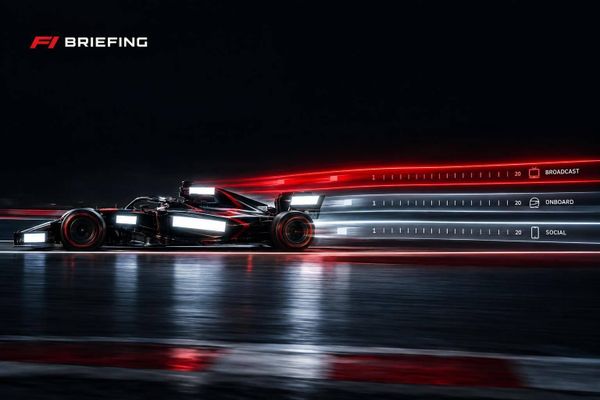
A dedicated pit-lane feed on beIN Sports 9 adds split-screen driver views, live standings, and track layouts for fans who want more detail than the main broadcast offers. So this isn't just a single broadcast stream. It's a deeper viewing product built for people who follow every lap, strategy call, and pit stop.
Doha also sits at the center of the setup. It serves as the regional production hub for live coverage and for original shows such as My Road to Red Bull.
How the deal affects F1 TV and direct live access
For viewers in the covered markets, beIN SPORTS linear channels and the TOD OTT platform are now the official live homes for Formula 1.
That has a clear effect on access. The deal limits Formula 1's own direct live offering in those territories. In plain terms, fans get fewer paths to watch live, while beIN gains tighter control over how the sport is packaged, distributed, and watched across the region.
Why a 10-year term is unusual in sports media
A 10-year rights term stands out because most sports media deals usually last 3 to 5 years. Shorter terms give rights holders more room to revisit pricing, audience trends, and market shifts. That's the usual playbook.
This agreement takes a different path. Formula 1 gets long-range revenue visibility, while beIN gets time to put money into Doha-based production and 4K infrastructure. That kind of investment makes more sense when the rights window is long enough to justify it.
Formula 1 pointed to that production setup as a core part of the agreement:
"In recent years, beIN has established itself as one of the leading sports broadcasters in the world... utilizing their extensive production capabilities in Doha, to continue to elevate F1's broadcast programming." - Ian Holmes, Director of Media Rights, Formula 1
Put it all together, and the deal looks different from a standard sports-rights contract. It's longer than the usual cycle, more locked-in, and more closely tied to a single regional broadcast system than the setup that came before.
What the deal changes for BeIN, Formula One, and viewers
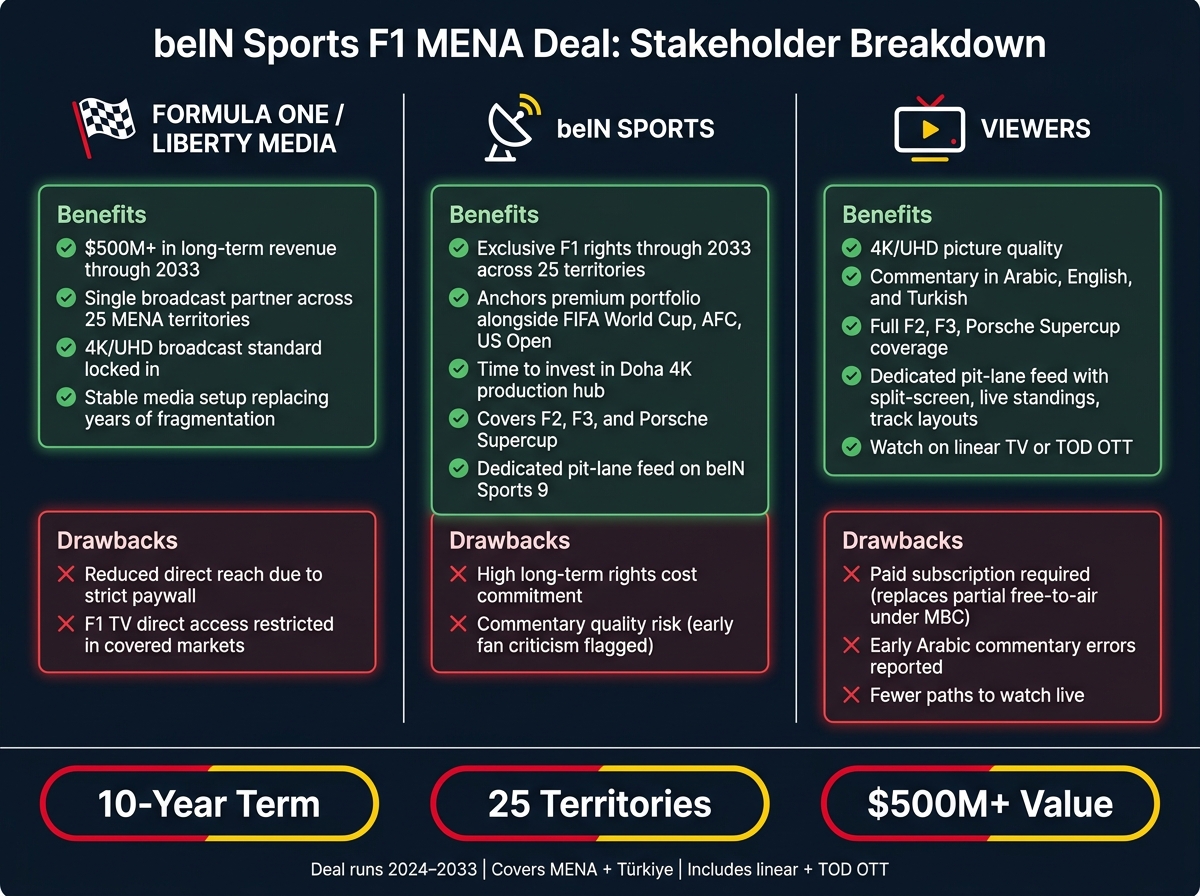
beIN Sports F1 MENA Deal: Who Wins, Who Pays?
What BeIN gains from locking in F1 through 2033
Formula 1 is one of beIN's main sports rights packages. And with more than 500,000 attendees across the four regional Grands Prix in 2023, it also helps pull in subscribers.
That makes this 10-year deal a big one for beIN. It gives the network a steady stream of premium motorsport through 2033, which matters when you're trying to keep subscribers from churning. A deal this long also changes the business math on both sides. BeIN gets time to spread out its rights costs, while Formula 1 gets a locked-in media partner across the region.
What Formula One and Liberty Media gain in MENA
For Liberty Media, a deal worth more than $500 million through 2033 means long-term revenue certainty in MENA. That kind of predictability is hard to ignore, especially in a market where Formula 1 wants a steady media setup instead of short-term resets every few years.
Formula 1 has also framed the agreement as a way to improve how the sport is shown across the region:
"With beIN, we have found a partner who elevates the broadcast experience and create best-in-class programming that delivers against our mission to showcase the drama and spectacle of Formula 1." - Stefano Domenicali, CEO, Formula 1
Consumer trade-offs: access, pricing, and market concentration
For viewers, the biggest change is simple: access now costs more. Races that were partly free-to-air under MBC are now behind beIN SPORTS and TOD subscriptions.
On paper, the product is strong. Fans get 4K/UHD coverage, commentary in Arabic, English, and Turkish, plus a dedicated pit lane feed on beIN Sports 9. There’s also full coverage of F2, F3, and Porsche Supercup, which matters for people who follow more than just the main Sunday race.
But there’s a catch. Early fan feedback has flagged issues with the Arabic commentary. Reports pointed to football correspondents being used for F1 coverage, along with mistakes in driver identification and technical terms. So while the picture quality is sharp, parts of the viewing experience still seem to need work.
| Stakeholder | Key Benefits | Potential Drawbacks |
|---|---|---|
| Formula One | Long-term revenue certainty; consistent 4K broadcast quality | Reduced reach due to strict paywall |
| beIN Sports | F1 anchors premium portfolio through 2033; exclusive localized content rights | High rights-cost commitment; commentary quality risk |
| Viewers | 4K/UHD; full F2, F3, and Porsche Supercup coverage; multi-language options | Paid access replaces partial free-to-air; early commentary concerns |
Conclusion: What this deal says about the future of sports rights in MENA
The beIN-F1 agreement is, at its core, a stabilizing deal. Formula One now has one broadcast partner through 2033, which gives MENA a steady rights setup and puts an end to years of fragmentation and regional consolidation.
For beIN, this isn’t just another rights pickup. It looks more like a long-range anchor for its portfolio in the region.
"beIN continues to be the leading sports broadcaster across MENA and Türkiye, with Formula 1 the centre-piece of our incredible portfolio."
That quote carries weight. More than 50% of new F1 fans in MENA began following the sport within the last four years. So locking in F1 now gives beIN a strong way to keep that growing audience inside its own platform while viewing habits are still forming.
beIN’s return also points to a steadier rights market after the 2019 piracy shock. And it hints at a model that may show up in other markets too: long-term exclusivity, a dedicated production hub in Doha, and distribution across both linear TV and OTT. Put together, that mix can help support the cost of the deal while also reducing piracy risk.
The trade-off is simple. The paywall gets tighter, and the quality of the broadcast will do a lot to shape how fans respond. Whether this turns into a long-lasting edge through 2033 will come down to execution.
FAQs
Will F1 TV still work in MENA and Türkiye?
No. F1 TV is not available in the Middle East, North Africa (MENA), and Türkiye because BeIN Sports holds the exclusive rights through the end of the 2033 season.
That means live and on-demand Formula 1 weekend coverage is available only through BeIN Sports and its streaming platform, TOD.
Which countries are included in the beIN deal?
The 10-year media rights deal between Formula One and beIN Sports covers 25 territories across the Middle East, North Africa (MENA), and Türkiye.
Under the agreement, beIN has exclusive rights to air every race weekend through the end of the 2033 season. That includes practice sessions, qualifying, and F1 Sprint events.
Why did F1 choose a 10-year rights deal?
Formula One signed a 10-year deal with BeIN Sports to build on record demand and a fast-growing fanbase across the Middle East, North Africa, and Turkey.
The long-term agreement gives F1 a strong broadcast partner with major production capabilities in Doha, supports programming tailored to the region, and helps deliver consistent, high-quality coverage across 25 territories through 2033.