Tire Choices for Changing Weather in F1
When to pick slicks, intermediates, or full wets—water clearance, crossover timing, and pit/race factors.
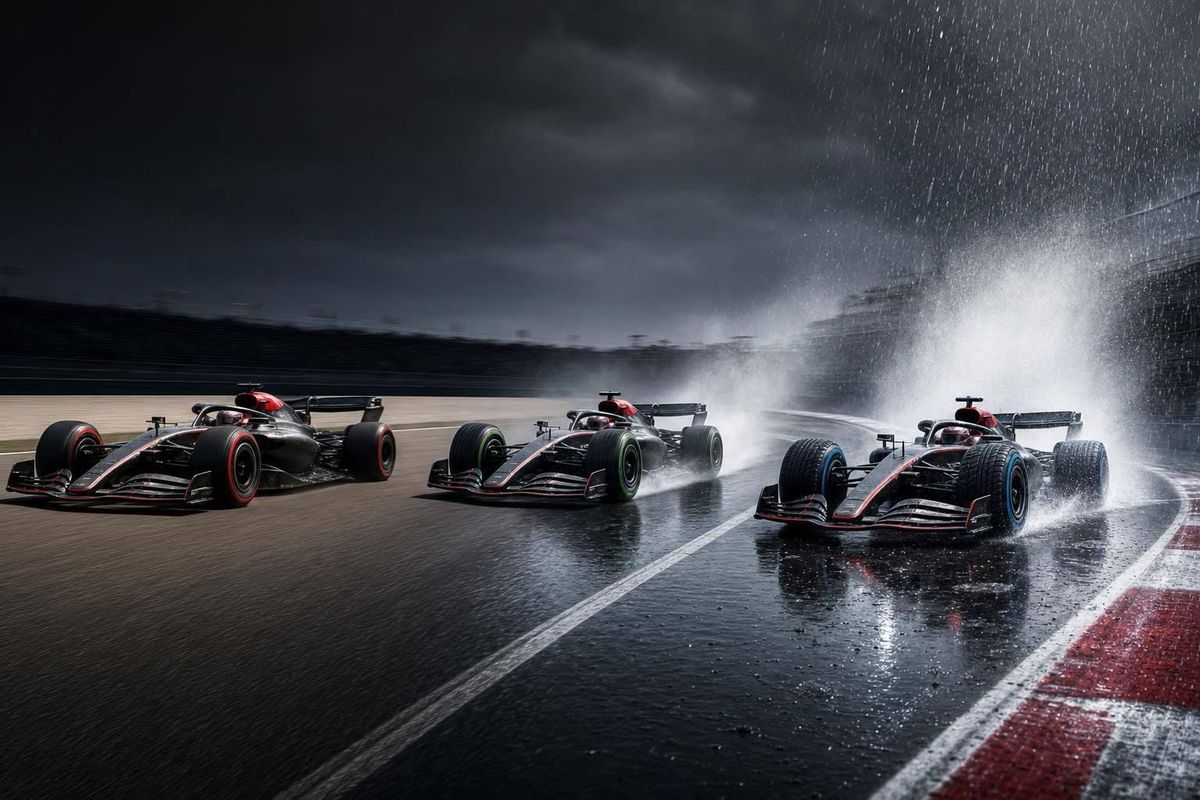
In F1, the best wet-weather tire call is usually the one that matches the next 5 minutes, not the track right now.
If I boil this down, the article says three things:
- Slicks work on dry pavement, but even light rain can make them risky because they clear 0 liters/second of water.
- Intermediates are the main tire for mixed weather. They clear about 30 liters/second and often become the best pick once rain starts or the track is only part dry.
- Full wets are for standing water and heavy rain. They clear about 85 liters/second, but they wear out fast once the track starts drying.
I also see that the call is not just about rain. Teams watch:
- Lap-time crossover
- Radar and track sensors
- Driver radio
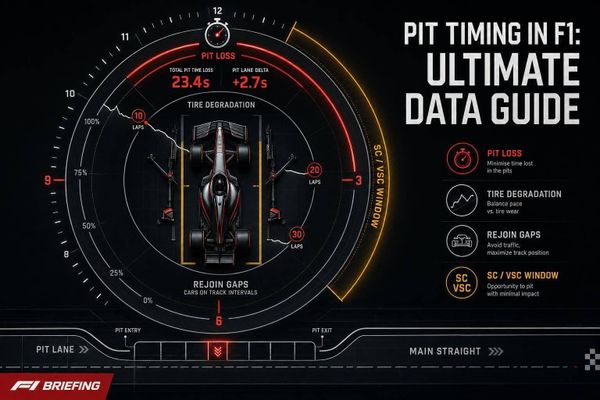
- Pit-loss time of about 20–25 seconds
- Safety Car, VSC, and red flags
- FIA tire rules and wet-tire allocation
One stat says a slick can be 8–12 seconds per lap faster than an intermediate once a dry line is there. But if too much of the lap is still wet, that same slick can become a bad bet in one corner.
A simple way to think about it:
- Stay on slicks if the track is mostly dry and rain looks brief
- Go to intermediates in damp, greasy, or light-rain conditions
- Use full wets only when spray, puddles, and aquaplaning take over
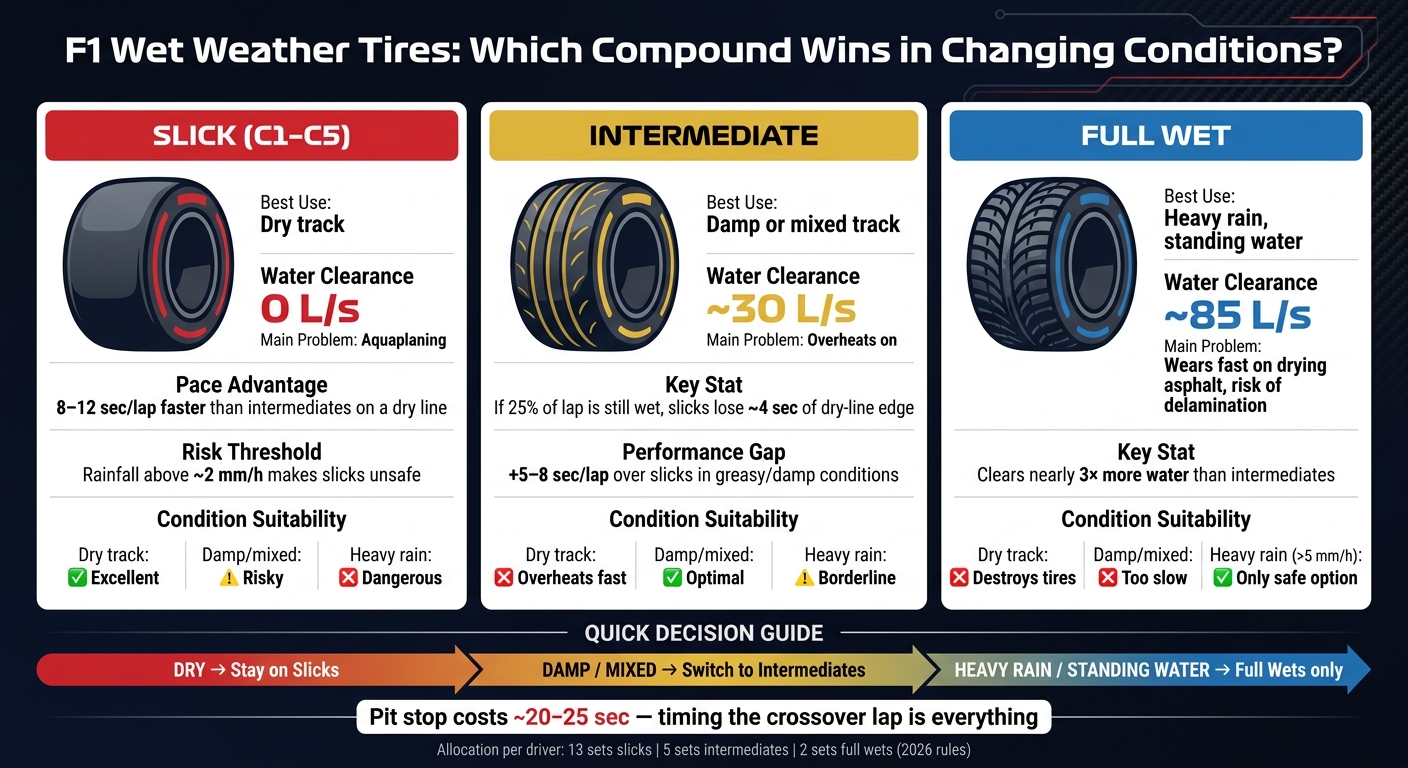
F1 Wet Weather Tires: Slick vs Intermediate vs Full Wet Compared
Why The Correct Wet Tyre Is Key For Victory At The Nurburgring | Tech Talk | 2020 Eifel Grand Prix
sbb-itb-7c68254
Quick Comparison
| Tire | Best use | Water clearance | Main problem |
|---|---|---|---|
| Slick | Dry track | 0 L/s | Aquaplaning |
| Intermediate | Damp or mixed track | ~30 L/s | Overheats on dry lines |
| Full Wet | Heavy rain, standing water | ~85 L/s | Wears fast on drying asphalt |
For me, the main takeaway is simple: weather tire calls are a timing game. Teams win or lose by reading changing grip, pit timing, and caution periods one lap before everyone else.
Slicks, Intermediates, and Full Wets: How Each Tire Works
How Slick Tires Behave on Cooling, Damp, and Drying Tracks
Slick tires (C1–C5) have no tread grooves, so they deliver the most grip on a dry track. That same design becomes a problem as soon as water shows up. With no way to clear water, even shallow standing water can turn into a major issue. Slicks are the first tire to fall apart, from a performance point of view, when weather shifts. Once rain starts, their edge is gone, and the risk of aquaplaning jumps fast.
They can hang on during a lightly damp phase if there’s no pooling water. But this is where things get sketchy. Driver confidence drops in a hurry, and lap times usually drop with it. Rainfall above about 2 mm/h is often the point where staying on slicks no longer makes sense.
| Condition | Slick Pros | Slick Cons | Key Risk | Typical Data Signals |
|---|---|---|---|---|
| Cooling Track | High peak grip | Harder to maintain temp | Glazing | Tire temperature falls |
| Damp (No Puddles) | Faster than inters | Low driver confidence | Sudden snap oversteer | Small traction losses in traction zones |
| Drying Track | 8–12s pace advantage | Lethal off-line | Aquaplaning on patches | Improving sector 2/3 times |
That’s the kind of behavior teams plug into wet-weather timing models when the track keeps changing lap by lap.
Intermediate Tires: The Main Option in Mixed Conditions
Intermediates are the go-to tire when conditions sit in that messy middle ground. Their four grooves can disperse around 30 liters of water per second, which lets them cope with damp or lightly wet surfaces while still holding decent speed on a drying line. The big thing here is timing. Intermediates give teams breathing room when the track is half-wet, half-dry, and they can punish anyone who waits too long to make the switch.
The downside is heat. On a drying track, the tread blocks move more than they should. Temperatures build fast, and the compound can start to grain or blister within only a few laps. If 25% of the lap is still wet, slicks lose about 4 seconds of their dry-line edge. That’s why this call is almost never simple.
| Track State | Preferred Tire | Performance Gap | Strategic Advantage | Pit Window Sensitivity |
|---|---|---|---|---|
| Greasy/Damp | Intermediate | +5–8s over slicks | Safety and consistency | High; early pit destroys tires |
| Light Rain | Intermediate | Fastest option | Prevents aquaplaning | Moderate; watch radar intensity |
| Drying Line | Intermediate (to Slick) | 8–12s slower than slick | Can stay out for track pos | Critical crossover point |
That crossover point is what teams try to nail with telemetry and radar. Miss it by a lap or two, and the whole race can swing.
Full Wets: When Heavy Rain and Standing Water Take Over
Full wet tires are built for the worst conditions on the calendar. Their tread clears far more water than intermediates, almost three times as much, which helps stop the car from aquaplaning through standing water at racing speed. They aren’t just for “regular rain.” They’re a short-use tool for a very narrow window: strong in torrential rain, but a problem the second conditions start to calm down.
On a track that’s only damp, full wets heat up too much and can delaminate within a few laps. They’re also slower than intermediates unless the rain is torrential. And in the real world, raw pace isn’t always the main issue. Visibility can become the bigger problem first. Heavy spray can cut visibility to almost zero, which is when a Safety Car or Red Flag starts to look more likely than a racing tire choice.
| Weather Intensity | Visibility | Aquaplaning Risk | Preferred Tire | Regulatory Factors |
|---|---|---|---|---|
| Heavy (>5 mm/h) | Near zero | Extreme | Full Wet | Safety Car / Red Flag likely |
| Standing Water | High spray | High | Full Wet | Mandatory use if race starts behind SC |
| Torrential | Zero | Critical | Full Wet | Race suspension (Red Flag) |
Those limits feed straight into the radar, track-surface, and lap-time models teams use when they’re deciding if a pit stop is worth the gamble.
The Data and Models Behind Tire Switch Decisions
Once teams understand what the tires are doing, the next step is turning that read into a pit call.
Telemetry, Weather Radar, and Track Sensors
Every tire call starts with live data. Teams monitor telemetry, weather radar, sector times, and track-temperature readings to judge whether the circuit is drying out or getting wetter. Driver feedback matters just as much. If a driver starts getting wheelspin in higher gears on the straights, that's a major sign that the track has moved beyond what slicks can deal with.
The pattern is pretty simple. When telemetry and driver feedback point in the same direction, teams box. When those two signals don't match, they usually hold position and keep watching. All of that information feeds into the crossover model.
How Teams Calculate Crossover Lap Times Between Compounds
Teams compare the time they're losing on the current tire against the time they'd gain by switching. They pit when that gain becomes bigger than the cost of the stop. Even then, crossover ranges are only guides, not hard rules.
| Baseline Dry Lap | Inter Crossover Time | Wet Crossover Time | Associated Track Conditions |
|---|---|---|---|
| 1:10.000 | ~1:18.000–1:22.000 | ~1:30.000+ | Damp surface, light spray, no standing water |
| 1:30.000 | ~1:40.000–1:45.000 | ~1:55.000+ | Heavy spray, visible puddles, high aquaplaning risk |
Teams also track wet-lap share, which is how much of the circuit still has standing water. That matters because slicks lose roughly 4 seconds when just 25% of the lap is wet. Once enough of the track is dry that the pace gained on the clean line beats the losses in the wet patches, the crossover point has arrived.
Pit Timing Under Short Showers, Sustained Rain, and Safety Cars
A short shower that radar says will clear in under five minutes is a completely different call from steady rain above 2 mm/h. In the first case, staying out can beat a pit loss of about 20 seconds. In the second, switching to intermediates can be worth 2–3 seconds per lap against drivers still trying to survive on slicks.
Sometimes the key factor isn't the rain. It's the neutralization. Safety Cars and Virtual Safety Cars (VSCs) can turn a costly stop into a cheap one, or close to free, so teams often use those moments to change compounds.
The 2024 São Paulo Grand Prix is a sharp example. Max Verstappen, Esteban Ocon, and Pierre Gasly stayed out on used intermediates during a VSC while rivals such as Lando Norris pitted. Then a red flag gave that trio a free tire change. Verstappen won from P17, and Alpine came away with a double podium.
| Forecast Scenario | Initial Tire Choice | Trigger Conditions | Outcome | Risk Level |
|---|---|---|---|---|
| Brief Shower | Stay on Slicks | Radar shows rain clearing in < 5 mins | Maintain track position | High |
| Sustained Rain | Intermediate | Rain intensity > 2 mm/h | 2–3s/lap faster | Low |
| Torrential/Standing Water | Full Wet | Driver reports floating or zero visibility | Prevents aquaplaning | Medium |
| Safety Car/VSC | New Set (Any) | Neutralization during weather shift | Low-cost tire change | Low |
Driver Adaptation and Race Execution in Mixed Conditions
Once the team chooses a compound, the next part is on the driver. A tire can be the right call on paper and still struggle if the driver doesn't adjust to it. In mixed conditions, race execution comes down to one thing: using the tire in the way it needs to be used.
How Driving Technique Changes Across the Three Tire Types
Wet driving asks for a different style. Drivers brake earlier, apply throttle more gently, and keep steering inputs smooth. Sharp inputs can trigger lockups, wheelspin, and sudden tire-temperature spikes. In these conditions, wheelspin can show up even in third gear on a straight, so drivers have to feed in power much more carefully than they would on slicks.
The racing line changes too, and that's often where the gap between compounds shows up most clearly. On intermediates, drivers will often step away from the dry line to find grip in damp patches and stop tire temperatures from climbing too far. On full wets, the focus changes. At that point, avoiding standing water at high speed becomes the main job, because that's where aquaplaning risk is at its worst.
What Teams Measure to Judge Wet-Weather Driver Performance
In the wet, teams look at far more than lap time. During the race, they track steering angle, throttle input, brake pressure, and tire temperature in real time. They also judge how fast a driver gets the tire into its operating window, how well tire wear stays under control, and whether lap times stay steady.
A driver who looks fast for one lap but overheats the tire or loses rhythm won't rate as highly as someone who builds pace and keeps the stint calm. That's the trade-off teams are watching.
How Driver Radio Can Change the Tire Call
When grip changes lap by lap, radio traffic becomes part of the strategy picture, not just a running commentary. Reports of wheelspin, lockup, spray, visibility, or standing water feed straight into the tire decision. On those borderline crossover laps, that input can be the last piece teams need to decide whether to pit or stay out.
That said, radio feedback doesn't override the rulebook. Those calls still have to fit FIA wet-weather rules and tire-allocation limits.
The last piece is compliance. Every tire call still has to work within wet-weather rules, pit-lane limits, and allocation constraints.
Rules, Tire Allocation, and Key Takeaways
Tire Allocation, Pit-Lane Limits, and FIA Wet-Weather Rules
Once teams know the crossover point, the next step is simple in theory and messy in practice: does the stop pay off?
That call is shaped by three things more than anything else: tire allocation, pit-loss time, and race neutralizations. In 2026, each driver gets 13 sets of slicks, five intermediates, and two full wets, so an early gamble can come back to bite later in the weekend. On top of that, the pit-lane speed limit is 80 km/h, and a stop still costs around 20 to 25 seconds.
There’s also an important rule twist here. If a driver uses intermediates or full wets, the normal dry-race rule that requires two slick compounds no longer applies. That changes the math right away. A team doesn’t have to plan around a second dry-compound stop if the race has already become a wet-weather event.
Then there’s the timing wildcard: Safety Car, VSC, or a red flag. Neutralizations can turn an expensive stop into a cheap one, or close to free, which is why teams often hang on for a lap or two when the weather is shifting. One well-timed caution can flip the order in a heartbeat.
These rules don’t just sit in the background. They change the price of every wet-weather decision.
| Regulation | Effect on Wet Tire Usage | Strategic Constraint |
|---|---|---|
| Fixed Allocation | Drivers get 5 sets of intermediates and 2 sets of full wets. | Risk of running out of fresh sets during a prolonged wet weekend. |
| Red Flag Rules | Allows a free tire change during a race stoppage. | Can erase the advantage of teams that stopped just before the flag. |
| Safety Car/VSC | Reduces the time lost during a pit stop. | Bunches the field and shrinks track-position gaps. |
| Wet Tire Rule | Waives the two-compound dry requirement. | Removes the need for a second stop on a drying track. |
| Pit Lane Speed Limit | Fixed time penalty on every stop, usually about 20 to 25 seconds. | Discourages speculative tire changes. |
Conclusion: The Fastest Tire Is the One That Matches the Next 5 Minutes
With the rules in place, the last piece is timing.
In most mixed-condition races, intermediates are the main crossover tire. Slicks become the better pick once a dry line starts to hold. Full wets are there for the worst cases, when standing water makes anything else a bad idea.
The teams that get these races right usually aren’t reacting to the lap they’re on. They’re thinking a few laps ahead. The 2021 Russian Grand Prix showed that in brutal fashion: Lando Norris stayed on slicks as rain got heavier, dropped to 7th, and Lewis Hamilton stopped for intermediates at the right moment and won.
That’s the heart of wet-weather strategy. It’s not just about which tire is fastest now. It’s about what will be fastest over the next five minutes, while working within allocation limits, pit-lane time loss, and the chance that a Safety Car or red flag changes everything.
FAQs
How do teams spot the crossover lap?
Teams spot the crossover lap by pulling together real-time telemetry, weather data, and driver feedback.
They track how fast the circuit is drying, compare that pattern with live and past data, and then weigh the tire delta. That means looking at the time a driver can gain by moving to a new compound against the time they give up by making a pit stop.
Driver feedback helps seal the call. Reports about grip levels - like wheelspin on the straights - can tell the team that the track is ready for a tire change.
Why are intermediates usually the safest call?
Intermediates are usually the safest and most practical choice because they sit in the wet-weather "Goldilocks zone." They strike a balance between grip and water clearance in damp conditions or light rain, where full wets can overheat and wear out fast.
Most wet-weather racing happens on intermediates because they deal well with changing track conditions and are faster than full wets in those situations. Full wets are mostly kept for heavy rain, although spray and poor visibility often limit how much they can be used.
When do full wets become slower than inters?
Full wets are slower than intermediates once the track moves from torrential rain and standing water to damp conditions or light rain.
The reason is pretty simple: full wets are built for LOTS of water. Their softer compound and deeper grooves heat up fast on a drying track. When that happens, grip drops off, and the tire becomes a clear step behind the intermediate.
That’s why teams usually make the switch as soon as standing water starts to disappear or the forecast shows the heavy rain backing off.