How Halo Changed F1 Cockpit Design
How the Halo reshaped F1 cockpits: new load paths, tighter exits, split sightlines and aero fixes.
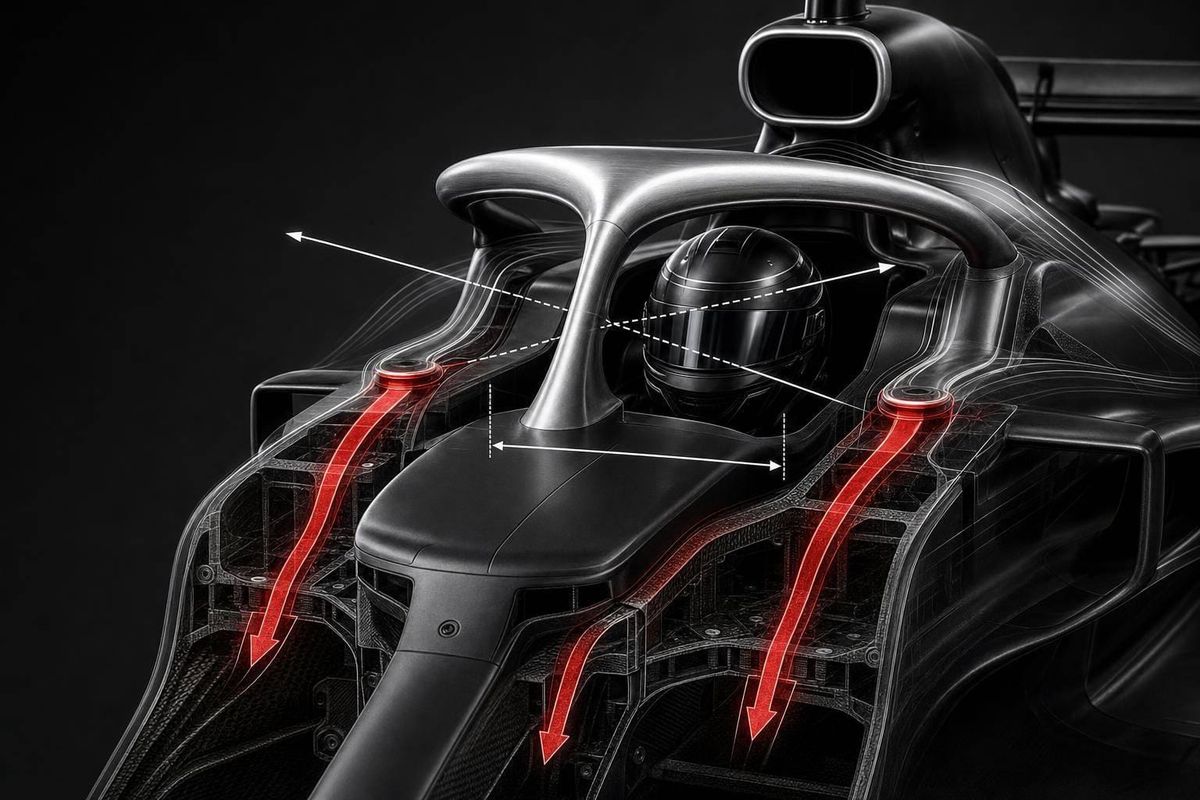
The Halo did far more than add head protection. It forced F1 teams to rebuild the cockpit around new crash loads, tighter driver-exit rules, changed airflow, and a split forward view.
If you want the short answer, here it is: the Halo changed the monocoque, cockpit opening, seating area, sightlines, and aero package all at once. Teams had to support loads up to 116 kN vertically, reinforce three mounting points, work around a center pillar, and fit the driver into a tighter space. The FIA also found the Halo would have helped in 15 of 17 serious crashes studied.
Here’s the core of it:
- Safety drove the change: open cockpits left the driver’s head exposed to debris and heavy impacts.
- The chassis had to change: teams added carbon-fiber reinforcement around the Halo mounts.
- The cockpit got tighter: headrest shape, padding, and exit paths had to be reworked.
- Visibility changed: the center post split the driver’s forward view.
- Airflow got messier: teams used small fairings and vane-like add-ons to control drag and wake.
- The proof came later: crashes in Bahrain 2020 and Monza 2021 showed why the redesign mattered.
| Area | What changed |
|---|---|
| Structure | Stronger monocoque around 3 Halo mounts |
| Driver exit | FIA extraction time moved from 4 to 5 seconds |
| Visibility | Center pillar affected sightlines |
| Aero | Wake disturbed flow to the airbox and rear wing |
| Cockpit fit | Headrest, padding, and opening shape were revised |
My take: the Halo is best understood not as one part, but as a rule that reshaped the whole cockpit package.
How FIA rules changed the cockpit package
Why the FIA chose the Halo
Before the FIA made the Halo mandatory in 2018, it tried a few other cockpit-protection ideas. Those included Red Bull's Aeroscreen, a jet-fighter-style canopy tested in 2016, and the Shield, a curved windscreen Sebastian Vettel tested at the 2017 British Grand Prix. In the end, the Halo got the nod because it gave the best mix of structural strength, debris deflection, and driver extraction.
As the FIA said, "The Halo was found to successfully deflect large objects away from the cockpit environment and also demonstrated an increased overall protection against small debris."
Once that decision was locked in, teams had to shape the whole cockpit package around the Halo's mounting points and clearance rules.
Load targets, mountings, and cockpit clearances
With the Halo now required, teams had to design the survival cell around a three-point mounting layout: one central front post and two rear attachments. The device also had to meet strict load targets:
| Test Direction | Halo Load Target |
|---|---|
| Vertical (downward) | 116 kN |
| Lateral (inward) | 93 kN |
| Longitudinal (rearward) | 46 kN (top) / 83 kN (side) |
Those figures meant teams had to reinforce the survival cell around all three mounting points. The Halo itself uses mandatory titanium, and teams are allowed to add a non-structural 20 mm aerodynamic fairing outside the helmet template. To deal with the extra mass and the extra reinforcement, the FIA added 6 kg to the minimum car weight for 2018.
That fixed mounting layout didn't just affect crash structure. It also changed how drivers got in and out of the car, and how they looked out from the cockpit.
Updated extraction and visibility rules
The Halo changed the driver-exit rules too. Since the central strut sits in the way of the exit path, the required driver extraction time went from 4 seconds to 5 seconds. If the Halo is badly damaged, marshals can cut the front post in about 2 seconds and each rear support in about 5 seconds.
It also split the driver's forward view, which pushed teams to rework cockpit rim geometry and mirror placement.
sbb-itb-7c68254
How teams redesigned the monocoque and cockpit opening
Stronger cockpit shoulders and new load paths
Once the FIA locked in the Halo's mounting points and load targets, teams had to rework the upper monocoque around them. The three-point layout - one front center post and two rear mounts - changed how forces moved through the structure around the cockpit opening.
That meant engineers had to build new load paths into the upper monocoque, beef up the attachment areas with extra carbon fiber layups, and test those interfaces under angled and vertical loads using prototype Halo mounts and dedicated rigs. In plain terms, the Halo wasn't something teams could just bolt on. The chassis around it had to do more work.
That extra structure also added weight, so teams had to claw back that mass in other parts of the car.
Cockpit opening, seating, and driver fit
The Halo also changed the shape of the cockpit opening itself. Teams had to fit the cockpit surround under the Halo arc, keep the removable headrest easy to access, and still make sure the driver could get out fast enough.
That sounds simple on paper. It wasn't. The tighter space above the driver's head forced teams to redo the headrest and padding layout so both still worked inside the reduced clearance.
Case studies: Mercedes W09, Red Bull RB14, and Ferrari test mules
Those limits pushed teams in different directions.
Mercedes put strength first. The team focused on making the survival cell strong enough to meet the Halo's load targets, then dealt with the aerodynamic wake flowing over the engine intake.
Red Bull looked at the rear mounts as a packaging chance. The team routed them through existing cooling flow paths to cut structural bulk and help control airflow into the engine airbox.
Ferrari used modified chassis as early test mules to study the center strut's effect on driver sightlines. The team found that it forced drivers to refocus on the central strut at speed.
So while every team faced the same rule, they didn't attack it the same way. Some chased strength first, some worked airflow, and some zeroed in on what the driver could actually see.
F1 Explained: The Halo
Aerodynamics, visibility, and on-track effects
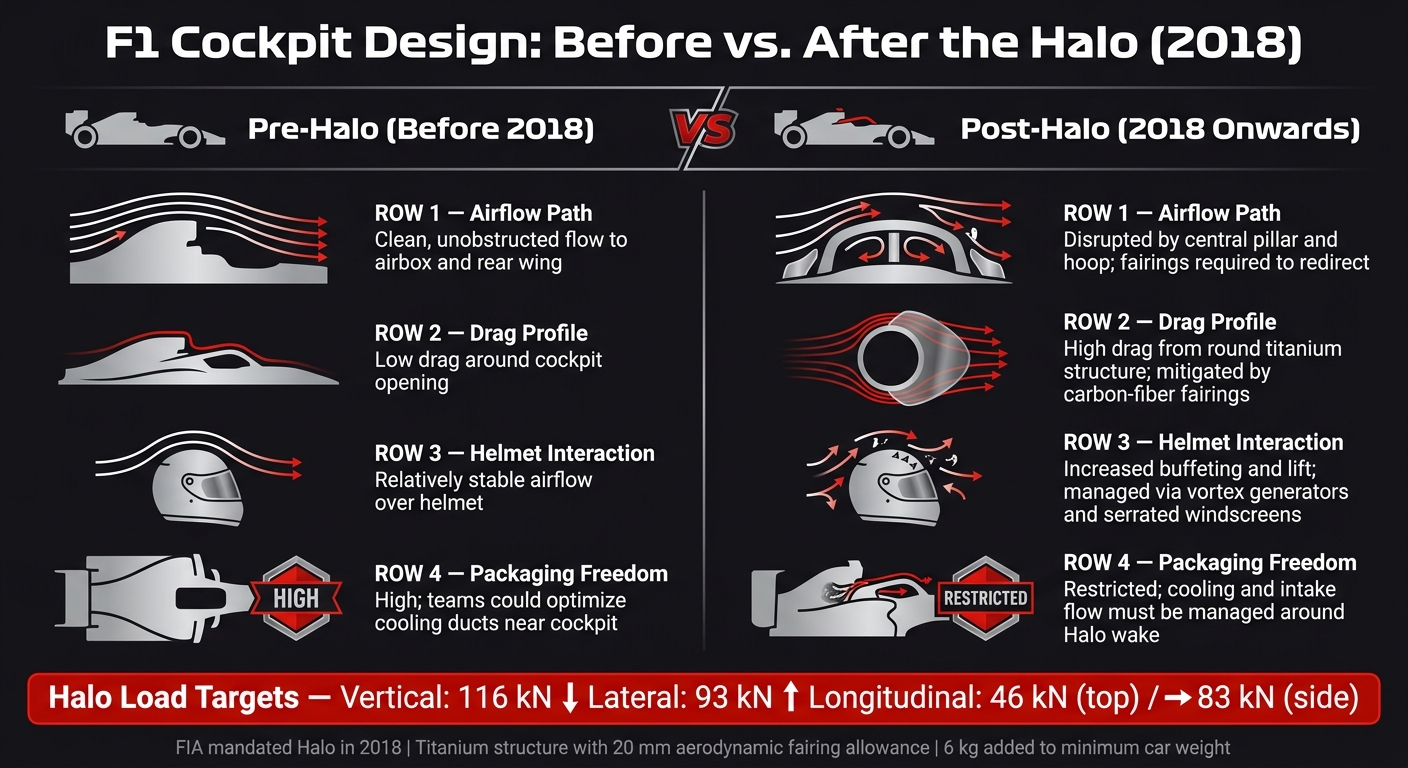
F1 Cockpit Design: Before vs. After the Halo (2018)
How the Halo disrupted airflow over the cockpit
Once teams reinforced the monocoque, the next job was dealing with airflow and visibility around this new piece of structure.
The Halo's round titanium frame wasn't kind to airflow. It created a wake that upset the air heading to the airbox and rear wing. To help teams deal with that, the FIA allowed an aerodynamic fairing within a 20 mm envelope around the titanium structure, as long as it remained outside the helmet template.
That small fairing area became the key way teams clawed back some of the airflow they had lost.
And teams didn't all take the same route. Some used McLaren-style boomerang winglets. Others went with Haas vortex generators or Renault air-guiding vanes. Same rule, different ideas.
Cockpit airflow before and after 2018
Before 2018, airflow over the cockpit opening was clean and mostly uninterrupted. That gave teams more room to work with around the airbox and cockpit rim. After 2018, they had to manage that same zone with much more care.
| Feature | Pre-Halo (Before 2018) | Post-Halo (2018 Onwards) |
|---|---|---|
| Airflow Path | Clean, unobstructed flow to the airbox and rear wing | Disrupted by the central pillar and hoop; requires fairings to redirect |
| Drag Profile | Low drag around the cockpit opening | High drag from the round titanium structure; mitigated by carbon-fiber fairings |
| Helmet Interaction | Airflow over the helmet was relatively stable | Increased buffeting and lift; managed via vortex generators and serrated windscreens |
| Packaging Freedom | High; teams could optimize cooling ducts near the cockpit | Restricted; cooling and intake flow must be managed around Halo wake |
Visibility, ergonomics, and driver adaptation
Those aero fixes only mattered if drivers could still see properly and get out of the car without trouble.
At first, the central pillar made the cockpit feel tighter for some drivers. Sightlines got better after the final changes to pillar width, but the central strut still took some getting used to. The FIA cut the pillar width from 20 mm in early prototypes to 16 mm in the final 2018 design to help visibility.
"Feedback from extensive track testing revealed that visibility was substantially unaffected, and there was no significant visual obstruction due to the central strut." - FIA
Not every driver saw it that way. Jenson Button said the fixed center pillar could become a distraction at high speed:
"At 200 mph, instead of focusing on the next corner, you're focusing on something dead ahead of your eyes – which can make you a little cross-eyed." - Jenson Button, F1 Driver
What the Halo changed long term
Crash evidence that validated the redesign
Those design changes got their proof the first time the Halo faced major impacts on track.
The 2020 Bahrain crash and the Hamilton-Verstappen collision at Monza in 2021 showed the Halo doing exactly what it was built to do: keeping head space intact under extreme force.
"Thank god for the halo. That ultimately saved me. And saved my neck." - Lewis Hamilton, Driver, Mercedes-AMG PETRONAS F1 Team
"I wasn't for the halo some years ago, but I think it's the greatest thing that we brought to Formula 1 and without it I wouldn't be able to speak to you today." - Romain Grosjean, Driver, Haas F1 Team
How the Halo shaped future single-seater cockpit design
Once that happened in plain sight, the Halo stopped looking like an F1-only patch and started to look like the new baseline for single-seater cockpit design.
Its impact went past Formula 1. The same head-protection approach spread to FIA junior single-seaters, where it became standard across those series. Teams also now build the monocoque around the Halo from day one, instead of treating it like an add-on.
The 2026 F1 regulations make that point even clearer: the Halo stays a permanent, non-negotiable part of Formula 1's safety setup.
Conclusion: The Halo reshaped the cockpit, not just the safety rulebook
The big lesson was simple: cockpit safety now starts at the chassis design stage.
The Halo did more than add one more safety part. It changed how Formula 1 cockpits are designed, built, and packaged.
FAQs
Why did the FIA choose the Halo over other cockpit protection ideas?
The FIA picked the Halo after a long round of testing against other ideas, including Red Bull’s jet-fighter-style canopy. In those tests, the Halo did the best job of pushing away large objects and cutting down the chance of cockpit intrusion.
FIA trials included firing tires at the cockpit, and the results showed strong protection in car-to-car, car-to-environment, and debris incidents. Track tests also showed that it didn’t meaningfully block driver visibility or get in the way during emergency extrication.
How did the Halo change how F1 teams build the monocoque?
The Halo changed monocoque design in a big way. Teams had to make the chassis stronger, most of all around the cockpit surround where the titanium frame bolts on.
That wasn’t the only challenge. The Halo also disturbed airflow, which could hurt the engine intake and rear wing. To deal with that, teams added allowed fairings to smooth the air as much as possible while still meeting the Halo’s extreme load demands.
Did the Halo hurt visibility and aerodynamics more than expected?
Yes, but not as much as many feared. FIA track testing showed that drivers’ visibility wasn’t substantially affected, because the eye naturally adjusts to the central strut.
From an aero point of view, the Halo was a tough problem. The standard titanium tube wasn’t efficient, so teams worked to cut the penalty with custom fairings. That turned a structural compromise into a new area for performance gains.