F1 Freight Logistics: Q&A with Experts
Logistics now drives F1 performance: teams limit air freight, rotate sea-freight sets, and use road/rail to cut costs and emissions.
In Formula One, freight is now a car-performance budget issue, not just a shipping task. I’d sum up the article like this: teams keep costs down by sending only race-critical parts by air, rotating five to six sea-freight sets for heavy gear, and using road or rail when the schedule allows. That matters because one freight choice can swing a lot of money over a season.
If you want the short version, here it is:
- Air freight is for cars, engines, electronics, tires, and late updates
- Sea freight is for garage structures, hospitality gear, and other heavy items
- Road transport handles much of the European season, with 350 to 400 trucks
- Formula One moves about 800 tons by air per flyaway event
- DHL handles about 1,323 tons per Grand Prix
- Shifting one 1,000 kg item from air to sea can save about $250,000 to $320,000 across a season
- Air-freight pressure got worse in 2026 when capacity dropped 18% in one week during Middle East disruption
- Teams now plan months ahead, build buffer time into shipments, and treat freight spend like part of the race budget
What stood out to me is how simple the core playbook is: fly what you must, ship the rest early, and avoid last-minute changes. When that plan breaks, teams can end up paying for emergency aircraft, extra customs work, and rushed transfers that eat into money that could have gone to the car.
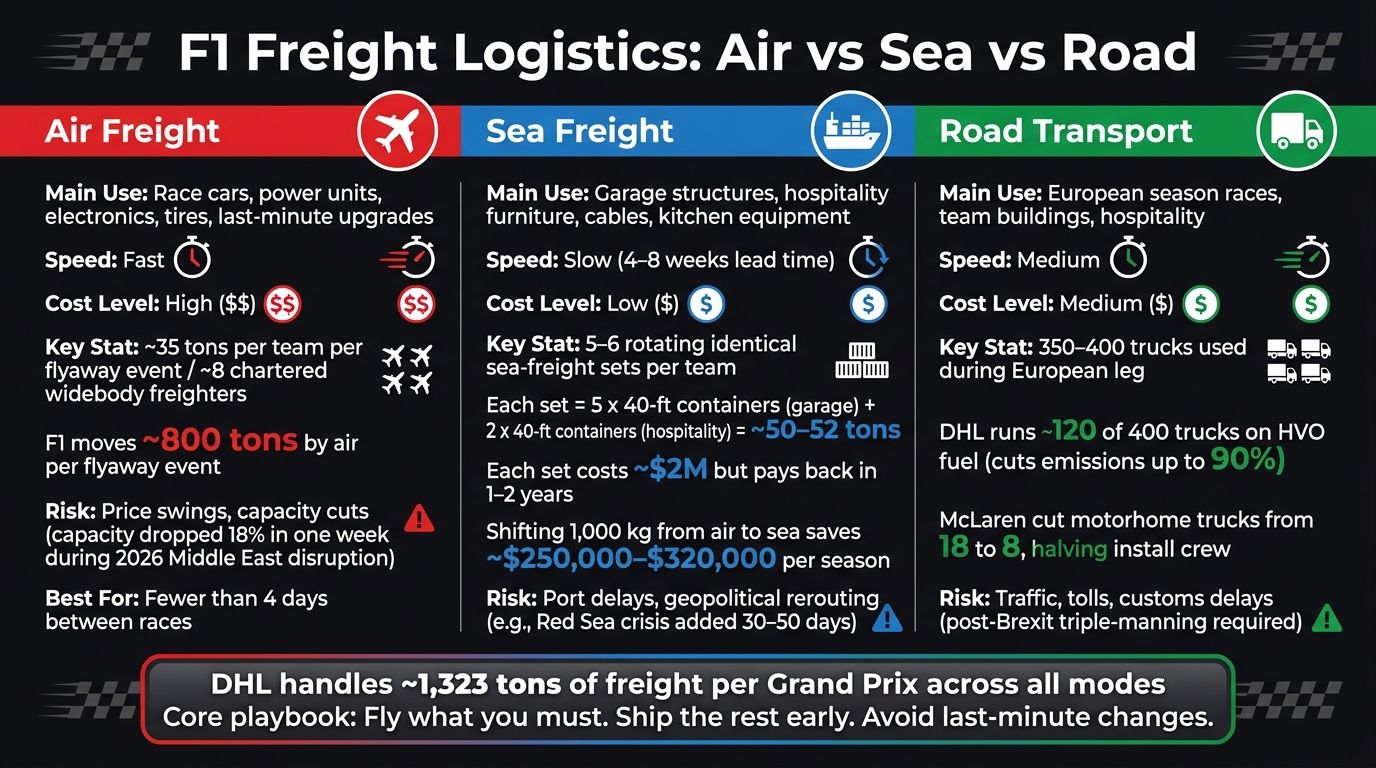
F1 Freight Modes Compared: Air vs Sea vs Road
F1 LOGISTICS: The INSANE operation behind Every F1 Race
sbb-itb-7c68254
Quick comparison
| Freight mode | Main use | Time | Cost level | Main risk |
|---|---|---|---|---|
| Air | Race-critical parts and late upgrades | Fast | High | Price swings, capacity cuts |
| Sea | Heavy, non-critical equipment | 4 to 8 weeks or more | Low | Port delays, rerouting |
| Road | European races, team buildings, hospitality | Medium | Medium | Traffic, tolls, customs delays |
So if you’re trying to understand F1 freight in plain English, this is the answer: the teams that plan early and limit air freight protect both race readiness and budget room.
Who Controls Freight Decisions and How Budgets Are Set
How Teams Split Freight Decisions Across Departments
Freight decisions don't sit with one group. They’re split across logistics, race operations, engineering, and finance, and each team has a clear lane.
The Head of Race Team Logistics handles route planning and sea-freight rotation. Race Operations works with F1 and the FIA on timing windows and manages venue-specific limits, with Monaco's restricted build order being a well-known example. Engineering decides what has to fly and what can travel by sea. Finance and procurement make sure those choices stay inside FIA budget limits.
When a part suddenly becomes urgent, teams may skip normal freight channels to avoid delays. That’s where logistics stops being just a shipping task and starts looking like a cost-cap call.
Post-Brexit customs rules have made European races harder to manage. As Karl Fanson, Head of Race Team Logistics at Mercedes, explained:
"Because of the customs process we go through now, we have to triple man the trucks to guarantee that we're going to get back."
That kind of strain affects how much teams can move by air and how hard they lean on sea freight instead.
Teams also rely on contracted logistics partners, mainly DHL and RPM, for door-to-door movement, customs clearance, and port-to-circuit trucking.
How Teams Track Freight Spend Under the Cost Cap
Planning begins far in advance. Aston Martin's logistics team, led by Franco Massaro, started mapping its 2025 season in July 2024, meeting with logistics partner RPM to plan six equipment sets.
Teams track each shipment by transport mode and by how necessary it is. Sea freight is monitored through vessel numbers and online shipping trackers. DHL also uses tracking devices and shock sensors to watch container movement and handling.
Air freight can swing fast in price. In early 2026, rates tied to oil prices above $100 per barrel pushed some teams to cut the number of components sent to upcoming races. Smaller teams feel that pressure more, because freight takes up a bigger slice of their budget.
That tracking shapes the next call: what stays in the air, what goes by sea, and what can move by road.
How Teams Cut Freight Costs Across Air, Sea, and Road
Every freight call has a direct effect on what money is still available for car performance.
Air Freight: When Speed Justifies the Cost
The first cost call is pretty simple: what has to fly, and what can wait?
For flyaways with fewer than four days between races, air freight is usually the only option that works. Race cars, power units, electronics, and last-minute technical updates go by air because the cost of not having them at the circuit is far higher than the shipping bill.
Each team moves about 35 tons of priority freight by air for flyaways on roughly eight chartered widebody freighters. The main way teams cut spend here is by keeping air manifests limited to race-critical items. Regular audits help them spot parts that can move by sea instead, which cuts duplicate shipments without hurting race readiness.
Sea Freight: Rotating Heavy Equipment Ahead of the Calendar
On the European leg, that same thinking shifts from urgent air loads to container planning.
Sea freight handles bulky gear that doesn’t need to arrive fast: garage wall panels, hospitality furniture, cables, and kitchen equipment. The catch is lead time. Shipments can take four to eight weeks, and geopolitical disruptions can stretch that even more.
Teams deal with this by using a leapfrog system of five to six identical sea-freight sets, with each one packed in the same layout to reduce setup time and mistakes. A typical set includes:
- Five 40-foot containers for garage equipment
- Two 40-foot containers for hospitality
- About 50 to 52 tons per set
Each set costs around $2 million, but the payback period is usually one to two years because sea freight is far cheaper than air freight. When all six sets use the same layout, crews unpack the same way at every venue. That saves time and lowers the odds of something being built wrong or left in the wrong place.
Road Transport: How Teams Move Efficiently During the European Leg
Teams also cut road costs by using fewer trucks and making builds simpler. McLaren redesigned its "Brand Centre" motorhome so it needs just 8 trucks instead of 18, which cut the installation crew in half and made triple-headers easier to handle. Over a full European calendar, that kind of efficiency adds up fast.
Road costs are shaped by route planning, tolls, and driver shifts. On tight back-to-back European rounds, tandem-driver setups let trucks keep moving around the clock. Sometimes that’s the difference between arriving calm and prepared, or showing up and scrambling at load-in.
Risk, Disruption, and Greener Choices in F1 Logistics
Freight savings can vanish fast when a delay forces a last-minute change.
Delays, Customs Problems, and the Cost of Contingency Moves
A missed port slot, a customs hold, or a storm can set off an expensive recovery plan.
One case shows this clearly. A vessel was delayed outside port and missed its Singapore transfer. DHL then unloaded the containers at a local depot and used three emergency aircraft to fly the equipment to Melbourne and Sydney in time for the Australian Grand Prix. That kind of last-minute switch from sea to air is expensive. Fast, yes. Cheap? Not even close.
"Shipping lines aren't like airlines: you have to build in extra time to make sure your sea freight arrives on schedule because they can suddenly change plans." - Franco Massaro, Race and Trackside Logistics, Aston Martin F1 Team
The Red Sea crisis made the risk plain. Geopolitical conflict forced shipping lines to reroute around the Cape of Good Hope, adding 30 to 50 days to affected routes. To keep freight moving on time, DHL and MSC built an overland transfer route: containers were unloaded in Bahrain, trucked across Saudi Arabia to Jeddah, and then loaded back onto vessels bound for Europe. That added more handling, more cost, and more moving parts. But it kept the race calendar on track.
Those route decisions don’t just affect timing. They also shape emissions and spending.
Where Lower-Emission Freight Choices Also Save Money
In many cases, the lower-emission option also costs less. The clearest case is moving heavy, non-critical equipment by sea instead of air. A 1,000 kg timing stand shipped by sea instead of air saves a team nearly $250,000 over a single season. Spread that idea across a full load of non-critical gear, and the savings add up fast.
Regionalization works the same way. When a sea freight set stays inside North America to cover Miami, Canada, Austin, and Las Vegas instead of going back to the UK between races, the team cuts shipping distance and lowers its exposure to intercontinental freight disruptions.
On the road side, DHL runs about 120 of its 400 European-leg trucks on Hydrotreated Vegetable Oil (HVO), which cuts carbon emissions by up to 90% compared with standard diesel. In air freight, Sustainable Aviation Fuel (SAF) is also being added as part of F1 and DHL's goal of being carbon neutral by 2030.
This is why calendar planning matters so much. It isn’t just an ops job. It can change the cost of the whole season.
Route Modeling and Calendar Planning as the Next Cost Lever
Once the route is locked in, the next place to save money is in how early teams model it.
In May 2026, DHL Global Forwarding moved 50 containers - 46 forty-foot high-cube units and 4 twenty-foot units - by intermodal rail from Miami to Montreal after the Miami Grand Prix. This replaced the road transport that usually handles 70% of that freight leg, while still meeting F1's strict timeline and cutting emissions. DHL plans a broader rollout of this model by 2027.
The biggest savings tend to go to teams that model disruption months in advance. They build buffer time into sea freight schedules and treat route planning as a direct input into performance, not just something handled in the back office.
Conclusion: What Experts Agree On About Freight Cost Control
The Main Lessons to Take Away
The main point from the expert interviews is simple: freight isn't a back-office task anymore. Under the cost cap, logistics now sits in the same budget discussion as car development. So when a team saves money on shipping, that money can go back into performance.
That hits smaller teams the hardest:
"The freight costs are no different for us than they are for a bigger team. They represent a larger part of our budget. So we have to be careful, definitely. And we have to be smart with what we do." - Hoagy Nidd, Head of Car Engineering, Haas F1 Team
That quote gets to the heart of it. Freight control now matters just as much as engineering efficiency. And across teams, the playbook looks pretty similar. The teams that manage freight well tend to use the same setup: multi-mode regional planning and rotating sea-freight sets. In plain English, they save air freight for urgent, race-critical parts, send heavy non-critical equipment by sea, and use road or rail when the schedule gives them room. They also leave buffer time in the plan, so one delay doesn't force an expensive last-minute air shipment.
The upside is easy to measure. Moving a 1,000 kg timing stand by sea instead of air saves nearly $250,000 over a season. That's not just a shipping win. It's money that can go straight back into the development budget. At the same time, teams still protect race-weekend readiness.
That kind of planning mattered even more in 2026, when Middle East disruption cut global air-freight capacity by 18% in a single week. And this isn't only about handling a crisis. It's shaping future planning too. The Miami-to-Montreal intermodal rail trial shows that early route modeling can cut costs and emissions at the same time, with broader North American use expected by 2027.
FAQs
Why is freight now a performance issue in F1?
Freight has become a direct performance issue in Formula 1 because logistics costs now sit inside the FIA’s $140 million budget cap.
That changes the math in a big way. If a team spends more on rushed shipping, last-minute fixes, or delay recovery, that’s money it can’t spend elsewhere. And in F1, those trade-offs hit hard: fewer upgrades, less engine development, and less room to pay for top talent.
The pressure gets worse when you look at the schedule. With a 24-race calendar and frequent back-to-back events, teams have to protect on-track performance while taking on these large, unavoidable costs.
How do teams decide what flies and what ships by sea?
Teams pick between air and sea freight based on three things: speed, cost, and what the item means for race weekend.
Mission-critical gear - like race cars, engines, and specialized technical equipment - goes by air. It’s fast, but it comes at a steep price: often more than $1,000,000 per race.
Larger, less time-sensitive items - such as hospitality structures, catering equipment, and standard garage components - travel by sea instead. That option costs about $200,000 per shipment. To deal with the longer transit time, teams use multiple identical container sets, so one set can be in use while others are already moving to the next events.
What happens when a shipment is delayed before a race?
When a shipment gets held up before a race, F1 teams and their logistics partners have to move fast to keep the paddock schedule on track. A delay tied to technical problems, bad weather, or geopolitical disruption can trigger expensive last-minute shipping changes just to get mission-critical equipment to the circuit on time.
F1 runs on a tight calendar, and that pressure gets even stronger during back-to-back race weekends. In those moments, logistics providers lean on contingency plans such as road bridges or cargo rerouting to limit the damage.