MGU-K Evolution: 2014 to 2026
MGU-K transformed from a minor hybrid boost into the primary power source reshaping braking, overtaking, and car design.
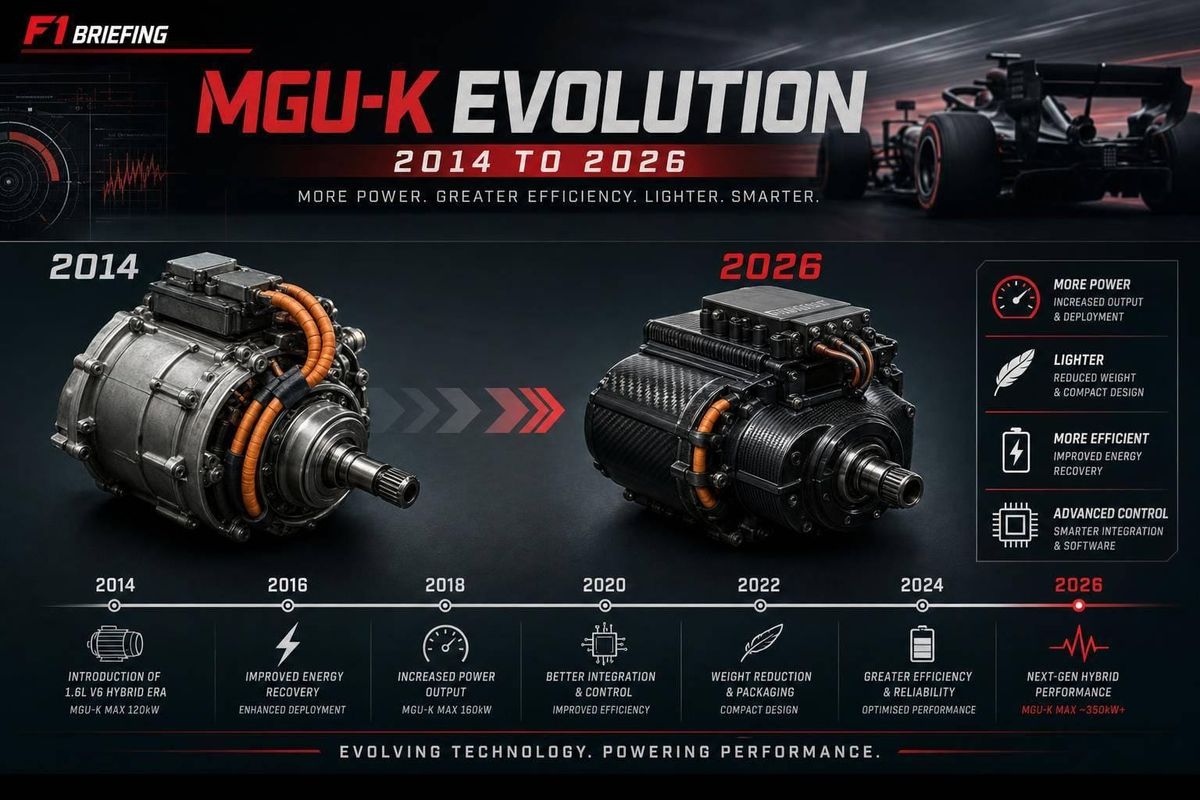
The short version: the MGU-K goes from a small hybrid boost in 2014 to a main power source in 2026. Output jumps from 120 kW (161 hp) to 350 kW (469 hp), energy recovery grows from about 2 MJ per lap to 8.5-9 MJ per lap, and the MGU-H is removed.
If you want the main takeaway fast, here it is:
- In 2014, teams mostly fought reliability, brake feel, and energy limits
- From 2015 to 2025, the hardware cap stayed the same, so gains came from software, cooling, packaging, and deployment control
- In 2026, the MGU-K becomes one of the car’s two main power sources, with the car aiming for about a 50/50 split between ICE power and battery power
- That shift changes braking, overtaking, battery use, and car layout
- It also means teams must recover, store, and deploy energy much more often during a lap
For you as a reader, the big point is simple: this is not just a power increase. It changes how an F1 car slows down, accelerates, and uses energy over a race distance.
Quick comparison
| Area | 2014 rules | 2026 rules |
|---|---|---|
| MGU-K output | 120 kW | 350 kW |
| Horsepower | 161 hp | 469 hp |
| Energy recovery per lap | 2 MJ | 8.5-9 MJ |
| MGU-H | Present | Removed |
| Electrical share of total power | About 20% | About 50% |
| Battery use | Shorter boost role | Repeated charge/discharge through the lap |
| Braking effect | Regen mattered, but less | Regen plays a much larger part |
| Overtaking | Deployment support role | Deployment becomes a main attack tool |
So if I had to sum up the whole story in one line, I’d say this: from 2014 to 2025, teams learned how to refine the MGU-K; in 2026, they have to build much more of the car around it.
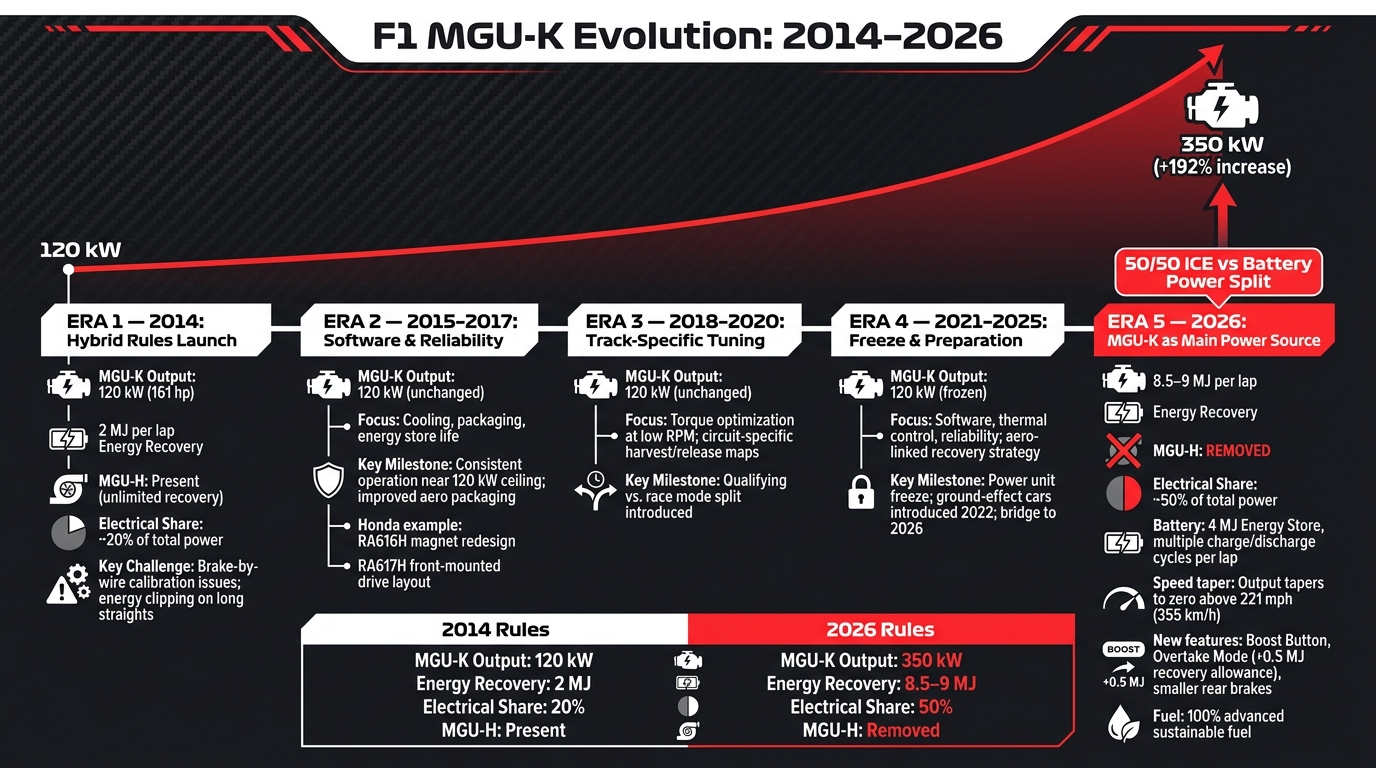
F1 MGU-K Evolution: 2014 to 2026 - Power, Recovery & Strategy
2014 to 2020: Launch, Learning Curve, and Early Optimization
2014: Hybrid Rules Arrive With Strict Limits and Early Problems
The 2014 rules put the MGU-K under tight control: 120 kW (161 hp), 200 Nm, 50,000 rpm, and 2 MJ per lap of energy recovery.
On paper, that looked clear enough. On track, it was messy.
The brake-by-wire system - which blends regenerative braking from the MGU-K with the rear mechanical brakes - was hard to tune. Drivers often complained about uneven pedal feel because the car didn't always shift cleanly between regen braking and mechanical braking. That made braking feel less predictable, especially when the system was right on the edge.
There was another issue too. On long straights, teams would sometimes run out of stored energy before the full deployment window was over. So even if the system had more time to deploy, the energy simply wasn't there.
At the same time, the MGU-H had no output limit. That gave teams a big opening: they could send energy straight to the MGU-K without touching the battery's 2 MJ-per-lap cap. In practice, that made MGU-H performance the key separator in 2014. From that point on, success wasn't just about peak power. It was about managing energy flow through the whole lap.
2015 to 2017: Software, Energy Storage, and Reliability Improve
As the rules stayed fixed, teams got better at using the system near its legal limit. The story from 2015 to 2017 wasn't about a new headline number. It was about getting closer to the 120 kW ceiling more often, for more of the lap, without things breaking.
Honda is a good example of how tough that job was. Its RA615H had trouble at high-altitude tracks because the compressor was packed tightly inside the engine's V-bank. In thin air, that layout limited boost pressure and cut how much energy the MGU-H could send to the MGU-K.
Honda then worked through a string of changes:
- In 2016, the RA616H addressed heat-related MGU-K failures by changing the internal magnets to better handle temperature.
- In 2017, the RA617H switched to a front-mounted drive layout, which removed interference with the lower engine casing and opened the door to a cleaner rear body shape.
Across the grid, progress came from control software, packaging, cooling, and battery management. Bit by bit, that let teams run the MGU-K closer to its ceiling with more consistency. By this stage, the next gains came less from the motor itself and more from how the full system fit into the car.
2018 to 2020: Track-Specific ERS Tuning and Marginal Gains
By 2018, the MGU-K had turned into a fine-tuned part of the power unit. The 120 kW cap hadn't changed, so teams went looking for small gains in how and when that power was used.
A big area of focus was torque optimization at lower engine speeds. Why there? Because braking zones offer the best chance to recover kinetic energy, and getting more out of those moments could shape the rest of the lap.
Honda's RA618H showed how hard these systems were to perfect. The unit needed a redesigned bearing support structure after failures showed up during bench testing, even though the motor had passed its standalone tests. It was a sharp reminder that full-car stress can expose problems that component tests miss.
Teams also became more selective with deployment. Qualifying and race modes started to split, and track layout played a bigger role in deciding when to harvest and when to release energy. A stop-start circuit demanded one plan. A track with long straights demanded another.
The table below bridges this first phase into the 2021–2025 era, showing how the MGU-K's role shifted even as its hardware limit stayed fixed:
| Season / Period | Max MGU-K Power | Key Engineering Priority | Strategic Effect |
|---|---|---|---|
| 2014 | 120 kW | Integration & reliability | Energy clipping on long straights; brake-by-wire calibration issues |
| 2015–2017 | 120 kW | Cooling, packaging & energy store life | Consistent operation near the 120 kW ceiling; improved aero packaging |
| 2018–2020 | 120 kW | Torque optimization (low RPM) | Circuit-specific harvest and release timing; qualifying vs. race mode split |
sbb-itb-7c68254
2021 to 2025: Stable Hardware, Changing Car Behavior, and 2026 Preparation
How Ground-Effect Cars Changed Braking Loads and Energy Recovery
The 2022 ground-effect rules changed the way teams harvested energy. Braking loads were less stable, so engineers had to balance regen drag against rear brake pressure in the harvest maps.
That sounds simple on paper. On track, it wasn't.
Porpoising made braking points and ride height less predictable, which made energy harvesting harder to repeat lap after lap. The MGU-K hardware didn't suddenly become weaker. The issue was that the car itself moved around more under braking, so teams had less room for error. That shifted the edge away from hardware and toward calibration.
Power Unit Freeze Shifted Work Toward Software and Reliability
The power unit freeze locked the MGU-K at 120 kW, 200 Nm, and 50,000 rpm. With the hardware locked down, teams had fewer chances to chase gains through redesign. So the work moved to software, thermal control, and reliability.
Honda's RA621H is a good example of that shift. A gear-ratio change let the MGU-K recover energy at maximum output even at lower engine speeds. Honda also increased housing rigidity and refined thermal materials to deal with higher combustion pressure and vibration.
By 2025, teams were linking energy recovery more closely to aero setup and deployment timing. In other words, recovery strategy wasn't just a power unit job anymore. It had to match how the whole car behaved. That software-heavy work became the bridge to 2026.
How 2025 Served as a Bridge to the 2026 MGU-K
By 2025, teams weren't just trying to run the current package cleanly. They were also getting ready for a very different rules set.
Across the 2021–2025 period, the MGU-K supplied about 20% of total power, while the ICE still did most of the work. For 2026, that balance changes in a big way:
"The target split is roughly 50/50 between ICE and battery power." - Bob Bell, Technical Director, Aston Martin
That meant manufacturers had to use 2025 to do more than keep current hardware reliable. They also had to rethink control electronics and deployment logic for a machine where electrical power would play a much larger role.
| Feature | 2021–2025 Era | 2026 Regulations |
|---|---|---|
| MGU-K Max Output | 120 kW | 350 kW |
| Max Energy Recovery (per lap) | 2 MJ | 9 MJ |
| MGU-H | Present (unlimited recovery) | Removed |
| Electrical Share of Total Power | ~20% | ~50% |
2026 Rules: The MGU-K as the Main Hybrid Performance Device
From 120 kW to 350 kW: The Largest MGU-K Power Increase of the Era
The 2026 rules don’t just add more power. They change what the MGU-K is.
Up to 2025, it worked more like a supporting unit. In 2026, it becomes one of the car’s main power sources, supplying about 50% of total thrust. That’s the big shift here. This isn’t only about a jump in output. It’s about how much more of each lap now depends on electrical deployment.
On track, the electrical side contributes roughly 50% of total thrust, up from about 20% in the prior era. At the same time, the ICE drops from roughly 550 kW to around 400 kW to match that new balance.
There’s one big limit on the headline 350 kW figure. A required taper starts at 181 mph (290 km/h) and cuts MGU-K output to zero by 221 mph (355 km/h). So at higher speeds, deployment isn’t just about what’s left in the battery. Vehicle speed also decides how much electrical power the car can use.
More Energy Recovery, No MGU-H, and New Deployment Logic
With no MGU-H, turbo response leans more on low-inertia turbo design and MGU-K torque out of slow corners. That changes corner-exit feel, and it also changes how teams shape their harvest maps.
On the recovery side, the MGU-K can now harvest up to 8.5–9 MJ per lap, versus roughly 2 MJ under the old rules. Since the usable battery capacity is only about 4 MJ, the Energy Store has to charge and discharge multiple times over a single lap. In plain English: the system has to keep cycling, not just save energy for one big release.
Deployment also stops being a background feature. Drivers now have a Boost Button for manual energy release, plus an Overtake Mode that switches on when they’re within one second of the car ahead. That gives them an extra 0.5 MJ of recovery allowance on the next lap and a more aggressive power profile. The result is a clear change in racecraft: passing moves away from drag reduction and leans harder on electrical deployment.
How 2026 Changes Braking, Rear Brake Size, and Driver Feel
Braking changes just as much as power delivery.
Because the MGU-K now handles a much larger share of deceleration, the rear friction brakes have less to do. That lets teams use smaller and lighter rear brake calipers and discs. Put simply, the rear brakes can shrink because the hybrid system is doing more of the stopping work.
The catch is setup. Blending regeneration with mechanical braking needs very precise brake-by-wire (BBW) tuning. If that blend isn’t right, the driver can get an inconsistent pedal feel. And there’s another layer to it: when lift-off regeneration kicks in, the car automatically moves from low-drag X-mode to high-downforce Z-mode, tying energy recovery straight into active aero.
That jump in MGU-K output also changes packaging. The unit now sits inside the survival cell, which affects both weight distribution and overall chassis layout.
What the Full MGU-K Timeline Means for Racing and Car Design
Energy Management as a Core Race Strategy Tool
By 2026, energy management becomes something fans can actually see play out, not just a backroom engineering job. Managing the 4 MJ Energy Store means charging and discharging it multiple times per lap. That’s a big jump from the 120 kW limits in 2014, and it turns energy use into a lap-by-lap race call.
Here’s how the main race modes play out:
| Strategy Mode | Advantages | Drawbacks | Ideal Situation |
|---|---|---|---|
| Qualifying Burst | Full 350 kW output through a flying lap | Drains the 4 MJ Energy Store completely | Single-lap shootouts where recharge isn't a concern |
| Sustained Race Mode | Balanced state of charge for steady lap times | Lower peak straight-line speed to preserve charge | Standard race stints; maintaining gaps |
| Overtake Mode | Extended 350 kW deployment; extra 0.5 MJ recovery allowance on the following lap | High energy cost; needs recharge laps to recover | Within 1 second of a rival |
| Recharge (Harvesting) | Rebuilds charge through lift-off regeneration | Disables X-mode and shifts the car into high-downforce Z-mode | Preparing for an attack phase |
That last tradeoff matters a lot. Lift-off regen forces the car out of X-mode and into Z-mode, so recharging carries an aero penalty. At 350 kW, regen load also starts to affect chassis balance. So teams can’t just crank up harvesting and hope for the best. Their maps have to keep the rear axle settled under braking.
Key Takeaways From 2014 to 2026
These modes show what changes in 2026 in plain terms.
The MGU-K began the hybrid era under strict limits. From 2014 to 2025, teams mostly chased reliability and better software-led deployment. By 2026, the picture changes. The MGU-K becomes a main performance part of the car, while the removal of the MGU-H makes the power unit less complex and helps draw in manufacturers such as Audi and Ford.
As Bob Bell put it:
"The headline figure is that 50 per cent of the power will be generated from the internal combustion engine and 50 per cent from the battery."
There’s also a fuel change in the mix. The 2026 rules switch to 100% advanced sustainable fuel, replacing the earlier E10 blend. So race pace won’t just come down to raw engine output. It’ll depend on how well teams turn harvested energy into usable deployment when it counts.
2026 F1 Engine & Battery Deployement Explained (MGU-K)
FAQs
Why was the MGU-H removed for 2026?
The MGU-H was dropped for 2026 for one main reason: it had become too complex and too expensive for what it gave back.
Yes, it could recover heat from the exhaust and help cut turbo lag. But there was a catch. Many people in the sport saw it as an industrial dead end, with limited carryover to road cars.
Taking it out makes the power unit simpler and cheaper to develop. It also makes the rules more appealing to manufacturers, because the focus shifts to a more road-relevant and more powerful MGU-K.
How will the bigger MGU-K affect overtaking?
In 2026, F1 plans to lean on a stronger 350 kW MGU-K to make passing easier as the sport steps away from DRS.
Here’s how it works: when a driver is within one second of the car ahead, they can switch on a new Overtake mode.
That setting adds 0.5 MJ of extra energy recharge and delivers a stronger electrical power profile. In plain English, it helps the chasing car keep more speed on the straights for longer, which should create a bigger closing gap and set up a pass.
Will 2026 cars feel different under braking?
Yes. In 2026, cars will feel different under braking because the MGU-K will take on a much bigger job, jumping from 120 kW to 350 kW.
That means drivers will get much stronger energy recovery under deceleration. And that changes how the car shares braking force between the front and rear.
So the challenge isn't just slowing the car down. Teams will need precise calibration to control how mechanical braking works alongside electrical regeneration.