Longest Gaps Between F1 Titles by Teams
Long Constructors' title droughts reveal the same fault lines: missed rule cycles, weak engines, unstable leadership, and shrinking budgets.
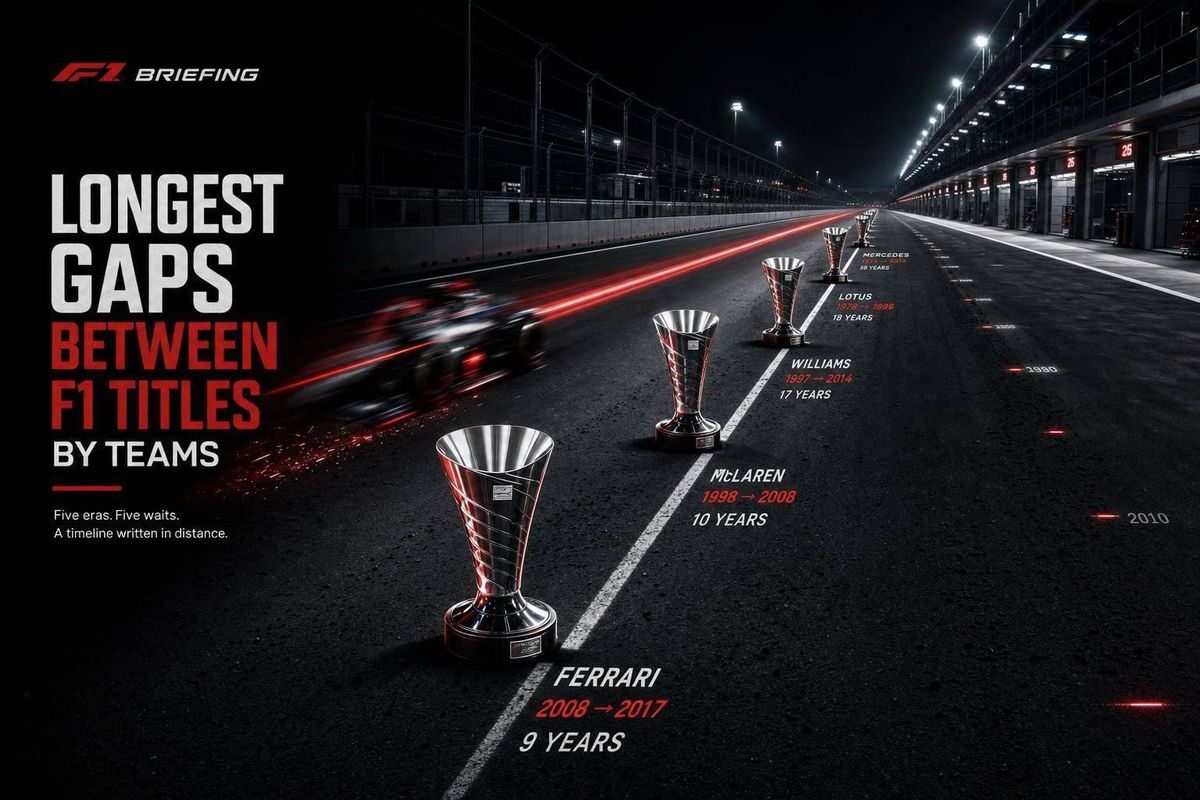
Some F1 teams wait decades to win the Constructors' title again - and some never get back. In this piece, I focus on the teams with the longest gaps, from Mercedes’ 59-year span tied to its time away from F1 to Ferrari’s current 18-year wait and Williams’ 28-year drought since 1997.
Here’s the short version: rule changes, engine problems, money pressure, and team instability tend to drive these long waits. I also cover how each team’s gap played out, why McLaren’s 26-year drought ended in 2024, why Red Bull’s gap lasted 9 years, and why teams like Lotus and Brabham never made it back.
If you want the full picture fast, here are the teams covered:
- Mercedes
- Ferrari
- McLaren
- Williams
- Renault / Alpine
- Lotus
- Red Bull Racing
- Brabham
Quick Comparison
| Team | Longest Gap | Status as of June 16, 2026 | Main reason |
|---|---|---|---|
| Mercedes | 59 years | Ended in 2014 | Left F1 before the WCC began |
| Ferrari | 18 years | Still active | Team churn, missed title chances |
| McLaren | 26 years | Ended in 2024 | Reliability issues, Spygate, Honda slump |
| Williams | 28 years | Still active | Loss of top people, budget gap |
| Renault / Alpine | 20 years before 2005; now 19 seasons since 2006 | Still active | Stop-start factory effort |
| Lotus | 4 seasons between titles | Defunct | Decline after peak years |
| Red Bull Racing | 9 years | Ended in 2022 | Hybrid-era engine shortfall |
| Brabham | No return after 1967 | Defunct | Inconsistent second-car results, later decline |
So if you’re looking for the core takeaway, it’s simple: long F1 title gaps usually start when a team misses a major rules cycle - and they drag on when the car, engine, leadership, and budget all slip at once.
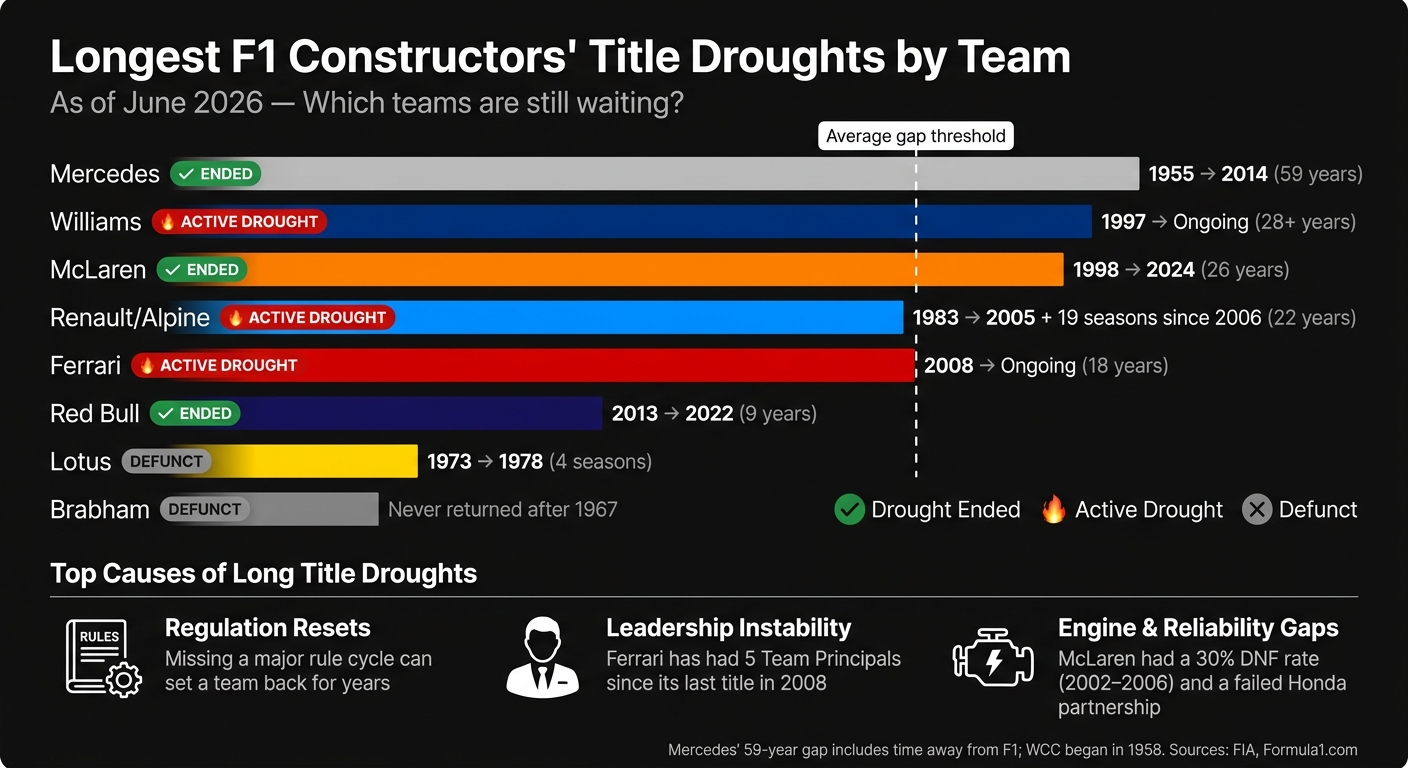
Longest F1 Constructors' Title Droughts by Team
Why Long Gaps Between Titles Matter
A long Constructors' title gap is more than a rough stretch. It shows whether a team can hold together when everything starts to crack at the same time. In Formula One, that kind of pressure tends to come from the same places again and again.
Most droughts trace back to a small set of problems: rule changes, engine output, leadership stability, and budget depth. A big regulation reset can erase an edge almost overnight. It can also give a struggling team a way back if it reads the new rules better than everyone else. A weak power unit can drag a car into the midfield even when the chassis is good. Then leadership changes make all of it harder. Ferrari has gone through five Team Principals since its last Constructors' title in 2008. And these issues don’t stay neatly separated. One bad cycle can spill into the next and turn one poor season into years of catch-up.
The money side hits hard too. Prize money falls steeply from first to last in the Constructors' Championship - about $140 million for the winner versus $60 million for the bottom team. So when a team stays stuck in a drought, it’s not just missing trophies. It also has less to spend on future development, which makes the climb back even tougher each year. The teams below show just how differently those pressures can play out.
sbb-itb-7c68254
1. Mercedes
Mercedes sits at the top of this list because the gap came from a long exit from Formula One, not just a dip in form. The team left the sport after the 1955 season, which meant there were 59 years between its 1955 high point and its first official World Constructors' Championship in 2014. That 2014 title was also, in a technical sense, its first-ever constructors' crown, because the Constructors' Championship didn't begin until 1958 - three years after Mercedes had already stepped away from F1.
The race-win gap was even longer. Mercedes went 56.6 years without a race victory, the longest drought for any constructor.
When Mercedes came back as a full works team in 2010, after buying the title-winning Brawn GP operation, it still needed four more seasons to get to the top. The shift came from Mercedes' work ahead of the new V6 turbo-hybrid rules, along with Lewis Hamilton's switch from McLaren before the 2013 season. That groundwork turned Mercedes into the team to beat in the hybrid era.
2. Ferrari
Ferrari’s longest Constructors’ Championship drought lasted 16 years, from 1983 to 1999. Parts of that stretch were especially rough. From 1991 to 1993, the Scuderia went 58 races without a single win. Ferrari didn’t end that skid by luck. It did it after rebuilding the team from the top down, with tighter leadership and stronger control over the technical side.
Luca di Montezemolo led that reset. The Ferrari president brought in Jean Todt as team principal, and Todt then recruited Ross Brawn as technical director and Michael Schumacher from Benetton. The message was simple: fewer errors, tighter discipline, no chaos. Todt pushed that mindset hard.
It paid off in 1999. Ferrari beat McLaren 128-124 after Schumacher came back from a broken leg and played a big part in a title-deciding 1-2 finish in Malaysia. Ferrari was first disqualified, then reinstated after an appeal.
As of June 2026, Ferrari’s current gap has reached 18 years, which makes it the longest Constructors’ title drought in the team’s history. But this spell hasn’t looked like the earlier collapse. Ferrari has still taken race wins and stayed in the fight, with near-misses in 2010, 2012, 2017, 2018, and 2022. That’s what defines this run: not failure across the board, but repeated chances that slipped away.
3. McLaren
McLaren went 26 years between Constructors' Championship wins, from its 1998 title to its 2024 return to the top. In all, that drought lasted 9,534 days and 519 races.
This wasn't about one bad season. It was a long chain of setbacks.
Reliability was the first big problem. From 2002 to 2006, McLaren missed 53 of 176 starts, which worked out to a 30% DNF rate. Then came the 2007 Spygate scandal. The team was kicked out of the Constructors' Championship and fined $100 million after being found with confidential Ferrari technical data.
After that, the team kept losing ground in other ways. Lewis Hamilton left after 2012, taking away McLaren's lead driver. The Honda partnership from 2015 to 2017 made things worse, with McLaren finishing ninth in the Constructors' standings twice. On top of that, the leadership picture kept shifting until Zak Brown became CEO in 2016 and Andrea Stella stepped in as team principal in 2023.
When the car finally got better, the turnaround was sharp. McLaren had scored only 17 points through the first eight races of 2023. Then a mid-season upgrade changed the pace of the season, and the team finished the year on 302 points.
The big moment arrived at the 2024 Miami Grand Prix, where a major technical upgrade pushed McLaren from hopeful challenger to race-winning title threat. It also gave Lando Norris his first Formula 1 win. By the end of 2024, McLaren had racked up 666 points and secured the Constructors' Championship, with Lando Norris and Oscar Piastri leading the charge.
4. Williams
Williams has now gone 28 years without a Constructors' title. Its last one came in 1997. The team still owns nine Constructors' championships, which puts it level with McLaren for the second-highest total, behind Ferrari's 16.
The slide started when Williams lost key people on the technical side.
One big moment came in 1997, when chief designer Adrian Newey left for McLaren. After that, Williams had to fight rivals with deeper pockets at the front of the grid. At the same time, money pressures made it harder to keep top engineers in place.
Even with that setback, the sport's rule changes kept shaping the drought. In 2003, a tire ruling hit Michelin teams like Williams and played into Ferrari's hands on Bridgestone. Looking ahead, the 2026 power unit reset may give Williams another shot. But a new rulebook by itself won't end a dry spell this long.
5. Renault
Renault’s title story has a stop-start feel to it. Long droughts, then a burst of success, then another long wait.
The team went 20 years without a Constructors' title, from 1983 to 2003. The win at the 2003 Hungarian Grand Prix helped shift the mood, and Renault turned that momentum into back-to-back championships in 2005 and 2006.
That run didn’t last. As of June 2026, Renault - now Alpine - has gone 19 seasons without a Constructors' title since 2006.
A big part of that issue wasn’t just pace on track. It was also structural. Renault had to split time, money, and focus between its works team and its engine-supply effort, which made it harder to defend titles over several eras.
6. Lotus
Lotus had a four-season gap between its 1973 and 1978 Constructors' titles. That’s short compared with the other teams on this list, but it still says a lot. From 1974 through 1977, Ferrari stayed in front in the title fight and kept Lotus from getting back to No. 1.
Back in 1968, after the deaths of Jim Clark and Mike Spence, Graham Hill still led Lotus to the championship. That run showed grit. But it also covered up a deeper problem. Lotus kept running into money trouble, losing key people, and struggling to keep its car development on track. So even when the team hit the top, it often couldn’t stay there for long.
That pattern helps explain why later dry spells became longer and far more costly.
7. Red Bull Racing
Red Bull Racing's dry spell wasn't one of those long, drawn-out slumps. It was more a case of how fast Formula 1 can turn when the rulebook changes. Their Constructors' title drought lasted eight seasons, from 2013 to 2022, after a run of four straight championships from 2010 to 2013.
The shift to the 2014 V6 turbo-hybrid era hit Red Bull hard. Renault lagged on power and reliability, and that gap showed up fast on track. Mercedes then took over the hybrid era and won eight straight Constructors' titles through 2021, which kept Red Bull on the outside looking in until the next big reset arrived.
When the 2022 ground-effect rules came in, Red Bull moved faster than its rivals. It turned that technical reset into an instant Constructors' title and ended the drought in one shot.
They didn't stop there. In 2023, Red Bull won the first 12 Grands Prix and all three sprint races of the season, then followed its 2022 crown with another championship.
8. Brabham
Brabham won back-to-back Constructors' Championships in 1966 and 1967. But 1967 also marked the team's last Constructors' title before it left Formula 1.
It did get back into the fight in the 1980s, thanks to Nelson Piquet. He won the Drivers' Championship in 1981 and 1983. Still, Brabham couldn't turn those personal titles into another Constructors' crown.
The main issue was consistency. Piquet could run at the front, but Brabham often didn't have a second car scoring enough points across a full season. On top of that, the BMW turbo cars in the mid-1980s had pace, but they also had reliability problems. That's a rough mix in Formula 1. One fast car can grab headlines. Two cars finishing week after week win team titles.
Piquet's move to Williams in 1986 pretty much ended Brabham's return bid. He then won the 1987 Drivers' Championship with Williams, while Brabham later withdrew from Formula 1.
Common Causes Behind Long F1 Title Gaps
When you look across all eight teams here, the same story keeps showing up. Long title droughts usually aren't bad luck. More often, they come from a small set of structural issues.
Regulation resets are the biggest spark. When the rules change, teams that commit early to a new car concept often pull ahead. Teams that react late can spend years trying to claw their way back. Mercedes and McLaren both show how moving early after a reset can end a drought in a hurry. Renault's 20-year gap between its 1983 and 2003 wins points in the same direction: a rule change can open the door, but only if the team also has the right driver lineup and enough money behind the project. And once that window opens, leadership plays a big part in whether the team stays on top.
Leadership stability is another pattern that jumps off the page. Ferrari is the clearest case. Leadership turnover has left it without a Constructors' title since 2008. McLaren's comeback, by contrast, has leaned on steady leadership. A stable group gives a team time to learn from mistakes instead of hitting the reset button every few seasons. After that, it comes down to the hard stuff: power, reliability, and day-to-day execution.
Engine partnerships and operational precision matter just as much. McLaren became a customer team in 2010 and then hit trouble during the difficult 2015–2017 Honda partnership. Its 2002–2006 stretch ended with a 30% DNF rate, a blunt reminder that raw pace means little if the car doesn't finish. Brabham had a different problem. It carried the load of designing, building, and developing its own cars, which made the challenge even steeper.
These trends are easier to compare side by side.
| Team | Main Drought Driver | Key Factor in Recovery |
|---|---|---|
| Mercedes | Extended absence from F1 as a constructor | Return as a full works team |
| Ferrari | Leadership instability and operational missteps | Still ongoing |
| McLaren | Reliability failures and poor engine partnerships | Stable leadership and a 2023 technical pivot |
| Williams | Loss of manufacturer support and financial strain | Still ongoing |
| Renault | Inconsistent investment and engine-performance gaps | Regulation reset and Fernando Alonso |
| Lotus | Post-Chapman leadership decline and technical setbacks | Defunct |
| Red Bull | Adaptation gaps during rule changes | Aerodynamic mastery during regulation changes |
| Brabham | Entrepreneurial challenges and the burden of building its own constructor | Withdrew from F1 |
Team Gap Comparison Table
This table compares title gaps by calendar year and by active season, because a long spell away from F1 can skew the raw total. Here’s the side-by-side look at those droughts.
| Team | First Title Year in Gap | Next Title Year | Gap (Years) | Main Drought Driver | Return Trigger |
|---|---|---|---|---|---|
| Mercedes | 1955 | 2014 | 59 | Long-term withdrawal from F1 | 2014 hybrid power unit regulation reset |
| Ferrari | 1983 | 1999 | 16 | Lack of technical cohesion and reliability | Rebuild led by Todt, Brawn, and Schumacher |
| McLaren | 1998 | 2024 | 26 | Reliability issues, Spygate, and a disastrous Honda partnership | Leadership restructure under Zak Brown and Andrea Stella |
| Williams | 1997 | Ongoing | 28+ | Loss of key technical staff and budget depth | N/A |
| Renault | 1983 | 2005 | 22 | Inconsistent factory commitment and management shifts | 2005 regulation changes and stronger execution |
| Lotus | 1978 | Defunct | N/A | Financial decline after Colin Chapman | No comeback |
| Red Bull | 2013 | 2022 | 9 | Hybrid engine power deficit | 2022 ground-effect regulation reset |
| Brabham | 1967 | Defunct | N/A | Technical lag and ownership changes | No comeback |
A quick look at the table makes the pattern pretty clear: these dry spells usually aren’t random. They tend to line up with big shifts in rules, engine eras, team structure, or all three at once.
The next section shows why these gaps so often track F1’s rule cycles.
How F1's Rule Cycles Shape Title Droughts
The table shows one thing pretty clearly: in F1, title droughts are often shaped by rule cycles. For Mercedes, McLaren, Ferrari, and Williams, the big turning points usually came from regulation resets, not slow year-by-year progress. In plain English, new rules often decide which teams snap a drought and which ones get left chasing.
You can see that pattern across different eras. When F1 switched to turbocharged engines in the 1980s, McLaren hit the change at the right moment. Its Porsche-built TAG turbo engine helped deliver 12 wins from 16 races in 1984. Then, when the sport moved to narrower cars and grooved tires in 1998, Adrian Newey's MP4/13 came out as the class of the field, and Mika Häkkinen won the title.
The 2014 hybrid rules did the same kind of thing, only on an even bigger scale. Mercedes built a package with a clear power unit edge and turned that into eight straight Constructors' Championships. For teams that failed to match that setup, the drought just kept stretching.
That same pattern showed up again in the hybrid and ground-effect periods. McLaren used the 2022 ground-effect reset as a chance to rebuild. By 2024, the MCL38 had become strong enough to end the team's 26-year Constructors' Championship drought.
What makes these cycles so brutal is how long the damage can last if a team misses one. A reset doesn't just shuffle the order for a season. It can push a former front-runner backward for years. The 1998 rules, for example, favored a different aero approach, and the team that had been leading the pack fell back.
Ferrari is living that reality now. Its current Constructors' title drought has reached 18 years, which is now longer than its previous 16-year gap from 1983 to 1999. That puts extra weight on the next major change: the 2026 power unit reset. For teams like Ferrari and Williams, that reset could be the next big opening to change the story.
Conclusion
The numbers make one thing plain: staying at the top in F1 is brutally hard.
Williams hasn't won a Constructors' Championship in 28 years. Ferrari is now 18 years into its longest-ever title drought, which is longer than the 16-year gap between 1983 and 1999. McLaren only just ended its own 26-year wait in 2024. Even the sport's biggest names can get knocked off course fast.
Across this list, the same pattern keeps showing up. Long title droughts usually grow out of a mix of rule changes, technical drift, and shaky leadership. It's rarely just one problem. And it almost never gets fixed with one big move either.
McLaren's climb back under Zak Brown and Andrea Stella took years of steady rebuilding. Ferrari's revolving door shows the other side of it: if a team can't keep a clear direction, getting back to the top becomes a grind.
That's what makes the 2026 reset so important. The 2026 rules could shake up the grid again and hand Williams, Ferrari, and other long-waiting teams another shot. The new rules bring a major reset, including a 50/50 electric-to-combustion split and active aerodynamics, which is the sort of shift that has often changed the pecking order in F1. Whether Williams and Ferrari can make that chance count is another question entirely.
FAQs
Why do rule changes extend title droughts?
Rule changes can drag out a title drought because they upend a team’s established design philosophy. Ideas that worked before can suddenly stop working, which forces the team back to square one.
That kind of reset can put a team behind while rivals adjust faster. It can also make old problems hit harder, like losing key people, budget limits, or having trouble dealing with tighter new rules.
Why is Mercedes' gap counted as 59 years?
Mercedes' 59-year gap spans the distance between its first works-team run in the 1950s and its later return to title-winning form.
Mercedes raced in Formula 1 from 1954 to 1955, then stepped away from the sport for decades. When it came back and built another championship-winning team, that 59-year figure came to represent the time between those two successful eras.
Which teams are most likely to end their drought next?
That will depend a lot on the 2026 technical regulations, which could shake up the pecking order.
Scuderia Ferrari is still one of the main contenders. The team hasn't won the drivers' title in 19 years, but Ferrari remains Formula 1's most successful outfit. And more than once, it has looked good enough to win, only to be undone by reliability issues or strategy errors.