Performance Metrics for Sustainable Suppliers: A Guide
How to score, verify, and act on supplier ESG using weighted scorecards, audits, and Scope 3 focus to drive sourcing decisions.

If I had to boil this down to one point, it’s this: supplier ESG work only matters when I can score it, verify it, and use it to make sourcing decisions.
Here’s the short version:
- I track three metric groups: emissions/resource use, labor/safety, and ethics/transparency.
- I use frameworks like ISO 20400, GRI, CDP, and SBTi to keep reporting consistent.
- I build a weighted scorecard so suppliers are judged on more than cost and delivery.
- I sort suppliers into Approved, Conditional, or At-Risk tiers.
- I use audits, reporting schedules, and corrective action plans to fix gaps.
- I focus extra attention on Scope 3 emissions, since supply chains often make up most of a company’s footprint.
- In Formula One, this matters a lot because freight, manufacturing, and event support drive a large share of supplier-related emissions.
A few points stand out.
First, not every supplier needs the same level of data. Lower-risk suppliers can start with spend-based estimates. Higher-impact suppliers need supplier-specific data, and sometimes product-level life cycle data.
Second, proof matters more than claims. Injury logs, payroll audits, fuel records, ISO certificates, and code-of-conduct sign-off data say more than polished policy language.
Third, the scorecard should lead to action. If a supplier misses a reporting deadline, fails a safety audit, or goes over an emissions target, I don’t just log it. I set a time-bound corrective action plan with owners and deadlines.
One example from the article makes the point well: McLaren Group cut carbon emissions per headcount by 9% in two years, and one equipment upgrade helped save 300 metric tons of CO2e per year. That shows what happens when measurement is tied to action.
How Sustainability fits into your Supplier Management and Supplier Risk strategy
sbb-itb-7c68254
Quick comparison
| Area | What I measure | What I check | What happens if performance slips |
|---|---|---|---|
| Emissions & resources | GHG intensity, energy, water, waste, recycled content | Fuel logs, Scope 3 data, material records | Reduction plan, tighter thresholds, supplier review |
| Labor & safety | Injury rates, training, wages, grievance handling, issue closure | Audit reports, payroll records, safety logs | Corrective action plan, follow-up audit, tier downgrade |
| Ethics & transparency | Anti-bribery controls, ESG oversight, traceability, certifications | Policies, training logs, ISO certs, chain-of-custody records | Escalation, disclosure deadline, sourcing limits |
So if I were starting from scratch, I’d keep it simple: pick a small set of metrics, weight them by risk, verify the data, and link scores to supplier decisions. That’s the core idea behind the full guide below.
Core Metrics to Track Across Environmental, Social, and Governance Performance
Once the frameworks are in place, the next step is simple: decide which metrics you’ll audit, benchmark, and tie back to Scope 3 and supplier-risk decisions. It helps to track metrics across three areas, but put the most weight on the ones you can verify and actually use when making sourcing calls.
Environmental Metrics: Emissions, Energy, Water, and Waste
The main environmental KPIs are GHG emissions intensity, renewable energy share, water usage intensity, waste generation rates, and material impacts like recycled content and sourcing origin.
A practical rule of thumb: use the lightest data method that still matches the supplier’s risk and spend level. There’s no point asking for product-level detail from a low-risk supplier if a simpler method will do the job.
| Method | Accuracy | Data Burden | Best Use Case |
|---|---|---|---|
| Spend-based | Low | Low | Initial screening and high-level Scope 3 estimates |
| Average-data | Medium | Medium | Industry benchmarking and secondary suppliers |
| Supplier-specific | High | High | High-impact suppliers and Scope 3 reduction targets |
| LCA-based | Highest | Very High | Product-level deep dives and high-risk materials |
These metrics show how a supplier uses resources. The social metrics below answer a different question: does that performance depend on fair labor conditions?
Social Metrics: Labor Conditions, Safety, and Human Rights
Social KPIs should rest on auditable records, not nice-sounding claims. Core indicators include injury rates, safety training coverage, workforce diversity, fair wage compliance, grievance mechanisms, and corrective action closure rates.
One metric worth watching closely is corrective action closure rate. It shows the share of labor or safety issues resolved on time. That matters because a supplier can find problems in an audit, but if nothing gets fixed, the audit doesn’t mean much.
The mix of priorities changes by sector. In manufacturing and logistics, injury rates and safety training tend to lead. In event staffing or artisanal sectors, the focus shifts more toward fair wage compliance and worker dignity.
Governance metrics build on this. They show whether the supplier has the internal checks to keep those labor and emissions gains from slipping.
Governance Metrics: Compliance, Ethics, and Transparency
Governance metrics show whether a supplier can prevent problems, spot them early, and fix them when they happen. Key indicators include controls and accountability such as anti-bribery policies and ESG oversight structures, whistleblower channel availability, supplier code-of-conduct sign-off rates, third-party certifications such as ISO 14001 and ISO 45001, compliance history, and supply-chain traceability.
| Governance KPI | Typical Evidence Sources | Minimum Standard |
|---|---|---|
| Anti-Bribery/Ethics | Policy documents, training logs | Signed policy and annual employee training |
| ESG Oversight | Board minutes, ESG committee charters | Dedicated personnel or committee for ESG |
| Code of Conduct | Signed supplier agreements | 100% of tier-1 suppliers have signed the code |
| Certifications | ISO 14001, ISO 45001 certificates | Valid, third-party audited certification in place |
| Traceability | Chain of custody docs, blockchain logs | Trace raw materials to origin |
| Compliance | Regulatory incident logs | No major environmental or safety violations in 3+ years |
Put plainly, this is the control layer. Environmental metrics tell you what the impact looks like. Social metrics show how workers are treated. Governance metrics show whether the supplier has the discipline to keep standards in place when no one’s looking.
How to Build a Supplier Sustainability Scorecard
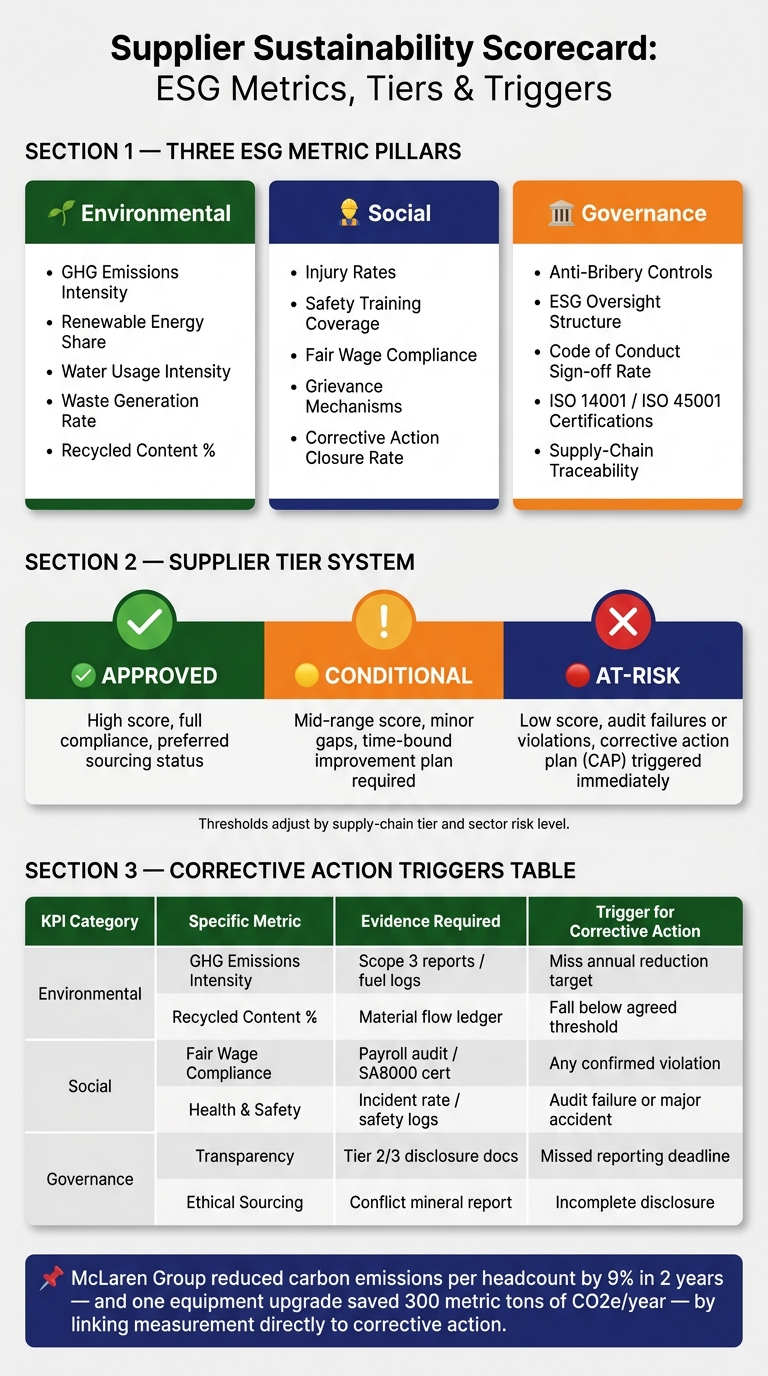
Supplier Sustainability Scorecard: ESG Metrics, Tiers & Triggers at a Glance
A scorecard takes ESG metrics and turns them into one repeatable tool for sourcing, contracts, and supplier reviews. The goal is simple: compare suppliers the same way every time, while still accounting for differences in risk and business importance.
The next move is to turn those metrics into a scoring model.
Choose Metrics, Weights, and Scoring Rules
Start with a short list of priority KPIs across environmental, social, and governance categories. For scoring supplier data, a 0–100 or 1–5 scale works well. Then weight each metric based on materiality, supplier risk, and business priorities.
Not every metric should carry the same weight. For example, emissions should count more for resource extraction and energy-intensive logistics. That reflects the actual risk instead of treating every supplier the same.
It also helps to check supplier-reported data against third-party audits and certifications. That step keeps the model defensible and reduces the chance of scoring based on weak or incomplete inputs.
Once the scores are in place, spell out what each score means in day-to-day use.
Set Supplier Tiers and Performance Triggers
After scores are calculated, place each supplier into one of three tiers: Approved, Conditional, or At-Risk. Thresholds can shift by supply-chain tier when visibility and risk are different.
When a supplier misses disclosures, fails an audit, commits labor-rights violations, or posts emissions intensity above the agreed threshold, use a time-bound Corrective Action Plan (CAP). The CAP should assign actions, owners, and deadlines so the response is clear and trackable.
Here’s a simple way to connect scores to action:
| KPI Category | Specific Metric | Evidence Required | Trigger for Corrective Action |
|---|---|---|---|
| Environmental | GHG Emissions Intensity | Scope 3 reporting / fuel usage logs | Failure to meet annual reduction target |
| Environmental | Recycled Content % | Material flow ledger | Falling below agreed threshold |
| Social | Fair Wage Compliance | Payroll audit / SA8000 certification | Any confirmed violation |
| Social | Health & Safety | Incident rate / safety logs | Audit failure or major accident |
| Governance | Transparency | Disclosure of Tier 2/3 dependencies | Missed reporting deadline |
| Governance | Ethical Sourcing | Conflict mineral report | Incomplete disclosure |
Applying the Scorecard to High-Risk Suppliers
For resource extraction and energy-intensive logistics, use stricter thresholds because emissions, traceability, and labor risk carry more weight in those sectors. Then tie the scorecard straight to procurement decisions and corrective action plans.
That way, the scorecard doesn’t just sit in a spreadsheet. It shapes what happens next.
How to Monitor, Audit, and Improve Supplier Performance
A scorecard only matters if the data behind it stays current and checked. Once scores sit too long, they lose value fast. Monitoring is what keeps the scorecard useful day to day. A simple way to handle this is to tie audit timing and validation depth to each supplier’s scorecard tier.
Set Reporting Cadence and Data Validation Rules
Set reporting frequency based on supplier risk and the quality of the data you already get.
| Supplier Transparency Level | Data Disclosure Scope | Verification / Audit Depth |
|---|---|---|
| Lowest | Legally required documentation only | Basic compliance checks |
| Mid | Detailed environmental and social metric reports | Regular periodic audits and third-party verification |
| Highest | Real-time data sharing and full production visibility | Continuous monitoring through sensor data, tamper-resistant records, and high-assurance audits |
When suppliers share real-time sensor and ledger data, monitoring becomes faster and easier to check.
Run Audits and Corrective Action Plans
Audits should do more than confirm that paperwork exists. They should test whether past corrective actions fixed the issue or just recorded it. Brands should ask for formal audits and, when possible, visit factories to check compliance with labor and environmental standards for themselves. If an audit finds a non-conformance, document the root cause and track the fix until it is fully closed.
Carbon reduction also needs to be treated as a continuous operating target, not a one-off audit item. Sustainable supplier audits should measure, manage, and reduce carbon emissions across operations, including the efficiency of shared systems such as air compressors and chillers, and energy-saving technologies like heat recovery systems.
Use Results to Cut Scope 3 Emissions and Supply Risk
Verified supplier data should feed straight into sourcing decisions. With verified emissions data, companies can track the embodied energy and carbon footprint of sourced materials and give preference to suppliers with lower environmental impacts.
Formula One gives a clear example of how this works in practice. McLaren Group cut carbon emissions per headcount by 9% in two years by linking its production center to a central plant, improving shared compressors and chillers, and installing more efficient simulation equipment that saved 300 metric tons of CO2e a year. That kind of result shows how measurement and corrective action can separate growth from emissions.
The same data can also surface hidden environmental, labor, and compliance risks. On top of that, it can support stronger supplier relationships and help justify longer contracts, higher volume, or technical support for better performers.
Conclusion: The Metrics That Matter Most and How to Start
A strong supplier sustainability program doesn't need dozens of KPIs to work. Start small, with a tight set of metrics focused on Scope 3 emissions, labor, and transparency. Scope 3 needs extra attention because supply chain activity often makes up most of a company's total footprint.
A weighted scorecard helps connect sustainability performance to sourcing decisions. That's the part that makes the program useful instead of just nice on paper. Add clear reporting cadences, data-validation rules, and third-party audits, and the work stays current and actionable instead of becoming a static compliance task.
In Formula One, that means looking past direct suppliers and building visibility into logistics, manufacturing, and event support. It also means pushing oversight beyond Tier 1 suppliers into the freight, manufacturing, and event layers that drive Scope 3 risk, while aligning reporting with established disclosure frameworks to improve comparability and auditability.
The same rule applies in any industry: metrics only matter when they change supplier behavior. So the goal isn't just to measure. It's to act. Start with materiality, then use the scorecard, audits, and corrective actions to reward strong suppliers and help weaker ones improve.
FAQs
How do I decide which suppliers need detailed ESG data?
Carry out a materiality assessment to pinpoint the environmental, social, and governance issues that matter most to your business model and stakeholders. Then use a risk identification matrix to sort suppliers by impact, such as high greenhouse gas emissions or operations in high-risk regions.
Start with an initial screen using self-assessment questionnaires and public record reviews. After that, put deeper due diligence and ongoing monitoring on the suppliers that sit in the highest-impact, highest-risk group.
What should I do if a supplier’s ESG claims can’t be verified?
Start with strict due diligence to close the transparency gap.
Require an on-site audit by an authorized third party to check compliance against established standards. Then put a formal corrective action plan in place with specific, measurable improvements.
If needed, use Zero-Knowledge Proofs to verify sensitive compliance data without exposing the underlying information. If noncompliance continues, flag the supplier as high-risk, limit engagement, or move toward disqualification.
How often should supplier sustainability scorecards be updated?
Supplier sustainability scorecards should be updated on a regular basis. The goal isn't just to check a box for compliance. It's to support continuous improvement over time.
The exact timing can vary based on company policy, but follow-up reviews are often driven by a supplier's results. For example, a supplier with a failing grade may need another assessment within six months to confirm that corrective actions are in place and working.
Regular updates also make it easier to track sustainability goals and keep the supply chain accountable.