MGU-K Parameters: 2026 Rules
2026 MGU-K explained: 350 kW electric, ~400 kW ICE, a 4 MJ usable battery, per-lap energy caps and speed-dependent deployment.
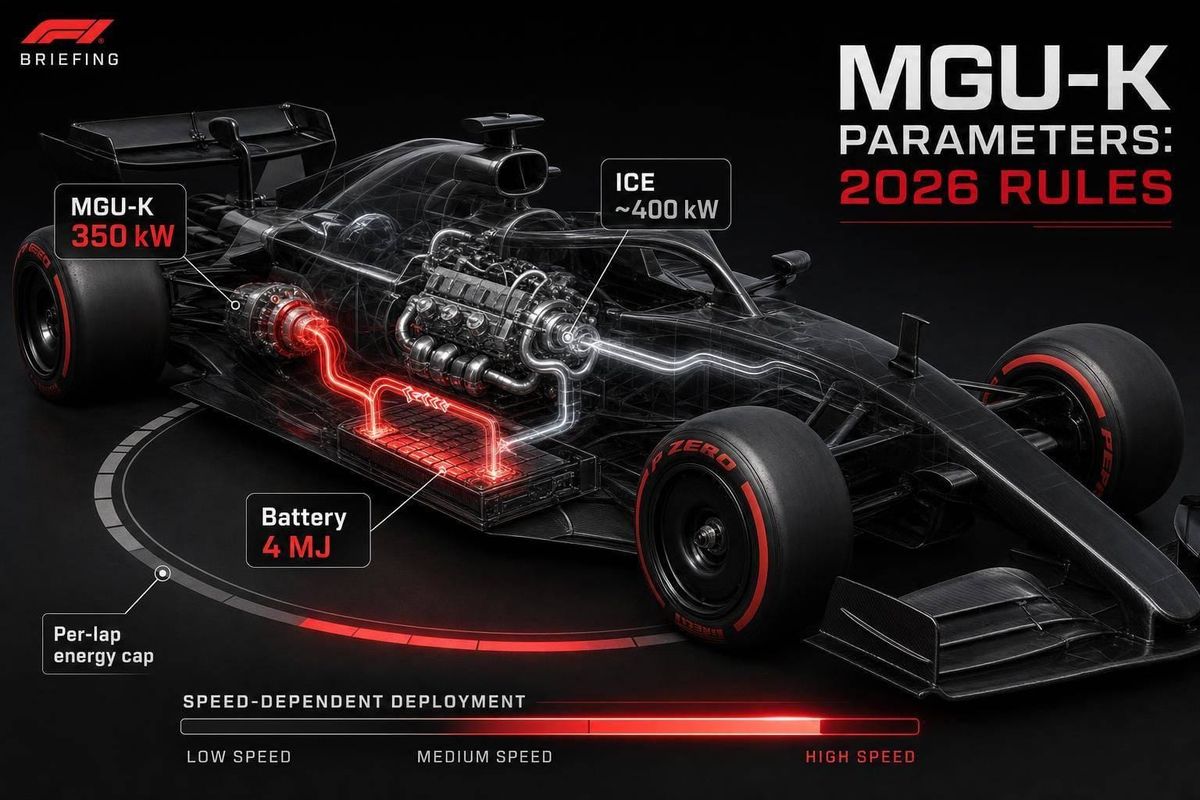
The 2026 F1 power unit is much more electric than before. I’d sum it up like this: the MGU-K jumps to 350 kW, the ICE drops to about 400 kW, the MGU-H is gone, and teams now live inside a tight 4 MJ usable battery window per lap.
If you want the short version, here it is:
- I see a near 50/50 split between electric and combustion power.
- I see the MGU-K become the only energy recovery system.
- I see full electric deployment in base mode only up to 174 mph (280 km/h).
- I see that power fade to 0 kW by 211 mph (340 km/h) in normal use.
- I see Override Mode hold full 350 kW much longer, up to 209 mph (337 km/h).
- I see battery use turn into a lap budget, not a simple push button.
- I see recovery capped at 9 MJ per lap and deployment capped at 8.5 MJ per lap.
- I see the MGU-K’s 4 MJ usable window emptied in about 11.4 seconds at full power.
- I see car setup, braking, overtakes, starts, and pit-out laps all shaped by charge level.
In other words: 2026 is less about peak power and more about timing. You won’t just ask, “How much power does the car have?” You’ll ask, “Where should the driver spend it, and when?”
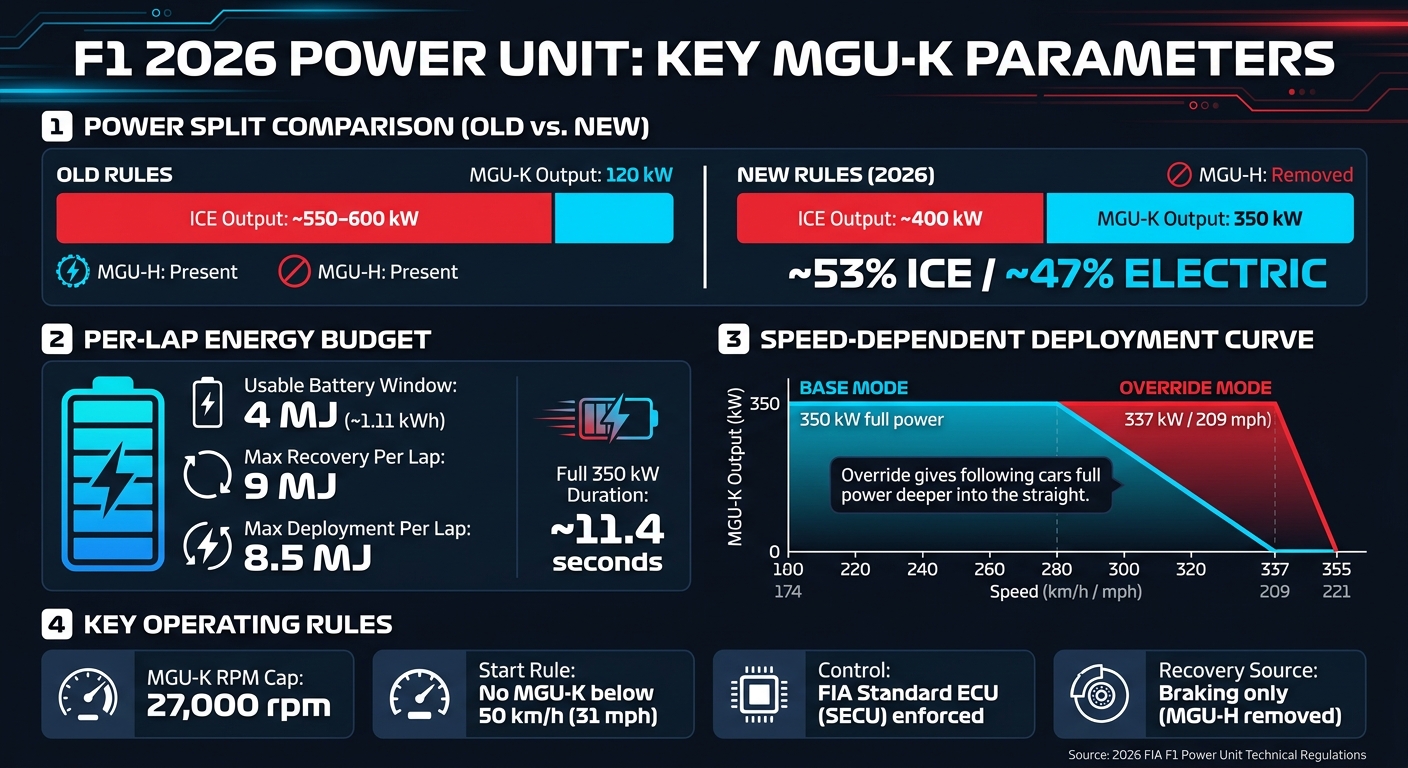
F1 2026 Power Unit: MGU-K Rules & Energy Parameters at a Glance
2026 F1 Engine & Battery Deployement Explained (MGU-K)
sbb-itb-7c68254
Quick Comparison
| Item | 2026 Rule |
|---|---|
| ICE output | ~400 kW |
| MGU-K output | 350 kW |
| MGU-H | Removed |
| Usable battery window | 4 MJ (~1.11 kWh) |
| Max recovery per lap | 9 MJ |
| Max deployment per lap | 8.5 MJ |
| Base full deployment | Up to 174 mph (280 km/h) |
| Base taper to 0 | 211 mph (340 km/h) |
| Override full deployment | Up to 209 mph (337 km/h) |
| Override taper to 0 | 221 mph (355 km/h) |
| Start rule | No MGU-K below 31 mph (50 km/h) |
| MGU-K rpm cap | 27,000 rpm |
What that means for me is simple: drivers will need to spend energy on the parts of the lap that pay back the most time, teams will need tighter brake-by-wire control, and overtaking will depend more on when a driver uses override than on raw top speed alone.
MGU-K Power Share in the 2026 Power Unit
From Support Motor to Main Power Source
In 2026, the MGU-K stops being a helper and becomes the car’s main source of electrical power. More than that, it becomes the only recovery source on the car. Every bit of electrical energy now comes from braking.
That’s a big change. Under these rules, the car can’t lean on any other recovery system to top up electrical power. If the driver and team don’t manage braking energy well, the battery charge drops, and performance drops with it.
The New Power Split: About 400 kW ICE and 350 kW MGU-K
The big numbers tell the story fast. The ICE falls to about 400 kW, while the MGU-K jumps to 350 kW. So the power unit moves much closer to an even split between combustion power and electrical power.
| Component | Current Rules | 2026 Rules |
|---|---|---|
| ICE Output | ~550–600 kW | ~400 kW |
| MGU-K Output | 120 kW | 350 kW |
| MGU-H | Present | Removed |
That changes how the car behaves over a lap. Battery charge is no longer a background detail. It becomes a direct lap-time factor. If charge gets low, power falls off sharply.
How Speed-Dependent Deployment Affects Straight-Line Behavior
Once electrical power plays this big a role, the next issue is simple: where can the car use it?
Full MGU-K output of 350 kW is available up to 280 km/h (174 mph). After that, deployment fades in a linear curve. By 340 km/h (211 mph), normal MGU-K deployment falls to 0 kW. At that point, the car is relying on the ICE alone at the top end of a long straight.
That taper has a clear job. It stops the battery from draining too early on long straights.
Override mode changes that during an overtake. It lets a driver hold the full 350 kW up to 337 km/h (209 mph). In plain terms, that gives the chasing car a clear speed edge over the car in front, whose electrical deployment is already dropping under the standard curve.
So overtaking becomes more about timing than brute force. The driver who uses electrical power at the right moment, especially near the end of a long straight, stands to gain the most.
That whole speed curve only works because battery energy is tightly capped per lap.
Battery Use, Energy Store Limits, and Per-Lap Budgets
The 4 MJ Usable Battery Window and What State of Charge Means
That speed taper works for one simple reason: the FIA keeps the battery window tight. A stronger MGU-K does not come with a bigger energy store. The FIA limits the usable energy window - the gap between the maximum and minimum state of charge during a lap - to just 4 MJ, or about 1.11 kWh. In plain English, that's the lap's usable electrical budget.
It helps to think of it as a small battery that charges and drains fast. Energy moves in and out at a high rate, but the store itself stays small.
The numbers make the limit hard to miss. At the MGU-K's full 350 kW output, the whole 4 MJ usable reserve is gone in about 11.4 seconds. That's why the harvest and deployment limits matter so much.
Per-Lap Harvest Limits: Why Energy Recovery Is Capped
The FIA also limits recovery to 9 MJ per lap and deployment to 8.5 MJ per lap. Both figures are higher than the 4 MJ usable window, so the battery has to cycle through that range more than once over a single lap.
That changes the job for engineers and drivers. They aren't just looking at total energy from start to finish. They're trying to keep charge in the right range at the right moments by aiming for key braking zones and acceleration zones.
| Parameter | 2026 Limit |
|---|---|
| Usable Window | 4 MJ (~1.11 kWh) |
| Max Energy Recovery (per lap) | 9 MJ |
| Max Energy Deployment (per lap) | 8.5 MJ |
| Full 350 kW Time | ~11.4 seconds |
That constant charge-and-drain cycle shapes prep for qualifying and also affects how cars rejoin after stops.
How Charge Restrictions Affect Qualifying and Pit Phases
Teams can't do much to recharge the battery while the car is stationary. So there isn't much room to top it up in the pit lane or on the grid before a flying lap. The out-lap sets the charge for the push lap, which makes that lap part of the setup - not just a drive to the line.
The same issue shows up after a pit stop. When a car rejoins, it can't count on a full battery to pull it through the next sector. It has to earn that energy back under braking once the car is up to speed again.
Control Logic, Override Modes, and FIA Operating Limits
The next limit comes down to how the MGU-K is connected and how it’s told to work.
Mechanical Link, Shaft Rules, and RPM Limits
The MGU-K must remain mechanically tied to the ICE so the energy flow stays under tight control. The FIA requires a permanent mechanical link to the crankshaft at a fixed ratio. That means no clutches, no variable-speed drives, and no mid-lap decoupling.
The motor is also capped at 27,000 rpm. That keeps energy transfer predictable and blocks exotic high-speed layouts.
Standard ECU Control and What Teams Can Still Tune
Every power unit function - MGU-K torque delivery, energy recovery, and brake integration - runs through the FIA Standard ECU (SECU).
The SECU is a hard cap. If a team’s code tries to go past a power, speed, or energy recovery limit, the SECU steps in and overrides it. So compliance isn’t just about staying legal. It becomes part of the performance game.
Teams can still shape the pedal-to-torque map, which is how throttle input turns into torque requests. They can also choose where the lap’s electrical budget gets spent. In plain English: engineers can pick where on the track to use the energy, but not how much total power the system is allowed to make.
Those SECU limits have a direct effect on how the power gets used on track.
Base Deployment, Overtake Override, and Start-Phase Rules
In standard running, the MGU-K delivers the full 350 kW up to 280 km/h (174 mph). After that, power tapers linearly until it reaches 0 kW at 340 km/h (211 mph). Past that speed, the ICE is working alone.
The Override Mode changes that for a following car. When switched on, it keeps the full 350 kW all the way to 337 km/h (209 mph) and only drops to 0 kW at 355 km/h (221 mph). Put simply, the following car gets full electrical boost for longer.
The launch phase has its own rules too. At race start, the MGU-K stays off below 50 km/h (31 mph). Once the car is above that speed, deployment begins, with torque limited if traction is low. So launch behavior is now tied to energy strategy, not just traction control by another name.
| Mode | Power Taper Begins | Power Reaches 0 kW |
|---|---|---|
| Base Deployment | 280 km/h (174 mph) | 340 km/h (211 mph) |
| Override | 337 km/h (209 mph) | 355 km/h (221 mph) |
| Standing Start | Below 50 km/h (31 mph), no deployment | 0 kW below 50 km/h (31 mph) |
How the 2026 MGU-K Rules Affect Driving, Setup, and Race Management
Driving Style: Timed Deployment Over Flat-Out Running
With deployment and recovery capped much more tightly, drivers have to spend energy where it buys the most lap time. Just holding the throttle wide open for as long as possible isn't always the best play anymore.
In standard mode, the MGU-K tapers off on long straights. Override Mode lets the following car keep full deployment deeper into the straight. But once that clipping starts, you can end up with unused power near the end of the straight anyway. That changes the whole thought process in the cockpit.
The smarter move is to hit electrical deployment hard on corner exit, where it does the most for lap time, then live with the taper before the braking zone. In plain English: get the punch early, not late. That also makes earlier lifting on a straight a real option if it helps save charge for the next exit.
Car Setup: Brake Balance, Drag, and Active Aero Trade-Offs
Higher MGU-K recovery pushes more braking load onto the rear axle under braking, which means the mechanical rear brakes have much less to do than before. Teams will lean toward smaller rear brake hardware, and brake-by-wire calibration becomes a much touchier engineering job. Those setup choices then flow straight into stint planning.
Active aero adds another layer. Low-drag mode helps the car hold speed on straights after electrical support starts to taper. High-downforce mode, on the other hand, gives the car more stability under heavy braking, right when the MGU-K is harvesting energy.
So these choices don't sit in separate boxes. Aero setup, brake stability, and energy recovery are tied together much more tightly.
Race Management: Lap-by-Lap Energy Budgets and Strategic Trade-Offs
That same 4 MJ window turns each stint into an energy-budget exercise. Strategists can't just radio in and say, "push." They have to pick the corners and straights where electrical energy is worth spending, and decide where to give some up so charge is there for a key passing chance.
There are a few clear trade-offs:
- Aggressive harvesting builds charge reserve, but it can cost time under braking.
- Attack-heavy deployment helps short-term pace, but it can lead to clipping on straights.
- Conservative saving sits in the middle and lowers the risk of running short on energy.
Safety car periods and pit windows add even more pressure to those calls. Battery charge at a restart can become a plain tactical edge, especially against cars that show up with less in reserve.
Conclusion: The Key Numbers and Why They Matter
Three figures define the 2026 MGU-K era: 350 kW of electric output, ~400 kW from the ICE, and a 4 MJ usable battery window per lap. Put those side by side, and the shift is hard to miss: electric and combustion power now sit on almost equal ground, with MGU-K output close to three times higher than in the previous era.
But peak power, on its own, doesn’t tell the full story.
What matters more is when that power shows up. Deployment is tied to speed limits and squeezed into a small per-lap energy window. So the edge won’t come from hitting the biggest number on paper. It’ll come from using that 4 MJ window with exact timing, lap after lap.
That’s the big swing for 2026: electrical energy management moves to the center of performance. The 4 MJ cap becomes the lap’s energy budget, and that budget shapes almost every call a driver and team make. It affects throttle use on corner exit, brake balance, active aero timing, and the choice between an Override attack and a conservation phase.
The teams that handle the 4 MJ window best will shape race pace, overtaking, and results. In 2026, energy management isn’t a side job. It is the race.
FAQs
Why was the MGU-H removed for 2026?
The MGU-H was removed mainly because it was complex, costly, and had limited road relevance. Since it was a heat recovery system tied to the turbocharger, it took a lot of money to develop and build.
Taking it out makes the hybrid power unit simpler. It also cuts thermal management complexity, lowers the barrier for engine suppliers, and keeps F1 focused on more road-relevant sustainable tech.
How does the 4 MJ battery window change race strategy?
The 4 MJ usable battery limit turns energy management into a core part of race strategy. With MGU-K output up to 350 kW, teams and drivers can’t just use electric power whenever they want. If they do, the battery runs out too soon.
So the approach has to be more measured. That means lift-and-coast, heavy harvesting under braking, and picking the right moments to deploy power on key straights and in overtaking zones. Active aerodynamics help here too by cutting drag, which takes some pressure off the battery.
When should drivers use Override Mode?
In 2026, drivers should use MGU-K Override mode when they’re chasing the car ahead and sitting within one second. This mode lets them use the full 350 kW of electric power up to about 209 mph, plus an extra 0.5 MJ of energy to help finish the pass.
That matters because it replaces proximity-based DRS. So instead of just opening a rear wing when they get close enough, drivers now have to pick the right moment and manage deployment with care in wheel-to-wheel fights.