How F1 Teams Scout Sim Racing Talent
How F1 teams evaluate sim racers: repeatable 15–20 lap pace, clean telemetry, racecraft, coachability, and sim-to-track validation.
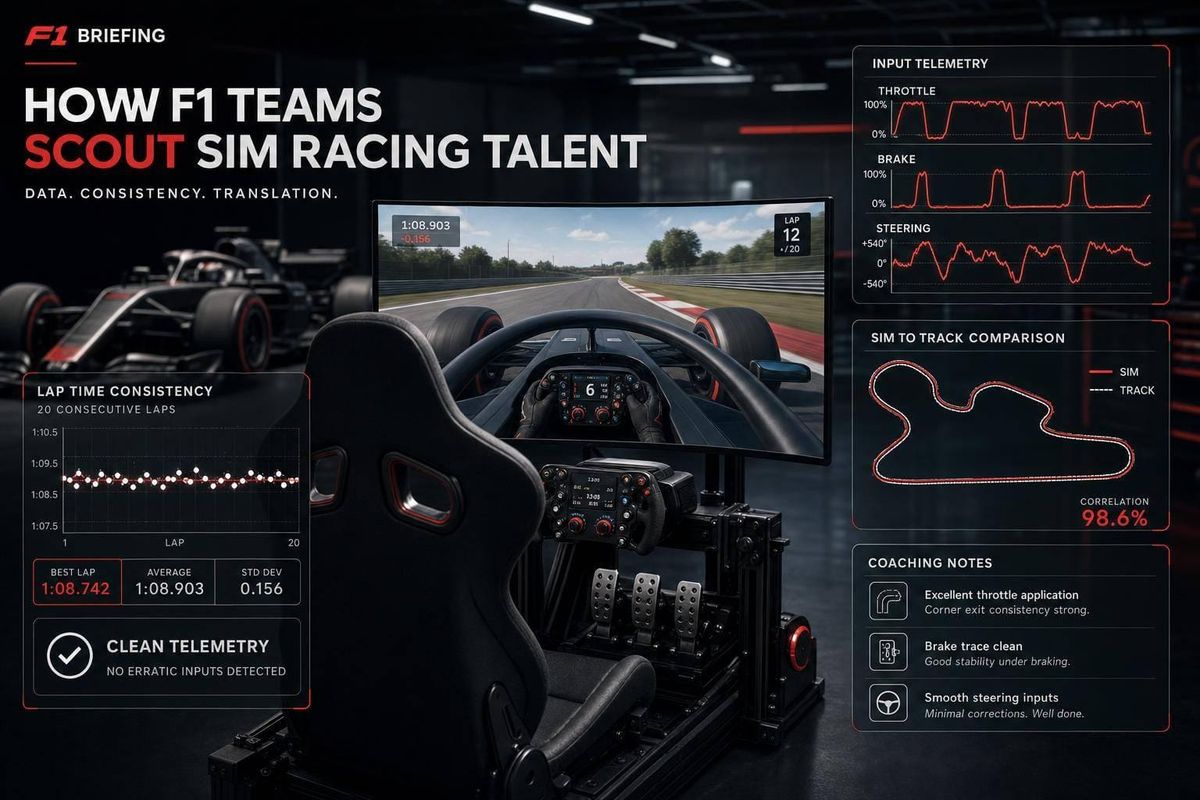
F1 teams don’t scout sim racers by leaderboard fame alone. I’d sum it up like this: they look for steady pace over 15–20 laps, clean telemetry, racecraft in traffic, and clear feedback to engineers. Then they check whether that sim form carries into a team simulator and, in some cases, a kart, F4, or GT test.
If you want the short answer, here it is:
- I’d say one fast lap is not enough
- Teams care more about repeatable pace and low lap-time variation
- They review brake, throttle, and steering traces
- They test how fast a driver applies coaching
- They listen for clear debriefs using engineering terms
- The last filter is sim-to-track transfer
A few numbers stand out. Many teams look at runs of 15–20 laps, and strong long-run variation is often kept to around 0.1–0.2 seconds. That tells scouts if a driver is under control or just hanging on for one big lap.
Here’s the simple version: I see the process as a funnel - source talent, filter with data, test racecraft and feedback, then confirm it in a factory simulator and on track. If a driver is fast and steady, can explain car balance well, and reacts to setup changes right away, that driver has a much better shot at moving forward.
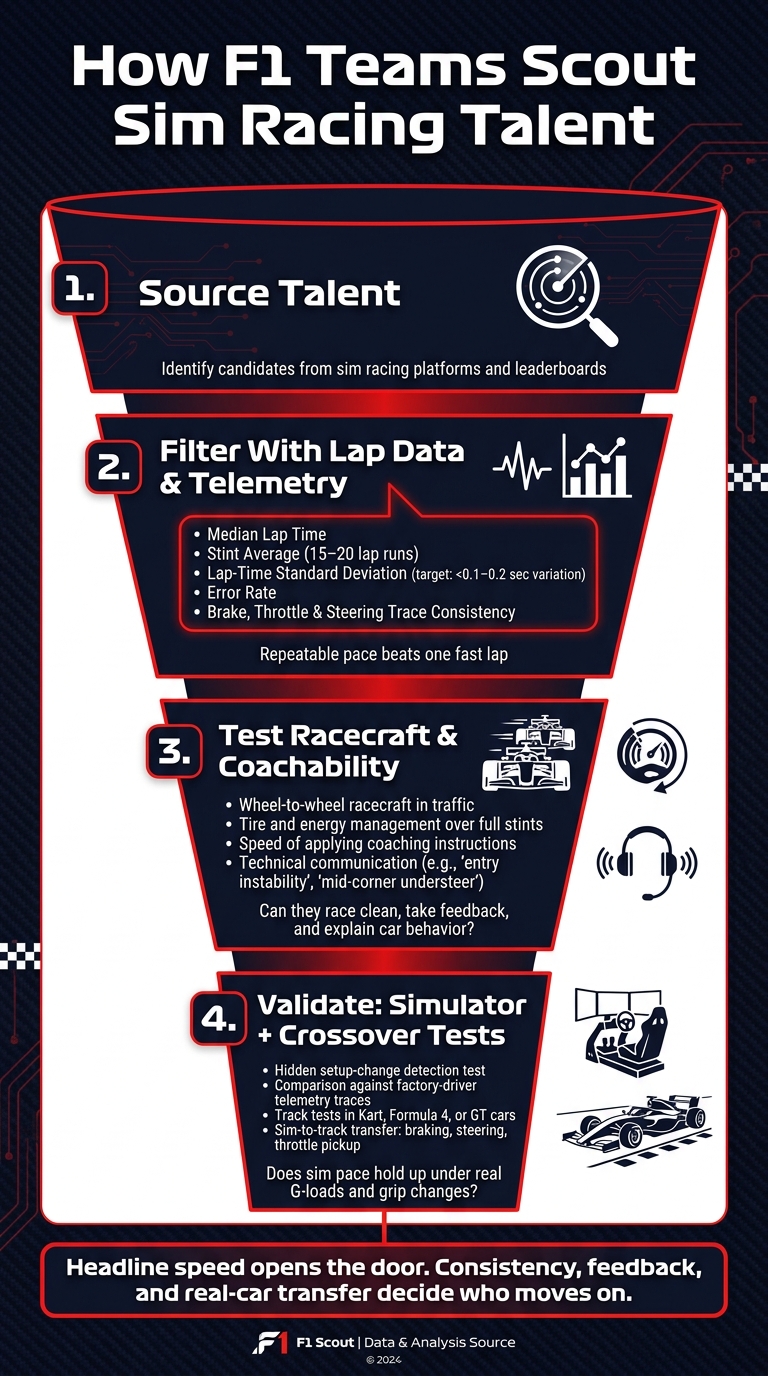
How F1 Teams Scout Sim Racing Talent: The 4-Step Funnel
How F1 Teams Are Finding New Talent
sbb-itb-7c68254
Step 1: Filter Drivers Through Lap Data, Pace, and Consistency
From those candidate pools, scouts move straight to data screening. They use platform logs to sort peak pace from repeatable pace. This step decides who gets a deeper look. It also gives teams a way to compare drivers from different series on the same scale.
The Core Metrics Teams Review First
Scouts usually don’t stop at the fastest lap. They start with median lap time and stint average across a 15–20 lap run. That’s where the picture gets clearer. A one-lap specialist will often show a big gap between peak pace and average pace over the stint. A steady driver keeps that gap tight.
Lap-time standard deviation is one of the clearest checks for consistency. A driver who is 0.2 seconds off the pace but has a variance of just 0.05 seconds can be more useful than someone faster but much less repeatable. In practice, scouts look for lap times that are almost identical from one lap to the next, with long-run lap-time variation ideally under 0.1–0.2 seconds. When the variance climbs, it can point to over-driving or a weak reference lap for braking and turn-in.
The table below shows what helps a driver get through to human review, not just what makes them look quick on paper.
| Metric | What It Reveals |
|---|---|
| Median Lap Time | More reliable sign of pace over time than one fast lap |
| Stint Average | Shows how pace holds across a 15–20 lap run |
| Lap-Time Standard Deviation | Measures consistency; low variance points to control |
| Error Rate | Shows how often the driver makes mistakes under load |
How Telemetry Comparison Exposes Real Strengths
Once a driver clears the basic pace filter, scouts go deeper with telemetry overlays. They compare brake traces and input consistency against a reference lap. This is where raw speed gets tested.
A fast driver with messy traces is often finding time through risk, not control. That’s harder to trust in a pro setting, where teams want clean, steady data they can work from. The best prospects tend to do the same thing lap after lap, and that repeatability stands out fast.
Drivers who clear this screen move on to checks for racecraft, coachability, and team fit.
Step 2: Test Racecraft, Coachability, and Team Fit
After lap data confirms raw speed, scouts look at the stuff that shows up once racing gets messy. A quick lap matters, sure. But teams also want to know if that speed survives traffic, pressure, and tire wear.
Once a driver gets past the telemetry screen, the next check is simple: can they still perform when they’re not out front in clean air?
Racecraft Beyond Qualifying Pace
At this stage, scouts stop looking only at qualifying pace and start looking at race behavior. They watch how a driver handles turbulent air, especially whether lap times stay steady while the driver manages tire and brake temperatures close behind another car.
They also pay close attention to starts, wheel-to-wheel battles, and judgment. Knowing when to attack and when to back off matters a lot. A sim racer who looks fast on an open lap can make very different choices once the pack tightens up.
Teams also track pace over a full stint. That’s a big one. A fast qualifying lap doesn’t always carry over to strong tire or energy management across a race run.
How Teams Measure Coachability and Team Fit
If the racecraft checks out, the focus shifts to behavior. Teams test coachability by giving a setup change or a driving instruction, then seeing how fast the driver applies it on the next run. It’s a direct test. Did the driver hear it, understand it, and use it right away?
Technical communication also carries a lot of weight. Scouts want drivers who can explain car behavior in clear engineering language, like entry instability or mid-corner understeer. That tells a team the driver can work well with a race engineer. It’s also part of what helps move a sim driver toward factory simulator work and real-world evaluation.
The table below breaks down the main evaluation categories and how each one is tested during scouting.
| Area | Example Traits | How Teams Test It |
|---|---|---|
| Technical | Pace, car control, consistency | Telemetry review, lap-time comparison, stint pace |
| Coachability | Feedback response, ability to adjust | Setup-change test, repeat sessions |
| Communication | Clear technical feedback | Debriefs with engineers, precise terminology |
| Team Fit | Preparation, professionalism | Structured debriefs, observation across sessions |
Drivers who pass both screens move on to simulator and crossover testing.
Step 3: Move Top Prospects Into Team Simulators and Crossover Tests
After pace, racecraft, and coachability, teams move to the simulator to see if those same traits still show up in a development setting. If a driver gets through the earlier checks, they earn time in the team's factory simulator. That's the next filter.
Factory Simulator Work as the Next Screening Layer
In the factory simulator, teams aren't just looking for speed. They want to know if that speed turns into useful feedback and repeatable engineering input.
A common test is simple but telling: teams run back-to-back laps with a hidden setup change and see if the driver notices it. If the feedback doesn't catch the change, that hurts the driver's case for factory-simulator work.
Teams also compare prospect data against factory-driver traces, with close attention to brake pressure and throttle pickup. The point is to check whether the driver's style can carry over to real cars, or if it's built around sim-only habits.
Because simulators don't give drivers the same G-loads and motion cues as a real car, teams pay close attention to input stability under pressure. That consistency is what separates a driver who can help with development from someone who's just a lap-time specialist.
If the feedback matches the data, teams move the prospect to track validation.
How Crossover Tests Turn Sim Results Into Track Opportunities
From there, top prospects get track tests in karts, Formula 4, or GT cars. This is the last big check before the next step. Teams want to see if sim pace still holds up once the driver deals with grip changes, vibration, and G-loads on an actual track.
The main question is straightforward: does the track result match what the sim data suggested? In other words, does the driver brake, steer, and pick up throttle the way the simulator predicted?
If the answer is yes, that match can open the door to another track test or a place in a junior program.
Conclusion: The Scouting Model F1 Teams Use
Taken together, the scouting model works like a funnel. F1 teams scout sim drivers in four steps: source, filter, test racecraft, then validate in team simulators and on track.
Raw pace may get a driver noticed, but that’s only the start. After the data narrows the field, behavior shapes who stays in the pipeline. Teams look at racecraft and coachability next: can the driver race cleanly, take feedback on board fast, and use it on the very next run?
If those traits keep showing up, teams move to factory simulators and crossover tests. At that stage, they want proof that the same habits still show up in a different setting. The last check is simple: does the prospect’s technique carry over to real cars, especially under braking and tire control?
Headline speed opens the door. Consistency, feedback, and real-car transfer decide who moves on.
FAQs
What telemetry matters most?
The most important telemetry is the data that best predicts lap time, tire wear, and fuel load, while helping teams make fast, accurate calls.
The main areas are tire health, engine and mechanical status, driver inputs, and GPS gap data. For engineers, the real value comes from correlation: lining up live track data with simulator models to check that the virtual car matches what the real car is doing on track.
How do teams test coachability?
Teams test coachability by watching how drivers react to guidance during simulator sessions and coaching work. Engineers don’t stop at lap times. They want to see whether a driver can take specific feedback - like adjusting braking points or changing throttle input - and use it right away in live runs.
They also watch how fast the driver adjusts and how they handle constructive criticism or conflicting data. A calm, teachable driver stands out here. The aim is to spot drivers who can turn technical input into steady improvement.
Can sim talent really transfer to track racing?
Yes. Sim racing and track racing share core skills like precision, data analysis, and technical feedback.
F1 teams use Driver-in-Loop simulator programs to help drivers sharpen braking points, dial in racing lines, and work on car balance in virtual conditions that mirror the real track. Sim racing also helps drivers learn how to read telemetry and give setup feedback, both of which matter in professional motorsport.