Pit Lane Tools: Ergonomics vs. Speed
Explores how F1 pit-stop tools juggle split-second speed, crew ergonomics, AI analysis and 2026 regulation changes.
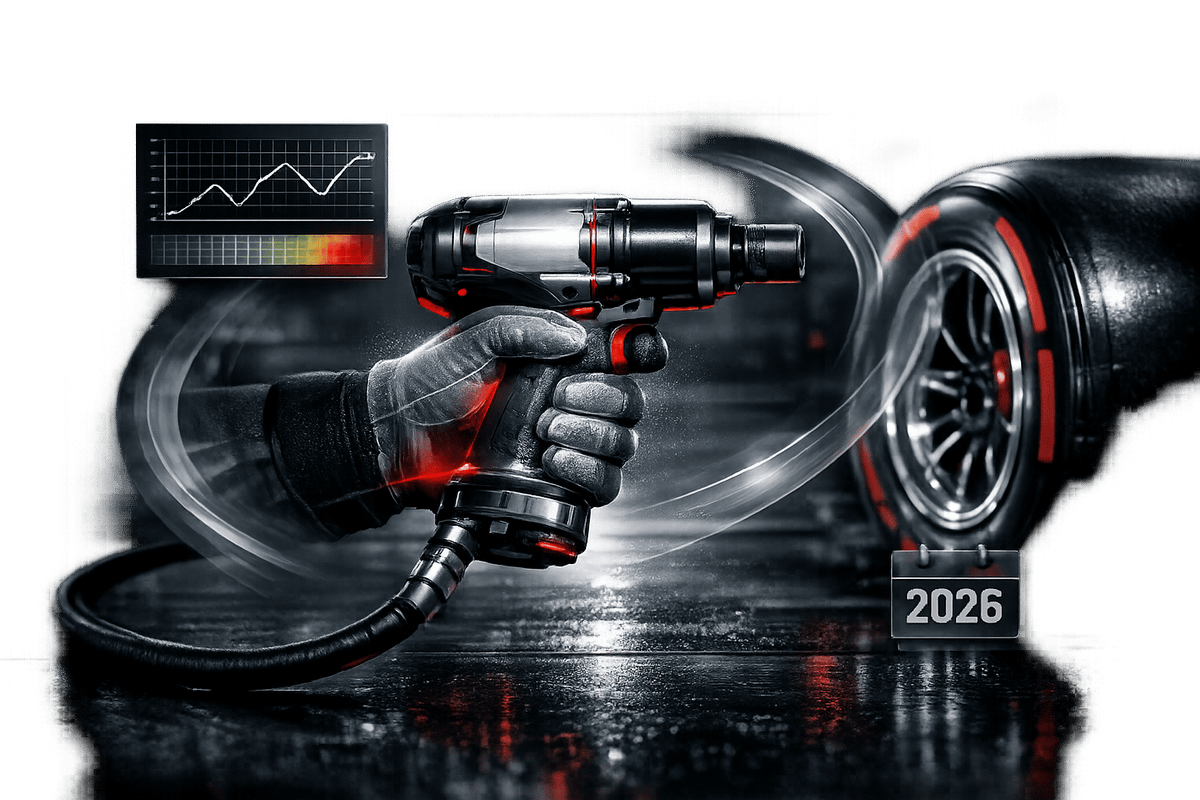
In Formula 1, pit stops are a race within a race. Teams aim for sub-2.5-second stops, but this speed comes at a cost. Tools like wheel guns, jacks, and tire trolleys are optimized for speed, yet they often strain the crew physically, increasing fatigue and injury risks. The challenge? Balancing speed with ergonomics to ensure both quick pit stops and crew well-being.
Key insights:
- Wheel Guns: Deliver immense torque but require precise handling to avoid strain.
- Jacks: Lightweight and fast but demand precision in tight spaces.
- Tire Trolleys: Must balance maneuverability and sturdiness for efficiency.
- Ergonomics: Reduces crew fatigue, ensuring consistent performance.
- New 2026 Regulations: Lighter cars and tighter spaces add complexity to tool design.
The future lies in smarter tools, AI analysis, and role-specific training to maximize both speed and crew health. Teams that master this balance will dominate the pit lane.
Formula 1 Pit Stops EXPLAINED | Fasterclass
sbb-itb-7c68254
Key Pit Lane Tools and Their Roles
Every F1 pit stop is a finely tuned performance, where specialized tools execute precise tasks in mere seconds. Let’s take a closer look at the roles of wheel guns, jacks, and tire trolleys, and how their design balances speed with usability.
Wheel Guns: Balancing Torque, Grip, and Weight
The wheel gun is perhaps the most iconic tool in a pit stop, yet it’s also one of the most complex to design. These pneumatic tools deliver immense torque to remove and secure wheel nuts in fractions of a second. Beyond raw power, operators must also manage spring-loaded retaining clips to keep the wheel in place and press a confirmation button to signal the car’s release system once the nut is secured.
The job of front and rear gunners differs slightly due to their positions. Front gunners can approach the wheel while the car is still rolling in, but rear gunners must wait for a full stop because of the recessed nut positions and the larger size of the rear wheels. These differences influence how each wheel gun is weighted and balanced, ensuring consistent torque while maintaining operator comfort. Even slight variations in timing and design can have a huge impact on pit stop efficiency.
Jacks: Speed Meets Crew Safety
Jacks are another critical element, designed to lift and lower the car swiftly while keeping the crew safe. The front jack, typically made from lightweight carbon fiber, includes a swivel mechanism that allows the operator to step aside as the car accelerates away. It also features a quick-release button for dropping the car precisely. In a 2.2-second pit stop, the front jack engages in just 0.3 seconds and lowers the car by 2.1 seconds.
The rear jack, however, faces unique challenges. Its "cup" must connect perfectly with the car’s lifting point on the first try, and the low-clearance ground-effect floor leaves little room for error. Operators work in tight spaces and deal with significant resistance, especially with the heavier power units set to debut in 2026. These changes will likely increase the physical demands on the rear jack and its operator.
Tire Trolleys and Other Support Tools
Tire trolleys, cooling fans, and data cables also play essential roles in pit stops. Tire trolleys must strike a balance between being easy to maneuver and sturdy enough to handle 30-pound tires. Poorly designed trolleys can slow down the handoff process, disrupting the entire pit stop flow.
Safety tools have also evolved. Starting in 2026, lateral safety lights will display the car’s Energy Recovery System (ERS) status, giving crew members a clear visual warning about potential electrical discharge risks. This integration of safety features into the pit lane setup demonstrates how design can protect the crew while maintaining the lightning-fast pace of F1 pit stops.
Ergonomic Design: Crew Health and Consistency
Cutting Crew Fatigue and Injury Risk
Pit crew members face immense physical demands, repeating precise, high-intensity movements throughout a race weekend. Without proper tools, they risk wrist strain, back injuries, and grip failures. Ergonomic design aims to address these issues by minimizing the physical strain and awkward positions needed to operate equipment under pressure.
Take the balanced pit socket, for example. Its design eliminates vibration and wobble during high-torque rotations, protecting the gunner's wrists while also speeding up nut engagement. This shows how ergonomics can enhance both safety and efficiency. Tool organization systems are another innovation, using laser-cut foam inserts and engraved labels to help crew members quickly identify the right tools, reducing mental strain during high-pressure moments.
The physical challenges have only intensified over the years. In 2017, Pirelli introduced updated tire specifications, adding about 4 lbs to each rear tire and 1.8 lbs to each front tire. This forced teams to rethink how crew members manage and position tires during pit stops. Mercedes-AMG Petronas responded by hiring a personal trainer and creating role-specific conditioning programs tailored to the exact movements required for each position.
"Working on ergonomics and body movement, each crew member now has a programme developed and tailored specifically to them and the role that they play in the pit stop." - DHL InMotion
This focus on ergonomics not only reduces injury risks but also ensures precision and consistency across every pit stop.
Keeping Pit Stop Performance Consistent
A lightning-fast pit stop means little if the team can't maintain that level of performance throughout the race. Ergonomically designed tools that fit naturally in the hand and reduce physical strain allow crew members to perform consistently under pressure.
McLaren's Operations Director Charlie Hooper highlighted this after their record-breaking 1.80-second pit stop at the 2023 Qatar Grand Prix. Despite cutting down practice sessions to protect the crew from extreme heat, they achieved this feat while maintaining reliability:
"It's no good breaking a world record if the next pit stop is five seconds!" - Charlie Hooper, McLaren
To maintain consistency, teams like Mercedes-AMG Petronas train their pit crews up to five times a week. They incorporate additional practice sessions and rotate roles to prevent repetitive strain injuries over the course of a long season. This commitment to training ensures that ergonomic improvements translate into reliable, repeatable performance at every stop during a race weekend.
Speed Optimization: Tools Built for Maximum Performance
Mechanical Features That Cut Pit Stop Times
Pit lane tools are all about getting cars back on track in record time. High-torque wheel guns, for example, are designed to remove and reattach lug nuts almost instantly. This precision saves crucial fractions of a second on each wheel. Combined with adhesive that keeps lug nuts secure, tire changes become lightning-fast. Under the upcoming 2026 "Nimble Car" regulations, additional updates like lateral safety lights will display the Energy Recovery System's status in real time, while a targeted weight reduction of 30 kg (about 66 lbs) will bring the car's total weight down to 1,596 lbs (724 kg). These advancements, however, come with their own set of challenges that teams must navigate.
Risks That Come With Speed-Focused Tools
While these tools are designed to maximize efficiency, they often push the boundaries of safety and ergonomics. For example, high-speed mechanisms used to eject lug nuts can sometimes misfire, sending them at the wrong angle. This can turn a swift pit stop into a costly mistake. Similarly, lightweight, fast-retraction jacks allow for rapid car releases, but if a crew member isn’t clear of the vehicle when it drops, the risk of foot injuries rises. As Mercedes-AMG Petronas highlights, "with sub 2.5 second stops now the expectation rather than the exception, the slightest fumble during a tire change can mean the difference between victory and defeat on track".
The introduction of new technology only adds to the complexity. For instance, the 2026 active aerodynamics system will replace DRS with front and rear wings that can adjust dynamically between low-drag and high-downforce modes. While this improves performance, it also introduces mechanical unpredictability during pit stops. This makes the balance between speed and safety even trickier to manage. Bradley Lord, a representative of the Mercedes F1 Team, summed it up:
"We're going to see, certainly in the early races... quite a decent chunk of unpredictability and chaos. Simply because we're all still learning and the learning curve is very, very high." - Bradley Lord, Mercedes F1 Team Representative
To address these challenges, teams are turning to AI-based data analysis and specialized athletic training for pit crews. These strategies help maintain consistency and reduce errors, even as tools and car systems grow more advanced. While the technology pushes the limits of speed, it also raises the stakes when something goes wrong.
Ergonomics vs. Speed: A Direct Comparison
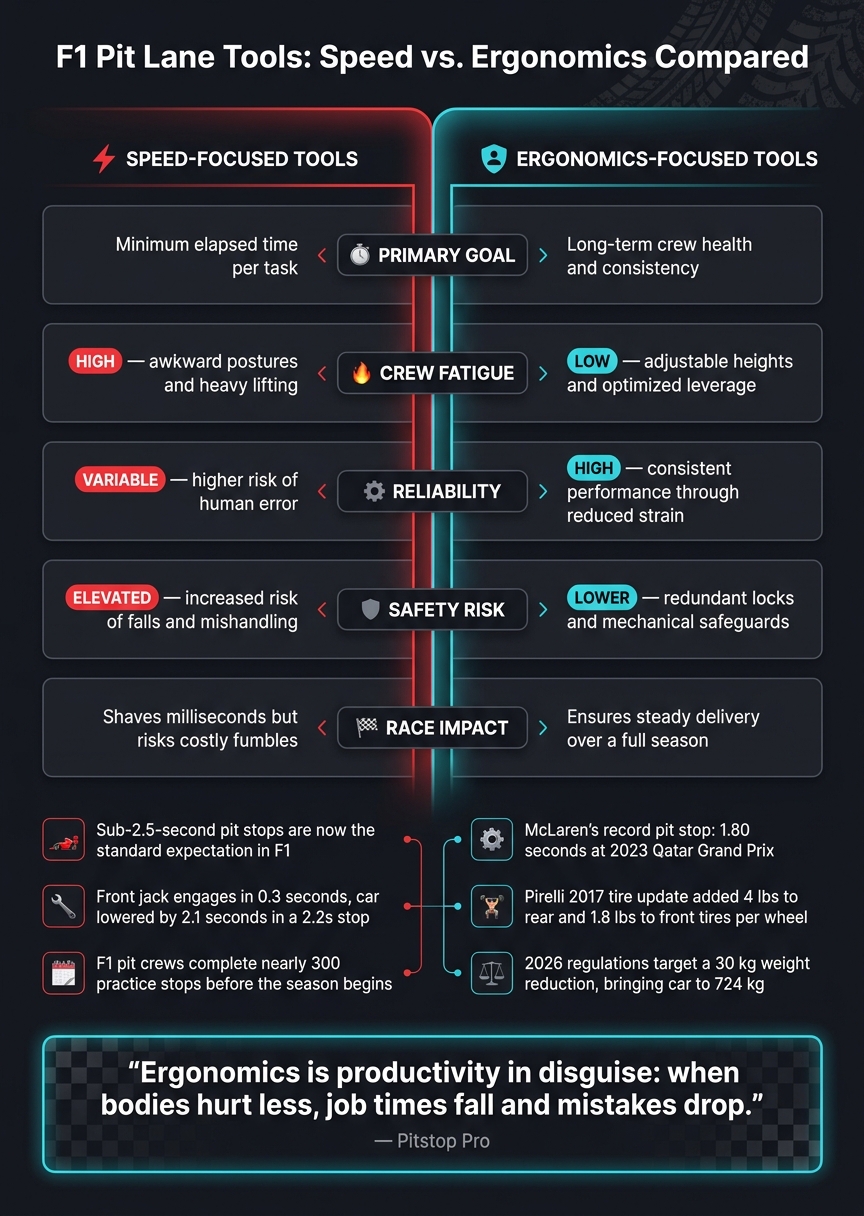
F1 Pit Lane Tools: Speed vs. Ergonomics Compared
When it comes to tool design in pit lanes, teams must carefully balance two key priorities: ergonomics and speed. Tools designed for speed aim to shave off precious milliseconds during pit stops, while ergonomic tools focus on protecting the crew and maintaining steady performance throughout a demanding race weekend.
Speed-focused tools prioritize quick execution but often force crew members into awkward positions or require heavy lifting. This increases fatigue and raises the likelihood of errors during pit stops. On the other hand, ergonomics-focused tools are designed to reduce physical strain, helping crews maintain consistency and precision from the first lap to the last. These trade-offs highlight the strategic decisions teams face when selecting equipment.
"A lift brings the job to the person, not the person to the job. Neutral-spine postures reduce back stress and joint load across long shifts." - Pitstop Pro
The physical toll on pit crews is immense. For example, F1 pit crews may complete nearly 300 practice stops before the racing season even begins. This level of preparation underscores how critical fatigue management is - not just for health reasons but also as a competitive factor. Upcoming 2026 regulations, which include complex active aerodynamics and a tighter wheelbase, will only add to the challenges pit crews face.
"Ergonomics is productivity in disguise: when bodies hurt less, job times fall and mistakes drop." - Pitstop Pro
The table below provides a clear comparison of the strengths and weaknesses of speed-focused and ergonomics-focused tools.
Comparison Table: Key Pit Lane Tools
| Dimension | Speed-Focused Tools | Ergonomics-Focused Tools |
|---|---|---|
| Primary Goal | Minimum elapsed time per task | Long-term crew health and consistency |
| Crew Fatigue | High - awkward postures and heavy lifting | Low - adjustable heights and optimized leverage |
| Reliability | Variable - higher risk of human error | High - consistent performance through reduced strain |
| Safety Risk | Elevated - increased risk of falls and mishandling | Lower - redundant locks and mechanical safeguards |
| Race Impact | Shaves milliseconds but risks costly fumbles | Ensures steady delivery over a full season |
Ultimately, there’s no clear winner between the two approaches. Speed-focused tools may lead to quicker individual stops, but they come with a higher risk of errors, especially as fatigue sets in. Meanwhile, ergonomics-focused tools might not deliver the fastest times, but they help maintain the consistency and reliability that are essential for long-term success in a championship season.
Balancing Ergonomics and Speed for Better Pit Stops
In Formula 1, teams face the challenge of blending lightning-fast pit stops with the physical demands of a grueling 24-race season. Achieving this balance means designing tools, training regimens, and workflows that prioritize both speed and crew well-being.
Data and AI have become essential in fine-tuning this equilibrium. Teams meticulously analyze video footage of pit stops, breaking it down frame by frame. AI helps identify subtle issues, like inefficient posture changes or delays in tool handling. Once these bottlenecks are spotted, teams can address them through smarter tool designs or by tweaking crew positioning.
"F1 teams use athletic training, role rotation, data and AI to turn pit-stop preparation into consistent, millisecond gains." - F1 Insights
One practical solution is role rotation. By regularly switching crew members between different tasks during practice, teams reduce the risk of repetitive strain injuries and keep everyone sharp. This strategy becomes especially important as fatigue builds over the course of a long season.
Another innovation involves using surrogate models - similar to how aerodynamicists refine wing designs with computational fluid dynamics (CFD). These models allow teams to optimize tool placement and crew movements virtually, saving time and avoiding the reinforcement of inefficient habits during physical rehearsals. This forward-thinking approach is particularly valuable as teams adapt to new regulations.
For instance, upcoming rule changes will require crews to adjust their standing zones and tool reach angles to accommodate lighter, more compact cars. Additionally, teams must incorporate instant visual recognition of new safety signals into their routines. By doing so, they can transform a safety requirement into an opportunity for even faster stops.
Conclusion: Getting the Balance Right
Balancing ergonomics and speed in pit lane tools is no small feat. The record-breaking pit stops in F1 history weren’t just about faster mechanical components - they were the result of well-conditioned crews using tools designed to reduce fatigue over an entire season.
Speed and consistency go hand in hand. Even the most powerful wheel gun loses its edge if the crew is too fatigued to operate it effectively. Ergonomic designs ensure that performance remains steady throughout every pit stop, a factor that becomes even more critical with evolving regulations.
The 2026 regulations emphasize this balance. With the introduction of the "Nimble Car Concept", which aims to cut 30 kg from the car’s total weight, bringing it down to 724 kg, the focus shifts to lighter and more agile systems. This philosophy extends to pit lane tools: lighter, better-balanced equipment can ease physical strain on the crew while maintaining the speed teams demand.
"The 2026 regulations tackle every aspect of F1 car design in order to create a new era of more competitive, safer and more sustainable racing." - FIA Official Statement
Looking ahead, the teams that dominate the pit lane will be those that put crew well-being at the forefront. From AI-driven movement analysis to smarter, ergonomically designed tools, the future of pit stop performance lies in innovations that enhance both speed and human endurance. These advancements will push the boundaries of what’s possible, ensuring both tools and teams remain effective and resilient under the intense demands of Formula 1.
FAQs
Why don’t F1 teams just prioritize the fastest possible pit tools?
F1 teams aren't just chasing the fastest pit tools. Why? Because prioritizing speed alone can compromise ergonomics, safety, and reliability. A quick pit stop isn't just about raw speed - it’s about balancing fast tools with consistent performance and ensuring the crew's safety. Pushing too hard for speed can lead to mistakes or even accidents. That’s why teams focus on a strategic approach that delivers efficiency, safety, and reliability, even under intense pressure.
Which pit-stop tool causes the most crew strain: wheel guns, jacks, or trolleys?
The wheel gun, or impact wrench, is the most physically demanding tool for the crew. Handling it requires both strength and precision, especially when dealing with heavier rear wheels. The strain intensifies during quick wheel changes or when tackling challenges like stuck nuts. On the other hand, tools like jacks and trolleys are less taxing. Jacks are only used momentarily to lift the car, while trolleys are mainly for moving equipment and don’t demand much physical effort.
How will the 2026 rules change pit-stop tool design and crew safety?
The 2026 Formula 1 regulations are set to tighten controls on pit lane operations, prioritizing safety and efficiency. Teams will need to rethink their pit-stop tools, ensuring they align with the new standards that emphasize precision and enhanced safety features. Changes such as limiting the number of personnel in the pit lane and imposing penalties for unsafe releases are designed to reduce risks. These adjustments are expected to push teams toward developing tools that not only improve safety for the crew but also maintain the speed and precision required in high-stakes racing.