2026 power rules: 5 engine development paths
How five paths—battery, turbo, cooling, fuel and software—will shape team performance under F1's 2026 power-unit rules.
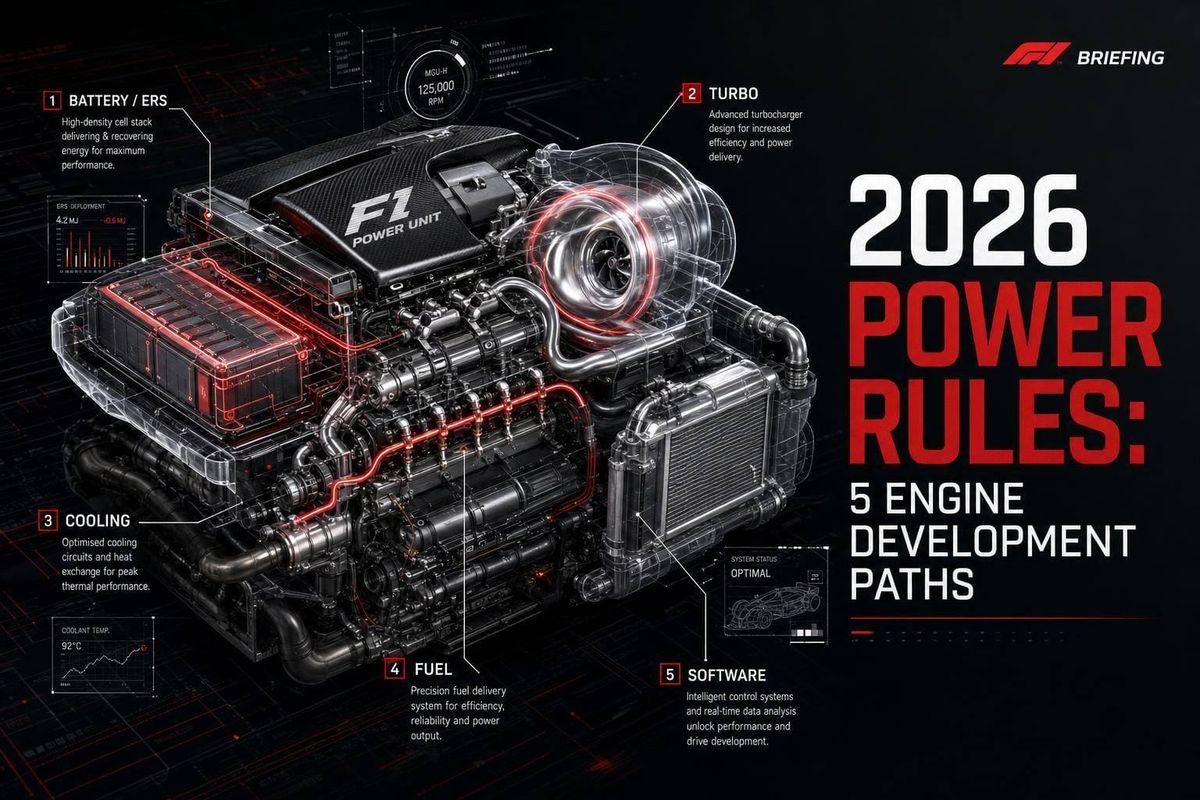
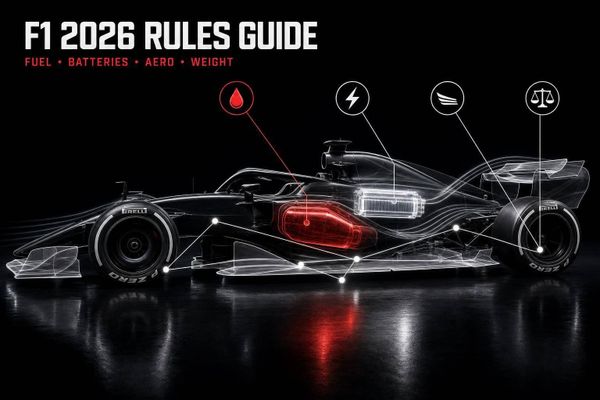
The 2026 F1 engine reset is simple to state and hard to solve: less ICE power, much more electrical power, no MGU-H, and new fuel. That means teams are not chasing one magic fix. They’re picking between five main development paths: battery use, turbo response, cooling, fuel burn, and control software.
Here’s the short version:
- ICE output drops to about 400 kW
- MGU-K output jumps from 120 kW to 350 kW
- Energy recovery climbs from 2 MJ to about 8.5–9 MJ per lap
- Battery temperature has to stay near 113°F to 131°F
- Teams must use 100% advanced fuel
- The biggest gap may come from system control, not peak power
So if I boil the article down, this is the main point: 2026 will reward teams that link power delivery, heat control, fuel behavior, and software better than everyone else. And because works teams can shape the car and power unit together, they start with more room to choose the path that suits them.
Quick Comparison
| Path | Main focus | Main upside | Main problem | Best fit |
|---|---|---|---|---|
| Battery-First Deployment | Use and save electrical energy well | Fewer clipping losses on straights | Battery heat and packaging | Works teams |
| Turbo and Spool Management | Cut lag without MGU-H | Better corner-exit feel | Hard handoff between ICE and MGU-K | Works teams |
| Thermal Control and Cooling | Keep battery and PU in range | More repeatable output | Weight, drag, and heat limits | Works teams |
| Fuel Efficiency | Get more from new fuel chemistry | Better combustion output | Narrower combustion window | Works teams with close fuel partners |
| Software and Control Strategy | Time harvest and deployment well | Lap time without major hardware changes | Bad energy timing and rear instability | Works and customer teams |
If you want one takeaway, it’s this: the fastest 2026 package may not be the one with the best single part - it’ll be the one that makes all five areas work together with the fewest weak spots.
sbb-itb-7c68254
What the 2026 Rules Change for Engine Programs
The 2026 rules turn the power unit into one linked system, not a box of separate parts. That changes how teams build, test, and tune everything.
The ICE drops from roughly 550–580 kW to 400 kW, while the MGU-K jumps from 120 kW to 350 kW. That's a 191% increase in electrical output. On top of that, energy recovery per lap climbs from 2 MJ to approximately 8.5–9 MJ.
Put simply: the old playbook doesn't fit anymore.
Instead of leaning mostly on combustion power, teams now have to treat electrical power, recovery, battery state, cooling, and control software as parts of the same machine. Those limits split development into five distinct paths.
Higher Electrical Share Changes Deployment Priorities
With electrical power sitting near half of total output, battery management becomes one of the main ways to find performance.
It's not just about storing energy. It's about when to harvest, when to deploy, and how to spread that choice over a full lap. A team that gets this wrong may have strong output in one sector and then run short where it hurts most.
Battery temperature is a big part of that puzzle. Cell temperature must stay within 45°C to 55°C (113°F to 131°F) or the system will derate. That means deployment strategy isn't only about speed. It's also about keeping the battery in its working window.
That's why some teams will go battery-first and build much of their setup around energy use and temperature control.
No MGU-H Makes Turbo Response a Bigger Factor
With the MGU-H gone, turbo response becomes a major problem again.
That might sound old-school, but it matters in a big way. Teams now have to balance turbo size against legal anti-lag methods, and that choice affects combustion behavior and heat control at the same time. If the turbo is slow to respond, the car can feel flat on corner exit. If engineers push too hard to fix that, they may create other problems in temperature or driveability.
So while one group may chase battery deployment, others will put most of their effort into turbo response and spool control.
Fuel, Cooling, and Controls Now Work as One System
The move to 100% sustainable fuel adds another layer.
These fuels vaporize and burn differently from conventional blends, so teams can't treat fuel, ignition, and cooling as separate jobs anymore. They have to be developed together. Change one area, and the others move with it.
As Ben Hodgkinson, Technical Director at Red Bull Powertrains, put it:
"Where you'll see daylight is the ICE - how hard you can run it, how cleanly you can burn it, and how well your fuel partner helps unlock that."
That line gets to the heart of it. For some engine programs, fuel efficiency won't just be a support goal. It may become the main source of lap time.
Works Teams and Customer Teams Face Different Constraints
Works teams and customer teams do not start from the same place, and that shapes their choices from day one.
A works team can build the chassis and power unit as one package. That gives it room to line up cooling layout, battery placement, and software logic from the start. A customer team doesn't get that freedom. It receives a pre-defined power unit and has to make the chassis fit around it.
That can create knock-on problems. A larger radiator package can add drag, and software calibration may not line up cleanly with the car's aerodynamic profile. Same rules, same power unit family in some cases, but not the same room to tune the whole package.
| Constraint | Works Teams | Customer Teams |
|---|---|---|
| Cooling design | Integrated from initial concept | Built around supplier PU limits |
| Software control | Fully customized to chassis behavior | Supplier-provided, limited flexibility |
| Fuel partnership | Direct collaboration, such as Red Bull and ExxonMobil | Uses supplier fuel spec |
| PU packaging | Chassis shaped around the power unit | Chassis adapted to a fixed PU architecture |
1. Battery-First Deployment
Battery deployment is the first big split in the road under the 2026 rules. It moves from a supporting piece to a main performance tool. Teams will attack it in different ways, but the ones that get energy use under control should have a built-in edge over the ones that don't.
Performance Upside
The clearest gain with a battery-first setup is avoiding "clipping" - that moment when the energy store runs dry and the car loses nearly 350 kW in the middle of a straight. That's a huge hit.
Teams that build around balanced deployment maps can keep a steady net charge lap after lap instead of going all-in for a single fast run. That matters over a race distance, where repeatable output often beats one-shot pace.
Manual Override Mode also changes the picture. It keeps full 350 kW deployment alive up to 209 mph (337 km/h), while the standard taper begins at 180 mph (290 km/h). In plain English, that gives drivers more time to attack, defend, and finish overtakes before the power falls away.
Integration Challenge
There’s a catch: more electrical use means tighter heat control. And with less room to package everything, battery cooling becomes a major design limit.
That’s why teams are looking hard at dielectric immersion cooling and cold plates. Immersion cooling handles heat well, but it adds weight. Cold plates are lighter, but they can struggle when the battery is under heavy load for long stretches. It's the old trade-off - better heat control or less mass.
Supplier Dependency
Battery-first doesn’t work on hardware alone. The supplier’s control logic has to match the chassis package, or the whole thing starts to fight itself.
For customer teams, that creates a ceiling. They rely on supplier software, so their battery-first pace is shaped not just by the parts they buy, but by how much control they have over integration.
Best-Fit Team Profile
This path suits works teams far more than customers. If a team has a deep electrical program in-house, it has more room to tune the full system.
Mercedes High Performance Powertrains is ahead in high-voltage efficiency and inverter design. Ferrari has moved more effort into electrochemical research. Red Bull Powertrains, working with Ford, is drawing on Ford's EV battery scaling experience to improve deployment timing.
Teams that can't find lap time through battery deployment will have to go hunting somewhere else - turbo response, thermal headroom, or software control.
2. Turbo and Spool Management
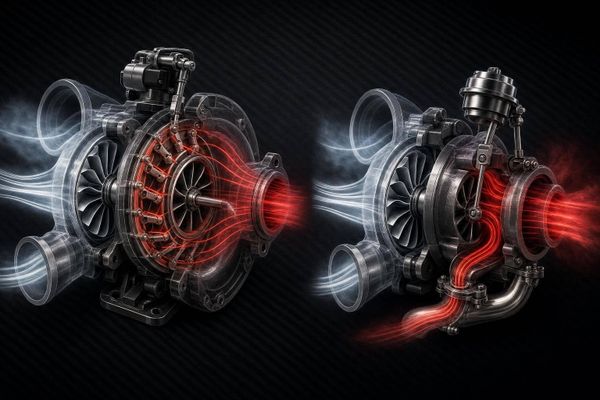
If battery-first is one path, turbo-first is the other. And with the MGU-H gone, turbo response moves right to the center of the fight. In the last era, the MGU-H used exhaust energy to keep the turbo spinning and cut most of the lag. Now the 1.6-liter V6 turbo has to spool on its own, without MGU-H help, which makes corner-exit drivability a much bigger problem.
Performance Upside
The teams that sort out spool management early should have a real edge. This is the mechanical counter to battery-first deployment.
The MGU-K now takes on the torque-fill job, helping cover the gap between throttle input and turbo response. And that’s no small task. At 350 kW, the MGU-K can generate enough reverse torque during harvesting to disturb the rear axle if the transition isn’t clean. That handoff between software and hardware is where small mistakes turn into lost lap time.
Integration Challenge
Spool control now leans on a recharge-under-load cycle. In plain English, the ICE may need to run harder on the straights so the battery can recharge while the car is still at speed.
That sounds simple on paper. It isn’t. Teams have to tune that cycle with the chassis, cooling layout, and fuel chemistry all pulling on the same system at once. The 16:1 compression cap tightens combustion margins, which directly shapes combustion efficiency and the amount of thermal headroom available. Push too hard in one area, and that heat limit starts shutting the door on extra gain.
Best-Fit Team Profile
The teams with the most room to work here are the ones that control the whole power-unit package. Works teams that handle turbo, ICE, and software development in-house have the clearest edge, because they can line up spool calibration, cooling architecture, and control logic from the start.
Customer teams don’t have that same freedom. They can’t easily retune spool response without supplier support, so turbo development stays tied to the original power-unit architecture.
3. Thermal Control and Cooling
Heat is the big cap on 2026 performance. The MGU-K can now recover up to 350 kW under braking, which is almost triple the old limit, and that energy has to be handled fast. The battery pack also needs to stay inside a narrow temperature band to work well. That puts thermal control right at the center of the fight. It can be the difference between one strong lap and a car that can keep doing it lap after lap.
Teams pushing hard in this area want to support aggressive deployment without stuffing the chassis with bigger cooling parts. That’s the balancing act: keep the system cool, but don’t pay for it with extra size, mass, or drag.
Performance Upside
Stable temperatures help preserve full energy recovery and stop derating. If a team can keep the battery in its working range, it can hold output steady instead of watching the system back off once the cells get too hot.
Mercedes is using thermal material expansion to reach an effective 18:1 compression ratio while still staying inside the 16:1 static limit. That idea is estimated to be worth 10 to 15 horsepower, or about 0.3 seconds per lap. The gain comes from thermal control, not combustion rule-bending. The static rule does not change; operating temperature does the heavy lifting.
Cooling also affects packaging. Smaller radiators and tighter cooling ducts can cut parasitic aerodynamic drag. That matters a lot under the 2026 rules, which aim for up to a 40% drag reduction.
Integration Challenge
Dielectric immersion cooling offers the most thermal headroom, but it comes with a weight cost that matters under the 768 kg minimum. In plain terms, every extra kilogram of cooling gear has to earn its keep on track.
Control strategy matters just as much as hardware. Predictive systems need to pre-cool before major braking zones. If the response comes too late, the thermal control unit may derate electrical power to protect the cells. At that point, the team isn’t just losing a bit of efficiency. It’s giving away output exactly when it wants it most.
Supplier Dependency
Works teams can co-design cooling, packaging, and calibration. Customer teams don’t have that same freedom and usually have to live with supplier limits.
Best-Fit Team Profile
Works teams with deep high-voltage systems know-how have the clearest shot here. They can lean on advanced thermal simulation and move faster than customer programs. Once they lock in thermal headroom, the next step is getting more from the fuel itself.
4. Sustainable Fuel Efficiency
Once thermal headroom is under control, fuel chemistry becomes the next bottleneck. The 2026 rules call for 100% sustainable fuels made from second-generation biofuels or e-fuels. That replaces E10 and pushes teams to work with a fuel that carries slightly less energy.
Performance Upside
With the ICE capped at 400 kW, combustion efficiency matters more than ever. Small gains here can add up in a big way. Better combustion chemistry and tighter compression control can unlock 10–15 hp and trim 0.3–0.4 seconds per lap.
That sounds like easy lap time on paper. It isn’t. The gain only shows up if combustion stays stable across the full operating range.
Integration Challenge
Sustainable fuels evaporate differently, and that changes the whole combustion picture. The result is a hotter, less forgiving combustion window.
So this isn’t just a fuel swap. The ICE has to be tuned as one package, with:
- calibration
- cooling
- materials
- ignition hardware
All of those parts need to work together around the new fuel chemistry.
Supplier Dependency
This route is tied closely to fuel partners. Works teams can co-develop fuel blends directly with suppliers like ExxonMobil and squeeze more from the engine hardware.
That matters because fuel isn’t just something you pour into the car anymore. It becomes part of the power unit setup itself.
Best-Fit Team Profile
The clearest edge goes to teams that can develop fuel, combustion, and calibration together. Works teams with strong fuel-partner ties and in-house combustion know-how have more room to tune the full package. Customer teams, by contrast, rely on supplier fuel specs and have less freedom to co-tune around the engine and fuel as a matched set.
From here, software turns fuel efficiency into usable lap time.
5. Software and Control Strategy
Fuel efficiency sets the floor. Software is what turns that into lap time. Under the 2026 rules, the control layer that ties together the battery, ICE, and MGU-K is the big performance lever. It's also the last place where teams can give away time - or find it.
Performance Upside
With the ICE at about 400 kW and the MGU-K at 350 kW, deployment strategy matters just as much as raw combustion output. Software has to keep recalculating the energy plan using live telemetry like track temperature, tire slip, and the wake from the car ahead. That same control logic also shapes how smoothly the car behaves when it transitions under braking.
Two tactics sit at the center of this.
- Burn-and-charge cycling: software coordinates the ICE to run at a higher load than propulsion alone needs, so the car can recharge the battery on straights.
- Manual Override Mode (MOM): a push-to-pass system where software decides when to deploy it. When teams use it well, it becomes a direct overtaking tool.
This is where things get interesting. A car might have the same headline power figures as a rival, but if its deployment logic is cleaner and better timed, it'll feel sharper in the places that matter most: corner exit, braking zones, and wheel-to-wheel moments.
Integration Challenge
The biggest software risk is torque-fill instability. With 350 kW of recovery under braking, the handoff between harvest and drive has to be controlled with great precision. If that change is abrupt, it can upset the rear axle, especially when the energy recovery logic and braking system aren't fully in sync.
Software also has to keep the battery inside a tight operating window. The FIA limits the on-track state-of-charge window to 4 MJ, while harvesting is capped at 8.5–9 MJ per lap. In plain terms, teams need a control map that can hold state of charge steady lap after lap, not just nail one good sector.
That sounds simple on paper. It isn't. The system has to make split-second tradeoffs between deployment, harvesting, drivability, and battery management, all while the car's grip level keeps changing.
Best-Fit Team Profile
This edge leans toward teams that can tune hardware and software as one package. Works teams with deep in-house software and simulation capability can line up control architecture and hardware development more closely than a customer team can. Customer teams will lean more on supplier control architecture, while the last bit of gain comes from chassis-side calibration.
The five paths above each come with a different cost and a different ceiling - the table below puts them side by side.
Side-by-Side Look at the Five Paths
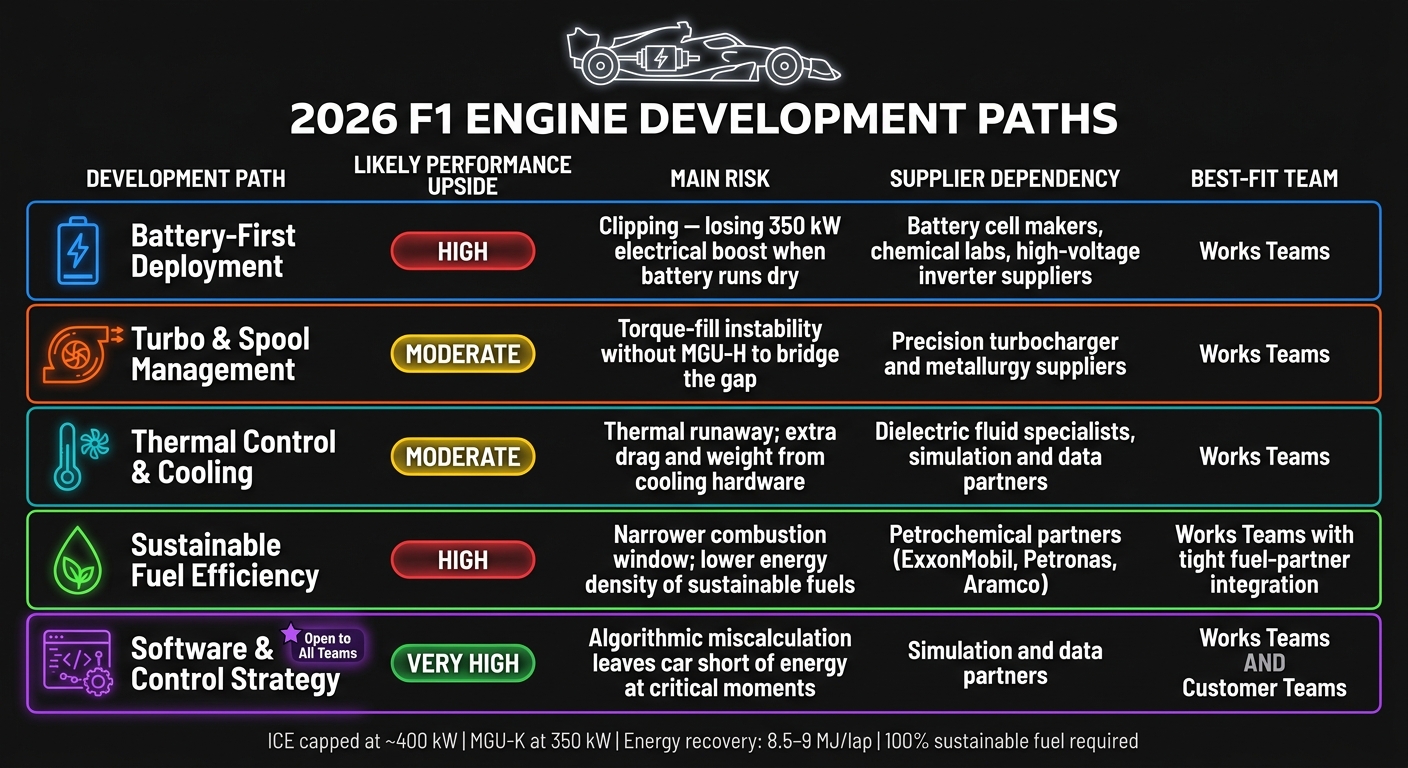
F1 2026 Engine Development Paths: 5 Strategies Compared
These five paths each ask for a different balance of hardware control, supplier backing, and risk.
Put simply: some paths lean hard on in-house engineering, while others depend more on outside partners. Some offer bigger lap-time gains, but they also come with sharper downsides if things go wrong.
The table below pulls those trade-offs into one view, covering upside, risk, supplier dependency, and the kind of team most likely to make each path work.
| Development Path | Likely Performance Upside | Main Risk | Supplier Dependency | Best-Fit Team Profile |
|---|---|---|---|---|
| Battery-First Deployment | High - strongest when deployment stays flat through long straights | Clipping: losing electrical boost when the battery runs dry | Battery cell manufacturers, chemical labs, and high-voltage inverter suppliers | Works teams |
| Turbo and Spool Management | Moderate - best on corner exit and throttle pickup | Torque-fill instability without the MGU-H to bridge the gap | Precision turbocharger and metallurgy suppliers | Works teams |
| Thermal Control and Cooling | Moderate - pays off through sustained output | Thermal runaway risk, plus aerodynamic drag and weight from cooling hardware | Dielectric fluid specialists and simulation and data partners | Works teams |
| Sustainable Fuel Efficiency | High - combustion efficiency can unlock real lap time | Regulatory or legal challenges, plus lower energy density | Petrochemical partners such as ExxonMobil, Petronas, and Aramco | Works teams with tight fuel-partner integration |
| Software and Control Strategy | Very high - smarter deployment can recover time without new hardware | Algorithmic miscalculation can leave the car short of energy at the worst possible moment | Simulation and data partners | Works teams and customer teams |
A clear pattern shows up here. The four hardware-heavy paths mostly favor works teams because they need tighter links between engine design, packaging, cooling, and suppliers. Software and Control Strategy stands out a bit. It still depends on strong simulation and data support, but it gives both works teams and customer teams more room to compete without building a whole new hardware stack.
That difference matters. Hardware can take months to rework. Control logic can change much faster, which makes software one of the few areas where a team may find time without waiting on a full parts cycle.
Conclusion
In practice, the 2026 rules reward integration, not peak output. A capped ~400 kW ICE and 350 kW MGU-K only pay off when combustion, cooling, and deployment work as one system.
What separates teams is execution fit - how well a chosen development path lines up with what a team can actually build and run. That’s why control systems matter just as much as hardware. The edge will come from how well teams connect the ICE, fuel, and deployment software. Early 2026 running already shows that energy management can split apart power units that look very similar on paper.
As 2026 develops, each of the five paths offers a different answer to the same set of limits. Teams that matched their path to their actual strengths will move forward. Teams that picked the wrong route will spend 2026 managing trade-offs instead of finding pace.
FAQs
Why is software so important under the 2026 rules?
Under the 2026 rules, software matters because performance comes down to managing the 50:50 split between the internal combustion engine and electric power.
That means the software has to control battery state of charge, energy harvesting, and deployment while staying inside a strict per-lap energy limit. Get that balance wrong, and the car leaves lap time on the table.
It also helps stop clipping on straights and handles thermal management by predicting heavy braking zones and overheating before they become a problem.
Put simply, software is what turns the battery system from a pile of hardware into lap-time performance you can actually use.
Which of the five development paths is most likely to create the biggest performance gap?
Software control for energy management is the area most likely to open up the biggest performance gap under the 2026 rules.
With the MGU-H gone, teams will have to work within a tougher rear-axle energy recovery limit. That puts battery management front and center. The edge will likely go to the teams with the best predictive software: the ones that can avoid clipping, time deployment well, and keep the car efficient over a race stint.
Others may find that much harder, especially when it comes to race pace and long-run efficiency.
Why do works teams have a bigger advantage than customer teams in 2026?
In 2026, works teams have a bigger edge because the power unit is built into the whole car package. It isn't just a separate engine dropped into a chassis. The chassis, cooling, and software all have to work in sync, and performance comes from that mix, not just raw engine output.
Works teams can build and tune that full package in-house. Customer teams have a tougher job. They need to fit a supplied engine to their own car, which can make packaging, thermal management, efficiency, and reliability harder to dial in.