Challenges of Reducing Battery Weight in F1
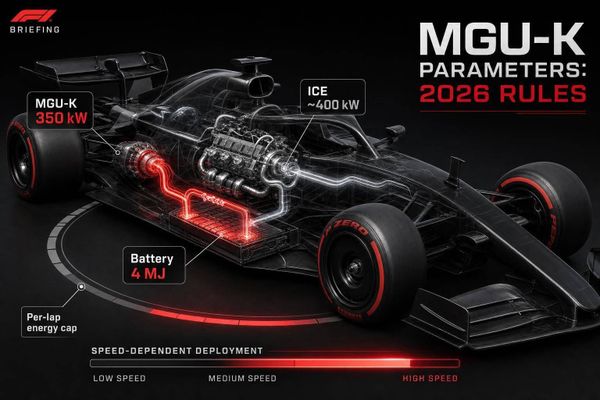
2026 F1 rules make cutting battery weight harder: heavier power units, 350 kW MGU‑K, greater heat, strict safety and tight packaging.
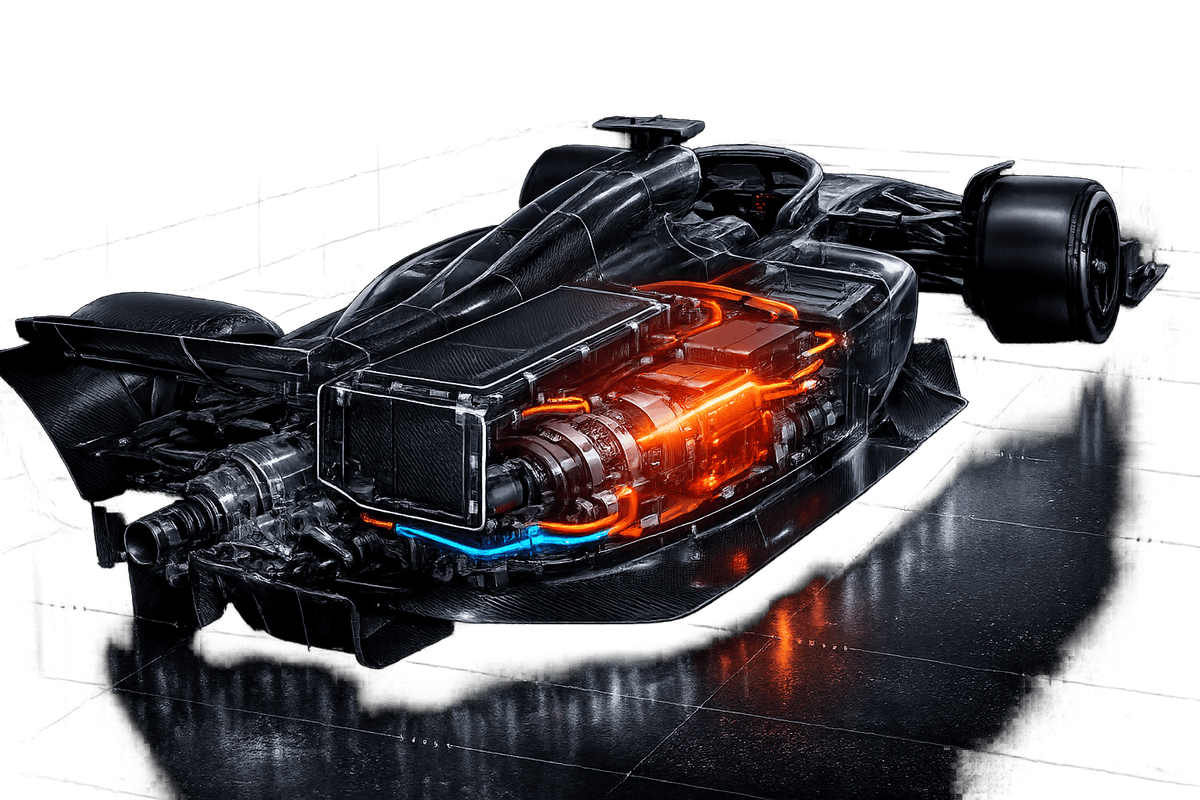
Reducing battery weight in Formula 1 is harder than ever under the 2026 rules. Teams face a tough situation: they must cut weight to meet the new 768 kg minimum car weight, while the power unit itself has gotten 34 kg heavier due to larger batteries and increased output demands. The MGU-K now delivers 350 kW - nearly triple its previous output - forcing batteries to handle more energy, heat, and stress.
Key issues include:
- Weight vs. performance: A heavier car slows lap times, reduces handling, and wears out tires faster.
- Thermal management: Batteries generate more heat due to higher power output, requiring advanced cooling systems that add weight back.
- Safety and regulations: Stricter crash and fire safety standards further complicate efforts to reduce weight.
Teams are addressing these challenges by using lightweight materials like carbon fiber for battery casings, improving cell designs to boost energy density, and integrating batteries more efficiently into the car's structure. However, balancing performance, safety, and weight remains one of the most difficult engineering tasks in modern F1.
Active Aero, Weight Reduction and More - 2026 F1 Regulations: You Asked, We Answered
sbb-itb-7c68254
Why Battery Weight Matters in F1
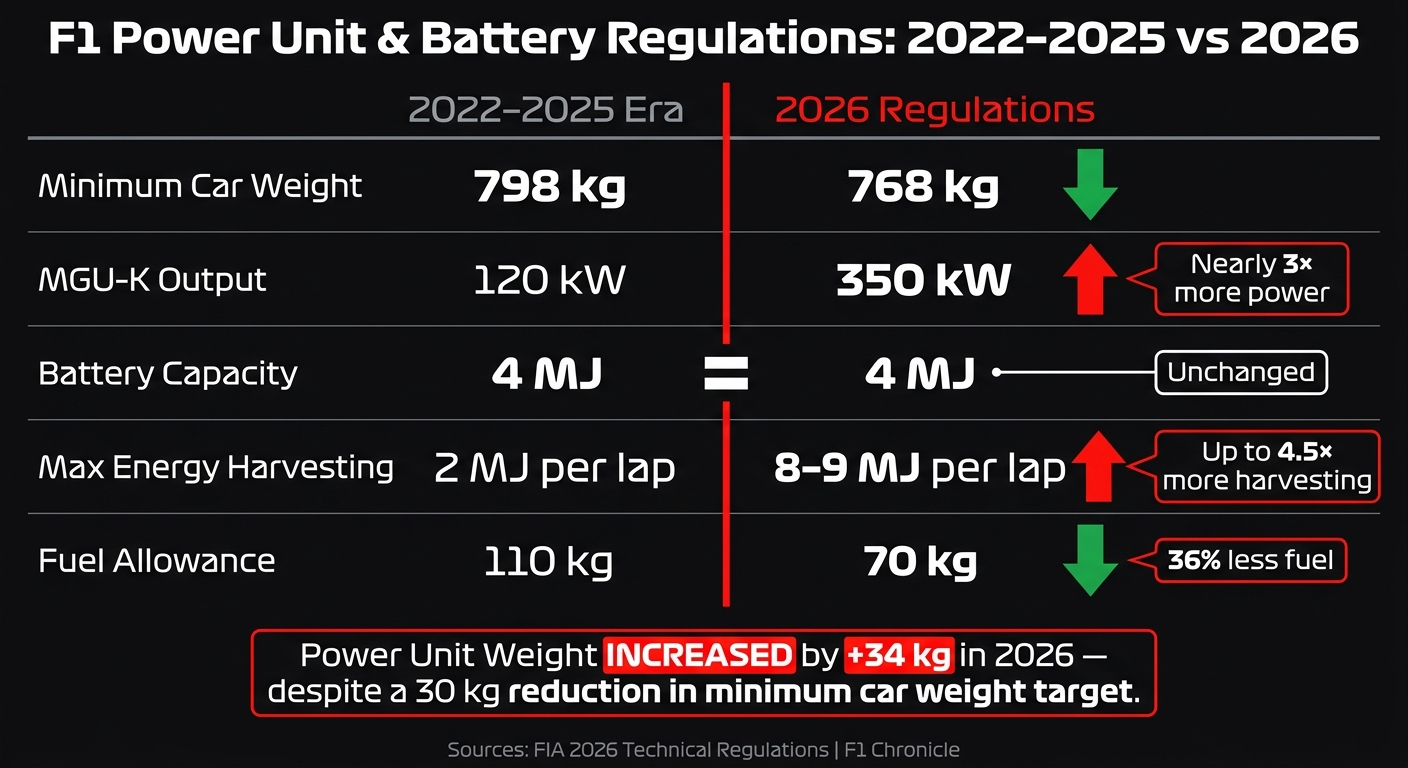
F1 Battery & Power Unit: 2022–2025 vs 2026 Regulations Compared
Weight is a crucial factor in F1 car design because every extra pound can cost valuable time on the track. Reducing battery weight isn't just about improving speed - it's also about addressing broader engineering challenges, especially under the new 2026 regulations.
How Battery Weight Affects Car Balance and Handling
Journalist Jarrod Partridge explains the impact of weight on an F1 car:
"A heavier car requires more force to accelerate to a given speed, corners more slowly because the tire contact patches bear increased load, reducing lateral grip, and brakes from high speed with more kinetic energy to dissipate."
When a car is heavier, it puts additional strain on the tires, causing them to wear out faster and limiting the window for optimal performance. While engineers can use ballast to fine-tune the car's balance, this is only possible if the car's total weight is below the 768 kg minimum. If it exceeds that limit, weight distribution becomes locked by the car's structure.
The 2026 rules make this even trickier. With downforce reduced by about 30% compared to the 2022–2025 era, cars are more prone to sliding. A heavier battery exacerbates these handling issues. As Mercedes' Bradley Lord put it:
"The cars are sliding a little bit more in the corners... [they] look more fun and entertaining for the drivers."
This highlights the delicate balance engineers must strike between energy capacity and weight.
The Trade-Off Between Energy Storage and Weight
The trade-off is straightforward: more energy storage enhances straight-line speed but adds weight, which slows the car in corners. For 2026, the MGU-K output jumps to 350 kW - nearly triple the 120 kW of the previous era. At the same time, the battery can drain about three times faster than before.
However, teams can't simply increase battery size to compensate. A larger battery adds significant weight, which negatively affects every aspect of the car's performance. McLaren's Chief Designer Rob Marshall explained:
"The new energy stores are bigger than last year's, and that, to some extent, fixes the car's length."
The 2026 fuel allowance reduction - from 110 kg to 70 kg - provides some relief by offsetting the battery's weight penalty at the start of a race. But as fuel burns off during a stint, the battery's weight becomes a larger proportion of the car's total mass, further influencing handling and tire performance.
| Parameter | 2022–2025 Era | 2026 Regulations |
|---|---|---|
| Minimum Weight | 798 kg | 768 kg |
| MGU-K Output | 120 kW | 350 kW |
| Battery Capacity | 4 MJ | 4 MJ |
| Max Energy Harvesting | 2 MJ per lap | 8–9 MJ per lap |
| Fuel Allowance | 110 kg | 70 kg |
Engineering Challenges in Cutting Battery Weight
Balancing power output with weight reduction is no small feat. Engineers must juggle competing demands like performance, heat management, and safety - each of which adds weight to the design. Cutting battery weight isn’t just about using less material; it’s about finding ways to meet performance goals, manage heat effectively, and comply with strict regulations all at once. These challenges primarily revolve around energy density, thermal management, and regulatory constraints.
Energy Density and Power Output Limits
To maintain a 50/50 power split between the internal combustion engine and the electric motor, engineers need battery cells capable of handling up to 9 MJ of electrical harvesting per lap. Meeting this performance standard while keeping the design lightweight is a significant challenge. High-energy-density cells, while powerful, generate considerable heat during rapid charge and discharge cycles. This necessitates the inclusion of cooling systems, which unfortunately add weight back into the vehicle. It’s a constant balancing act between achieving high performance and managing the additional mass from cooling hardware.
Thermal Management and Safety Requirements
Heat management is another critical hurdle. As journalist Jarrod Partridge highlighted:
"A 350kW MGU-K operating at typical efficiencies... generates heat at rates that are substantially higher than the 120kW unit it replaced."
Even with 95% efficiency, a 350 kW motor produces around 17 kW of waste heat, which must be dissipated immediately to avoid thermal runaway. To address this, teams are increasingly adopting dielectric cooling. This method uses an electrically non-conductive fluid that directly contacts the battery cells, operating at temperatures around 122°F (50°C). While more effective than traditional liquid cooling systems, this approach brings its own challenges. It requires pumps, heat exchangers, and piping, all of which add weight. On top of that, managing separate dielectric circuits alongside the engine’s water-glycol and intercooler systems increases the risk of cross-contamination, further complicating the design.
FIA Regulations and Durability Demands

Regulatory requirements add yet another layer of complexity. The FIA has announced a reduction in the minimum car weight from 798 kg to 768 kg for 2026. However, added safety measures and a 34 kg increase in power unit weight mean the total mass could rise by as much as 64 kg. Technical writer Giorgio Piola explains:
"Advances in safety, with more stringent roll hoop tests and the new two-stage frontal crash test, have added further mass. The result is a total weight increase of approximately 64 kg."
This discrepancy between the FIA’s weight reduction target and the reality of building a safe, high-performance hybrid car makes reducing battery weight one of the toughest engineering challenges for the 2026 grid. Engineers must find ways to navigate these constraints without sacrificing safety or performance.
How F1 Teams Are Building Lighter Batteries
F1 teams are making strides in reducing battery weight despite strict weight limits. They're achieving this through smarter material choices, advanced cell engineering, and better integration with the car's chassis. The process starts with rethinking how the battery is built from the outside in.
Lightweight Materials and Casing Design
One key focus is the battery casing. Teams are switching to carbon fiber composite materials, which are both lighter and strong enough to handle the demands of racing. The 2026 car dimensions - featuring a shorter wheelbase of 3,400 mm and a reduced width of 1,900 mm - mean less overall material is needed. This frees up weight specifically for the battery system. Jarrod Partridge, Co-Founder of F1 Chronicle, breaks it down:
"A shorter wheelbase means a shorter chassis tub, shorter floor structure, and shorter sidepod assemblies, each of which uses less carbon fibre composite material than the longer equivalents."
Improved Cell Designs for Lower Mass
At the cell level, engineers are tackling increased energy recovery demands. The system now needs to handle up to 8–9 MJ of energy recovery per lap - four times the 2 MJ limit that applied from 2014 to 2025. Additionally, the MGU-K output has jumped from 120 kW to 350 kW, requiring the cells to charge and discharge much faster than before.
To meet these demands, teams are refining cell chemistry and electrode designs, aiming to boost power density without adding unnecessary weight. These advancements also help with thermal management, as more efficient electrodes generate less waste heat. However, higher-performance cells tend to run hotter, keeping cooling systems a critical part of the design equation. McLaren's Chief Designer Rob Marshall highlights the challenges of packaging these larger energy stores:
"The new energy stores are bigger than last year's, and that, to some extent, fixes the car's length... you've probably only got 150 to 300 millimetres of the car length that you can really control."
Fitting the Battery Into the Chassis
The placement of the battery within the car is just as important as its design. Teams aim to keep the car's total weight under the 768-kg limit while leaving room for ballast adjustments. This allows for fine-tuning the car's front-to-rear weight distribution to improve handling.
The tighter chassis dimensions planned for 2026 demand a well-thought-out integration of the battery. With fixed engine and gearbox sizes taking up much of the car's space, the battery must fit seamlessly into a defined area. This approach forces teams to treat the battery not as an add-on but as a core structural component designed alongside the chassis. By doing so, they address earlier concerns about weight balance and performance.
Managing Cooling, Safety, and Weight Together
Addressing battery weight reduction is just one part of the equation. Teams must also ensure the battery stays cool, meets fire safety standards, and survives crashes - all without undoing the progress made in shedding weight.
Thermal Management Systems
The switch to a 350 kW MGU-K brings a significant rise in waste heat, which pushes traditional cooling methods to their limits. This has led teams to adopt dielectric cooling, a system that uses an electrically non-conductive fluid circulating directly over the battery cells. This approach improves heat extraction without requiring excessive space. As Jarrod Partridge, Co-Founder of F1 Chronicle, explains:
"Dielectric cooling uses an electrically non-conductive fluid that can be circulated directly in contact with the cell surfaces... achieving better thermal contact and higher heat extraction rates per unit of packaging volume."
These systems operate at around 50°C (122°F) and rely on specialized heat exchangers. While maintaining fluid purity adds complexity, dielectric cooling offers a compact and lightweight solution to thermal challenges.
As cooling systems improve, teams must also navigate strict crash and fire safety standards.
Fire Protection and Crash Safety
Efficient cooling alone isn’t enough to meet FIA safety standards. Batteries must also comply with rigorous structural and fire safety requirements. For instance, 2026 regulations demand that cars pass a 20g load test for the roll hoop, and battery housings must endure crash forces without compromising the cells inside.
These safety measures inevitably add weight. In fact, the minimum weight for the 2026 power unit has increased by 34 kg (about 75 lbs) compared to previous designs, largely due to the larger battery and the materials needed for its protective systems - even with the removal of the MGU-H. Engineers now face the challenge of balancing these safety demands with the goal of reducing weight.
An incident at the Japanese Grand Prix highlighted the importance of consistent power damping protocols at high speeds. GPDA chairman Alex Wurz emphasized:
"From a safety standpoint, we simply must prohibit sudden surges in power output at top speed. This will require software that is uniform across all teams."
As a result, power output is now gradually reduced from 290 kph to zero at 355 kph to manage collision energy effectively.
Future Regulations and Battery Design Directions
How FIA Rule Changes Could Affect Battery Design
The upcoming 2026 regulations are pushing teams to rethink their battery designs. These new rules build on earlier challenges, particularly the need to balance energy demands with strict weight limits. The most significant change is the shift to a 50:50 power split between the internal combustion engine and electric power - up from the previous 80:20 ratio. This adjustment means the MGU-K will now deliver 350 kW, nearly triple its prior 120 kW output. Such a dramatic increase impacts every aspect of battery design.
Adding to the complexity, teams must work within fixed car dimensions, leaving little room for battery integration. To offset the 34 kg (75 lb) weight increase of the power unit, the FIA introduced the "Nimble Car Concept." This initiative reduces the minimum car weight by 30 kg, bringing it to 768 kg, and shortens the maximum wheelbase from 3,600 mm to 3,400 mm. McLaren has taken this concept even further with its MCL40, designing it to be about 6 inches (15 cm) shorter than the regulatory limit, saving additional weight in the chassis.
In addition to these structural adjustments, the FIA has been fine-tuning energy recovery rules during the season. For instance, the energy harvesting limit during qualifying was lowered from 8 MJ to 7 MJ per lap. This change aims to address "super-clipping", where cars slow abruptly on straights while harvesting energy. These mid-season tweaks indicate that battery performance regulations remain a work in progress. Moving forward, future regulation cycles are expected to continue reshaping how teams manage and design their energy systems, paving the way for advancements in battery efficiency and lighter designs.
New Technologies on the Horizon
Beyond regulatory changes, emerging technologies are opening new doors for improving battery performance and reducing weight. One standout advancement is dielectric cooling, which has become the standard. Operating at around 122°F (50°C), this method efficiently extracts heat without requiring bulky hardware. As teams refine these systems, they’re focusing on cutting down fluid volume and minimizing heat exchanger size, which could lead to even more weight savings.
Active aerodynamics is another area making a big impact. Ferrari, for instance, has designed a 2026 rear wing capable of fully rotating its upper element upside down in straight-line mode. This reduces aerodynamic drag significantly - a response to the 4 MJ usable energy cap. Lower drag means less energy is needed to maintain top speeds, which eases the workload on the battery. Ferrari driver Lewis Hamilton captured the complexity of these advancements perfectly:
"It's ridiculously complex. I sat in a meeting the other day and they're taking us through it, and it's like you need a degree to fully understand it all."
Smaller, smarter changes are also playing a role. With tighter packaging rules, improved energy management software, and innovations like active aerodynamics, teams are finding opportunities to shave off weight and improve efficiency. Incremental gains in these areas, combined with evolving regulations, will continue to shape what’s achievable in battery technology.
Conclusion: Engineering Precision in Battery Weight Reduction
Cutting down battery weight in F1 is a balancing act, where every gram saved introduces its own set of hurdles. The 2026 regulations push this challenge even further: the minimum car weight will drop by 30 kg (66 lbs) to 768 kg, while the power unit itself will weigh 34 kg (75 lbs) more than before. As Giorgio Piola, a technical illustrator, aptly described:
"Meeting this minimum mass parameter has been a true nightmare, especially considering that 10kg of weight can cost from 2 to almost 4 tenths of a second per lap."
Teams are tackling these obstacles with creative engineering. Take McLaren's MCL40, for instance - it features a compact design achieved by refining its gearbox casing and spacer assembly. This kind of meticulous attention to detail sets competitive teams apart.
On top of such innovations, removing the MGU-H eliminates related components like inverters, cabling, and cooling systems in one go. When paired with narrower tires, a reduced fuel load of 70 kg (down from 110 kg), and streamlined car dimensions, these changes contribute to a lighter overall car mass. Each improvement - whether it's a compact chassis, fewer components, or better energy systems - works as part of a larger strategy where advancements in one area enhance performance across the board.
The essence of this engineering lies in balancing weight, cooling, safety, and energy management, all while staying within FIA regulations. It's precision at its finest.
FAQs
Why can’t F1 teams just use a bigger battery in 2026?
In 2026, Formula 1 teams are restricted from using larger batteries because regulations cap usable energy at 4 megajoules. On top of that, the required reduction in wheelbase - from 360 cm to 340 cm - along with fixed dimensions for key components like the engine and gearbox, significantly reduces the available space. These strict design rules make accommodating larger batteries impossible.
What makes the 2026 battery and MGU-K run hotter?
The 2026 power units will operate at higher temperatures due to the MGU-K's output increasing dramatically from 120kW to 350kW, which significantly raises the electrical load. With battery capacity limited to 4 megajoules, teams are forced to depend on intense energy recovery methods, such as aggressive braking and super clipping. Additionally, the elimination of the MGU-H places all energy recovery responsibilities on the MGU-K, creating considerable thermal stress throughout the system.
What battery tech changes could cut weight without hurting safety?
Reducing battery weight without sacrificing safety hinges on advancements in thermal management rather than simply making batteries smaller. With 2026 regulations demanding larger energy capacities, teams are turning to dielectric cooling. This method uses non-conductive fluid to flow around battery cells, efficiently pulling heat away. Compared to traditional cooling techniques, this approach offers superior thermal control, allowing for higher performance while maintaining the structural integrity of the cells. F1 Briefing dives into how teams are tackling these technical and regulatory hurdles.