Redundancy in Telemetry: Key Design Principles
Multi-layer backups, automatic failover, and fault detection that keep Formula 1 telemetry reliable and compliant under 2026 rules.
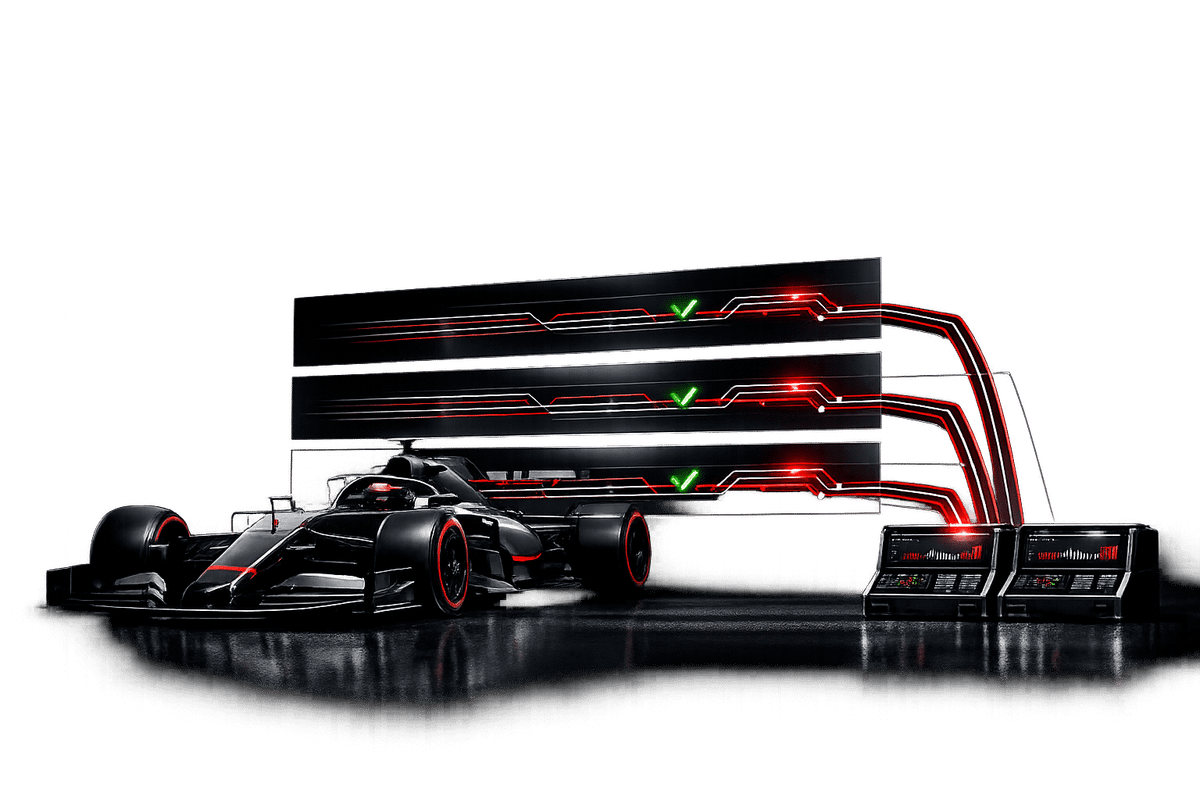
Telemetry redundancy in Formula 1 is all about ensuring data reliability during races. With cars generating massive amounts of real-time data, any interruption can lead to missed strategic opportunities or mechanical failures. Here's the core idea: eliminate single points of failure, build multi-layered backups, and automate fault recovery.
Key takeaways:
- Why it matters: Telemetry drives strategy, energy management, and car health monitoring. A single data gap can ruin analysis or decisions.
- How it works: Teams use dual-site setups (trackside and remote), high-frequency sampling, and independent FIA backups to protect data.
- Design principles: Redundancy is applied at every level - disk, server, and site - to avoid system-wide failures.
- New challenges in 2026: With stricter energy rules (50/50 ICE-electric split), active aerodynamics, and more electrical power, telemetry systems must handle greater complexity.
The article dives into strategies inspired by aerospace, telecom, and cloud systems to ensure Formula 1 telemetry remains reliable, even under extreme conditions.
Episode 54: Fault Tolerance, Redundancy, and High Availability
sbb-itb-7c68254
Core Design Principles for Redundant Telemetry Storage
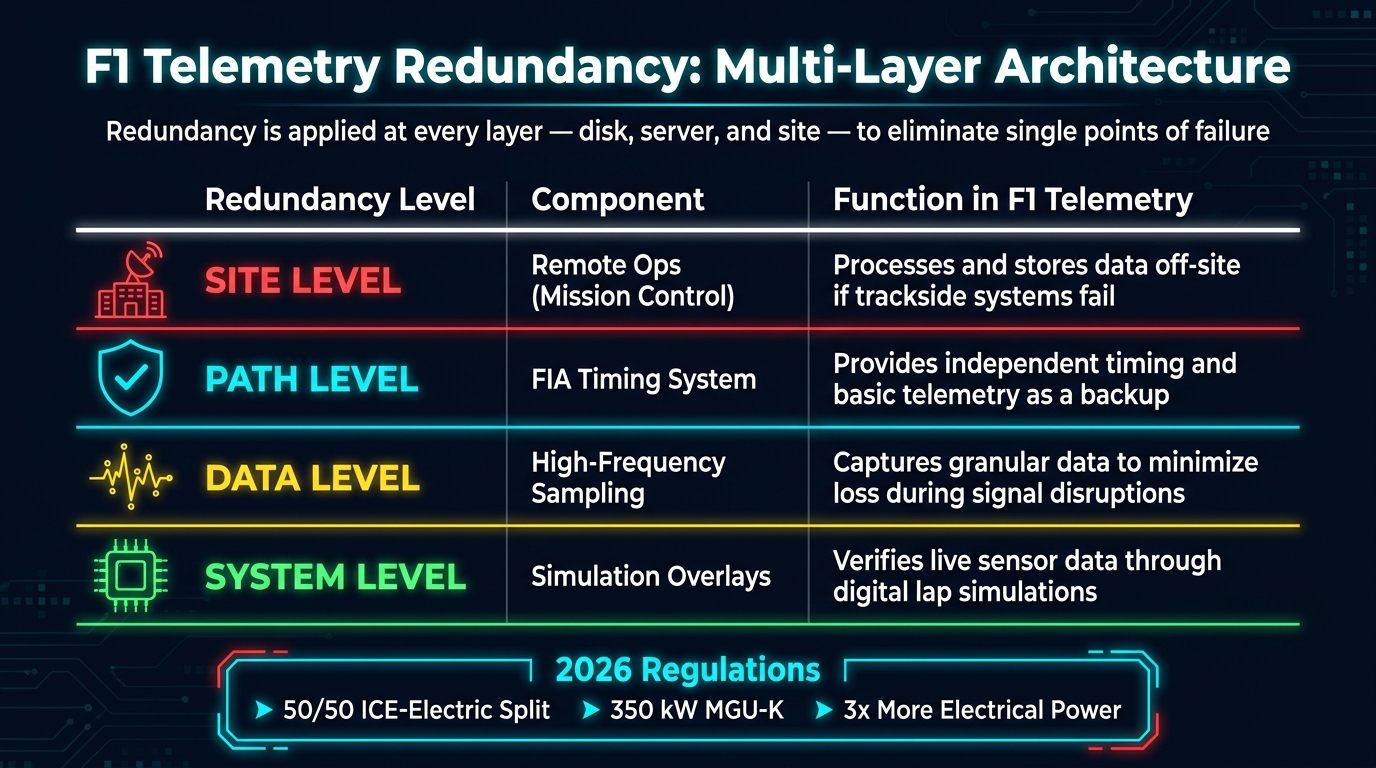
F1 Telemetry Redundancy: Multi-Layer Architecture Explained
Effective telemetry storage in Formula 1 relies on carefully planned architecture to manage data flow, ensure secure storage, and handle potential system failures.
Removing Single Points of Failure
A single point of failure (SPOF) refers to any system component whose breakdown could jeopardize the entire operation. In F1 telemetry, SPOFs often include trackside servers or the communication links between the garage and the factory.
To address this, teams commonly employ a dual-site architecture, splitting operations between the trackside garage and a remote operations center (often called "Mission Control") at the home base. This setup ensures that if trackside systems fail, the factory can seamlessly take over data processing and storage. Additionally, the FIA timing system independently records a subset of telemetry, acting as a backup source when proprietary communication links falter.
"How F1 pit wall teams use radios, telemetry, strategists, and remote ops to make split-second race decisions." - F1 Insights
High-frequency sensor sampling adds another layer of protection. By capturing data at extremely high rates across numerous channels, it minimizes the impact of brief transmission interruptions. Combined with SPOF mitigation, multi-layer redundancy provides a robust safety net for telemetry.
Multi-Layer Redundancy in Storage Architectures
Eliminating SPOFs is only part of the solution. True reliability in F1 telemetry demands redundancy across multiple operational layers. This includes protection at the disk level (redundant hardware within servers), the node level (multiple servers managing the same data), and the site level (trackside versus factory).
Here's how redundancy plays out in F1 telemetry:
| Redundancy Level | Component | Function in F1 Telemetry |
|---|---|---|
| Site Level | Remote Ops (Mission Control) | Processes and stores data off-site if trackside systems fail |
| Path Level | FIA Timing System | Provides independent timing and basic telemetry as a backup |
| Data Level | High-Frequency Sampling | Captures granular data to minimize loss during signal disruptions |
| System Level | Simulation Overlays | Verifies live sensor data through digital lap simulations |
The 2026 regulations have heightened the importance of this multi-layered approach. With the introduction of a 50/50 internal combustion engine (ICE) and electric power split and a 350 kW MGU-K, the volume of telemetry from electrical systems has surged. Additionally, active aerodynamics - where movable wings adjust for straight-line speed or cornering - require constant monitoring to ensure performance and safety.
Balancing Consistency, Latency, and Replication
Telemetry storage must balance competing priorities: real-time data access for the pit wall and complete, consistent records for the factory. Even a one-second delay can impact race-day decisions, while incomplete data undermines long-term analysis.
The solution lies in prioritizing these needs separately. Trackside storage focuses on low latency, tolerating minor inconsistencies to deliver data instantly. In contrast, factory storage prioritizes data integrity, using asynchronous replication to ensure a complete dataset is transferred, even if it arrives with a slight delay. This division protects both immediate race strategy and the comprehensive data engineers need for analysis.
As Dan Fallows explains, managing this balance has become even more complex under the 2026 regulations:
"In 2026, we have added a great deal of complexity to that process, with the modes of operation of the car and possible differences in energy recovery and deployment with the power unit." - Dan Fallows, F1 Engineer
Striking the right balance between speed and accuracy remains a core challenge in modern telemetry design, ensuring teams can react in the moment while building a reliable foundation for future performance.
Fault Detection and Automatic Failover
In Formula 1, ensuring telemetry continuity isn't just about having robust storage; it's also about detecting faults quickly and implementing automatic responses to keep systems running smoothly.
Health Monitoring and Fault Isolation
Telemetry systems thrive on catching problems early. In F1, the Standard ECU (SECU) is the backbone of this process. It constantly monitors critical data points like throttle position, steering angle, and differential behavior, flagging any mismatches between what the driver inputs and how the hardware responds.
"The FIA monitors compliance through the telemetry data streams that the Standard ECU provides, checking that the differential behavior is consistent with the permitted input signals rather than responding to direct wheel spin detection." - Jarrod Partridge, Co-Founder, F1 Chronicle
High-frequency sensor sampling allows engineers to zero in on issues with incredible precision. Instead of losing visibility across the entire vehicle, they can pinpoint the exact sensor or subsystem causing the problem. Once identified, automated systems step in to handle the response.
Automated Failover Processes
When a fault is detected, automation ensures the system continues to function without skipping a beat. Take the brake-by-wire (BBW) system in 2026 F1 cars as an example. This system integrates mechanical calipers with MGU-K regenerative braking using electronic signals. If the electronics fail, regulations mandate that a minimum level of mechanical braking automatically kicks in to maintain safety.
"The regulations specify the minimum level of mechanical braking that must remain available at the rear wheels at all times, ensuring that a failure of the electrical system does not remove all rear braking capability." - Jarrod Partridge, Co-Founder, F1 Chronicle
Meanwhile, telemetry data is continuously sent to both the garage and the FIA timing system. If one pathway fails, the other immediately takes over, ensuring no loss of critical data. This automatic rerouting happens seamlessly, without requiring manual intervention.
Reducing Common-Mode Failures
A common-mode failure occurs when a single issue - like a software glitch, power surge, or faulty hardware - knocks out multiple systems simultaneously. The 2026 regulations tackle this risk head-on, particularly in the braking system, by requiring separate hydraulic circuits for the front and rear brakes. This design ensures that if one circuit fails, the other remains fully operational.
The same principle applies to data systems. By diversifying physical locations, hardware, and software, F1 teams minimize the chances of simultaneous failures. This approach is critical, especially with 2026 power units generating nearly three times more electrical power than earlier models. These precautions are vital not just for race-day reliability but also for preserving data integrity for post-race analysis.
Case Studies: Redundancy Design in Practice
Building on the earlier design principles, let’s explore how redundancy has been implemented across aerospace, telecom, and cloud systems. These examples show how systems designed with failure in mind can ensure reliability. F1 teams can take valuable lessons from these applications to strengthen their own telemetry systems.
Redundancy in Aerospace Telemetry
In aerospace, data loss simply isn’t an option. Missions rely on a layered redundancy approach, incorporating backup systems at every stage - sensors, storage, and transmission. This ensures that even if one component fails, critical data remains intact. It’s a practical example of the multi-layered storage architecture discussed earlier, proving its effectiveness in high-pressure environments.
This strategy is a reminder for F1 teams that redundancy isn’t just about backups - it’s about creating a system where no single failure can derail operations. By adopting similar practices, teams can ensure their telemetry data is always available, even in the face of unexpected challenges.
Telecom and Network Redundancy Practices
Telecom networks handle massive amounts of data by using techniques like multi-path routing, where data packets are sent along multiple independent routes simultaneously. F1 teams already use a comparable method in their remote operations model. Telemetry data is transmitted both to the trackside garage and a remote operations center. If one connection weakens, the other ensures engineers can still make real-time decisions. This directly reflects the dual-site architecture principle highlighted earlier.
However, while telecom systems prioritize throughput for many users, F1 telemetry has unique demands. It requires extremely high-frequency sampling to capture split-second events, such as throttle adjustments or braking during a corner. Redundancy solutions in this context must maintain both data accuracy and availability, ensuring no critical moment is missed.
High-Availability Storage in Cloud Systems
Cloud providers like Amazon Web Services and Google Cloud have set the standard for fault-tolerant storage by replicating data across multiple geographic zones. This approach ensures that even if hardware fails in one location, the system as a whole remains operational. F1 teams face a similar challenge, especially with 2026 regulations requiring real-time monitoring of MGU-K energy harvests, capped at 9 megajoules (MJ) per lap. The Standard ECU must continuously log this data, and any storage gap could lead to compliance issues.
Beyond regulatory needs, cloud-inspired redundancy also supports digital lap simulations. These simulations depend on large, uninterrupted datasets from past telemetry sessions. Without fault-tolerant storage, the insights gained from these simulations - and the car development decisions based on them - would be at risk. This underscores why robust redundancy is essential for F1 teams to maintain both performance and compliance in their operations.
Conclusion: Best Practices and What Comes Next
After diving into design strategies, fault management, and practical applications, the road ahead for telemetry redundancy in Formula 1 is becoming much clearer.
Key Takeaways for F1 Teams
The main takeaway is simple: critical telemetry data cannot rely on a single component. To meet the demands of 2026, teams must eliminate single points of failure and implement layered redundancy across both storage and transmission systems. With the upcoming regulations requiring real-time monitoring of a 350 kW MGU-K and a 7 MJ-per-lap energy strategy, even a brief data gap could have serious consequences.
Ensuring redundancy in energy deployment systems is essential under these rules. As Dan Fallows pointed out, the accuracy of performance analysis directly depends on the quality of the data and simulations driving it.
These strategies lay the groundwork for integrating cutting-edge technologies into the world of telemetry redundancy.
Emerging Trends in Telemetry Redundancy
Building on these principles, several trends are reshaping telemetry redundancy. Three stand out:
- AI-driven predictive fault management: AI is no longer just a concept. Teams are already using it to analyze pit lane tools and car performance in real time, and now it's being extended to monitor telemetry systems for potential faults.
- Digital lap simulations: These are becoming an essential tool for diagnosing issues. In April 2026, Red Bull's Dan Fallows explained how simulations are used to "replay" laps with altered engine parameters, helping teams pinpoint whether problems stem from the power unit or the chassis.
- Active aerodynamics: With the introduction of active aerodynamics in 2026, telemetry systems must now manage redundant fail-safes for movable front and rear wings. These wings dynamically adjust between straight-line speed and cornering modes, adding a whole new layer of complexity.
Final Thoughts
The principles discussed here make one thing clear: redundancy in telemetry isn't just a safeguard - it's the foundation. As the 2026 power unit overhaul pushes teams to balance a 50/50 split between internal combustion engines and electric power, the sheer volume and complexity of data that must remain accurate and uninterrupted will continue to grow.
"This is now the most high-stakes, high-technology game of people trying to outdo each other." - Chris Papadopoulos, Former Renault Engineer
Teams that prioritize redundancy as a core part of their design philosophy will have a distinct edge, enabling quicker, more confident decisions when it matters most.
FAQs
What’s the simplest way to eliminate single points of failure in F1 telemetry?
The search results don’t outline specific strategies for eliminating single points of failure in telemetry storage systems. While the FIA Technical Regulations emphasize compliance and standardization, they don't delve into fault-tolerant design principles. For a deeper understanding of how teams maintain data integrity and ensure system reliability, F1 Briefing provides detailed analyses of the technical advancements driving modern Formula One.
How do teams decide what data must be low-latency vs fully consistent?
Formula 1 teams rely on low-latency data for tasks that demand instant decision-making, such as live race simulations, energy deployment strategies, and monitoring systems like MGU-K harvesting. This type of data enables split-second choices, such as adjusting pit strategies or fine-tuning performance during the race.
On the other hand, fully consistent data plays a crucial role in long-term analysis. Teams use it to study tire wear, compare stint performances, and improve digital twin models. This accurate historical telemetry helps refine car setups and boost overall performance.
What new telemetry failure risks do the 2026 rules introduce?
The 2026 Formula 1 regulations are set to bring a whole new level of complexity to telemetry and car systems. One major shift is the requirement for power units to evenly split their output between internal combustion engines and electric energy. This balance introduces more intricate data streams for teams to monitor and manage.
Another game-changer is the introduction of active aerodynamics. Cars will now switch between high-drag and low-drag modes, adding yet another dynamic layer to the data teams must analyze in real time. On top of that, strategies like energy recovery, deployment, and lift-and-coast techniques will become even more critical. These systems and strategies are tightly interconnected, and any mismanagement could lead to performance dips or reliability issues during races.
All of this means teams will need to be more precise than ever in managing their cars' integrated systems to stay competitive on the track.