F1 Branding Challenges: Balancing Global and Local
Teams win by keeping a fixed global identity and flexing local liveries, sponsors, and activations to stay recognizable.
F1 teams win more when they keep one clear brand worldwide and only change the local details. That’s the main point. If a team changes too much from market to market, fans lose track of it. If it changes too little, it can feel far away from local fans and sponsors.
I’d sum the article up like this:
- The main problem: F1 is global, but fans and sponsors are local.
- Where it shows up: car paint, team names, sponsor deals, social posts, and race-weekend activations.
- What works: keep fixed brand parts like colors, logos, and story; change local parts like one-off designs, local-language content, and market-specific events.
- What the data shows:
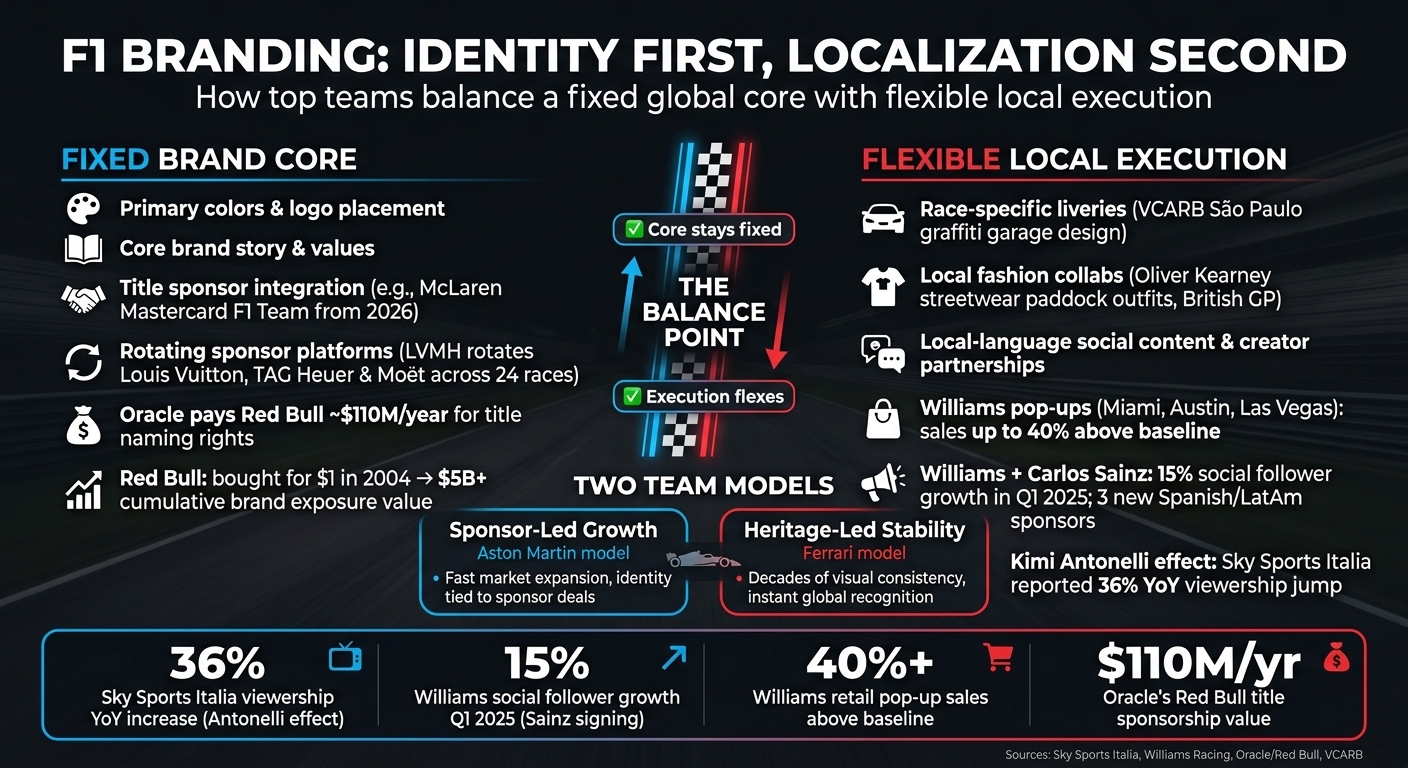
- Sky Sports Italia reported a 36% year-over-year viewership jump tied to Kimi Antonelli’s rise.
- Williams said Carlos Sainz helped drive 15% social follower growth in Q1 2025.
- Williams retail pop-ups in Miami, Austin, and Las Vegas delivered sales up to 40% above baseline.
- Oracle pays Red Bull about $110 million per year for title naming rights.
At a basic level, I see two paths. Some teams lean harder on sponsor-driven growth, like Aston Martin. Others lean on long-term history and a steady look, like Ferrari. Neither path is automatic. The teams that do this well set fixed rules first, then let local campaigns work inside those rules.
If you want the short answer: identity first, local fit second. That is how teams stay easy to spot on a global calendar while still giving each market something that feels close to home.
F1 Branding Strategies: Global Consistency vs. Local Adaptation by the Numbers
Where the Branding Tension Shows Up in Practice
Liveries, Team Names, and Sponsor Visibility
F1 liveries need to work in a split second on TV. At the same time, they have to satisfy sponsors and fit market-by-market needs. That's where the tension gets obvious.
Title sponsors now shape team identity in a direct way. McLaren will race as the McLaren Mastercard Formula 1 Team starting in 2026, while Visa Cash App RB (VCARB) uses a dual-fintech title setup that brings two sponsor deals into one team identity. These agreements don't just sit on the car. They shape how the team shows up all season.
You can see that push and pull most clearly on race weekends when teams tweak the same brand for a local crowd. VCARB brought in a São Paulo graffiti artist to design its garage for the Brazilian Grand Prix, and hired London College of Fashion graduate Oliver Kearney to make streetwear-inspired paddock outfits for drivers Liam Lawson and Arvid Lindblad at the 2026 British Grand Prix. Those local touches can feel new and place-specific, but the core brand still has to stay recognizable for sponsors watching across the whole calendar.
Regional Campaigns, Social Content, and Fan Activations
Teams also need content that works around the world without feeling generic. It has to travel, but it also has to feel close to home.
VCARB CEO Peter Bayer said:
"We have to actually open up as a team and we have to invite these people in, and we have to not only invite them in but also go outside and meet them where they are."
That idea is simple: a team can't just be seen. It has to feel present.
Drivers are one of the strongest links between a global team and a local audience. When Mercedes-AMG Petronas driver Kimi Antonelli won the Miami Grand Prix in May 2026, Sky Sports Italia reported a 36% year-over-year viewership increase for the preceding Japanese Grand Prix, as Antonelli became the first Italian title contender since 1985. In a similar way, Williams signed Carlos Sainz and turned his regional pull into business results, landing three new sponsors aimed at Spanish and Latin American markets and helping drive 15% social follower growth in Q1 2025.
Here’s where that tension shows up across the main brand touchpoints:
| Branding Element | Global Consistency Needs | Local Adaptation Needs |
|---|---|---|
| Livery Design | Core colors and primary sponsor placement for broadcast recognition | One-off takeovers by local artists, such as VCARB's São Paulo garage design |
| Team Naming | Title sponsor integration and long-term commercial stability | Regional sponsor relationships or "homecoming" campaigns |
| Fan Engagement | Scalable digital content and universal storytelling through sports, music, and fashion | Local activations, creator partnerships, and driver-led storytelling |
| Digital Content | Broadcast-style visuals and technical explainers | Local-language content that taps into national pride |
These trade-offs don't look the same for every team. Some lean harder into sponsor structure. Others get more mileage from drivers, local campaigns, or social storytelling. The pressure point stays the same: keep the brand clear while making it feel close to each market.
sbb-itb-7c68254
Team Case Studies: Sponsor-Led Expansion Versus Heritage-Led Stability
Aston Martin and Ferrari: Sponsor-Led Expansion Versus Heritage-Led Stability
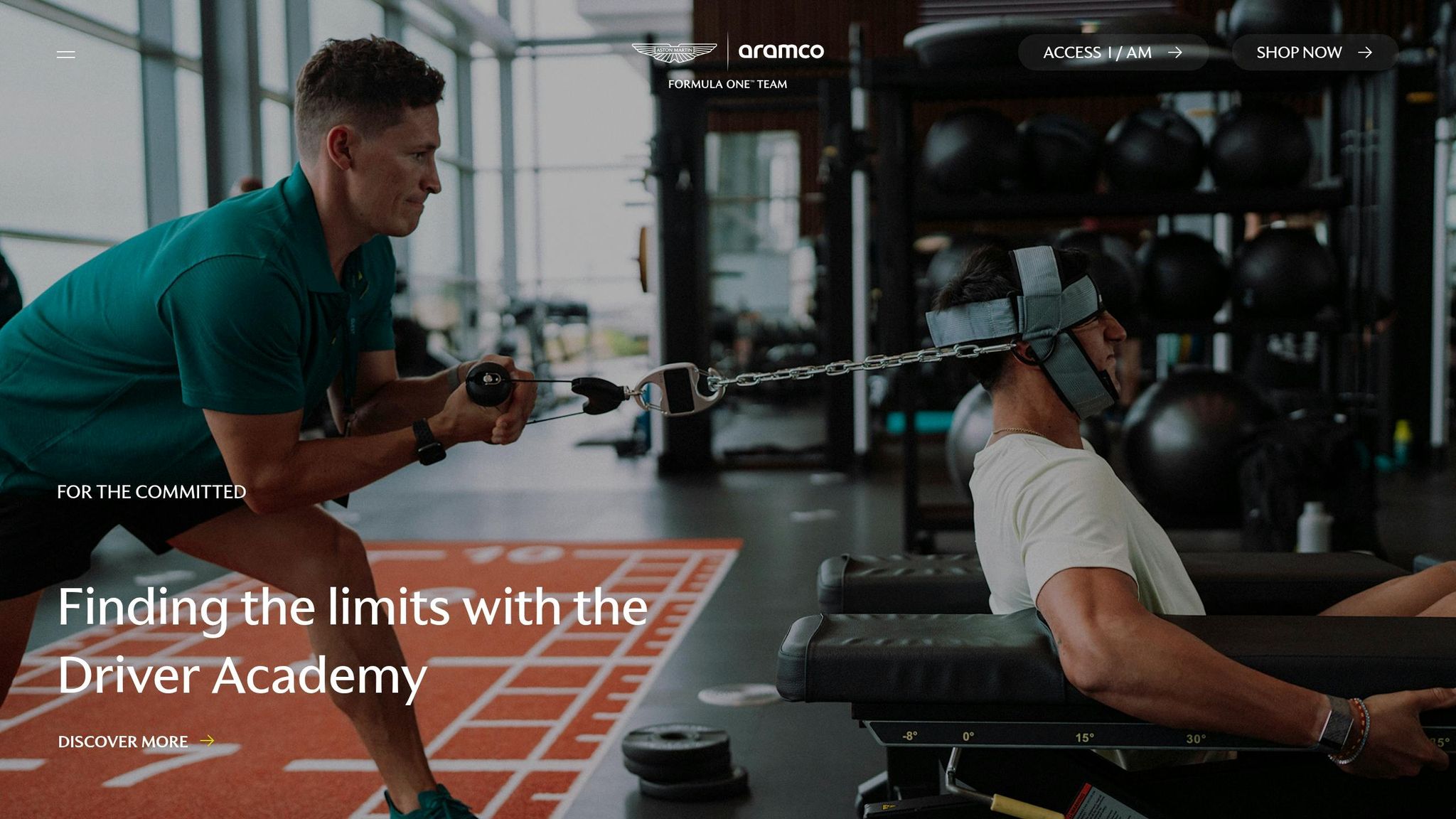
You can see those branding trade-offs more clearly when you put two very different teams side by side. Aston Martin and Ferrari take almost opposite paths.
Aston Martin leans into sponsor-led expansion. In plain English, it weaves sponsors into the team’s core identity so it can scale across markets fast. That approach can open doors and help the team grow its presence in more places.
Ferrari goes the other way. It sticks with heritage-led stability, built on a steady visual identity and decades of recognition. The look stays familiar, and that consistency makes the brand easy to spot from region to region.
The trade-off is pretty simple: sponsor-led branding can grow faster, while heritage-led branding stays clearer.
How Teams Can Balance Global Consistency and Local Fit
Set a Fixed Global Brand Core and Allow Flexible Local Execution
Both branding models lead to the same rule: keep the core fixed, and flex the execution.
In practice, every team’s brand has two parts. One part stays the same everywhere. The other can shift by market. The fixed core includes things like primary colors, logo use, core values, and the main brand story.
Williams Racing is a good example. It centers its brand on a “grit and innovation” story and a navy and electric blue palette. Those pieces stay the same in every market.
The flexible layer is where local work happens. That can include race-specific liveries, regional creator partnerships, and sponsor treatments shaped for a given market. In early 2025, Williams ran a fan-voted livery campaign with Gulf Oil that drove record participation on its app. That’s what this balance looks like when it works.
Use Data, Audience Segmentation, and Sponsor Rules to Prevent Identity Drift
Flexibility only works if teams set clear guardrails. If they don’t, local campaigns can drift far enough from the core that the brand starts to feel uneven from one market to the next.
Williams tackled that issue with its FanID loyalty program. FanID segments fans by interest, not geography, so local campaigns can reach the right people without changing the brand itself.
Sponsor rules need the same kind of discipline. Partners can flex, but the core visual system can’t. LVMH’s approach with Formula One shows this clearly. Instead of piling logos onto one car, the group rotates its Maisons - Louis Vuitton, TAG Heuer, and Moët - across the 24-race calendar.
The table below shows how that system plays out in practice:
| Problem Addressed | Practical Action | Illustrative Team Example |
|---|---|---|
| Identity drift | Lock non-negotiable visual anchors (colors, logos) while allowing local livery variations | Williams Racing - Gulf fan-vote livery |
| Younger-fan disengagement | Create a "Creator Platform" to let local creatives design market-specific assets | VCARB - São Paulo garage graffiti |
| Sponsor clutter | Use platform-level sponsorship to rotate brands rather than cluttering the car | LVMH - rotating Louis Vuitton, TAG Heuer, Moët across the calendar |
| Lack of local relevance | Bridge global goals with local cultural icons or heritage events | Audi - Jacques Villeneuve "Innovation Series" in Canada |
The Secret Behind F1’s Fastest-Growing Brand? | Rob Bloom
Conclusion: What Successful F1 Branding Looks Like Over Time
The pattern is pretty clear: teams do better when they lock in their core identity first, then adjust for each market. Put simply, identity first, localization second.
A steady global core gives regional campaigns room to move without weakening recognition.
You can see that in local activations too. Selective localization is what turns brand consistency into a stronger link with fans. Williams Racing's pop-up retail activations in Miami, Austin, and Las Vegas produced merchandise sales up to 40% above baseline per-market monthly averages. The brand itself didn't change. The local entry point did.
The same idea carries into sponsor strategy. Red Bull is the clearest example of what this can look like at full scale: a team bought for $1 in 2004 has since produced an estimated cumulative brand exposure value of over $5 billion, with Oracle paying about $110 million per year for title naming rights alone. That's what it looks like when a brand owns attention instead of paying for a short window of it.
Long-term F1 branding works when a team stays consistent around the world and stays relevant in each local market. The strongest brands use sponsors, activations, and storytelling to support both.
FAQs
Why can’t F1 teams fully localize their branding?
F1 teams can’t fully localize their branding because the sport depends on a global identity and broad recognition across 180 countries.
Teams can still run local projects to connect with people in specific regions. But the main brand has to stay consistent. That consistency matters for sponsors, broadcasters, and fans who follow the sport across many markets.
In practice, one international identity works better than making frequent market-specific changes.
Which parts of an F1 team’s brand should stay the same worldwide?
An F1 team’s global brand needs to stay consistent at its core. That means holding on to its performance values - precision, engineering excellence, and a hard-edged racer mindset that shows up in everything the team does.
It also needs to keep its most recognizable brand elements in place. Think iconic visuals, standardized team kits, and recurring branding across channels and markets. Those steady cues help the brand feel clear and connected, even when the content itself is shaped for local audiences.
How do teams measure whether local branding actually works?
Teams judge local branding by looking at fan engagement data, direct feedback, and their own research. F1’s official fan monitoring reports give teams hard numbers, including how fans score team content. That lets them compare their progress with rival teams instead of guessing.
They also watch for clear local signals on the ground, like ideas fans submit during activations and how many people join specific programs. And in the paddock, there’s another tell. When an initiative is working well, staff from rival teams often start asking questions and paying close attention.