Short-Term vs Long-Term Innovation: F1 Budget Breakdown
How F1 teams balance immediate upgrades versus future car development under the $135M cost cap and why timing beats raw spend.
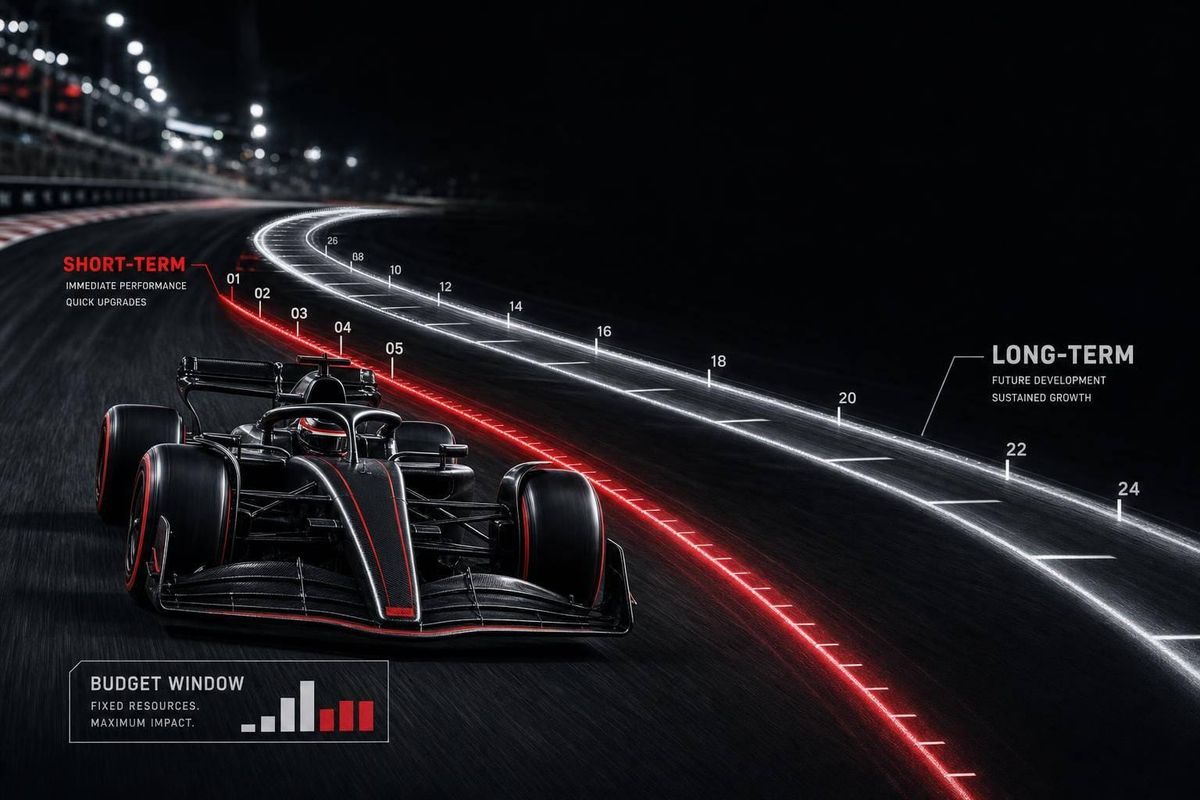
F1 teams don’t win this budget fight by spending more. They win it by spending at the right time. With a $135 million cost cap, each dollar used on a new floor, wing, or setup fix is a dollar that cannot go into next year’s car, future aero work, or 2026 planning.
If I boil the article down, the main point is simple: short-term spending chases lap time now, while long-term spending tries to build a better car later. Teams have to split one capped chassis budget across R&D, manufacturing, wind tunnel time, CFD, and trackside work, while some big costs like driver pay and power-unit development sit outside that cap. That is why teams such as Ferrari can stop current-car aero work early and move those resources to the next rules cycle, while others keep spending to hold points and prize money.
Here’s the article in plain English:
- The cap is fixed: the current baseline is $135 million
- Most car development sits inside it: design, parts, aero tools, and race support
- Some big costs sit outside it: driver salaries, marketing, top executive pay, and power-unit work under a separate cap
- Short-term spend means parts for the current season, like floors, wings, cooling packages, and suspension changes
- Long-term spend means future-car concept work, simulation, and rules-cycle planning
- The hard part is timing: spend too much now and the next car may suffer; spend too much later and current results may slip
How F1 Teams ACTUALLY Spend $350M a Year (ft. Guenther Steiner)
sbb-itb-7c68254
Quick Comparison
| Area | Short-Term Spend | Long-Term Spend |
|---|---|---|
| Main goal | Lap time this season | Car performance in future seasons |
| Typical uses | Floor updates, front wings, cooling changes, suspension tweaks | Future-car concepts, CFD, simulation, integration work |
| Payoff timing | Next race or next few races | 12 to 18 months or more |
| Main risk | Wasting budget on parts that do not work | Giving up points in the current season |
| Best fit | Tight title fights, points battles, fixing current weaknesses | Rule changes, early rebuilds, future-focused teams |
For me, the clearest takeaway is this: F1 budget choices are less about total money and more about what a team is willing to give up. Every update has a cost beyond the invoice, because it also delays some other job the team could have funded instead.
Cost Cap Rules That Shape Innovation Spending
The F1 cost cap started at $145 million in 2021 and dropped to a $135 million baseline from 2023 onward. That lower ceiling makes every call tougher. Teams have to choose between parts that help right now and work that may pay off later.
A big shift is lined up for 2027, when the cap is projected to move to $215 million. At first glance, that sounds like teams suddenly get a lot more room to spend. But that’s not the full story. As Mercedes-AMG Petronas CFO Russell Braithwaite explained:
"What you actually find is a number of costs that existed already are now becoming included. Depreciation is a good example. We've always had depreciation, it just wasn't included before."
So the 2027 change is more about accounting scope than a straight jump in performance spending. And that matters, because once more costs sit inside the cap, teams have less room left for car development.
Inside the Cap
The current $135 million limit covers R&D, design, manufacturing, wind tunnel work, CFD, and trackside operations. All of that comes from the same pool.
That means a team can’t treat each area like its own separate wallet. A new floor for the next race weekend and a simulation push for the next rules cycle are pulling from the same budget at the same time.
Outside the Cap
Some major spending areas still sit outside the current $135 million cap, including driver salaries, marketing, hospitality, and the pay of the three highest-compensated executives.
Power-unit development also follows a separate cap, so 2026 engine work sits on a different budget path. Red Bull Powertrains, for example, recruited about 600 to 700 people to build its 2026 power unit fully in-house. That’s a huge long-term commitment, but it does not come out of the chassis cap.
| Cost Category | Inside the $135M Cap? |
|---|---|
| R&D and Design | ✅ Yes |
| Manufacturing | ✅ Yes |
| Wind Tunnel / CFD | ✅ Yes |
| Trackside Operations | ✅ Yes |
| Driver Salaries | ❌ No |
| Marketing / Hospitality | ❌ No |
| Top 3 Executive Pay | ❌ No |
| Power Unit Development | ❌ No (separate cap) |
| Depreciation | ❌ No (included in 2027 cap) |
Once those cap boundaries are clear, the pressure point becomes obvious: how much goes into upgrades for the next race, and how much gets saved for the next big idea.
Short-Term Innovation: Spending for Immediate Performance
With a fixed cap, short-term work in F1 is all about this season's car and this weekend's lap time. Teams spend on aero updates, floor changes, cooling tweaks, and small suspension revisions that can pay off right away. Each part has to clear a blunt test: how much lap time does it buy for the dollars spent? That return-on-spend mindset now sits at the center of most in-season calls.
What Teams Buy With Short-Term Development Budget
The floor tends to offer the biggest step, while wings, cooling packages, and small suspension changes round out the in-season toolkit. Circuit-specific cooling packages are a good example of targeted spending. At hot or high-altitude tracks, they can help teams win back aerodynamic efficiency, so they make sense as a track-by-track choice instead of a one-size-fits-all upgrade.
Red Bull answered a 2025 slump with a major floor update at Monza and a new front wing in Singapore to get balance and lap time back - because the team needed speed immediately. As Red Bull's Chief Engineer Paul Monaghan explained:
"A lot of work went in... to try and give ourselves a better car. We thought we'd identified what was wrong, and it took us a couple of steps to really get to that and not just take a load of downforce out of the car."
McLaren took a smaller step in Canada, using a minor front-suspension change to improve front-end feel. It was a reminder that even a modest update can be worth it if it addresses a very specific driver complaint.
Why Upgrade Cadence Has Become More Selective
Teams can't afford to bring new parts to every race just to look busy. Every update eats into budget that might be better saved for a stronger package later in the year. So now teams screen upgrades in virtual tools before green-lighting production, with the goal of sending only high-probability gains to the factory floor.
And if a team gets it wrong, the hit is immediate. An update helped George Russell win in Canada, but it hurt Andrea Kimi Antonelli enough that Mercedes removed it before the Hungarian Grand Prix in July 2025. That's the kind of mistake teams hate: it can cost points, and it also uses budget that's gone for good. That's why more teams are willing to skip an upgrade cycle rather than rush out a part that hasn't been checked hard enough.
That restraint is the trade-off. Money not used here can go into next year's car, the next concept, or the tools that shape both.
Long-Term Innovation: Spending on Future Cars, Concepts, and Tools
Long-term spending pulls money away from today’s upgrade cycle and puts it into the car, ideas, and systems that will shape the next rules era.
Short-term development is about finding lap time for the next race. Long-term investment is different. It aims at next year’s car, future regulation concepts, and the R&D tools that make both possible. Same budget question, different clock: is this dollar buying speed now, or is it building the base for later?
The return doesn’t show up in a single race weekend. It plays out over whole seasons.
That’s why teams start early. They look at future regulations, test core concepts, and work on the architecture that could define the next car.
Short-Term vs Long-Term Innovation: The Real Budget Trade-Off
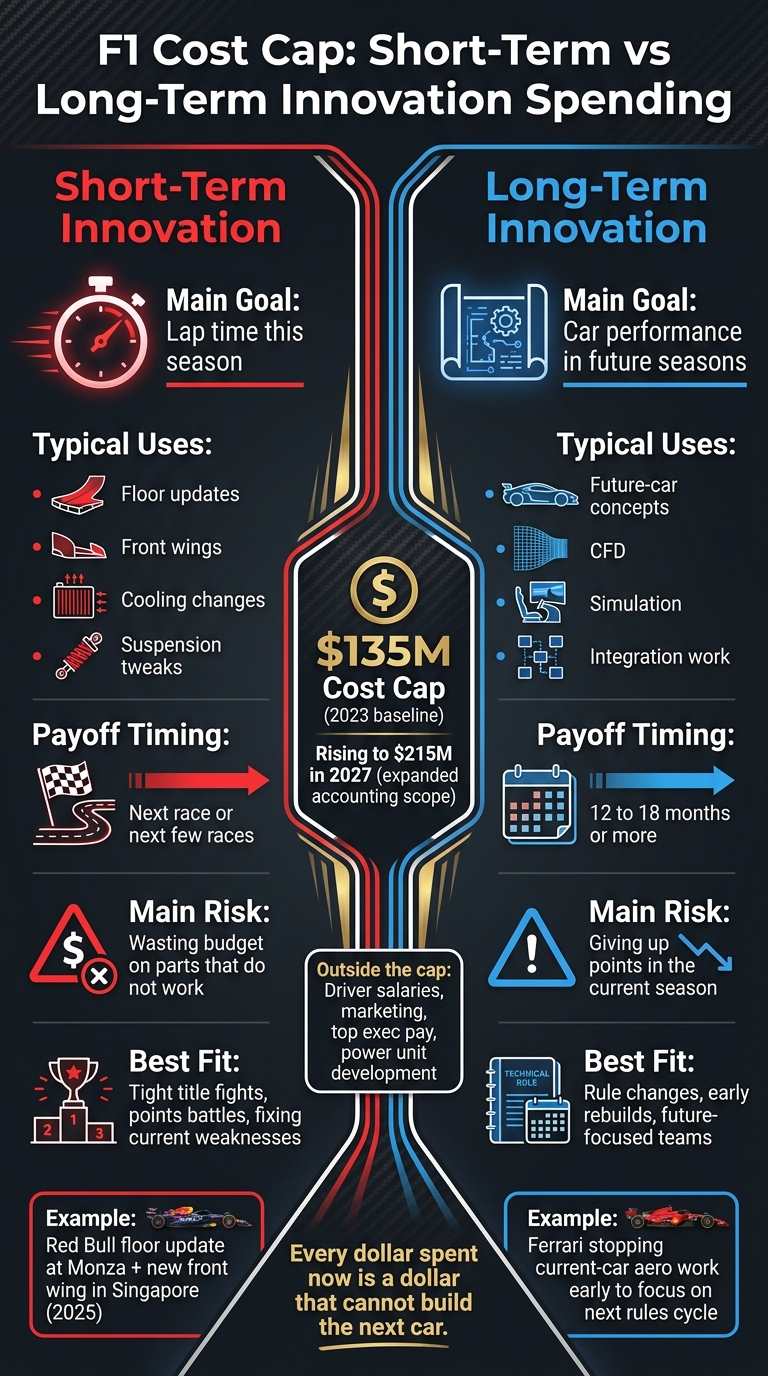
F1 Cost Cap: Short-Term vs Long-Term Innovation Spending
Under the cost cap, every development dollar has an opportunity cost: put it into next weekend's car, or put it into the next rules cycle. That's where the pressure kicks in. Teams aren't just picking upgrades. They're deciding whether to chase speed now or build for what comes next.
And that choice gets harder when results start to swing.
When performance drops, the pull toward short-term fixes gets strong. A team sees a problem on today's car and wants to solve that problem first. That's understandable. Points matter now. Position matters now. But the same cap has to cover future concept work too, so money spent on immediate fixes is money that can't go somewhere else.
That's why short-term gains can't be treated as safe or permanent. A quick upgrade might protect today's standing, but it can slow work on the next big step. On the other hand, leaning too far into future projects can leave points on the table in the current season.
So the hard part isn't picking one side and ignoring the other. It's finding the split that makes sense. Too much weight on short-term work helps defend the present. Too much weight on future work can hurt race-day results. The teams that get this right are the ones that stay in the fight now without giving away the next cycle.
Conclusion: Which Budget Model Works Best in the Cost Cap Era
With the cap boundaries in place, the main issue is timing, not ambition. There isn't one budget split that fits every team. The right approach depends on where a team sits in the championship, how close the next rules reset is, and how strong its factory, tools, and engineering base are.
Under the cost cap, teams tend to lean toward three modes: balanced spending, a short-term push, or a long-term rebuild.
Each route comes with risk. Balanced spending sounds sensible, but it takes discipline, and that gets tough when results start to slide. A hard short-term push can help now but leave a team flat-footed when the rules change. And a long-term rebuild only works if the tools behind the scenes are ready to support it. Williams' late switch to 2026 testing is a good example of that. Early focus on the future only pays off when simulation and engineering infrastructure are already strong.
Key Takeaways for Reading Team Development Choices
The clearest signals usually show up in upgrade timing. Late-season upgrades often point to a points chase. A late-season floor upgrade usually means a team is pushing for constructors' position and prize money. As regulation deadlines get closer, cost cap pressure changes the math too. At that stage, spending on the current car gets much harder to defend when new rules are about to reset the board.
In F1, innovation budgets matter less by size than by timing.
FAQs
Why can’t teams keep upgrading all season?
Formula 1 teams can’t keep upgrading all season because they operate under tight budget, technical, and rule-based limits. The $135 million cost cap forces them to make trade-offs. A small gain today might cost them progress later in the year.
There’s another bottleneck too: teams get only so much wind tunnel and CFD time. That means they can’t test every idea that looks good on paper. They have to back the upgrades most likely to work.
At a certain point, the math changes. Instead of squeezing tiny gains from the current car, it makes more sense to shift time and money to next year’s car, where the payoff can be much bigger.
When should a team stop developing the current car?
Teams usually stop when the next upgrade doesn’t offer much compared with getting an earlier start on the next car.
That decision often comes down to where they sit in the championship. Teams near the front may keep pushing development for longer. Teams that fall behind early, on the other hand, often shift their attention sooner.
It’s a day-by-day judgment call. They weigh wind tunnel data, the performance they expect to get back, and budget limits. That includes the cost of making new parts and shipping them to the track.
How do rule changes affect budget priorities?
Rule changes put teams in a tough spot. They have to pick between results now and work that could pay off later. When a big reset hits, like the 2026 change, the question gets pretty simple: do you keep improving the current car, or do you move people and money to the next one early?
That call gets even harder because of the cost cap, plus limits on wind tunnel and CFD time. There’s only so much room to experiment. So teams lean on simulations and set aside part of the budget to stay in the fight now without waiting too long to start the next project.